
The short answer: You’ve outgrown DIY bookkeeping when five things start happening: you’re spending more than a few hours a month on the books, you’re doing them at night or on weekends, you’re postponing decisions because you can’t get current numbers, you keep finding errors or missing deadlines, and the work no longer fits your skill set or your rate. Any one of these is a yellow flag. Two or more, and the books have quietly become the most expensive task you’re still doing for free.
Colin used to do his books on Sunday nights. It started as twenty minutes with a coffee, a quick tidy before the week began. Two years and a dozen new clients later, it was three hours, the coffee had become a glass of wine, and he’d catch himself reconciling accounts while his family watched a movie in the next room. He kept doing it because he’d always done it, and because hiring help felt like admitting he couldn’t handle his own business. He had the sign backwards. Still doing it himself wasn’t proof he had it handled. It was proof he’d outgrown handling it alone.
Here’s the tricky thing about the DIY-to-delegate moment: it never announces itself. There’s no alert that says “you have officially outgrown this.” The books just get a little heavier each month, so gradually you don’t notice the weight until your weekends are gone. So let’s make the invisible visible. Here are five concrete signs the moment has arrived. If you recognize two or more, it’s not too early. It’s overdue.
Sign 1: The books are eating your evenings and weekends
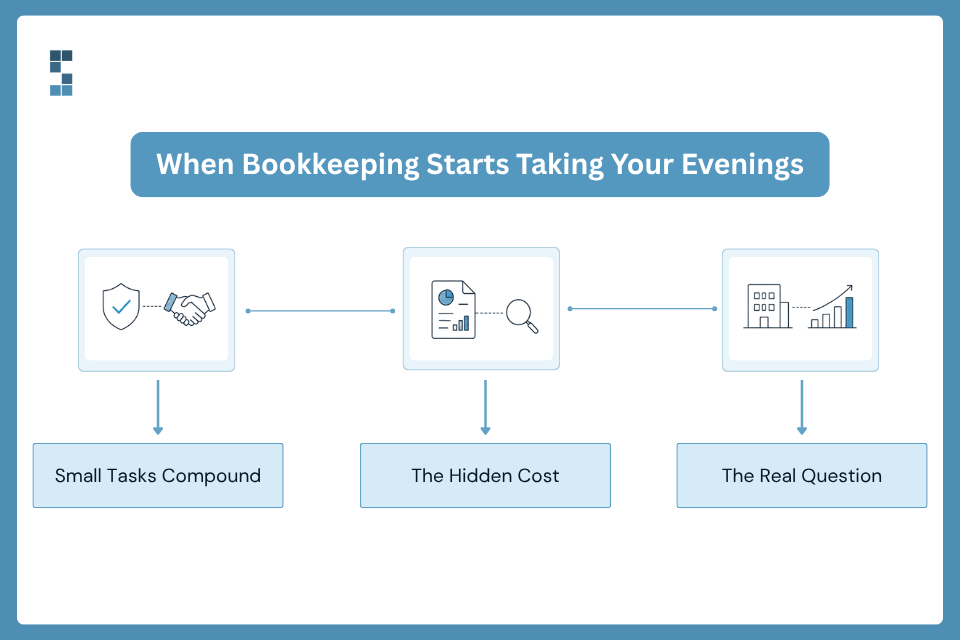
This is the most obvious sign and the easiest to rationalize away. If your bookkeeping happens after hours, because there’s simply no room for it during the billable day, that’s not a scheduling quirk. That’s the work telling you it no longer fits.
Colin’s Sunday nights aren’t unusual. Owners routinely discover, when they actually track it, that they’re spending fifty to a hundred percent more time on financial management than they’d assumed. What feels like “just twenty minutes” on cash flow becomes two and a half hours a week, which is roughly 130 hours a year, more than three full work weeks handed over to data entry. Nobody decides to spend three weeks a year on bookkeeping. It accumulates in twenty-minute lies. When the books have colonized your personal time, the question isn’t whether you can afford help. It’s whether you can afford to keep paying in weekends.
Sign 2: You’re postponing decisions because the numbers aren’t ready
Watch for a specific sentence coming out of your own mouth: “I just need to update my spreadsheets before we can talk about that.” If getting current numbers requires a manual scramble every time, you’ll start avoiding the scramble, which means avoiding the decision.
This is more dangerous than lost time, because it’s lost opportunity. When you can’t quickly see your financial position, you delay the calls that actually move the business, whether to hire, whether to take the big project, whether you can afford to invest. That hesitation has a price, and it’s often a multiple of the hours you’d have saved. A business flying on stale numbers doesn’t crash dramatically. It just quietly makes slower, foggier decisions than its competitors, and wonders why it isn’t pulling ahead.
Sign 3: Errors and missed deadlines are creeping in
Everyone fat-fingers a number occasionally. The warning sign is pattern, not incident: discrepancies between reports that should match, a payroll tax deadline that sailed past, a client billing error that turned into an awkward conversation.
Manual bookkeeping breeds these mistakes structurally, not because you’re careless. When the same number lives in QuickBooks, a cash flow sheet, and a profitability tracker, every update is a chance for the three to drift out of sync, and one mistyped figure quietly poisons every decision downstream until someone catches it. Manish, a business owner who tried the cheaper route first, learned this the hard way: his freelance bookkeeper filed most of the payroll taxes incorrectly, and there was no simple way for a non-expert to untangle the mess. His takeaway was blunt, that going the cheap route is likely to hurt you in the long run, and he’d pay for real expertise without hesitation. Errors aren’t just a cost in dollars. They’re a cost in trust, with clients, with the IRS, and with your own confidence in your numbers.
Sign 4: The work has outgrown your skill set
There’s a difference between basic bookkeeping and what a growing firm actually needs. Cash-basis entries are one thing. Accrual accounting, multi-state payroll, project profitability, milestone billing, and clean books for a potential audit or sale are another, and they’re genuinely specialized.
At some point the honest question is whether you’re the right person for this job at all. Not out of inability, but because your expertise is worth far more pointed at clients. The DIY route can also cap your growth in ways you can’t see: firms have turned down their biggest-ever contracts because their financial systems couldn’t handle the required tracking and reporting. When the books demand skills outside your wheelhouse, muddling through isn’t thrift. It’s a bottleneck you built yourself, and it’s holding back the parts of the business only you can do.
Sign 5: You’re doing for free what you’d never let a client do
Here’s the reframe that cuts through everything. You bill your expertise at a real rate. Every hour on bookkeeping is an hour not billed, so the true cost of DIY isn’t zero, it’s your hourly rate times the hours you sink into it.
Run Colin’s math. An owner billing $200 an hour who spends ten hours a month on financial tasks is sacrificing $24,000 a year in revenue potential, before counting the business development that never happens because the calendar’s full. “Free” bookkeeping is often the most expensive line item in the business, precisely because it never shows up as a line item. John, who runs a small online business, admitted he figured he’d be fine keeping the books in-house and only skeptically tried outsourcing, then found he was incredibly glad he did, because the strategic insight he got back was a gamechanger he’d never have reached alone. That’s the hidden upside of stopping: you don’t just save the hours, you get back capacity and clarity you didn’t know you were missing.
What to do if you recognized yourself
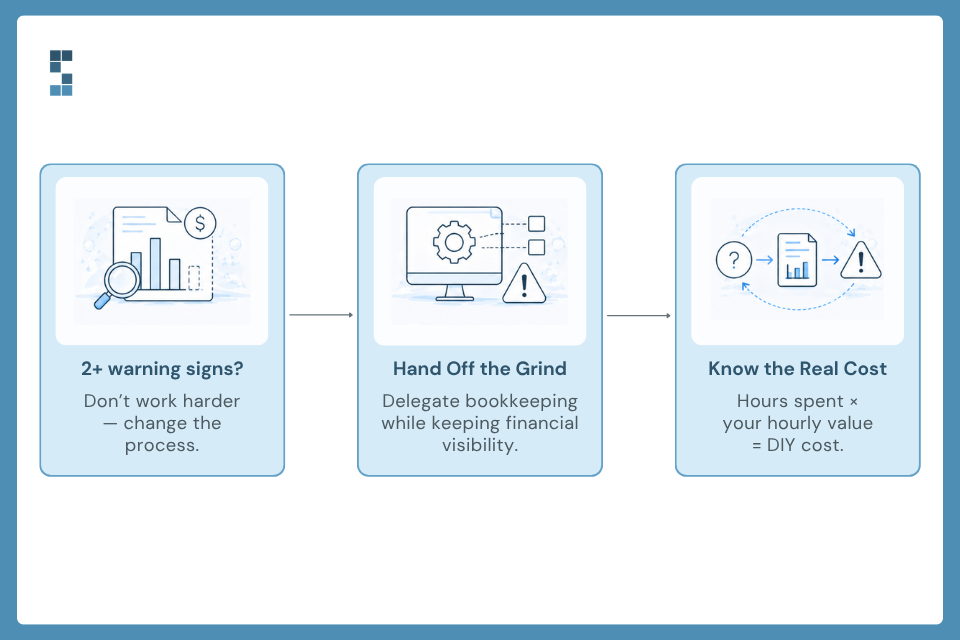
If two or more of these landed, don’t spiral about it, and definitely don’t resolve to try harder. Trying harder is what got the books into your weekends. The move is to hand off the part of the business that’s become a drag on the rest of it.
And handing off doesn’t mean losing control, which is the fear that keeps most owners stuck. It means someone else owns the monthly grind, cleans up what’s drifted, and hands you clean numbers on time, while you finally get to just look at your business instead of assembling it. This is the shift System Six builds for the consulting firms and growing businesses it serves, and it’s why over half of new clients arrive by referral and existing ones rate the firm an average 9.5 out of 10. People don’t refer a bookkeeper. They refer the Sunday night they got back.
So one honest question to close on. If you added up every hour you spent on your books last month and priced it at your real rate, would you call that a bargain, or the most expensive thing on your plate? You already know whether you saw yourself in this list. The only question left is how many more weekends you want to spend proving you can do it alone.
Frequently asked questions
When should a small business owner hire a bookkeeper?
The clearest trigger is when bookkeeping starts costing more than it saves, in time, errors, or missed opportunities. Practical signals include spending more than a few hours a month on the books, doing them after hours, postponing decisions because numbers aren’t current, errors or missed deadlines creeping in, and the work outgrowing your skill set. If two or more apply, it’s generally past time to hire help.
Is it worth paying for a bookkeeper, or should I keep doing it myself?
It’s usually worth it once you count the true cost of DIY, which is your billable hourly rate times the hours you spend, plus the cost of errors and delayed decisions. An owner billing $200 an hour who spends ten hours a month on the books gives up around $24,000 a year in revenue potential. For most growing firms, professional bookkeeping costs far less than the time and opportunity it frees up.
How many hours a month should bookkeeping take?
For a small but growing firm, routine bookkeeping shouldn’t consume more than a few hours of the owner’s month, and ideally far less once systems are automated. Many owners are surprised to find they’re spending 10 to 20 hours monthly once they actually track it. If the real number is well above a few hours, that time is almost always worth more redirected to client work.
What’s the risk of doing my own books for too long?
The main risks are accumulating errors, missed compliance deadlines, and capped growth. Manual systems drift out of sync and produce mistakes that compound until caught, and missed payroll or tax deadlines carry real penalties. Firms have also had to turn down their largest contracts because DIY financial systems couldn’t support the required tracking, a growth cost that never appears on any invoice.
About System Six
System Six is a Seattle-based bookkeeping and financial services firm that helps small and mid-sized businesses streamline their financial operations. We specialize in providing technology-driven financial management solutions for consulting firms, enabling owners to focus on growing their businesses without worrying about cash flow, payroll, or compliance. Our team of over 40 professionals brings an average of 10+ years of accounting experience to every client relationship, serving more than 175 businesses across the U.S. With a 9.5/10 NPS score, we deliver the financial clarity and peace of mind that consulting firm owners need to thrive. Learn more at www.systemsix.com.