The short answer: Bad bookkeeping rarely shows up as one big bill. It hides in four places: the owner’s time spent on financial busywork instead of billable work, the direct cost of errors and compliance penalties, the growth blocked when weak systems force you to turn down work, and the productivity your whole team loses to financial chaos. Added together across a year, these hidden costs routinely reach tens of thousands of dollars, which is exactly why “I’ll just do it myself for free” is the most expensive sentence in small-business finance.
Theo thought his books were fine. His IT consulting firm was growing, clients paid, payroll cleared, and the bank balance looked healthy enough. Then his bookkeeper spotted something buried in the bank statements: a small categorization error that had been quietly triggering overdraft and bank fees for months. Seven hundred dollars a month. He’d been bleeding $8,400 a year and never felt the cut, because it never arrived as a single, obvious bill. It just leaked.
That’s the thing about bad bookkeeping. It almost never announces itself. No invoice says “this is what your messy books cost you.” Instead it drips out in a dozen directions at once, each drip small enough to ignore, until you add up the year and the number is staggering. So let’s actually add it up. Where does the money really go when the books are bad? Four places. Let’s count them.
How much do bookkeeping errors actually cost?
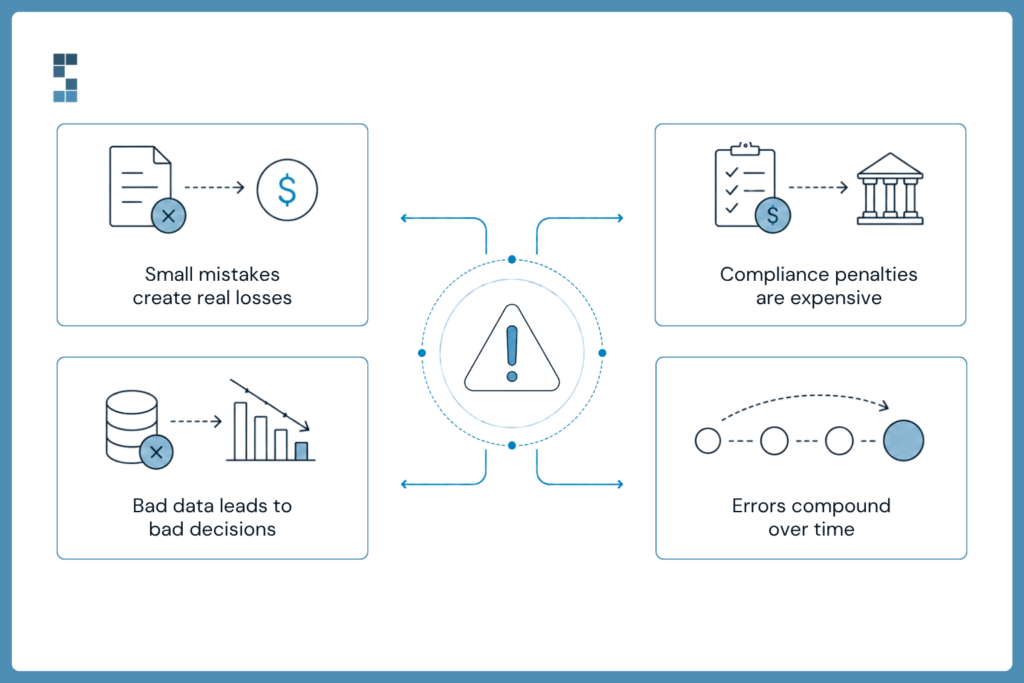
Start with the most direct cost: the errors themselves. Theo’s $700-a-month overdraft leak isn’t a freak event. It’s the rule. Manual systems breed mistakes the way still water breeds mosquitoes. A miscoded transaction here, a missed invoice there, a payment that slips past its due date, and each one carries a real price tag.
Then there’s the compliance layer, where the stakes jump. File your taxes late, and the penalty runs into the thousands. Miss a payroll tax deadline, and you trigger automatic penalties plus interest, no warning, no appeal. And if sloppy records earn you an audit, you’re suddenly paying professional fees that can easily hit five figures to prove you’re not hiding anything. None of these costs feel like “bookkeeping.” They feel like bad luck. They’re not. They’re the predictable downstream cost of books that were never built to be clean.
Here’s the part that makes errors especially nasty: they don’t stay put. Mistype an invoice amount in one place, and that wrong number flows into your cash flow projection, your hiring math, your spending plan, quietly poisoning every decision that touches it until someone finally catches it. One wrong cell becomes ten wrong decisions. The original error might take a minute to make and months to undo fully.
What is the hidden cost of your time?
Now the cost almost nobody puts on the books: your own time. Every hour you spend wrestling expense categories or rebuilding a spreadsheet is an hour you didn’t spend on billable work or winning the next client. That hour has a price, and it’s your effective hourly rate.
Run the math, and it stings. Consulting firm owners typically pour fifteen to twenty hours a month into bookkeeping, invoicing, and compliance. At consulting rates, that’s somewhere between $72,000 and $120,000 a year in lost revenue potential, gone not to competitors or bad markets but to administrative busywork you could have handed off. Picture an owner billing $200 an hour who spends ten hours a month on manual financial tasks. That’s $24,000 a year sacrificed, before you even count the business development that never happened because the calendar was full of data entry.
And the meter doesn’t stop at hours. There’s a quieter tax on top: the mental load. When your numbers live in your head and three different spreadsheets, part of your brain is always running background anxiety about whether they tie out. That cognitive drag dulls your focus on the work that actually pays. You postpone decisions about hiring or investment because pulling current numbers is a chore, and that hesitation costs opportunities worth far more than the hours themselves.
How does bad bookkeeping cap your growth?
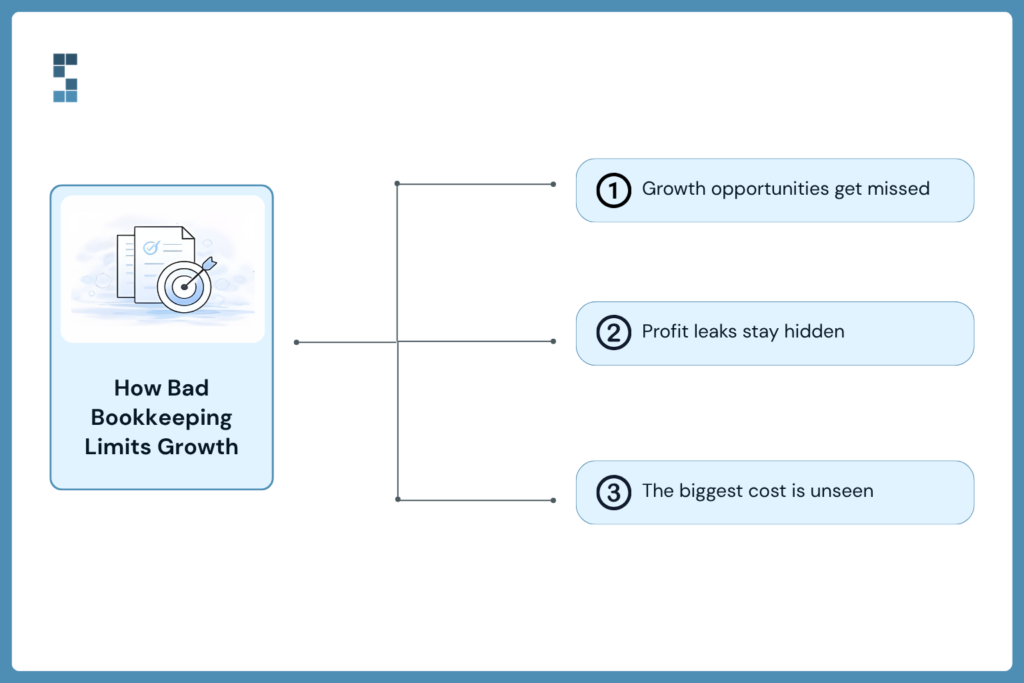
This is the most expensive cost of all, and the hardest to see, because it’s the money you never made. Poor financial systems build an invisible ceiling over your business. You don’t hit it dramatically. You just quietly stop rising.
Consider a consulting firm offered the biggest contract in its history, a $200,000 engagement. But the project demanded detailed financial tracking, milestone billing, and multi-phase budget management, and the firm’s systems couldn’t carry that weight. So they passed. Walked away from their largest-ever deal because their books couldn’t keep up. How do you price that loss? It’s not just the $200,000. It’s the bigger team that contract would have funded, the better clients it would have attracted, the compounding growth that never got to start. One missed opportunity quietly forecloses a dozen future ones.
There’s a subtler version of this ceiling, too: profitability blindness. When you can’t see true project costs, you fly blind on pricing. Firms routinely lose 15 to 25 percent of potential profit this way, convinced their biggest client is their best one when it’s actually breaking even after all the hidden partner time and scope creep get counted. You can’t fix a leak you can’t see, and bad books keep the lights off.
What does financial chaos cost your team?
The final cost spreads past the owner and soaks the whole team. Financial chaos doesn’t stay in the finance corner. It seeps into everyone’s day.
Project managers who should be focused on clients end up reconciling expenses instead. Team members burn mental energy wondering whether payroll will clear on time, and that worry shows up in their work. One System Six client put it plainly: their team was spending so much mental energy worrying about making payroll that client work suffered. Strategic conversations that should be about growth get hijacked by basic financial questions nobody can answer, because the numbers aren’t trustworthy or aren’t current. That’s a productivity drain you’ll never see itemized, but you’ll feel it in everything that takes longer than it should.
Add it up
So tally the four. Direct errors and penalties, easily thousands. Owner time, tens of thousands. Capped growth, potentially six figures. Team drags, hard to quantify but real. The “$50,000 mistake” in the title isn’t hyperbole. For a lot of firms, it’s conservative, and the worst part is how invisible it stays, spread thin across a year in pieces too small to trigger alarm.
Here’s the math that should reframe the whole question. One firm spending 20 hours a month on financial admin at a $200 rate was losing $4,000 a month in opportunity cost. They moved to automated systems, cut that to about 3 hours of reviewing reports, and started paying roughly $800 a month for the service. They saved $3,400 monthly in recovered billable time against that $800 cost, a 325% return before counting a single avoided penalty or new client. Over a year, that’s more than $40,000 in recovered earning capacity. “Doing it yourself for free” was costing this firm four times what the fix did.
That’s the System Six pitch in one breath: clean books aren’t an expense; they’re the thing that stops the leaks you can’t see. It’s why over half of new clients arrive by referral, and why existing ones rate the firm an average 9.5 out of 10. People don’t refer a bookkeeper. They refer the moment they found out what bad books were quietly costing them, and the relief of making it stop.
So here’s the question worth sitting with. You already know what your books cost you to maintain. But do you know what they’re costing you when they’re wrong? Because that’s the number that hides, and it’s almost always the bigger one. Find it before it finds you.
Frequently asked questions
How much do bookkeeping mistakes really cost a small firm?
More than almost any owner expects, because the cost is spread across four areas: direct errors and penalties, lost owner time, capped growth, and reduced team productivity. A single overlooked error can quietly cost thousands a year, like the client paying $700 a month in avoidable bank fees. Stack that on owner time worth tens of thousands and growth opportunities worth more, and a firm’s total annual cost from bad bookkeeping routinely reaches well into five figures.
What are the hidden costs of bad bookkeeping?
The four highest hidden costs are: the opportunity cost of the owner’s time spent on financial busywork instead of billable work; the direct cost of errors and compliance penalties such as late tax filings and missed payroll deadlines; the growth blocked when weak systems force a firm to turn down complex or large projects; and the productivity lost when financial chaos distracts the whole team. None of these arrive as a single bill, which is exactly why they go unmeasured.
Is it cheaper to do my own bookkeeping?
Usually not, once you count the hidden costs. “Free” manual bookkeeping carries time, error, stress, and opportunity costs that often run three to five times the price of a professional solution. One firm cut its monthly financial admin from 20 hours to 3 after automating, saving $3,400 a month in recovered billable time while paying about $800, a 325% return before any avoided penalties or new revenue. The DIY route tends to be the most expensive option, just in costs that never show up on an invoice.
How do bookkeeping errors affect business growth?
Weak financial systems create an invisible ceiling. When the books can’t support detailed project tracking or milestone billing, firms are forced to turn down large or complex contracts, losing not just that revenue but the compounding growth it would have funded. Poor visibility also causes profitability blindness, where firms lose an estimated 15 to 25 percent of potential profit by mispricing work whose true costs they can’t see.
About System Six
System Six is a Seattle-based bookkeeping and financial services firm that helps small and mid-sized businesses streamline their financial operations. We specialize in providing technology-driven financial management solutions for consulting firms, enabling owners to focus on growing their businesses without worrying about cash flow, payroll, or compliance. Our team of over 40 professionals brings an average of 10+ years of accounting experience to every client relationship, serving more than 175 businesses across the U.S. With a 9.5/10 NPS score, we deliver the financial clarity and peace of mind that consulting firm owners need to thrive. Learn more at www.systemsix.com.