Elena thought she was being smart. She’d just hired her first in-house bookkeeper — $50,000 salary, tidy desk by the window, problem solved. Six months later, she sat across from her accountant, staring at a number that didn’t add up. What she’d budgeted for and what she was actually spending were two different things entirely.
Sound familiar? The in-house vs. outsourced bookkeeping debate sounds straightforward. You put a salary on one side, a monthly fee on the other, and pick the smaller number. But that math is missing most of the equation. The real cost of in-house bookkeeping isn’t the salary line — it’s everything underneath it.
Let’s run the actual numbers.
The Comparison Most People Make — and Why It’s Incomplete
Here’s how the typical thought process goes: a bookkeeper costs $50,000 a year. An outsourced service costs $1,500 a month, or $18,000 a year. In-house wins by $32,000. Done.
Except that’s not remotely how it works. The $50,000 salary is just the starting point. What gets added to it — quietly, incrementally — is where the real cost lies. And for a 10 to 50-person consulting firm, those additions can push a $50K hire well past $75,000 before the person has filed their first reconciliation.
The outsourced fee, meanwhile, is the fee. No surprises. No add-ons. Just a fixed, predictable number every month.
The True Cost of an In-House Bookkeeper

Start with payroll taxes. Employers pay 7.65% in FICA on top of every salary — that’s $3,825 on a $50K base, before anything else. Then add health insurance. Depending on your plan, employer contributions typically run $5,000 to $8,000 per year for a single employee. Paid time off — two weeks of vacation plus federal holidays — adds another $2,000 to $3,000 in salary cost for days not worked.
Now layer in recruiting. Hiring a bookkeeper takes time and often money. Job board listings, hours spent reviewing resumes, interview rounds, potential recruiter fees — it’s not unusual for a hire to cost $3,000 to $5,000 before the first day of work. And if the hire doesn’t stick? You run that process again.
There’s also software. Your bookkeeper needs a license for your accounting platform, possibly for expense management tools, and for payroll software if they’re handling that too. Add $1,500 to $3,000 annually.
Then there’s the management overhead that nobody budgets for: onboarding time, training, answering questions, reviewing work, and handling performance issues. For an owner or office manager already stretched thin, supervising a direct report is a real-time cost, and for a consulting firm owner, it isn’t free.
Add it all up. A $50,000 bookkeeper realistically costs $68,000 to $80,000 per year once you factor in taxes, benefits, PTO, recruiting, software, and management time. That’s not a worst-case scenario. That’s just the math.
What Outsourcing Actually Costs — and What You Get
For a consulting firm with $1M to $5M in revenue, outsourced bookkeeping typically costs $10,000 to $25,000 per year, depending on the scope of services. That covers bookkeeping, payroll processing, financial reporting, and compliance support — often more than a single in-house hire would handle anyway.
There’s no employer tax. No benefits package. No recruiting cycle. No software licenses. No management overhead. The monthly fee is the monthly fee.
And when your bookkeeper goes on vacation — or quits — you don’t scramble. With a firm like System Six, you get a full team behind your account, not a single person whose absence brings your financial operations to a halt.
Manish G., a business owner who learned this the hard way, described what happened when he went the solo-contractor route: payroll taxes filed incorrectly, invoicing falling apart when the contractor left, and no one left to process payroll. “If you’re thinking about going the cheap route with a freelancer,” he said, “it is likely to hurt you in the long term.” He found System Six after that experience and didn’t look back.
The Side-by-Side You Actually Need to See
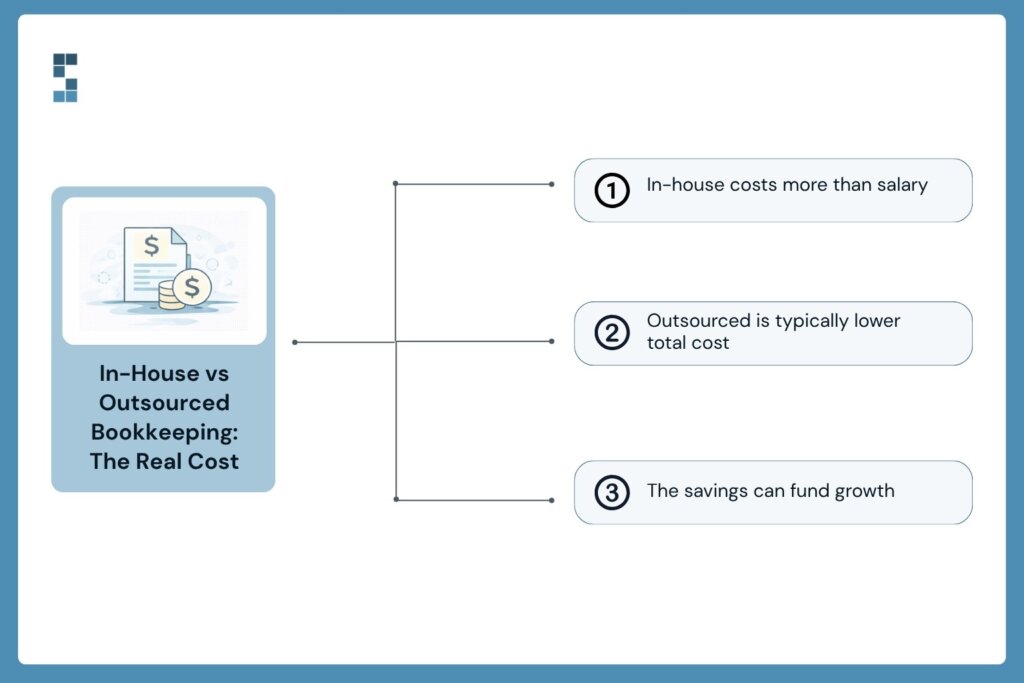
Let’s put real numbers next to each other. In-house bookkeeper: $50,000 salary, plus $3,825 payroll taxes, plus $7,000 health insurance, plus $2,500 PTO, plus $4,000 recruiting, plus $2,000 software, plus management time. Conservative total: $69,000 to $80,000 per year.
Outsourced bookkeeping: $10,000 to $25,000 per year, all-in.
The gap is $44,000 to $70,000 annually. That’s not a rounding error. For a 15-person consulting firm, that delta could fund a business development role, a marketing push, or be retained as margin.
But here’s what the numbers still don’t fully capture: depth of expertise. A single in-house hire brings one person’s knowledge. A good outsourced partner brings a team — experienced bookkeepers, controllers, compliance specialists — all available without the overhead of employing them.
Ann D., a business owner in Seattle, put it this way: “I found the right level of service at the right price. I own a business and can delegate all bookkeeping, payables, receivables, tax preparation, projected budgeting, and monthly financial reporting over to them. I don’t want to run my business without them.”
The Cost You’re Probably Not Counting: Your Own Time
For many consulting firm owners, the bookkeeper decision is moot — because they’re the bookkeeper. They’re the ones reconciling accounts on Sunday nights. They’re the backup when something goes wrong. They’re the person who gets cc’d on every financial question, even when they’d rather be doing literally anything else.
At $200 to $300 an hour — a conservative estimate for most consulting principals — even 10 hours a month spent on financial oversight represents $2,000 to $3,000 in opportunity cost, per month. That’s $24,000 to $36,000 a year in time you’re spending on bookkeeping instead of client work, business development, or growth.
John D., a small business owner who was skeptical about outsourcing before he tried it, admitted he didn’t think he needed the help. He “somewhat skeptically” made the move to System Six — and was “incredibly glad” he did. The skepticism is understandable. The math, once you look at it honestly, usually isn’t.
The Real Question
The question was never whether you can afford to outsource bookkeeping. Once you run the true cost analysis — salary fully loaded, turnover risk, management time, your own hours — the question flips. Can you afford not to?
For consulting firms spending $1,500 to $2,000 a month on outsourced services and getting back their Sundays, their peace of mind, and a team of experts instead of a single point of failure, the ROI isn’t even close.
If you’ve been doing the math on in-house vs. outsourced and something still isn’t adding up, it might be time to run the complete numbers. System Six works with consulting firms exactly like yours — fixed weekly pricing, no long-term contracts, and a US-based team that already knows your industry. The conversation is free. The spreadsheet might surprise you.
About System Six
System Six is a Seattle-based bookkeeping and financial services firm that helps small and mid-sized businesses streamline their financial operations. We specialize in providing technology-driven financial management solutions for consulting firms, enabling owners to focus on growing their businesses without worrying about cash flow, payroll, or compliance. Our team of over 40 professionals brings an average of 10+ years of accounting experience to every client relationship, serving more than 175 businesses across the U.S. With a 9.5/10 NPS score, we deliver the financial clarity and peace of mind that consulting firm owners need to thrive. Learn more at www.systemsix.com.