by Chris Williams | Oct 22, 2025 | Blog
Sarah stared at the proposal in front of her, calculator in hand. The automated cash flow system would cost her consulting firm $800 per month. That seemed like much money.
But then she started thinking about last month. She’d spent an entire Sunday reconciling accounts because three client payments got misallocated. Her project manager had wasted half a day tracking down expense receipts. And they’d nearly missed a tax deadline.
What Sarah was experiencing is the ROI confusion that costs businesses thousands in hidden expenses every year. She was focused on that $800 monthly fee while completely missing the expensive chaos her “free” system was creating.
Here’s what most business owners don’t realize: ROI isn’t just about what you spend. It’s about what you gain, what you save, and what you avoid losing. When you understand this distinction, the math becomes crystal clear.
The Real Cost of “Free”
Here’s the truth: your manual system isn’t free.
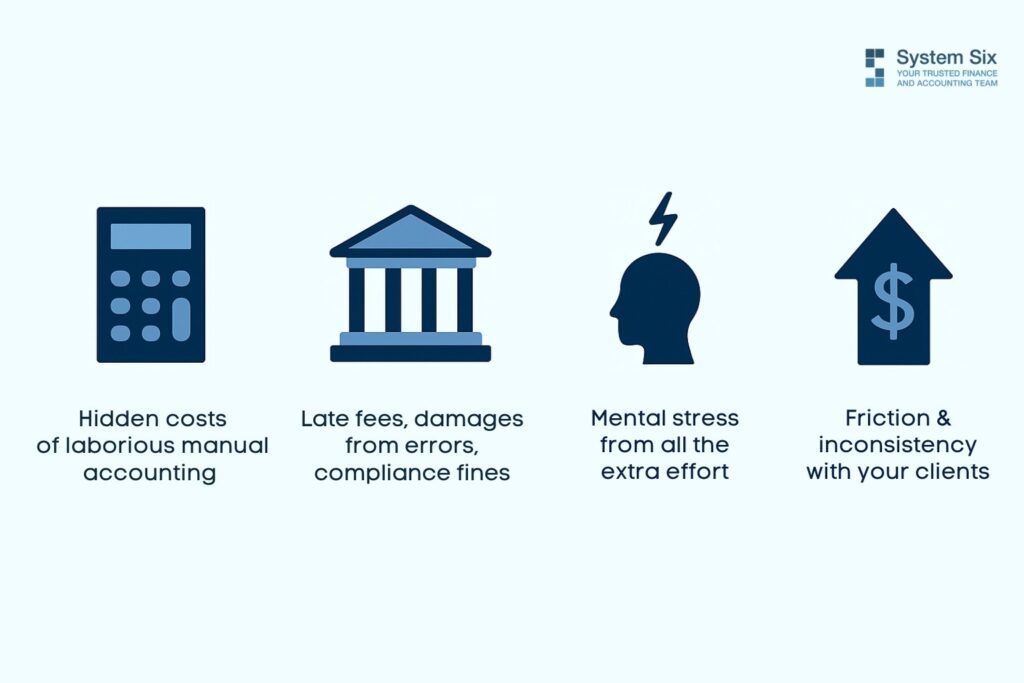
If you’re spending 15 hours monthly on financial tasks—invoicing, reconciling, tracking expenses, chasing payments—and your effective hourly rate is $200, you’re looking at $3,000 monthly in hidden costs. That’s $36,000 annually, just in your time.
But it gets worse.
One business owner discovered he was paying $700 in unnecessary bank fees each month because poor cash flow tracking led him to trigger overdraft fees repeatedly. That’s $8,400 annually—enough to pay for sophisticated tools and still come out ahead.
Then there are the error costs. Late payment penalties. Compliance fines. Client relationships were damaged due to inconsistent billing. These aren’t theoretical—they’re real money walking out your door.
And we haven’t even touched on the mental load. Those Sunday nights reconciling accounts. The background anxiety about whether you’re missing something. The constant switching between “business owner” mode and “amateur accountant” mode.
Your “free” system often costs three to five times as much as professional solutions. You can’t see it on your bank statement.
The Three-Part ROI Framework
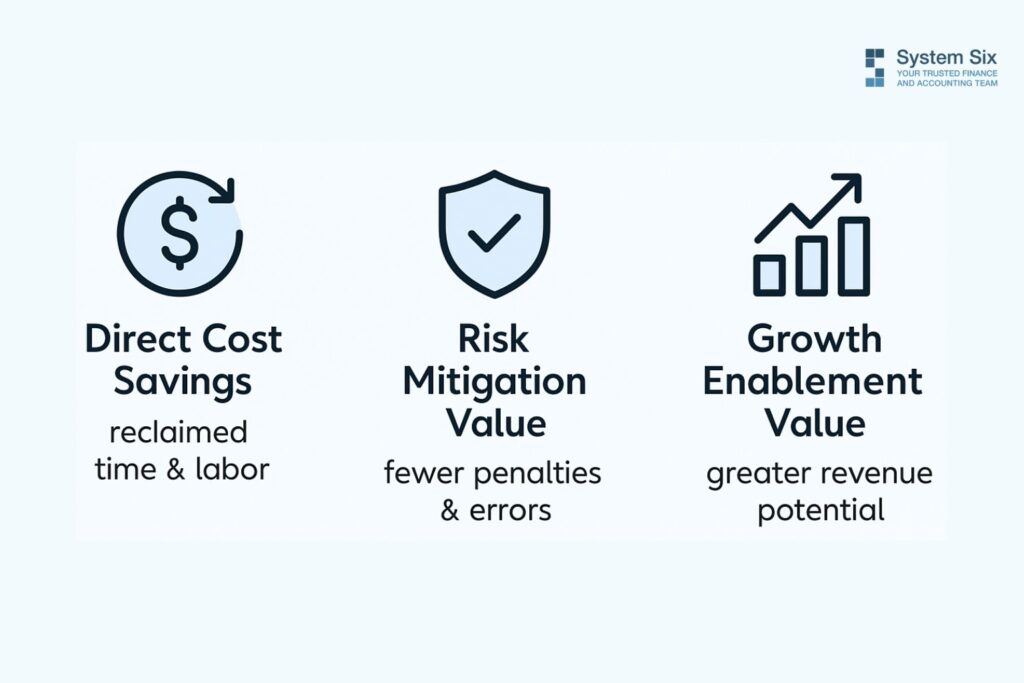
ROI isn’t just what you spend. It’s what you gain, save, and avoid losing.
Part 1: Direct Cost Savings
This is time and labor you get back. Mark runs an environmental consulting firm. Before automation, he spent 12-15 hours weekly on financial tasks. After implementing automated transaction categorization and real-time dashboards, he reclaimed 10+ hours every week.
His firm grew 40% the following year while maintaining the exact administrative headcount.
“Working with System Six to automate our finances changed everything,” Mark shares. “Now I can pull up real-time insights from my phone between client meetings. We’ve grown significantly because I can focus on clients instead of paperwork.”
Part 2: Risk Mitigation Value
What do you save by avoiding penalties, errors, and missed opportunities? Automated systems catch things you’d forget. They track compliance deadlines systematically. They reconcile accounts daily rather than monthly, catching mistakes when they’re minor rather than catastrophic.
“System Six has done wonders for my stress level,” one client told us. “They’ve created automated systems that track every deadline and requirement. I no longer worry about compliance—it’s all handled automatically.”
No more late fees. No more scrambling at tax time. No more discovering errors three months after they happened.
Part 3: Growth Enablement Value
This is the big one. Better financial systems don’t just improve efficiency—they unlock revenue opportunities.
Elena runs a 12-person strategy consulting practice. Before automation, the month-end close took 5-7 days, and financial reports were perpetually outdated. After implementing full automation, the month-end dropped to less than a day.
But the real magic? Elena’s team gained clear visibility into project profitability, leading to a 22% increase in average project margin. Cash flow forecasting improved, allowing strategic hiring ahead of demand.
“The clarity we gained gave us the confidence to open a second office and hire three new consultants,” Elena reports. “We knew exactly which project types to pursue and had the cash flow visibility to make these moves confidently.”
One extra client meeting per week, enabled by automation, can translate into tens of thousands of dollars in additional annual revenue.
Your DIY ROI Worksheet
Let’s make this real. Grab a calculator.
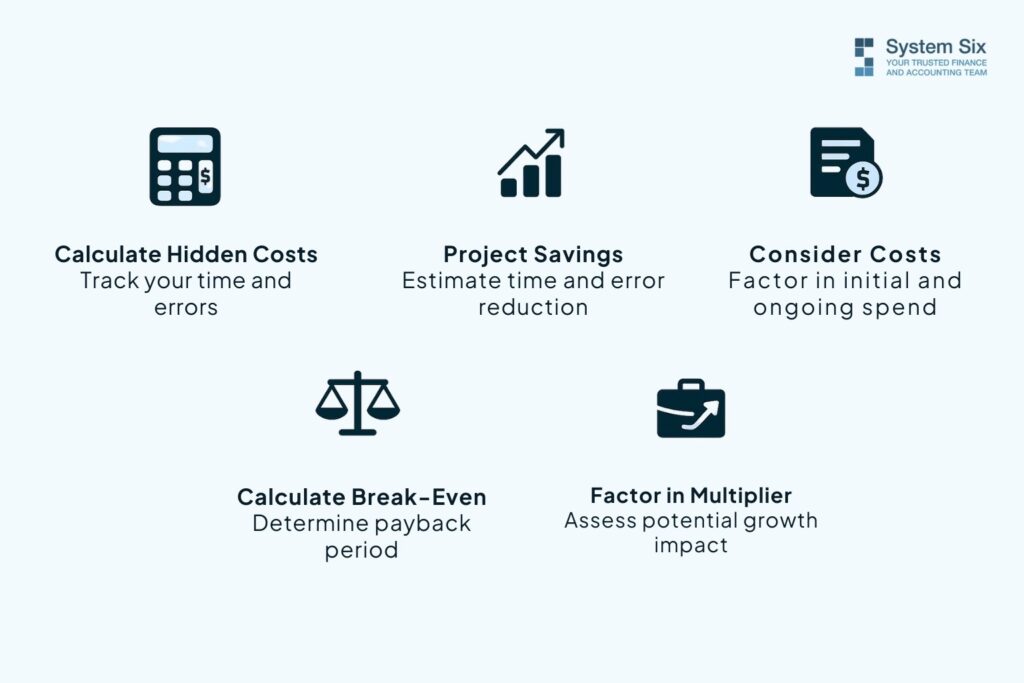
Step 1: Calculate Your Current Hidden Costs
Track your time for one week. How many hours are you spending on financial tasks? Multiply that by four to get monthly hours. Then multiply by your effective hourly rate.
Example: 4 hours weekly × 4 weeks = 16 hours monthly × $200/hour = $3,200 in opportunity cost.
Now add up recent error costs from the last three months. Bank fees. Late penalties. That invoice you forgot to send. Divide by three for your monthly average.
Step 2: Project Your Savings
Automation typically reduces time spent on financial tasks by 70-80%. So if you’re spending 16 hours monthly now, you’d drop to about 3-4 hours, mostly reviewing automated reports.
You’d save 12 hours monthly. At $200/hour, that’s $2,400 in reclaimed time.
Most businesses see errors drop 80-90% with automation. If you’re averaging $500 in monthly error costs, reduce them to under $100.
Cash flow improvement? Automated invoicing typically reduces average payment time by 15-25 days. If you’re carrying $50,000 in receivables and your cost of capital is 6%, shaving 20 days off payment time saves roughly $165 monthly.
Step 3: Consider Costs
Setup typically ranges from a few hundred to a couple of thousand dollars. Monthly costs for automation tools and services usually range from $400 to $800 for small- to mid-sized businesses, covering bookkeeping, automation, reporting, and advisory support.
Step 4: Calculate Break-Even
Simple formula: Total One-Time Investment ÷ Monthly Net Savings = Months to Payback.
Real numbers: Say you invest $2,000 in setup and pay $800 monthly. Your monthly savings total $2,900 ($2,400 in time + $400 in error reduction + $165 in cash flow improvement minus $800 in fees = $2,165 net monthly benefit).
Your one-time costs pay back in less than one month. After that, you’re $2,165 ahead every single month.
Industry benchmark? Most firms hit break-even within 2-3 months.
Step 5: Factor in the Multiplier
What could you do with 12-15 extra hours monthly? Land one additional client quarterly? That could represent $50,000 to $100,000 in annual revenue growth.
As one business owner told us: “We’ve grown 40% this year because I can focus on clients instead of paperwork.”
Real Numbers from Real Businesses
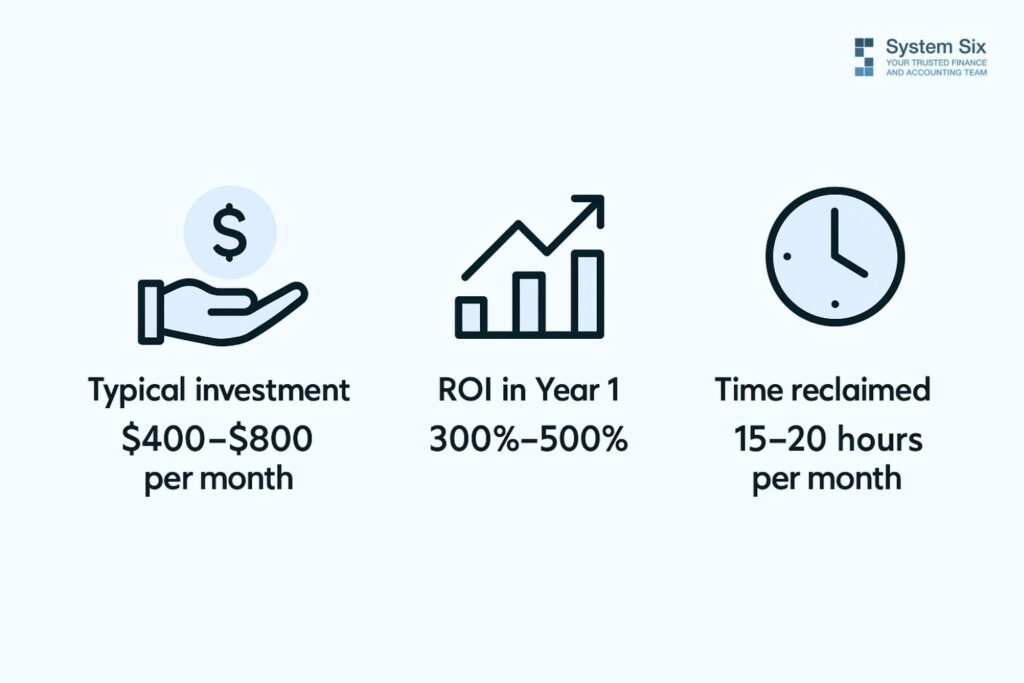
Typical investment runs $400-$800 per week. Expected first-year ROI? Most businesses see returns of 300-500% through reclaimed time, improved efficiency, better decision-making, reduced compliance costs, and accelerated growth.
Payback period averages 2-3 months. Time reclaimed typically runs 15-20 hours per month.
Elena’s strategy firm went from struggling with a 5-7 day month-end close to opening a second office. The financial clarity didn’t just improve operations—it enabled growth that wouldn’t have been possible before.
The investment becomes self-sustaining within months, then generates profits for years.
The Decision Framework
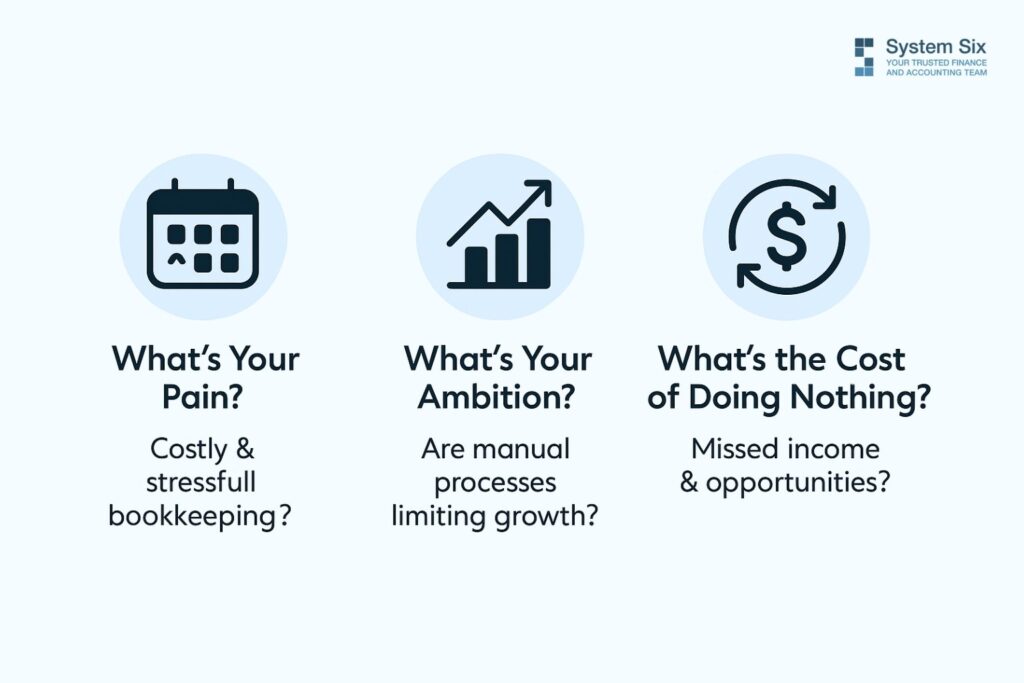
Still on the fence?
What’s your current pain level? If you’re spending Sundays on bookkeeping and stressed about missed deadlines—that’s a signal. Your manual system is costing you more than money.
What’s your growth ambition? You can’t scale on manual systems. At some point, administrative burden becomes a constraint on growth.
What’s the cost of inaction? Every month you delay, you miss strategic opportunities. That $3,000 monthly in wasted time? That’s $36,000 in annual income you’re leaving on the table.
The question isn’t whether you can afford to automate. It’s whether you can afford not to.
Your Next Move
You didn’t become a business owner to spend weekends wrestling with reconciliations. You started your business to solve problems, serve clients, and build something meaningful.
Automation doesn’t just save time and money. It gives you back your weekends and lets you focus on what you do best.
What would you do with an extra 15-20 hours each month? Successful business owners already know the answer. They’d grow their business.
Start simple. Track your time for one week. Write down every hour you spend on financial tasks. Calculate what those hours cost. Add up recent error costs. Look at the total.
The numbers will speak for themselves.
About System Six
System Six is a Seattle-based bookkeeping and financial services firm that helps small and mid-sized businesses streamline their financial operations. We specialize in providing technology-driven financial management solutions for consulting firms, allowing owners to focus on growing their businesses without worrying about cash flow, payroll, or compliance issues. Our team of over 35 professionals brings an average of 10+ years of accounting experience to every client relationship, serving more than 175 businesses across the U.S. From accurate bookkeeping to cash flow forecasting, we deliver the financial clarity and peace of mind that consulting firm owners need to thrive. Learn more at www.systemsix.com.
by Chris Williams | Oct 15, 2025 | Blog
Sarah thought she’d done her homework. She’d asked around, gotten a referral, and hired a bookkeeper who seemed perfectly fine. Six months later, she was sitting in her CPA’s office learning that her payroll taxes hadn’t been filed correctly. The penalties cost her $12,000. Worse? Her biggest client started asking uncomfortable questions about her firm’s financial management.
Your financial services partner isn’t just keeping your books. They’re protecting your professional reputation with every invoice, every payroll run, every tax filing. Get this decision wrong, and you’re not just losing money—you’re risking the credibility you’ve spent years building.
That’s why a well-crafted Request for Proposal matters. It helps you find a partner who understands your business and provides the financial clarity to make confident decisions.
Why Your Financial Services Partner Is Too Important to Wing It
Here’s what most people don’t realize until it’s too late: your finance team touches everything. Payroll. Compliance. Investor reports. Project profitability tracking.
The wrong choice creates real damage. Late payrolls destroy employee morale. Tax penalties drain cash you needed for growth. Messy books make you look unprofessional during audits. One acquisition entrepreneur inherited books so disorganized that his first audit nearly killed the deal’s financing.
Your clients and investors are watching. When you can’t answer basic questions about your finances, people notice. They wonder if the same disorganization affects other parts of your business. Your professional reputation isn’t just about the work you deliver—it’s about demonstrating that you run a tight ship.
The 7 Essential Elements Your Financial Services RFP Must Include
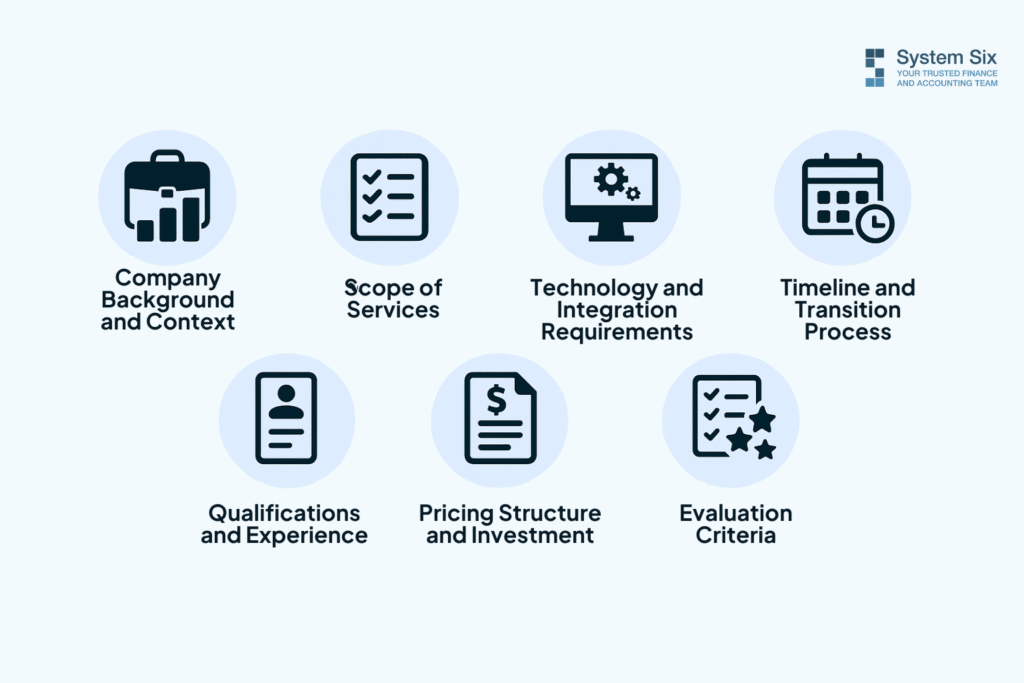
Company Background and Context
Paint a clear picture. What industry are you in? What’s your revenue range and employee count? What financial systems are you using, and what’s driving you crazy about them?
Be specific about growth. Are you a $2M consulting firm scaling to $5M? An entrepreneur who just bought your first company? A 15-person agency adding services faster than you can track them?
This context matters because the right provider needs to understand your specific world. Consulting firms have different needs than e-commerce businesses. Please provide them with the information necessary to craft a relevant proposal.
Scope of Services—Be Specific
Don’t just say “we need bookkeeping.” Break it down.
Monthly bookkeeping and reconciliation? Obviously. But what about payroll? If you have remote employees across multiple states, that’s complex. If you’re working with contractors, proper 1099 classification becomes critical. One misclassification and you’re facing a five-figure IRS audit.
What about bill pay and accounts receivable? Many consulting firms waste hours monthly paying bills and chasing invoices. A good partner automates this so you don’t spend evenings on busywork.
Financial reporting matters too. Do you need basic statements or sophisticated project profitability tracking? If you’re running a consulting practice, you need to know which clients actually make you money. If you have investors, you need reporting packages that meet their requirements.
And consider advisory services. Do you want someone who records what happened, or a partner who helps you forecast and make strategic decisions?
Technology and Integration Requirements
List every piece of software you use. QuickBooks. Harvest for time tracking. HubSpot for CRM. Ramp for expenses.
The right partner should integrate seamlessly with your existing tools. You shouldn’t export spreadsheets and manually transfer data. That’s precisely the administrative waste you’re trying to eliminate.
Be clear about security expectations. What encryption standards do they use? How do they handle data security?
Timeline and Transition Process
When do you need services to start? Be realistic. If your books are a disaster and you need someone operational in two weeks, say so.
How messy are your current books? Clean? Somewhat behind? Complete chaos? The state of your financials affects transition time and the cleanup work required. Don’t pretend everything’s fine—you’re just setting everyone up for unpleasant surprises.
Qualifications and Experience
What industry-specific experience do you require? If you run a consulting firm, you want someone who understands project-based billing, utilization rates, and milestone-based cash flow.
Ask about team structure. Who will actually work on your account? What happens if your main contact leaves? You need backup, not a single point of failure.
Client retention rates tell you a lot. If clients keep leaving after a year, that’s a red flag. Over 95% retention suggests consistent value delivery.
And get references from businesses similar to yours—same industry, same size, same complexity.
Pricing Structure and Investment
Request transparent, detailed pricing. What’s included in the base fee versus what costs extra? Monthly subscription or hourly billing? What happens when your business grows?
Be suspicious of pricing that seems too good to be true. The cheapest option often becomes the most expensive once you factor in mistakes and the time you spend fixing them.
Think ROI instead of just cost. Most consulting firms reclaim 15-20 hours monthly once they outsource financial management. What’s your billable rate? That time pays for the service several times over.
Evaluation Criteria—Tell Them How You’ll Decide
Be upfront about how you’ll make your decision. Is cost your top priority? Industry expertise? Technology capabilities?
Rank your criteria so providers know what matters most. If you’re willing to pay more for search fund experience, say so. If integration with your tech stack is non-negotiable, make that clear.
Include your decision timeline and how they should submit proposals.
Red Flags to Watch For (and Green Flags to Celebrate)
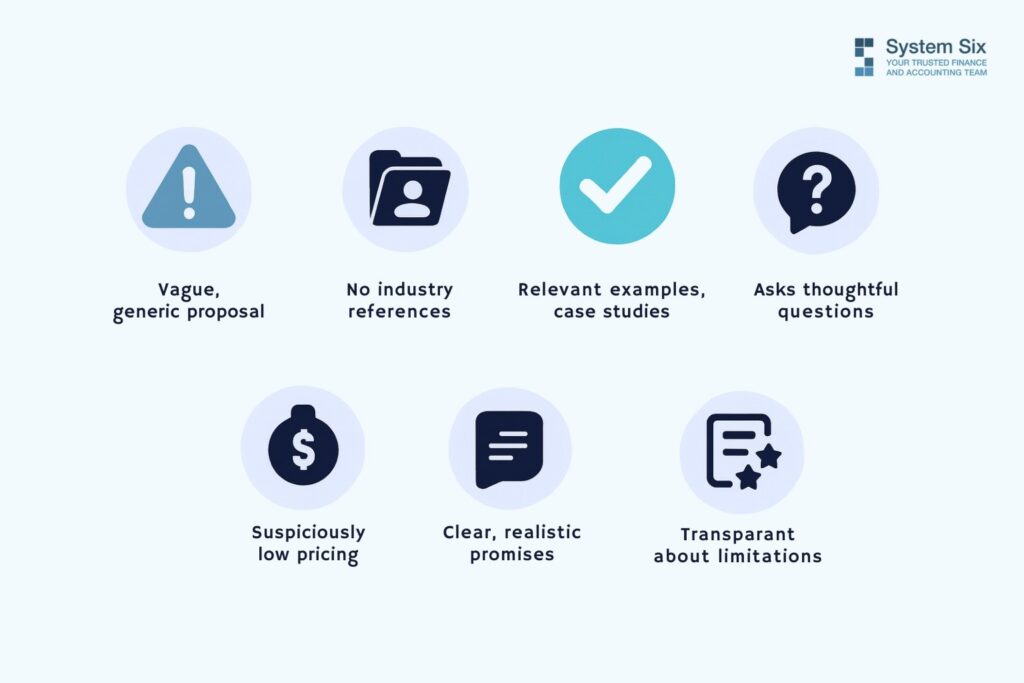
Watch out for vague, template-style responses that could apply to any business. If their proposal doesn’t reference your specific industry, they didn’t do their homework.
Run away from providers who won’t give you industry references. There’s a reason they’re hiding their track record.
Pricing is dramatically lower than everyone else’s. There’s always a catch—usually inexperienced staff, sloppy work, or surprise charges.
Please pay attention to whether they ask you questions. A provider who accepts your RFP without seeking clarification probably doesn’t understand the complexity. The best partners ask thoughtful questions because they want to understand your business honestly.
Green flags? Look for proposals with industry-specific examples and case studies. When they explain their process in detail, that’s confidence speaking. One search fund entrepreneur said his financial partner “has done wonders for my stress level to feel like this is all now taken care of with a professional partner.”
Transparency matters. The best providers are honest about what they can and can’t do. If they promise everything, they’re overselling.
What Happens After You Send Your RFP

Schedule discovery calls with your top three candidates. These conversations reveal what proposals can’t. How do they communicate? Are they genuinely interested in your challenges?
Ask about their onboarding process. What does transition look like? How long does cleanup typically take? A straightforward, structured process suggests professionalism and experience.
Discuss how they handle mistakes because mistakes happen. What matters is how they own their problems and fix them quickly. One client praised their partner for being “inquisitive, asking follow-on questions, and looking around corners”—that proactive approach makes all the difference.
Check those references. Actually call them. Ask specific questions based on your pain points. If cash flow keeps you up at night, ask how their provider helped with forecasting. If compliance worries you, ask about their experience with audits.
Trust your gut. This is a partnership, not just a vendor relationship. You’ll be sharing sensitive financial information and relying on these people for critical decisions. If something feels off, listen to that instinct.
Your Financial Partner as Reputation Insurance

A thorough RFP process might feel like extra work when you’re already overwhelmed. But it’s reputation insurance.
The right financial services partner doesn’t just keep your books clean. They give you clarity and confidence to make better decisions. They eliminate 3 a.m. worries about whether you filed something correctly. They free up the 15-20 hours you’re wasting on administrative tasks so you can focus on growth.
Most importantly, they protect the professional reputation you’ve spent years building. When clients, investors, or potential acquirers look at your financials, they see competence and credibility. No surprises. No red flags. Just a well-run business that knows its numbers.
What could you accomplish if you never had to worry about compliance, payroll, or cash flow again? What would it mean for your business if you actually understood your financials well enough to make confident strategic decisions?
That’s what’s at stake when you choose your financial services partner. Take the time to do it right. Your future self—and your professional reputation—will thank you.
About System Six
System Six is a Seattle-based bookkeeping and financial services firm that helps small and mid-sized businesses streamline their financial operations. We specialize in providing technology-driven financial management solutions for consulting firms, allowing owners to focus on growing their businesses without worrying about cash flow, payroll, or compliance issues. Our team of over 35 professionals brings an average of 10+ years of accounting experience to every client relationship, serving more than 175 businesses across the U.S. From accurate bookkeeping to cash flow forecasting, we deliver the financial clarity and peace of mind that consulting firm owners need to thrive. Learn more at www.systemsix.com.
by Chris Williams | Oct 8, 2025 | Blog
Marcus checks his phone during a client meeting break, and his stomach tightens. Three overdue invoice reminders from contractors. Two urgent messages from his office manager about payroll. An email from his biggest client requesting a project timeline extension—with payment terms to match. He’s running a $3 million business, but his financial systems still operate like he’s a $500K startup.
Sound familiar?
QuickBooks was perfect when you started. Simple, affordable, and got the job done. But somewhere between $1M and $5M in revenue, something shifted. The tool that once simplified your finances now feels like it’s holding you back. You’re spending weekends updating spreadsheets and making guesses about cash flow and avoiding growth opportunities because you can’t confidently answer basic questions about your financial capacity.
Here’s the thing: your growth has outpaced your financial infrastructure. And there are clear, unmistakable signs when it’s time to scale beyond entry-level software. Making the switch isn’t just about fancier tools—it’s about reclaiming your time and gaining the visibility to scale confidently.
The Hidden Cost of Staying Too Long
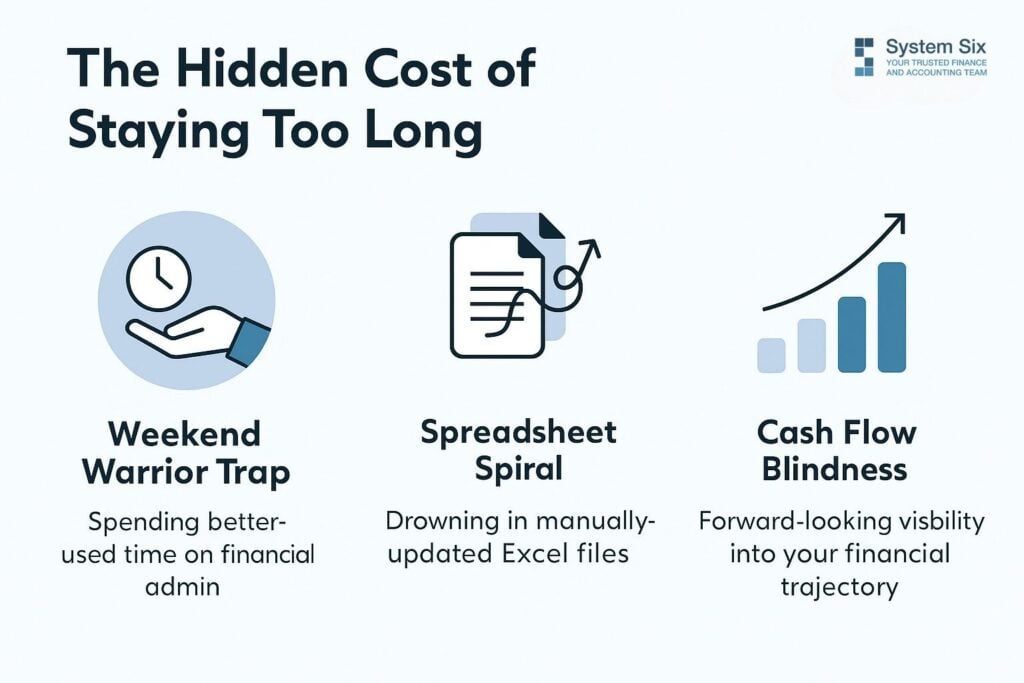
What most business owners don’t realize is that outgrowing your system costs you in ways that don’t show up on any report.
The Weekend Warrior Trap
You’re spending 15-20 hours monthly on financial tasks—reconciling accounts, chasing receipts, updating tracking spreadsheets. At your typical billing rate, that’s $3,000 to $5,000 in lost revenue every single month. But it’s worse than that. It’s the opportunity cost of not spending that time on strategy, business development, or simply having a life outside work.
One environmental consulting firm owner told us, “I started this business to solve complex environmental challenges, not to become an amateur accountant working weekends.” She’d grown from 5 to 25 employees in 18 months. Revenue was climbing. But she was drowning in financial administration that had nothing to do with her actual expertise.
The Spreadsheet Spiral
It starts innocently enough. QuickBooks handles your basic bookkeeping, but you need cash flow projections. So you create one spreadsheet. Then you need project profitability tracking—another spreadsheet. Budget variance analysis? Spreadsheet number three. Before you know it, you’re maintaining five or six interconnected Excel files that require manual data entry, constant reconciliation, and elaborate version control.
Vincent, who runs a consulting company in Bellevue, described this exact problem. His team spent hours each week copying data between systems, always worried they were working with outdated information. After implementing an integrated solution, he noted how they finally had “a customized tool that fits our current and growing needs” instead of duct-taped spreadsheets held together with hope.
Cash Flow Blindness
You can’t predict cash crunches until they hit. Every hiring decision feels like a gamble. Should you invest in that new technology? Expand into a new market? You’re making these decisions with gut instinct instead of data because your current system can’t give you forward-looking visibility.
A home services company founder described this transformation after implementing proper forecasting: “We went from hoping we’d make payroll to confidently planning our next five hires.” That’s the difference between reactive panic and a proactive strategy.
So how do you know when you’ve crossed the line from “manageable” to “actively holding us back”?
Seven Unmistakable Signs You’ve Outgrown QuickBooks
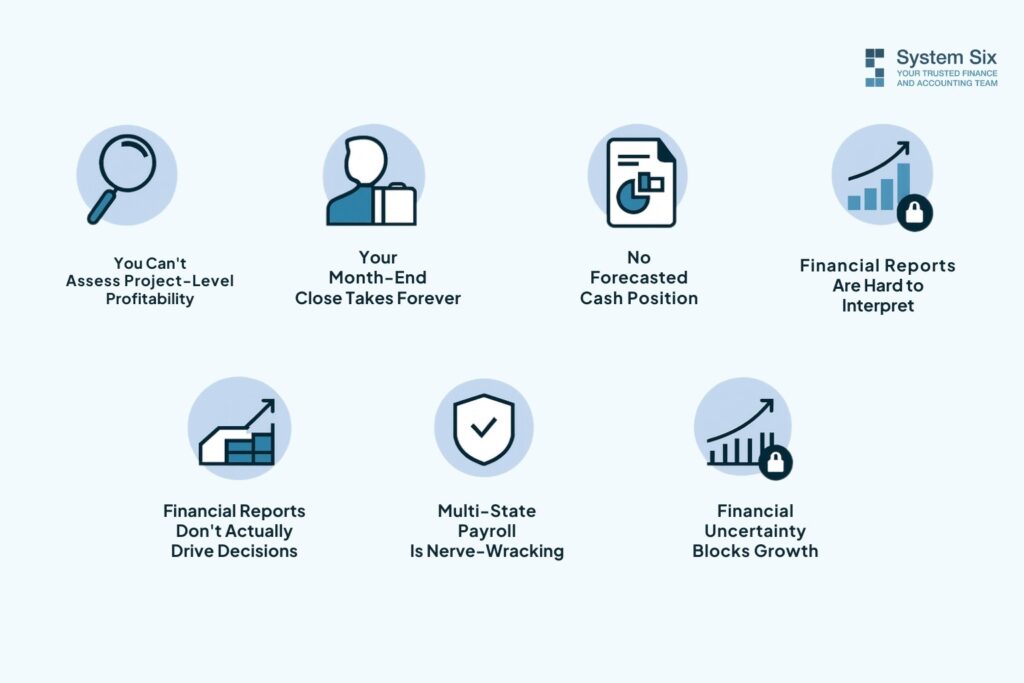
Sign #1: You Can’t Answer “Are We Profitable?” by Client or Project
Sure, QuickBooks shows your overall profit and loss. But which clients actually make you money? Which projects drain resources? Which service lines should you double down on, and which should you quietly phase out?
Growing businesses need project-level profitability tracking. Without it, you’re scaling the wrong things. You might be pouring resources into clients that look profitable on the surface, but eat up disproportionate time and support. Meanwhile, your most efficient, high-margin work gets neglected because you can’t see the difference.
Sign #2: Month-End Close Takes a Week (Or Longer)
Still manually categorizing transactions? Chasing down receipts? Reconciling accounts line by line?
Modern systems automate 95%+ of transaction categorization through AI and rules-based logic. One client reported a 40% improvement in financial reporting accuracy after automating these processes. But more importantly, they got their evenings and weekends back.
If closing your books feels like preparing for an audit every single month, you’ve outgrown your current system.
Sign #3: Your Accountant Dreads Your Books
Pay attention to your CPA’s reactions. If they’re spending hours cleaning up your books before they can even start on taxes, that’s a red flag. You’re paying them premium rates to do work that automation should handle.
Multiple business owners told us that after upgrading their systems, their accountants actually thanked them. The books arrived organized, accurate, and audit-ready. Tax preparation time dropped by half in some cases.
Sign #4: You Have No Idea What Cash Position Will Look Like in 90 Days
Revenue is growing, but cash feels unpredictable. You can’t confidently model hiring decisions or major purchases. You’re constantly surprised—sometimes pleasantly, often not—by your actual cash position.
Alecia, a Seattle business owner, described the moment this changed for her: “I had tears come to my eyes as I was able to see projected cash flow integrated with realtime QuickBooks.” That’s not being overly emotional. That’s the relief of finally having visibility into the future instead of constantly reacting to the present.
Sign #5: Financial Reports Don’t Actually Drive Decisions
You generate reports because you’re supposed to. They sit in your inbox. Maybe you glance at them. But they don’t actually inform your strategy because there’s too much noise and not enough insight.
There’s a massive gap between “having numbers” and “understanding your business.” Entry-level software gives you the former. Strategic financial infrastructure gives you the latter.
Sign #6: Multi-State Payroll Makes You Anxious
You’re hiring talent across state lines. Each state has different requirements for unemployment insurance, workers’ compensation, and employment law. QuickBooks was built for simpler scenarios. You’re now spending time researching compliance requirements instead of running your business.
And the stakes are high. Get it wrong and you’re facing penalties, back taxes, and potential legal issues.
Sign #7: You’re Avoiding Growth Opportunities Due to Financial Uncertainty
This is the most insidious sign. You can’t confidently say yes to expansion because you don’t know if you can afford it. That key hire you need? You’re not sure. Opening a second location? Too risky without better visibility. Taking on a major client that could transform your business? The cash flow implications scare you.
You’re experiencing growth paralysis, not because the opportunities aren’t there, but because your financial systems can’t give you the confidence to act. One home services company saw 60% revenue growth after implementing proper financial visibility—not because they suddenly worked harder, but because they could finally see which growth moves made sense.
What Scaling Your Finance Stack Actually Means
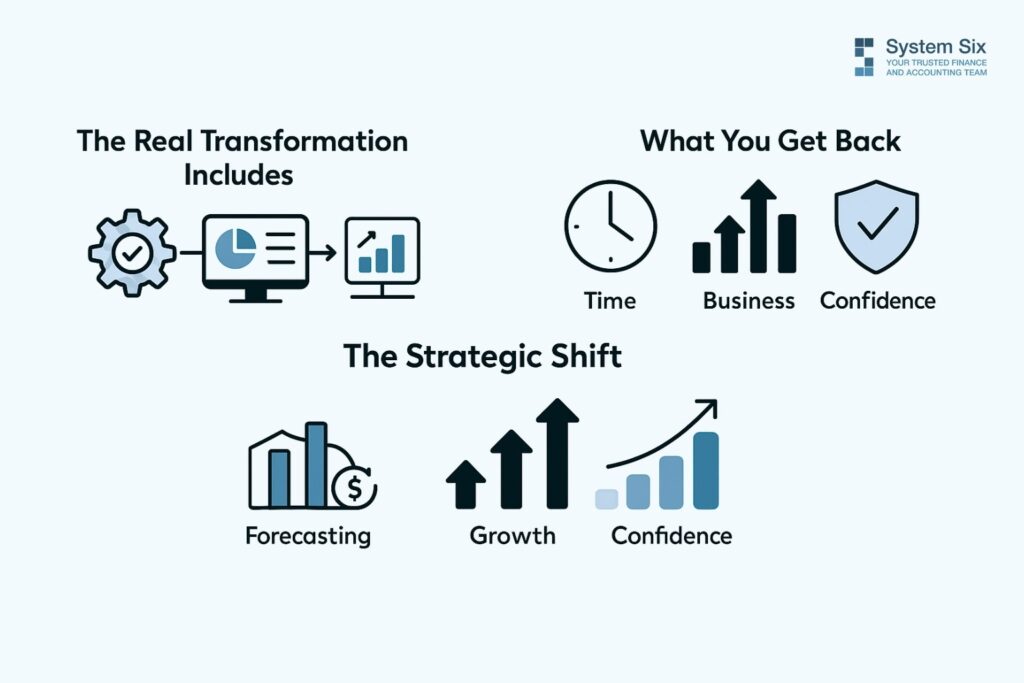
Scaling your finance stack isn’t about switching from one software to another. It’s about transforming your entire approach to financial operations.
The Real Transformation Includes:
Automated workflows that eliminate manual data entry. Realtime dashboards you can access from anywhere. Integration with your other business systems—CRM, project management, time tracking—so data flows automatically. Cash flow forecasting that actually works —12 months out, based on your payment cycles and seasonal patterns. Project and client profitability tracking that shows you where you’re really making money.
What You Get Back:
Those 15-20 hours monthly. That’s half a work week you can redeploy to revenue-generating activities. But over time, you get confidence. Confidence to make hiring decisions. Confidence to pursue growth opportunities. Confidence to sleep at night knowing you understand your financial position.
Manish, who runs a business in Bellevue, described it as the difference between bookkeeping and strategic analysis. His previous approach gave him numbers. The new system gave him insights that, in his words, became “a game-changer” for how he runs his business.
The Strategic Shift:
You move from reactive to proactive. Instead of asking “What happened last month?” you’re asking “What should we do next quarter?” You stop drowning in data and start having actionable insights.
Marcus, an acquisition entrepreneur, appreciated having a team that was “inquisitive, asks follow-on questions, and looks around corners.” That’s what proper financial infrastructure enables—not just recording what happened, but understanding what it means and what comes next.
The numbers back this up. Businesses that make this transition see 90%+ retention—they don’t revert to DIY approaches. They report average annual time savings of $100,000+. Client satisfaction scores average 9.5 out of 10.
The Cost of Waiting
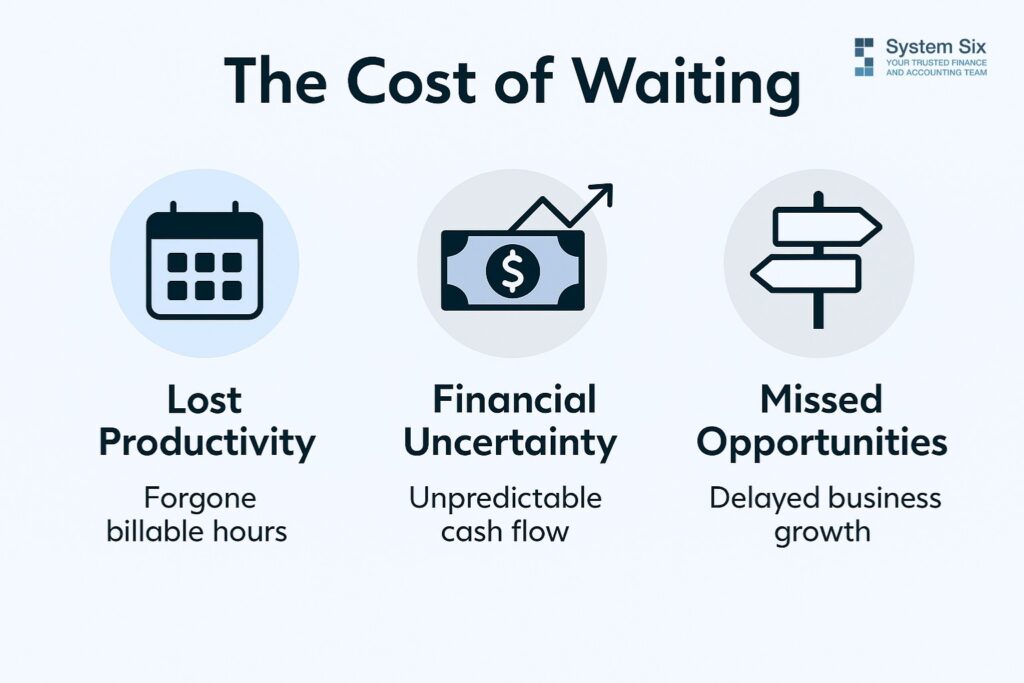
Every month you delay is another month of lost billable hours. Another month of stressful cash flow surprises. Another month of making growth decisions essentially blind.
Let’s be honest about what this costs you. Not just money, though that’s significant. It costs you peace of mind. It costs you strategic opportunities. It costs you the ability to scale at the pace your market demands.
Imagine knowing your cash position 12 months out. Picture making hiring decisions with actual confidence. Consider what you could do with 20 extra hours every month—time you’re currently spending on tasks that could be automated.
Paul, an acquisition entrepreneur, said that hiring professional help “was the best decision I made at the start of the business.” He wished he’d done it sooner. Most business owners say the same thing—not that they made the switch, but that they didn’t do it earlier.
You wouldn’t ask a startup founder to run enterprise operations with the resources of a startup. Why are you asking startup-level software to handle your growing business?
The question isn’t whether to scale your finance stack; it’s how to do so. It’s whether you can afford not to.
About System Six
System Six is a Seattle-based bookkeeping and financial services firm that helps small and mid-sized businesses streamline their financial operations. We specialize in providing technology-driven financial management solutions for consulting firms, allowing owners to focus on growing their businesses without worrying about cash flow, payroll, or compliance issues. Our team of over 35 professionals brings an average of 10+ years of accounting experience to every client relationship, serving more than 175 businesses across the U.S. From accurate bookkeeping to cash flow forecasting, we deliver the financial clarity and peace of mind that consulting firm owners need to thrive. Learn more at www.systemsix.com.
by Chris Williams | Oct 1, 2025 | Blog
It’s Tuesday night, you’re three coffees deep, and you’re staring at two browser tabs. One’s got a job posting template for a staff accountant. The other is showing you proposals from outsourced accounting firms. Your business is growing—actually growing—and you know your current financial setup is held together with spreadsheets and hope. You need help. But which kind?
Here’s the thing everyone gets wrong about this decision. They think it’s about comparing salary numbers. It’s not. This choice shapes how your business scales, how fast you can move, and whether you’ll spend the next two years managing someone or actually running your company. Let’s cut through the noise.
The Real Question Isn’t “Which Is Cheaper?”
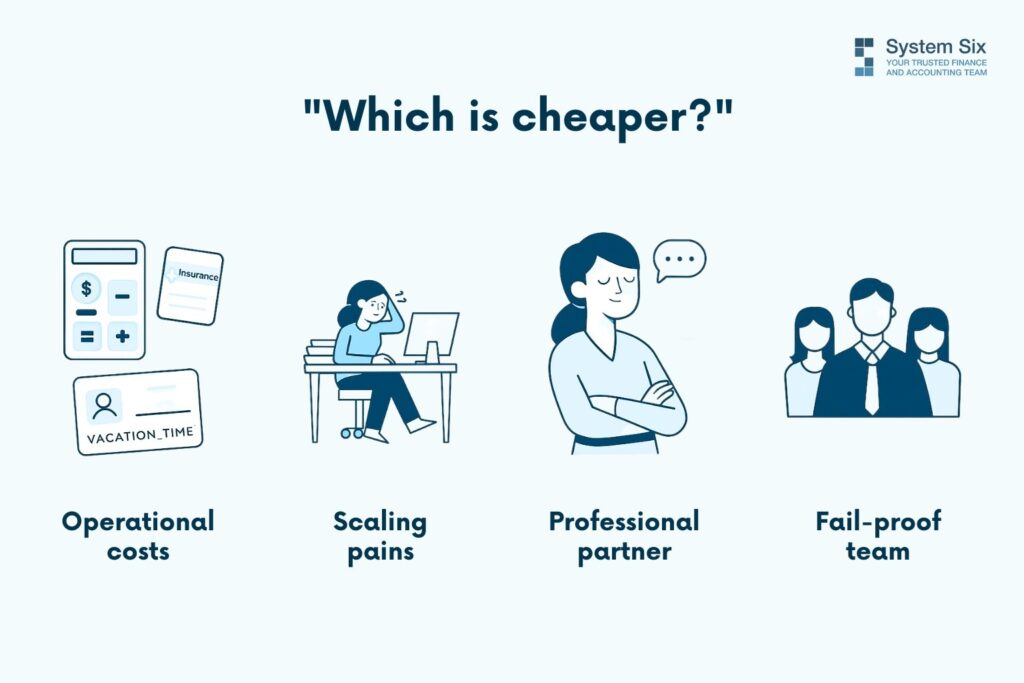
Most business owners I talk to lead with cost. “What’s a staff accountant’s salary versus outsourcing?” Wrong question.
Think about what you’re actually buying. A staff accountant costs $50-70K in salary, sure. But then there’s health insurance, payroll taxes, PTO, that fancy standing desk everyone wants now, software licenses, training time, and—here’s the one nobody mentions—your time managing them. You’re not just hiring someone to do accounting. You’re hiring someone you need to supervise, review, motivate, and cover for when they’re out sick or on vacation.
Now look at the outsourced controller option. Yeah, it might run you $3,000-$6,000 monthly, depending on your complexity. More, right? But you’re getting a whole team—multiple people who know your books. Someone’s always available. They bring systems you’d spend months building internally. And when tax season hits or you need scenario modeling for a big decision? That expertise is just there.
Here’s what really matters, though: scalability. Growth changes everything fast. Betsy, who runs an investor-backed business, said—System Six has done wonders for my stress level to feel like this is all now taken care of with a professional partner.” That peace of mind during rapid scaling? You can’t expense that, but it’s worth real money.
One staff accountant creates a single point of failure. They go on maternity leave, and suddenly you’re three months behind. They quit, and you’re starting over. Your needs double next year, and they’re overwhelmed. It’s not their fault. It’s just what happens when you build critical operations around one person.
So if cost isn’t the deciding factor, what is? Where are you actually right now?
The Growth Stage Litmus Test
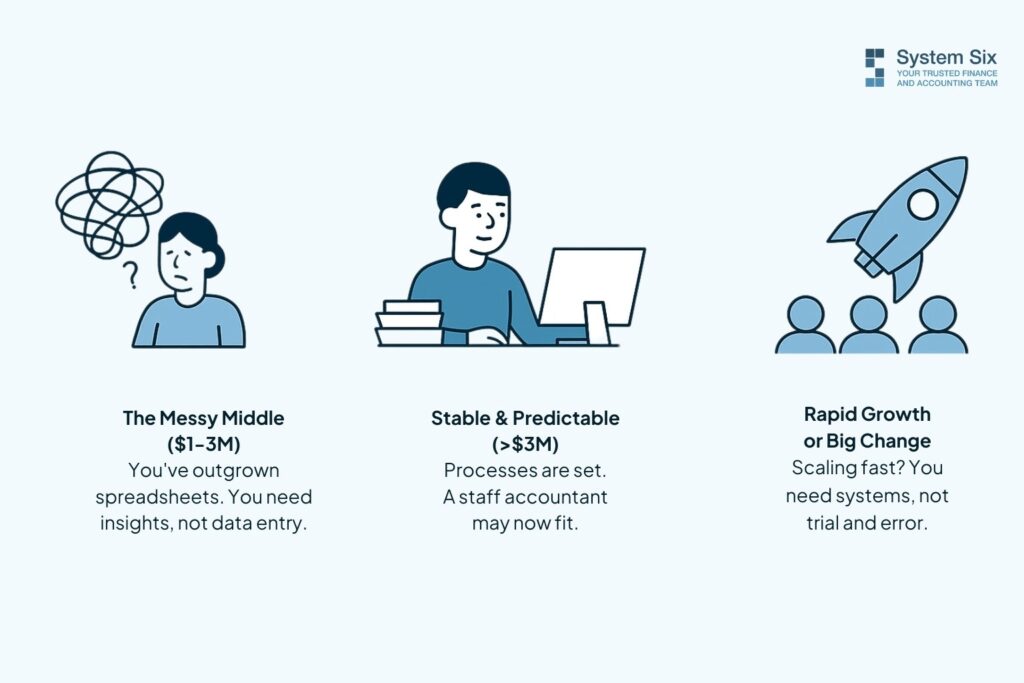
Look at where you are right now. Not where you hope to be in three years. Right now.
You’re in the messy middle. Revenue’s somewhere between $1-3M. You’ve outgrown spreadsheets, but hiring a CFO seems insane. You can’t quickly answer whether that big project was actually profitable. Invoice payments slip through the cracks. Someone asked about your cash flow forecast last week, and you made something up.
This is where outsourced wins, and it’s not even close. You don’t need someone to enter transactions. You need controller-level strategic guidance. The kind of insight that shows you which service lines actually make money, after accounting for all the hidden costs. One consulting firm discovered, through careful analysis, that its large regulatory projects were break-even—they’d been pursuing the wrong work for years. That revelation alone justified the investment many times over.
Your needs also fluctuate like crazy at this stage. Some months, you’re drowning in complexity. Others are quiet. A staff accountant costs the same either way. Flexibility matters when you’re still figuring things out.
You’re stable and predictable. You may be past $3M with steady patterns. Established processes. The same basic financial tasks every month. This is the zone where a staff accountant starts making sense—if, and this is huge, you have the management bandwidth to supervise them properly. Do you? Really? Because most founders think they do until they’re suddenly spending six hours a week answering questions and reviewing work.
You’re about to explode. Got acquisition talks happening? Major contract on the table? Funding round closing? Everything’s about to change fast, and the last thing you need is onboarding someone new into chaos. Manish shared how his business was saved from “falling into operational ruins” after a freelance bookkeeper had mishandled payroll taxes—System Six’s team came in and fixed what would’ve been catastrophic. When things are volatile, you need proven systems and deep expertise, not someone learning as they go.
Which of these sounds like your Tuesday morning?
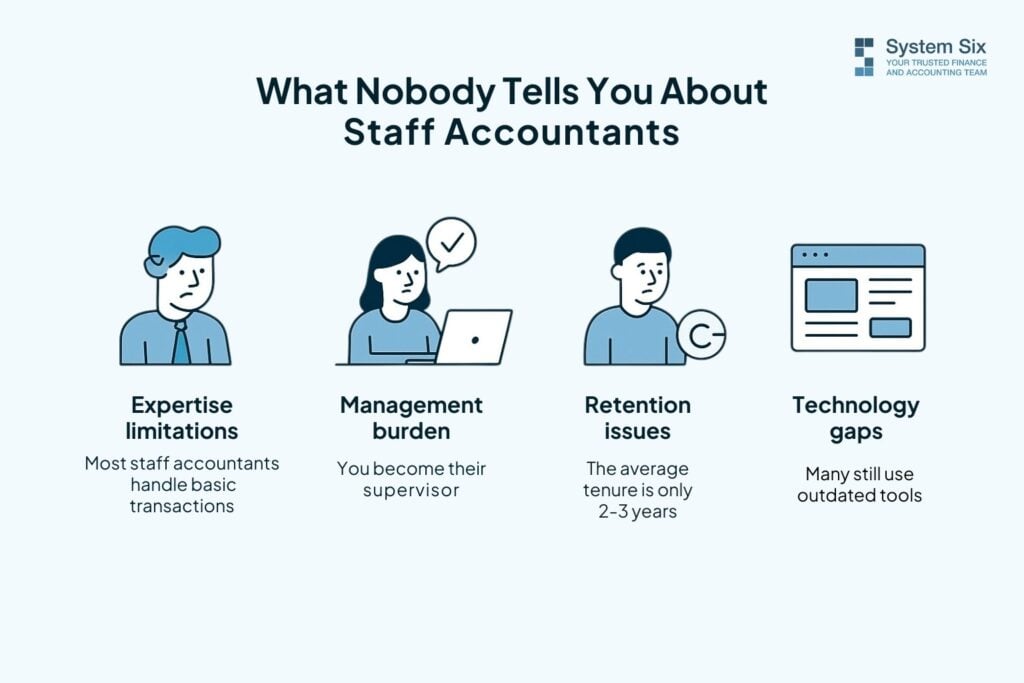
What Nobody Tells You About Staff Accountants
Everyone says, “Hire in-house for control.” Let’s be honest about what you’re actually getting.
The expertise ceiling is real. Most staff accountants handle transactions. They’re great at recording what happened. But strategy? Cash flow forecasting? Multi-state compliance? Acquisition accounting? That’s a different territory. You end up paying someone to learn on your dime, and when truly complex issues arise, you’re hiring consultants anyway. One business owner noted that when they initially went the cheap-freelancer route, it “hurt in the long-term”—the pricing seemed fair until payroll mistakes added up.
You also become their manager. Weekly check-ins. Performance reviews. Figuring out who covers their work when they’re out. Most founders don’t have bandwidth for this, but nobody talks about it during the hiring process. You’re excited about financial help, not realizing you’ve just added “accounting manager” to your job description.
Then there’s retention. The average tenure for staff accountants is 2-3 years. When they’re fully trained, they leave for more money or a controller title somewhere else. Now you’re recruiting again while your books fall behind. The cycle repeats.
And technology? Many staff accountants use the tools they learned in school—maybe QuickBooks basics, definitely Excel. But modern financial operations require automation, system integration, and real-time dashboards that inform decision-making. Building that infrastructure isn’t typically in their wheelhouse. Multiple reviewers noted that System Six’s technology-driven approach and automated workflows were game changers compared to manual processes.
Look, I’m not saying staff accountants aren’t valuable. They absolutely are. But figuring out if you actually need one versus wanting the comfort of someone sitting in your office—that’s the trick.
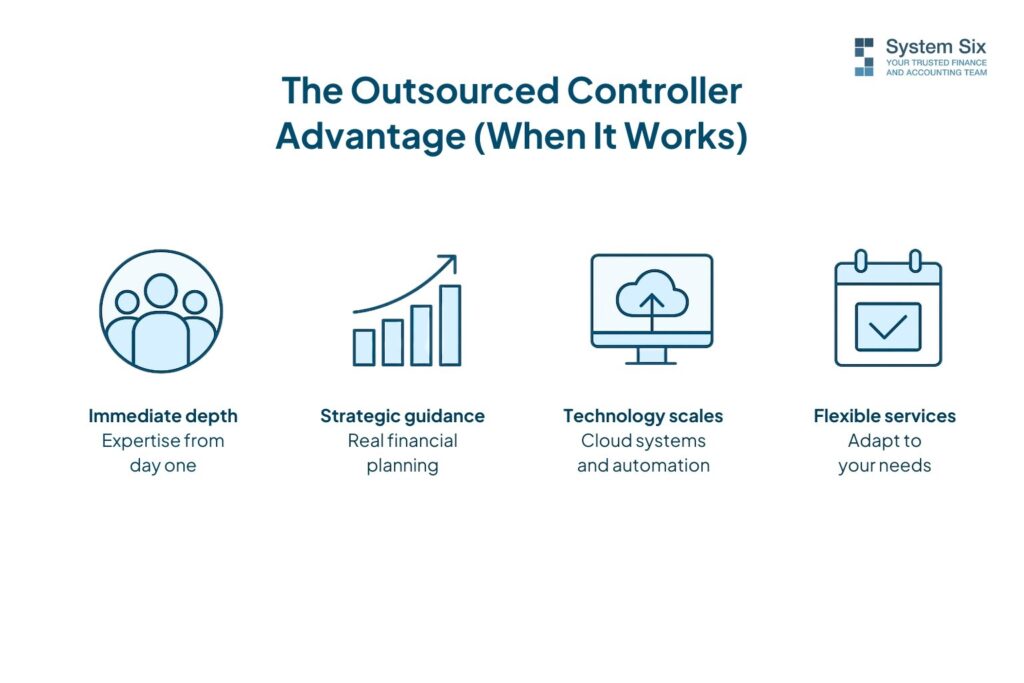
The Outsourced Controller Advantage (When It Works)
Here’s what changes when you’ve got an entire team in your corner.
You get immediate depth. Day one, you’ve got expertise that would cost $150K+ to hire internally. A multi-person team means redundancy is built in—someone’s always available. As one client put it, their financial operations are “just taken care of seamlessly” with “great service, great value.” That’s not marketing speak. That’s what happens when you’re not dependent on a single person’s vacation schedule.
But it’s more than execution. You get strategic guidance. Real financial planning. Scenario modeling for big decisions: What if we hire three people? What if we open that second location? What if we pursue this acquisition? One consulting firm principal discovered, through proper project profitability tracking, that their mid-sized projects were 40% more profitable than their large engagements. That insight completely shifted where they focused business development efforts.
The technology scales with you, too. Modern cloud systems, automated workflows, integration with your existing tools—time tracking, project management, CRM, all feeding real-time data into your financial picture. Not a month-old report you’re trying to make decisions from. When surveyed, over 95% of customers gave their outsourced provider a 9.5 out of 10 likelihood-to-recommend score. That kind of satisfaction usually means something’s working.
Services flex with your needs. Busy season? They handle it. Slower quarter? You’re not paying idle salary. Growing fast? The team expands to fill the roles, so you don’t have to post jobs.
But here’s the catch, and I’ll be straight with you: there’s less face time. They’re not in your office for impromptu hallway conversations. This requires some trust in a partnership model. If you genuinely need someone at daily standups or you manage through constant in-person interaction, outsourcing might feel uncomfortable. Rebecca noted her team “isn’t just a vendor, they are friends who feel like part of our team”—but building that relationship takes intention when they’re not physically present.
How to Actually Decide (Without Losing Sleep)
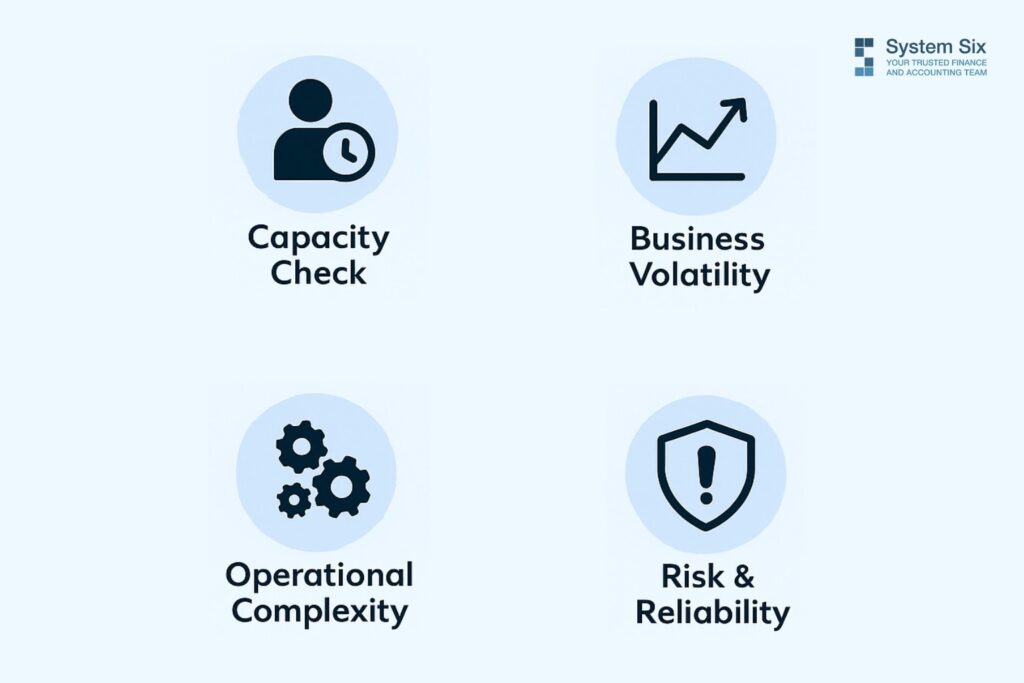
Stop overthinking. Ask yourself these five questions.
Can you genuinely manage another employee right now? Not “should you”—can you? Do you have time for weekly check-ins, training, reviews, and supervision? If you’re already stretched thin, adding management responsibility might break you.
How fast are things changing? If your revenue, team size, or service offerings shift quarterly, flexibility wins. Stable and predictable favors in-house. Volatile and growing favors outsourced.
What’s your actual complexity level? Multiple states? Various revenue streams? Contractor management? Complex project accounting? Investor reporting? High-complexity projects require specialized teams with broad expertise. A capable individual can perform simple operations.
What’s your risk tolerance for financial mistakes? Payroll tax errors cost real money. Compliance issues damage your reputation. Single-person operations carry a higher error risk—nobody is checking their work. One founder emphasized how affordable the expertise became after experiencing what happens when things go wrong: “I would pay for this expertise without hesitation.”
What does your growth trajectory actually require? Be honest. Are you building toward $10M or stabilizing around $3M? Different futures need different financial infrastructure. If you’re staying small and steady, one great person might be perfect. If you’re scaling aggressively, you need systems that won’t break.
One thing people forget: hybrid approaches exist. Some businesses use both—an outsourced controller for strategy and monthly close, plus a part-time internal coordinator for day-to-day stuff. Others start outsource and transition later when it makes sense. There’s no law saying you have to choose once and be stuck forever.
The Choice That Fits Your Growth
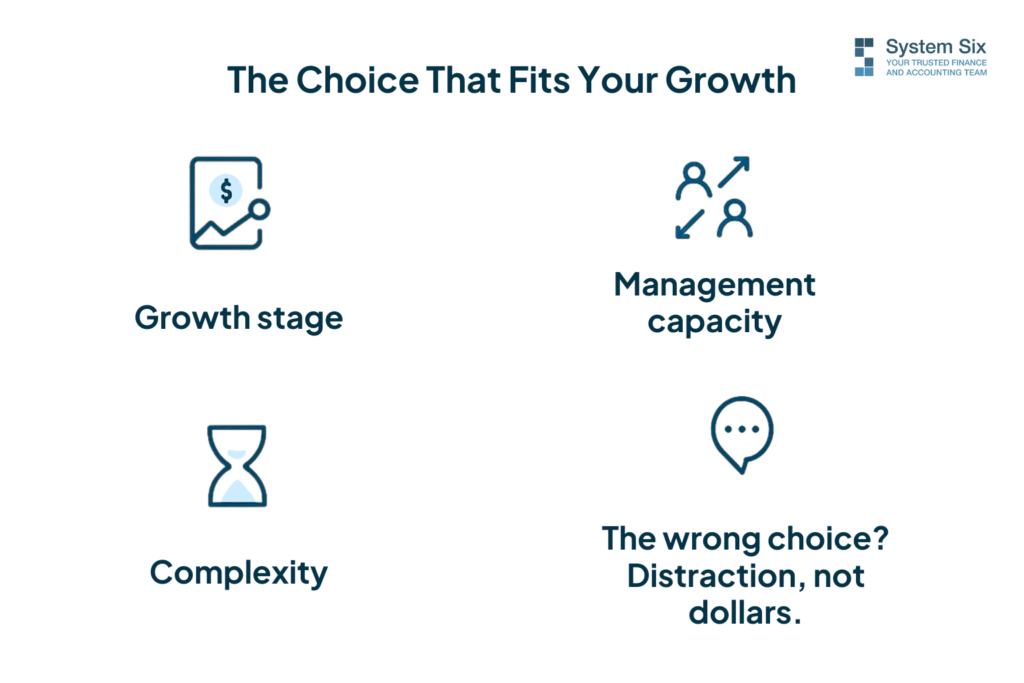
The staff accountant versus outsourced controller decision isn’t about which option is “better.” It’s about honest self-assessment of where you are and where you’re heading.
Remember that late-night stress about making the wrong choice? You’ve got a framework now. Look at your growth stage. Evaluate your management capacity. Consider your complexity. Match the solution to your actual situation, not your ideal fantasy of how organized you wish you were.
Your business is growing. Your financial operations should make that easier, not harder. Whether that means a desk in your office or a team you’ll never meet in person—pick the option that gives you back your time and your clarity.
Still stuck? Talk to people who’ve walked this path. Ask what they wish they’d known earlier. And trust your gut—you didn’t build a business without decent instincts.
What’s the real cost of the wrong choice? Not the dollars. The months of distraction when you should be focused on growth.
About System Six
System Six is a Seattle-based bookkeeping and financial services firm that helps small and mid-sized businesses streamline their financial operations. We specialize in providing technology-driven financial management solutions for consulting firms, allowing owners to focus on growing their businesses without worrying about cash flow, payroll, or compliance issues. Our team of over 35 professionals brings an average of 10+ years of accounting experience to every client relationship, serving more than 175 businesses across the U.S. From accurate bookkeeping to cash flow forecasting, we deliver the financial clarity and peace of mind that consulting firm owners need to thrive. Learn more at www.systemsix.com.
by Chris Williams | Sep 1, 2025 | Blog
It’s 3:17 AM, and you’re lying there staring at the ceiling again. Your mind’s racing through the same questions that hijacked your sleep last Tuesday. And the Tuesday before that. Which projects are actually making money? Will cash flow cover next month’s payroll? Should you take on that new client or hire another consultant first?
The irony isn’t lost on you. During daylight hours, you’re the strategic advisor. The one with all the answers. But when it comes to your own firm’s finances, you’re navigating in the dark with a dying flashlight.
Here’s the thing: You’re sitting on a goldmine of financial data. Every timesheet, every invoice, every expense report contains a piece of the puzzle. But without the right dashboard, it’s like having a Ferrari engine attached to bicycle wheels. All that power, going nowhere fast.
What if, instead of those 3 AM wake-ups, you could check your phone over morning coffee and know—really know—exactly where your business stands? Not through some complex spreadsheet gymnastics, but through clear, visual insights that take 30 seconds to understand?
That’s what a properly designed financial dashboard delivers. And it’s not as complicated as you think.
The Dashboard Dilemma: Why Most Consultants Are Flying Blind
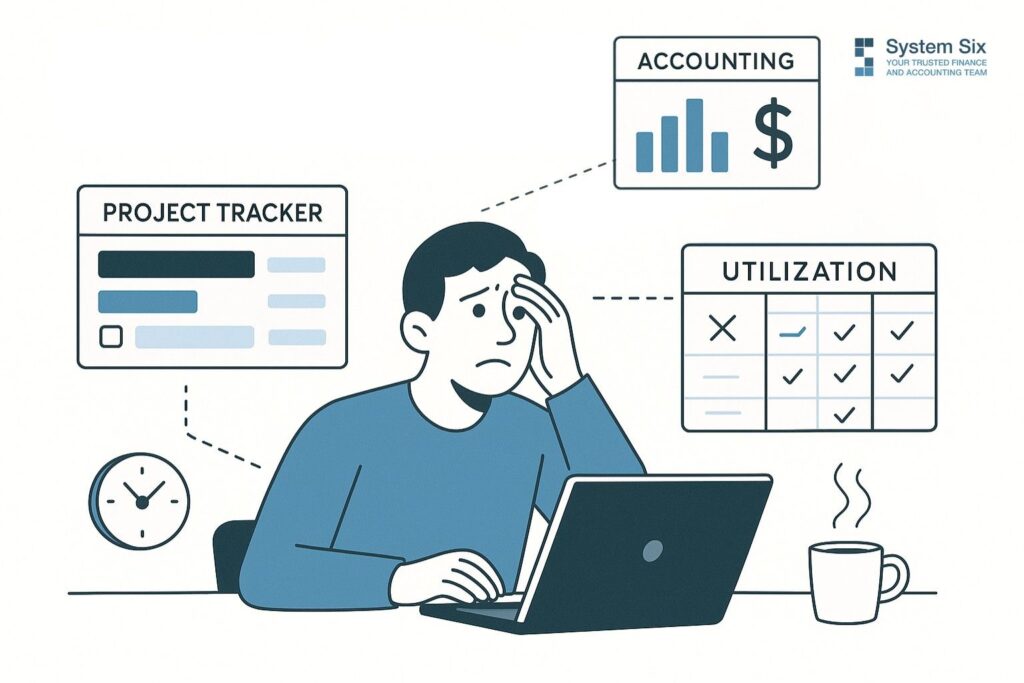
Let me paint you a familiar picture. Monday morning arrives, and you need to decide on that new project proposal. You pull up three different spreadsheets. The project tracker says one thing. The accounting export says another. And that utilization report from two weeks ago? It might as well be written in ancient Sumerian.
You spend the next hour trying to reconcile the numbers, jumping between tabs like you’re conducting some bizarre digital orchestra. By the time you piece together something resembling clarity, your first client call is starting. The decision gets punted to next week.
Sound familiar?
“Before implementing structured financial reporting, we were essentially guessing about which projects and clients were profitable,” admits Chris, founder of a healthcare consulting practice. “We’d celebrate landing big clients without understanding if they contributed to our bottom line.”
This isn’t just frustrating—it’s expensive. Every delayed decision is a missed opportunity. Every reactive scramble costs more than proactive planning. And the stress? That’s the hidden tax you pay every single day.
But what if you could see your entire financial picture in 30 seconds? What if those scattered spreadsheets transformed into a single source of truth?
The Essential Dashboard Elements: Your Financial Control Centre
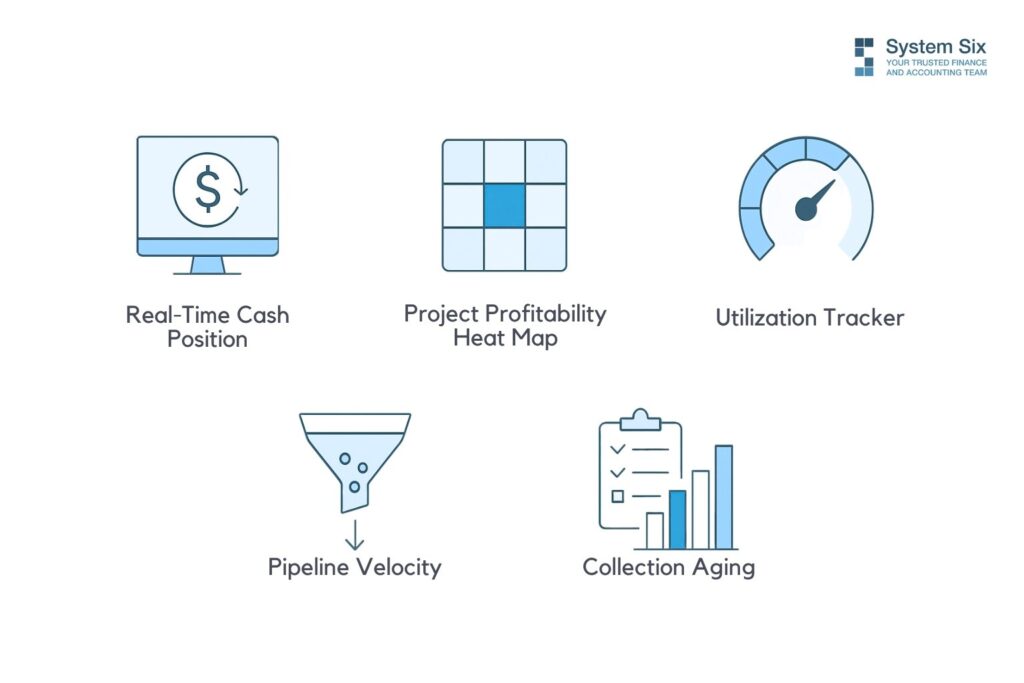
Think of your dashboard like an aeroplane cockpit. You wouldn’t fly through clouds without instruments, yet that’s exactly how most consultants run their businesses—on gut feel and good intentions.
Your financial dashboard needs five essential instruments to keep you flying straight:
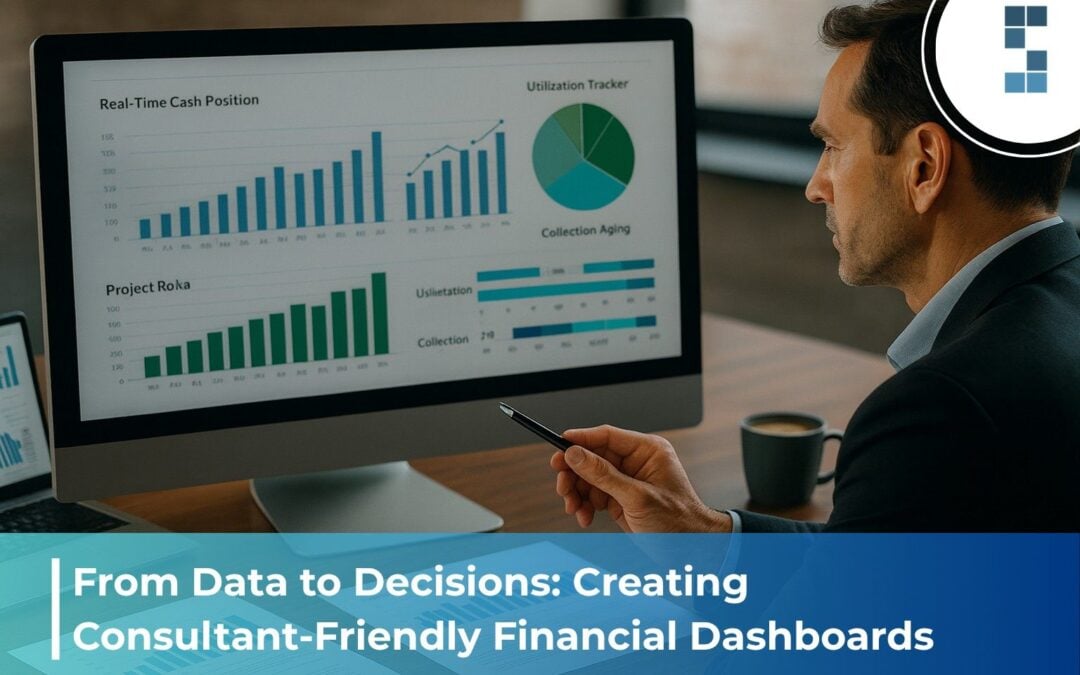
Real-Time Cash Position
This isn’t your bank balance. It’s your true available cash after accounting for upcoming payables, pending receivables, and that payroll hitting next week. One consultant told me this single metric helped them sleep through the night for the first time in months. Know if you can make that hire today, not after three hours of spreadsheet archaeology.
Project Profitability Heat Map
Picture this: Every active project displayed as a colored tile—deep green for your profit champions, yellow for break-evens, red for the silent killers. “We discovered our mid-sized projects were more profitable than our largest engagements,” one System Six client notes. “The large projects carried hidden costs in coordination time and scope management that weren’t properly billed.”
Utilization Tracker
Your team’s time is your inventory, but unlike widgets in a warehouse, you can’t see it stacking up. This metric shows you exactly where capacity sits—who’s overwhelmed, who’s underutilized, and whether you need to hire or hustle for more projects. Track billable hours against available hours, and suddenly, those resource allocation decisions become crystal clear.
Pipeline Velocity
From the payment proposal, see how fast opportunities move through your funnel. This isn’t just about sales—it’s about cash flow prediction. When you know your average collection period is 47 days, not the 30 you assumed, you can plan accordingly.
Collection Aging
Those outstanding invoices aren’t just numbers; they’re your business’s oxygen supply. Visual aging buckets show you at a glance what needs attention today versus what’s flowing normally.
Here’s what matters: utilization rate (billable hours divided by available hours), realization rate (what you bill versus what you could bill at standard rates), and that critical collection period. Get these three right, and everything else falls into place.
Building Your Dashboard: From Chaos to Clarity
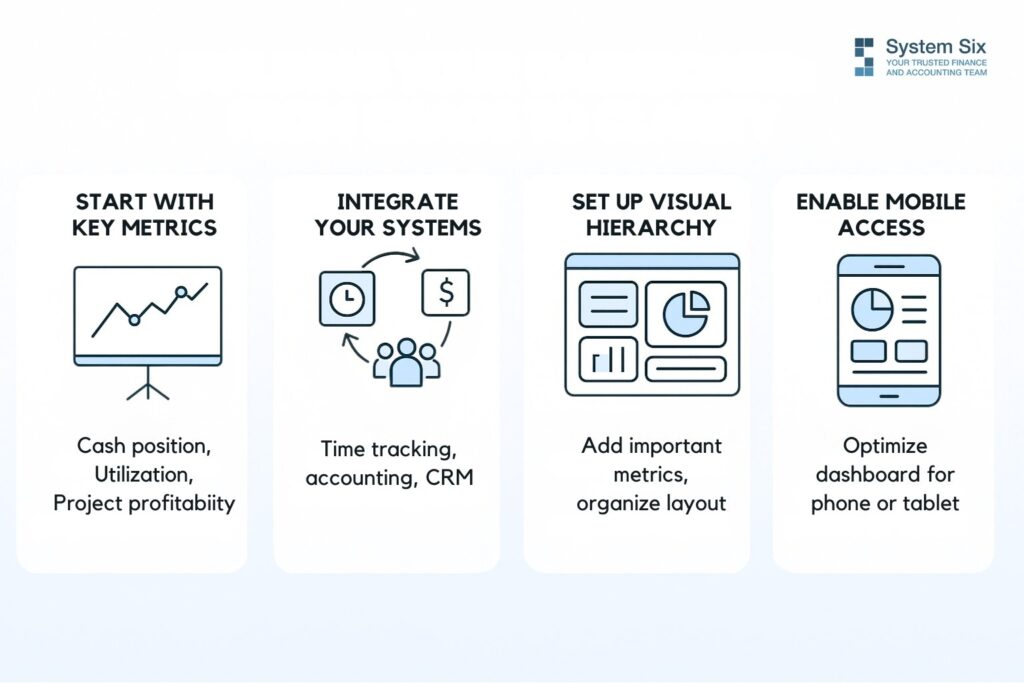
You don’t need to boil the ocean here. Start simple. Pick three metrics that keep you awake at night. For most consultants, that’s cash position, utilization, and project profitability.
Integration is everything. Your time tracking needs to talk to your accounting system. Your CRM should shake hands with your project management tool. Sounds complex? It’s not. Modern tools connect like Lego blocks—you just need to know which pieces fit together.
“Our financial reporting used to take 3-4 days each month,” shares a consulting firm owner who partnered with System Six. “Now it’s largely automated, providing real-time insights through dashboards we can check anytime.”
Think about that. Three to four days. Every month. That’s basically a full work week every quarter spent just figuring out where you stand. What could you do with that time back?
The visual hierarchy matters more than you’d think. Your most critical metrics—usually cash and utilization—should hit you immediately when you open the dashboard. Secondary metrics can live one click away. And those detailed reports you check quarterly? They can stay in the basement.
Don’t forget mobile accessibility. You’re checking this between client meetings, in the airport lounge, maybe even during that boring conference call (we won’t tell). If it doesn’t work on your phone, it doesn’t work.
The Transformation: Real Results from Real Firms
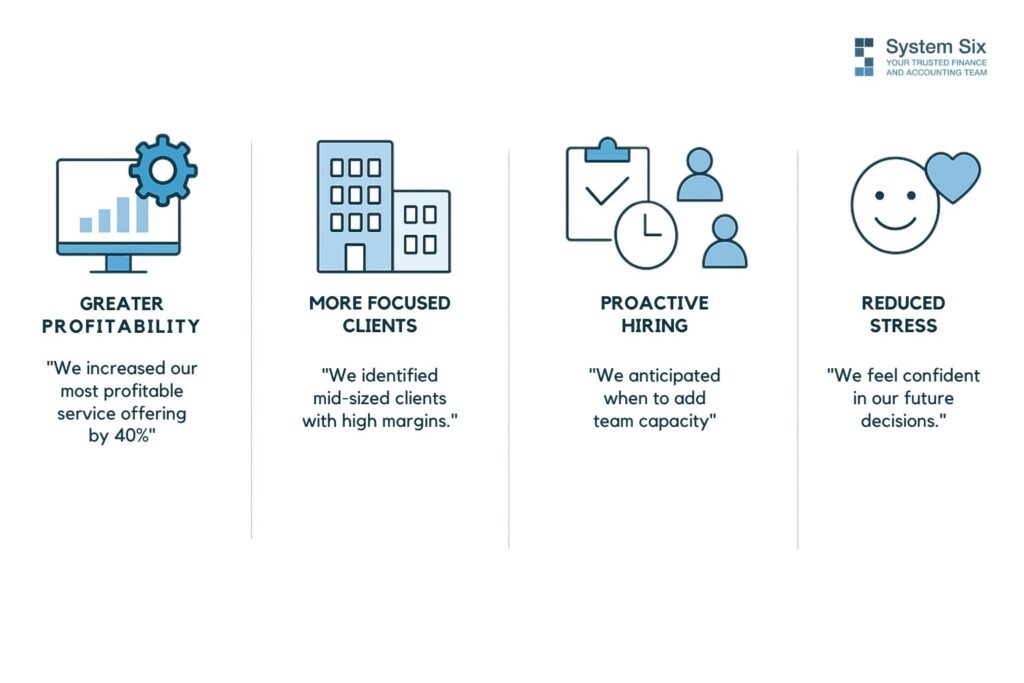
Let’s talk about Jamie, an IT consultant who thought technology implementation was her bread and butter. Her dashboard revealed something shocking: “We realized our technology implementation services were far more profitable than our strategic assessments. We reorganized our marketing to emphasize implementation, growing that service line by 40% within six months.”
Forty percent growth. Not from working harder, but from working smarter.
Or consider this healthcare consulting practice that discovered its sweet spot wasn’t where it expected. Those prestigious enterprise clients? Barely profitable after factoring in partner time and scope creep. But their mid-sized clients? Gold mines of efficiency and profit.
One System Six client transformed their entire hiring strategy: “Instead of reactive hiring when we’re already drowning in work, we now can see three months ahead when we’ll need additional capacity in specific practice areas.”
Imagine that—hiring before you’re desperate. Revolutionary concept, right?
But here’s my favorite testimonial, because it gets to what really matters: “Good financial reporting didn’t just improve our profitability—it reduced our stress. Instead of lying awake wondering if we’re making the right decisions, we now know where we stand and where we’re headed.”
That’s not just about numbers. That’s about life.
Your Next 30 Days
Here’s your challenge: Track how much time you spend this week gathering financial information versus actually analyzing it. I’m betting it’s a 90/10 split. Gathering, reconciling, checking, cross-referencing—all that busy work that feels productive but isn’t.
What if you flipped that ratio?
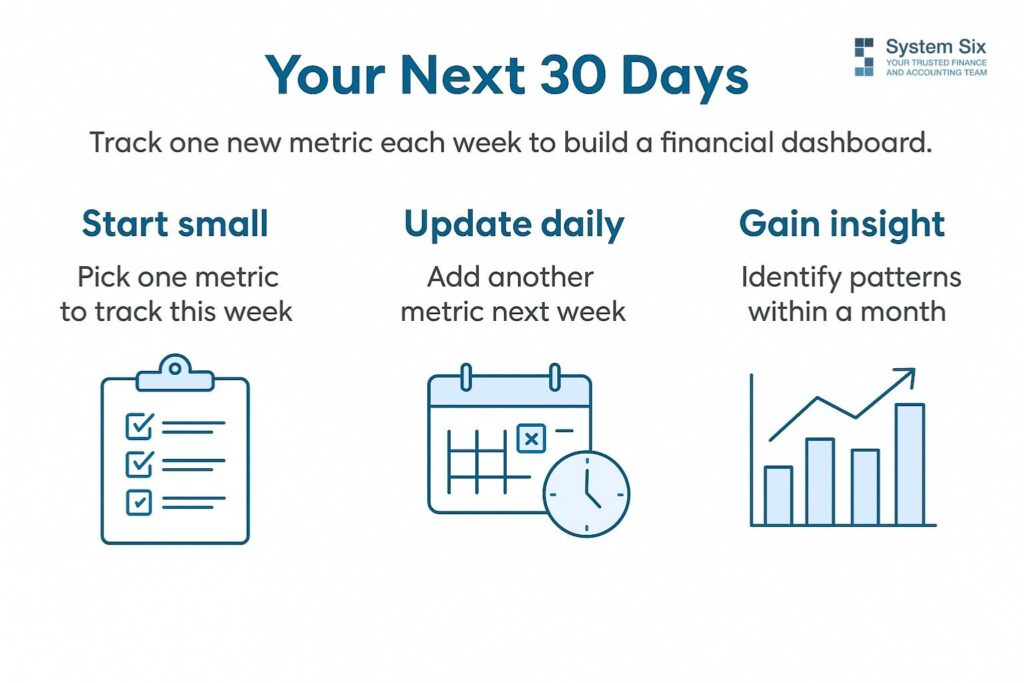
Start small. This week, pick one metric. Just one. Maybe it’s utilization. Set up a simple tracker—even a spreadsheet works to start. Update it daily. By Friday, you’ll see patterns you’ve been missing for years.
Next week, add cash position. The week after, project profitability. Within a month, you’ll have the foundation of a dashboard that actually serves you instead of the other way around.
The compound effect of daily visibility is remarkable. You start catching issues while they’re still pebbles, not boulders. You spot opportunities while they’re still available, not after they’ve passed. And those 3 AM anxiety sessions? They become 3 AM deep sleeps.
Every minute you spend staring at spreadsheets, trying to decode your business’s financial story, is a minute not spent serving clients or growing your firm. What could you accomplish with that time back?
Your data is trying to tell you something. Maybe it’s time you gave it a voice.
Ready to transform your financial chaos into clarity? The dashboard you need isn’t as far away as you think. Sometimes the first step is just admitting that what you’re doing now isn’t working. And that’s okay. Every successful consultant has been exactly where you are. The difference? They decided to do something about it.
About System Six
System Six is a Seattle-based bookkeeping and financial services firm that helps small and mid-sized businesses streamline their financial operations. We specialize in providing technology-driven financial management solutions for consulting firms, allowing owners to focus on growing their businesses without worrying about cash flow, payroll, or compliance issues. Our team of over 35 professionals brings an average of 10+ years of accounting experience to every client relationship, serving more than 175 businesses across the U.S. From accurate bookkeeping to cash flow forecasting, we deliver the financial clarity and peace of mind that consulting firm owners need to thrive. Learn more at www.systemsix.com.