Marcus checks his phone during a client meeting break, and his stomach tightens. Three overdue invoice reminders from contractors. Two urgent messages from his office manager about payroll. An email from his biggest client requesting a project timeline extension—with payment terms to match. He’s running a $3 million business, but his financial systems still operate like he’s a $500K startup.
Sound familiar?
QuickBooks was perfect when you started. Simple, affordable, and got the job done. But somewhere between $1M and $5M in revenue, something shifted. The tool that once simplified your finances now feels like it’s holding you back. You’re spending weekends updating spreadsheets and making guesses about cash flow and avoiding growth opportunities because you can’t confidently answer basic questions about your financial capacity.
Here’s the thing: your growth has outpaced your financial infrastructure. And there are clear, unmistakable signs when it’s time to scale beyond entry-level software. Making the switch isn’t just about fancier tools—it’s about reclaiming your time and gaining the visibility to scale confidently.
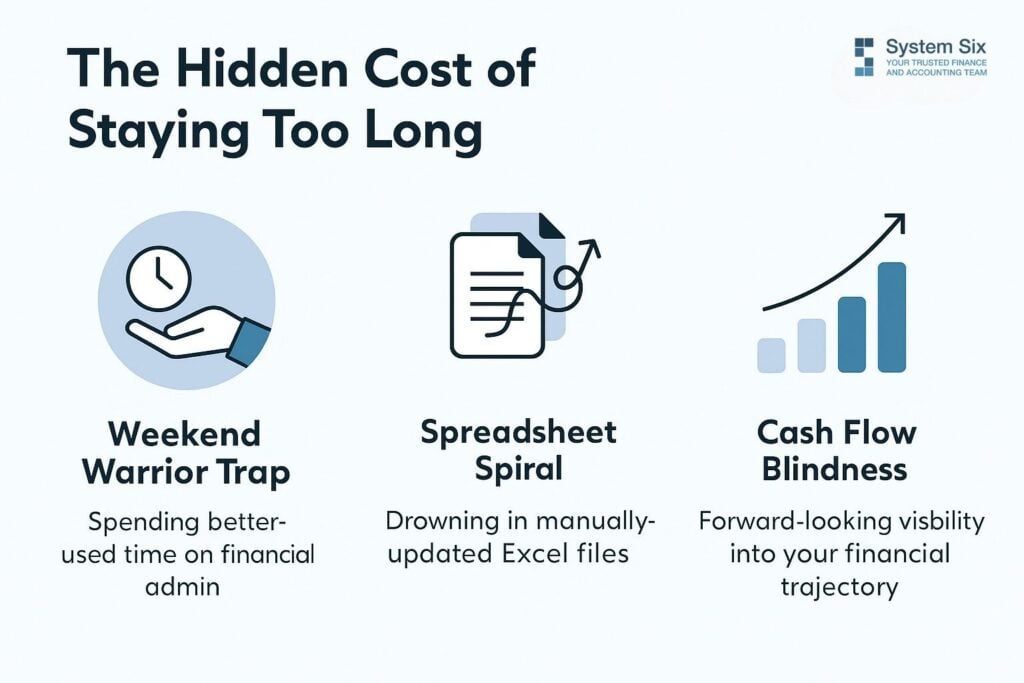
The Hidden Cost of Staying Too Long
What most business owners don’t realize is that outgrowing your system costs you in ways that don’t show up on any report.
The Weekend Warrior Trap
You’re spending 15-20 hours monthly on financial tasks—reconciling accounts, chasing receipts, updating tracking spreadsheets. At your typical billing rate, that’s $3,000 to $5,000 in lost revenue every single month. But it’s worse than that. It’s the opportunity cost of not spending that time on strategy, business development, or simply having a life outside work.
One environmental consulting firm owner told us, “I started this business to solve complex environmental challenges, not to become an amateur accountant working weekends.” She’d grown from 5 to 25 employees in 18 months. Revenue was climbing. But she was drowning in financial administration that had nothing to do with her actual expertise.
The Spreadsheet Spiral
It starts innocently enough. QuickBooks handles your basic bookkeeping, but you need cash flow projections. So you create one spreadsheet. Then you need project profitability tracking—another spreadsheet. Budget variance analysis? Spreadsheet number three. Before you know it, you’re maintaining five or six interconnected Excel files that require manual data entry, constant reconciliation, and elaborate version control.
Vincent, who runs a consulting company in Bellevue, described this exact problem. His team spent hours each week copying data between systems, always worried they were working with outdated information. After implementing an integrated solution, he noted how they finally had “a customized tool that fits our current and growing needs” instead of duct-taped spreadsheets held together with hope.
Cash Flow Blindness
You can’t predict cash crunches until they hit. Every hiring decision feels like a gamble. Should you invest in that new technology? Expand into a new market? You’re making these decisions with gut instinct instead of data because your current system can’t give you forward-looking visibility.
A home services company founder described this transformation after implementing proper forecasting: “We went from hoping we’d make payroll to confidently planning our next five hires.” That’s the difference between reactive panic and a proactive strategy.
So how do you know when you’ve crossed the line from “manageable” to “actively holding us back”?
Seven Unmistakable Signs You’ve Outgrown QuickBooks
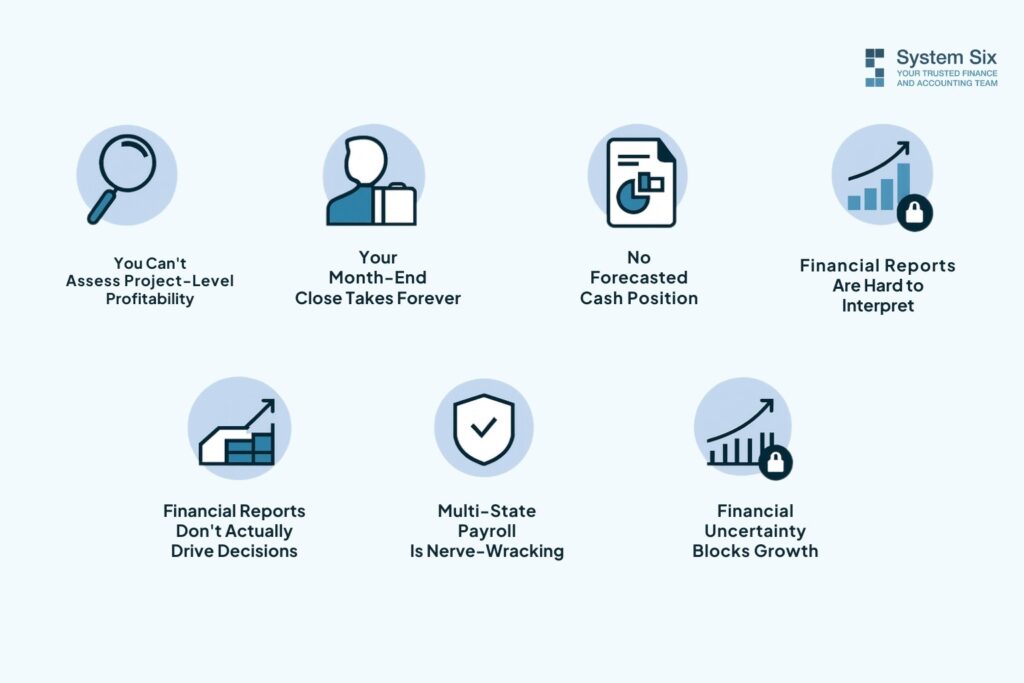
Sign #1: You Can’t Answer “Are We Profitable?” by Client or Project
Sure, QuickBooks shows your overall profit and loss. But which clients actually make you money? Which projects drain resources? Which service lines should you double down on, and which should you quietly phase out?
Growing businesses need project-level profitability tracking. Without it, you’re scaling the wrong things. You might be pouring resources into clients that look profitable on the surface, but eat up disproportionate time and support. Meanwhile, your most efficient, high-margin work gets neglected because you can’t see the difference.
Sign #2: Month-End Close Takes a Week (Or Longer)
Still manually categorizing transactions? Chasing down receipts? Reconciling accounts line by line?
Modern systems automate 95%+ of transaction categorization through AI and rules-based logic. One client reported a 40% improvement in financial reporting accuracy after automating these processes. But more importantly, they got their evenings and weekends back.
If closing your books feels like preparing for an audit every single month, you’ve outgrown your current system.
Sign #3: Your Accountant Dreads Your Books
Pay attention to your CPA’s reactions. If they’re spending hours cleaning up your books before they can even start on taxes, that’s a red flag. You’re paying them premium rates to do work that automation should handle.
Multiple business owners told us that after upgrading their systems, their accountants actually thanked them. The books arrived organized, accurate, and audit-ready. Tax preparation time dropped by half in some cases.
Sign #4: You Have No Idea What Cash Position Will Look Like in 90 Days
Revenue is growing, but cash feels unpredictable. You can’t confidently model hiring decisions or major purchases. You’re constantly surprised—sometimes pleasantly, often not—by your actual cash position.
Alecia, a Seattle business owner, described the moment this changed for her: “I had tears come to my eyes as I was able to see projected cash flow integrated with realtime QuickBooks.” That’s not being overly emotional. That’s the relief of finally having visibility into the future instead of constantly reacting to the present.
Sign #5: Financial Reports Don’t Actually Drive Decisions
You generate reports because you’re supposed to. They sit in your inbox. Maybe you glance at them. But they don’t actually inform your strategy because there’s too much noise and not enough insight.
There’s a massive gap between “having numbers” and “understanding your business.” Entry-level software gives you the former. Strategic financial infrastructure gives you the latter.
Sign #6: Multi-State Payroll Makes You Anxious
You’re hiring talent across state lines. Each state has different requirements for unemployment insurance, workers’ compensation, and employment law. QuickBooks was built for simpler scenarios. You’re now spending time researching compliance requirements instead of running your business.
And the stakes are high. Get it wrong and you’re facing penalties, back taxes, and potential legal issues.
Sign #7: You’re Avoiding Growth Opportunities Due to Financial Uncertainty
This is the most insidious sign. You can’t confidently say yes to expansion because you don’t know if you can afford it. That key hire you need? You’re not sure. Opening a second location? Too risky without better visibility. Taking on a major client that could transform your business? The cash flow implications scare you.
You’re experiencing growth paralysis, not because the opportunities aren’t there, but because your financial systems can’t give you the confidence to act. One home services company saw 60% revenue growth after implementing proper financial visibility—not because they suddenly worked harder, but because they could finally see which growth moves made sense.
What Scaling Your Finance Stack Actually Means
Scaling your finance stack isn’t about switching from one software to another. It’s about transforming your entire approach to financial operations.
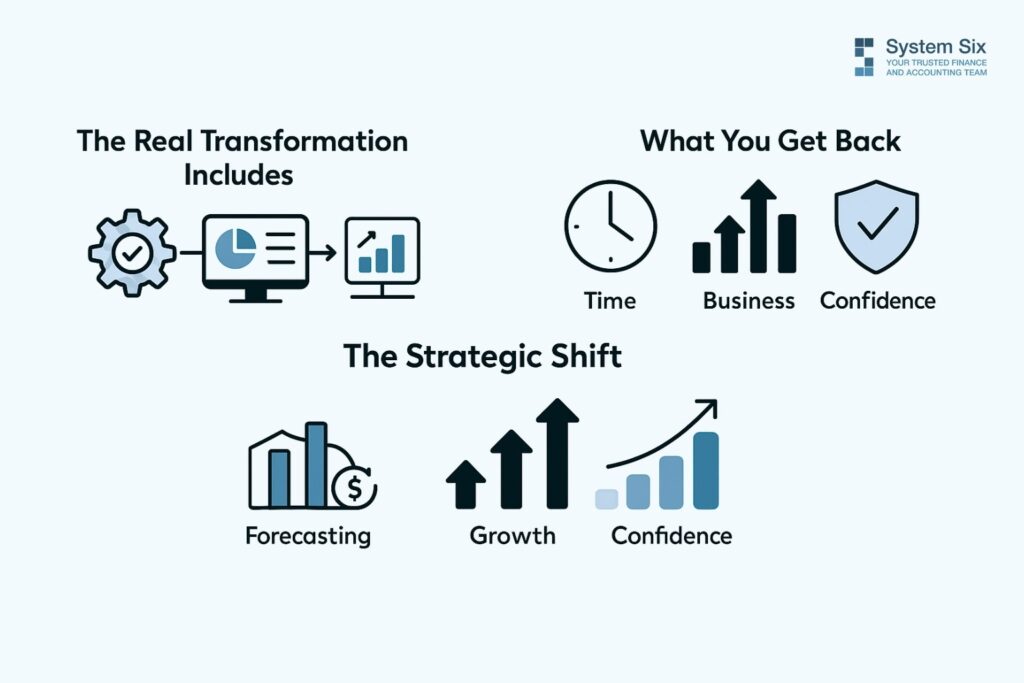
The Real Transformation Includes:
Automated workflows that eliminate manual data entry. Realtime dashboards you can access from anywhere. Integration with your other business systems—CRM, project management, time tracking—so data flows automatically. Cash flow forecasting that actually works —12 months out, based on your payment cycles and seasonal patterns. Project and client profitability tracking that shows you where you’re really making money.
What You Get Back:
Those 15-20 hours monthly. That’s half a work week you can redeploy to revenue-generating activities. But over time, you get confidence. Confidence to make hiring decisions. Confidence to pursue growth opportunities. Confidence to sleep at night knowing you understand your financial position.
Manish, who runs a business in Bellevue, described it as the difference between bookkeeping and strategic analysis. His previous approach gave him numbers. The new system gave him insights that, in his words, became “a game-changer” for how he runs his business.
The Strategic Shift:
You move from reactive to proactive. Instead of asking “What happened last month?” you’re asking “What should we do next quarter?” You stop drowning in data and start having actionable insights.
Marcus, an acquisition entrepreneur, appreciated having a team that was “inquisitive, asks follow-on questions, and looks around corners.” That’s what proper financial infrastructure enables—not just recording what happened, but understanding what it means and what comes next.
The numbers back this up. Businesses that make this transition see 90%+ retention—they don’t revert to DIY approaches. They report average annual time savings of $100,000+. Client satisfaction scores average 9.5 out of 10.
The Cost of Waiting
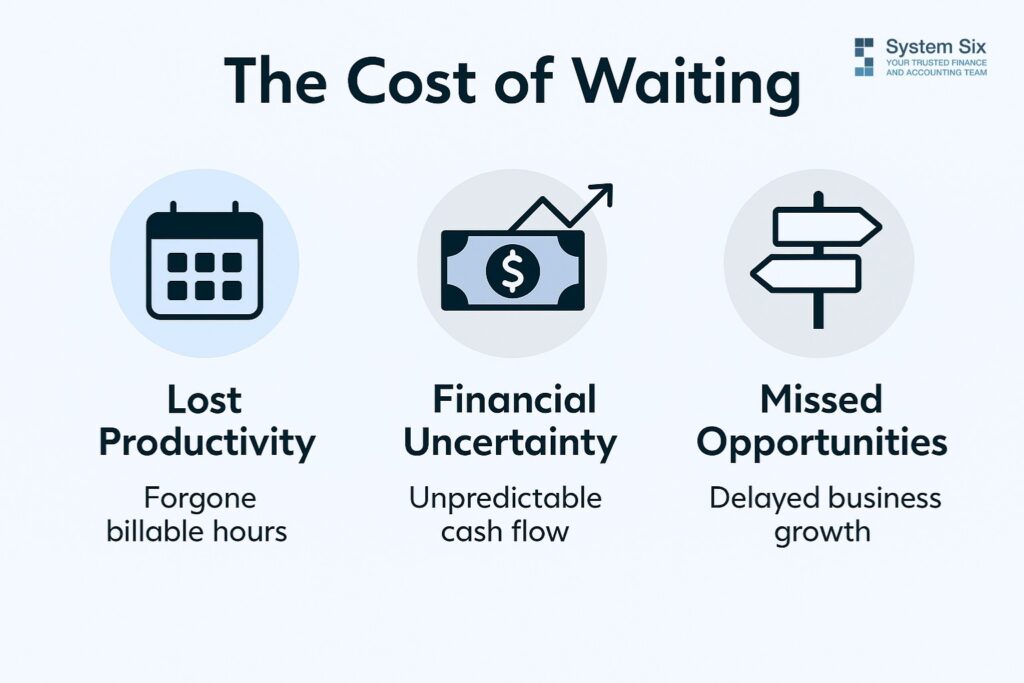
Every month you delay is another month of lost billable hours. Another month of stressful cash flow surprises. Another month of making growth decisions essentially blind.
Let’s be honest about what this costs you. Not just money, though that’s significant. It costs you peace of mind. It costs you strategic opportunities. It costs you the ability to scale at the pace your market demands.
Imagine knowing your cash position 12 months out. Picture making hiring decisions with actual confidence. Consider what you could do with 20 extra hours every month—time you’re currently spending on tasks that could be automated.
Paul, an acquisition entrepreneur, said that hiring professional help “was the best decision I made at the start of the business.” He wished he’d done it sooner. Most business owners say the same thing—not that they made the switch, but that they didn’t do it earlier.
You wouldn’t ask a startup founder to run enterprise operations with the resources of a startup. Why are you asking startup-level software to handle your growing business?
The question isn’t whether to scale your finance stack; it’s how to do so. It’s whether you can afford not to.
About System Six
System Six is a Seattle-based bookkeeping and financial services firm that helps small and mid-sized businesses streamline their financial operations. We specialize in providing technology-driven financial management solutions for consulting firms, allowing owners to focus on growing their businesses without worrying about cash flow, payroll, or compliance issues. Our team of over 35 professionals brings an average of 10+ years of accounting experience to every client relationship, serving more than 175 businesses across the U.S. From accurate bookkeeping to cash flow forecasting, we deliver the financial clarity and peace of mind that consulting firm owners need to thrive. Learn more at www.systemsix.com.