Every buyer heading into diligence faces the same scoping decision, usually with an exclusivity clock already running: how much quality of earnings work does this deal actually need? Buy too little and you close on numbers nobody tested. Buy too much and you burn five figures and three weeks on schedules your deal never required.
The industry’s name for the smaller product is a red-flag QoE. We call ours QoE Lite, because the name describes what it is: the same rigor, concentrated on the questions that kill deals, without the full analytical build-out. Having bought three companies myself, I have used both scopes, and the right answer is almost always obvious once you look at the deal honestly. Here is how to look.
What a QoE Lite covers
QoE Lite concentrates on the kill-shot questions. Does cash tie out, meaning can reported earnings actually be traced to bank activity? Are the major add-backs real, or does adjusted EBITDA collapse under the replacement test? Is there a customer concentration or revenue-quality problem severe enough to walk away from? And what does a simple working capital analysis say about the cash the business actually needs to run?
That last item matters more than most buyers expect. Even a Lite engagement should tell you enough about working capital to avoid the post-close cash crunch that quietly wrecks buyers who did everything else right.
What QoE Lite deliberately skips: the complete debt-like items schedule, detailed revenue cohorts, the full trailing-twelve-month working capital build that supports a negotiated NWC peg, and dollar-quantification of every secondary finding. Those omissions are the price of speed and the lower fee, and on many smaller deals they are omissions you can live with.
What full scope adds
Full scope is the complete anatomy: the line-by-line EBITDA bridge, revenue cohorts and retention, the working capital analysis that sets a defensible peg, a dollar-quantified debt-like items inventory, and findings packaged so a lender’s credit committee or an investment committee can rely on them without re-work.
The practical difference shows up in negotiation. QoE Lite tells you whether to proceed. Full scope arms you to reprice: every finding sized in dollars, every schedule ready to hand across the table when the seller’s accountant pushes back. If diligence is going to move price or terms, full scope is what moves them.
Side by side
| What’s covered | QoE Lite | Full scope |
| Proof of cash (earnings tied to bank activity) | Yes | Yes |
| Major add-backs tested | Yes | Yes, complete adjustments schedule |
| Customer concentration & revenue quality | Top-level check | Detailed cohorts and retention analysis |
| Working capital | Simple analysis | Full TTM analysis supporting the NWC peg |
| Debt-like items inventory | Obvious items only | Complete schedule, dollar-quantified |
| Quantified findings for negotiation | Headline items | Every finding, sized in dollars |
| Lender / IC-ready schedules | Sometimes sufficient for SBA | Yes |
| Typical fee | $10,000–$20,000 | $25,000–$50,000 |
| Typical timeline | Inside 10 business days | 3–4 weeks |
Which one your deal needs
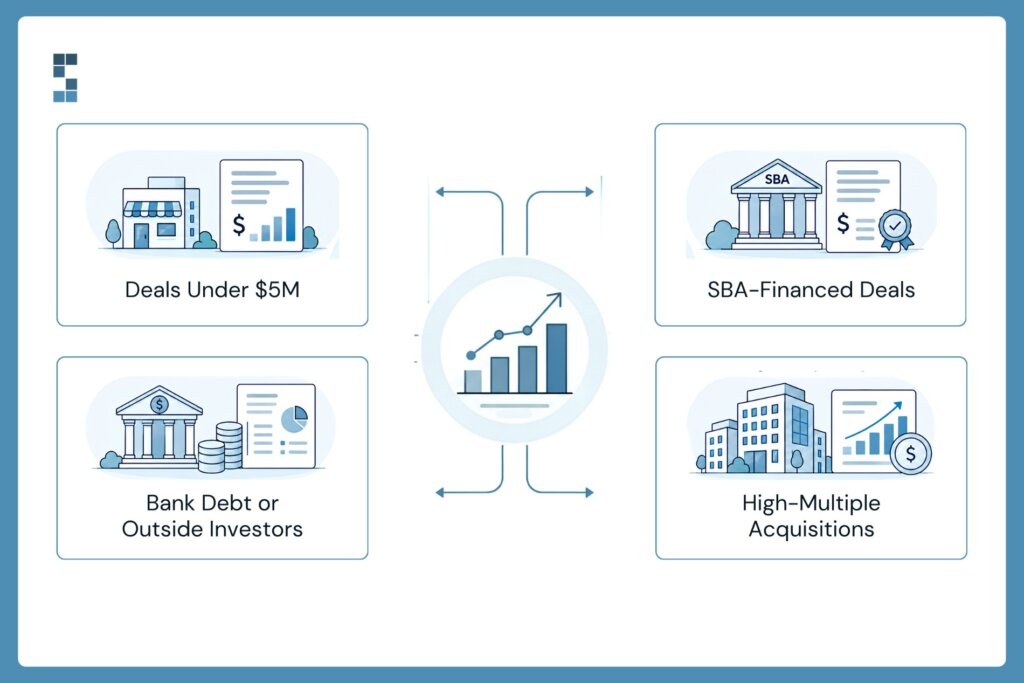
Deals under $5M: start with QoE Lite. At this size the books are usually simple enough that the kill-shot questions are most of the risk, and QoE Lite will work well for many deals. The exception is complexity out of proportion to size: multiple entities, deferred revenue, or heavy inventory push you toward full scope even on a small deal.
SBA-financed deals: often QoE Lite, confirm with your lender. Many SBA lenders accept a focused-scope report from a credible independent provider. Ask your lender what they require before you scope; it is a five-minute call that can save you $20,000.
Bank debt outside SBA, or outside capital: full scope is often where you will need to be. Senior lenders, private credit, and equity co-investors expect the complete schedules, and independent sponsors raising deal-by-deal need a report that travels to family offices. The trust-instrument job requires the full product.
Paying above a small-deal multiple: full scope. At 4–7x, every dollar of EBITDA that fails scrutiny is four to seven dollars of price. The bigger the multiple, the more expensive it is to skip the analysis that tests the number.
The upgrade path: the best of both
The pattern I recommend for cost-conscious buyers: start QoE Lite, with a pre-agreed upgrade path to full scope if the deal survives the first pass and is large enough to warrant it. If the Lite work surfaces a deal-killer, you spent $10,000–$20,000 to avoid a seven-figure mistake. If it comes back clean and the deal justifies it, you upgrade.
Good providers structure the engagement this way and credit the QoE Lite fee against the full-scope engagement, so the staged approach costs nothing extra. We scope this way deliberately. It puts the diligence spend where the deal risk actually is, and it means nobody pays for analysis their deal does not need.
Frequently asked questions
What is a red-flag quality of earnings?
A focused-scope QoE, which we call QoE Lite, concentrating on proof of cash, major add-backs, obvious risks, and a simple working capital analysis. It typically runs $10,000–$20,000 and lands inside ten business days.
Is QoE Lite enough for an SBA loan?
Often, yes. Many SBA lenders accept a focused-scope report from an independent provider, but requirements vary by lender. Confirm what yours requires before scoping the engagement.
Can I upgrade from QoE Lite to full scope mid-diligence?
Yes, and you should agree on the upgrade path before engaging. A good provider credits the Lite fee against full scope, so staging the work costs nothing extra.
What does each scope cost?
QoE Lite runs $10,000–$20,000 for deals under $5M. Full scope from a boutique firm runs $25,000–$50,000 for typical lower-middle-market deals. See our full pricing guide for what drives the ranges.
Scope it in one call
Send us the CIM or the seller’s P&L and a partner will tell you which scope your deal actually needs, as a fixed fee with a start date. If QoE Lite is the honest answer, that is what we will quote.
Get a fixed-fee QoE quote from System Six.