Here is the answer most firms make you sit through a sales call to get: for a typical lower-middle-market deal, a quality of earnings report costs $10,000 to $20,000 for a focused QoE Lite scope, and $25,000 to $50,000 for a full-scope engagement from a boutique firm. National and Big-4 firms start around $100,000. That is the whole market in one sentence.
The more useful questions are what drives where you land in those ranges, which scope your deal actually needs, and how to buy diligence without getting burned on either end of the price spectrum. I have paid for QoE reports three times as a buyer, first in private equity and then buying System Six and two add-on acquisitions, and I have strong opinions on all three questions.
QoE pricing at a glance
| Deal size | Right-sized scope | Typical fee | Notes |
| Under $5M purchase price | QoE Lite (focused scope) | $10,000–$20,000 | Proof of cash, major add-backs, obvious risks, simple working capital analysis |
| $5M–$25M | Full-scope QoE, boutique or regional firm | $25,000–$50,000 | Complete adjustments schedule, NWC peg support, debt-like items, quantified findings |
| Complex or multi-entity at any size | Full scope, expanded | Upper end of range | Deferred revenue, inventory, multiple entities, or messy books push fees up |
| Any LMM deal | National / Big-4 firm | $100,000+ | Frequently junior-delivered under a recognizable brand. You shouldn’t be spending this much. |
Treat these as planning numbers, not quotes. The honest answer for your specific deal depends on the factors below, which is why any provider worth hiring will scope before pricing.
What actually drives the price
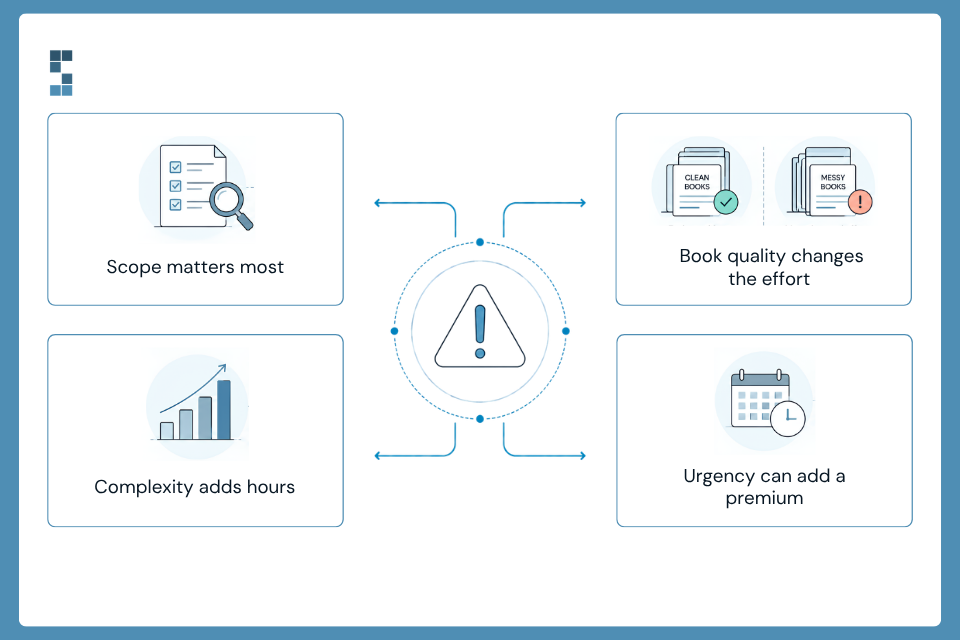
Scope. The biggest lever. A QoE Lite engagement concentrates on proof of cash, the major add-backs, and deal-killer risks and working capital analysis. Full scope adds the complete working capital analysis, debt-like items inventory, revenue cohorts, and quantified findings a lender or investment committee expects. Roughly speaking, full scope is twice the work, and the pricing reflects that.
The state of the books. Clean accrual books in QuickBooks Online price at the bottom of the range. Cash-basis books with commingled personal expenses, an inventory number nobody believes, or a bookkeeper who left last year price higher, because the team has to reconstruct reality before they can analyze it.
Complexity. Multiple entities, deferred revenue, percentage-of-completion accounting, heavy inventory, or franchise structures all add analysis hours. A $4M SaaS company with clean subscriptions can cost less to diligence than a $2M contractor with work-in-progress schedules.
Timeline pressure. A compressed exclusivity window sometimes carries a rush premium. The better fix is starting the data request the day the LOI is signed, which is free.
QoE Lite vs. full scope: matching spend to deal risk
For deals under roughly $5M, QoE Lite is often all you need: it answers the kill-shot questions, including whether cash ties out and whether the add-backs are real, plus a simple working capital analysis. QoE Lite will work well for many deals at this size.
Full scope is where you will often need to be if you are using bank debt outside SBA, raising outside capital, or paying anything above a small-deal multiple. The extra spend buys the schedules you negotiate the working capital peg with and the findings you take back to the seller when the numbers don’t hold.
The pattern I recommend for cost-conscious buyers: start QoE Lite with a pre-agreed upgrade path to full scope if the deal survives the first pass and the deal is large enough to warrant it. Good providers will credit the QoE Lite fee against the full-scope engagement. We structure it this way deliberately, because it puts the diligence spend where the deal risk actually is.
Fixed fee vs. hourly: always push for fixed
Two pricing structures exist in this market, and the difference matters more than the headline number.
Hourly billing puts both the cost risk and the timeline risk on you. Diligence on a messy company expands to fill whatever budget is available, and an open meter gives the provider no reason to be efficient inside your exclusivity window.
Fixed-fee pricing does the opposite: the provider absorbs the overrun risk, and the fee is known before you commit. A firm that has seen enough lower-middle-market books can scope fixed-fee with confidence after a short look at the financials. Reluctance to quote fixed is information about how well they know this market.
Get scope, fee, and start date in writing before you engage. You are buying certainty inside a 60–90 day window; a provider who won’t commit to any of the three is reserving the right to consume your deal clock.
The two ways buyers get burned
Buying too cheap. There are QoE services priced below $10,000, and my advice is to shy away from them. For many buyers this is the most important financial decision of your life, or at least top three alongside a marriage and a house. The cut-rate product is usually a template: no proof of cash, no working capital analysis, no one senior in the workpapers. Don’t skimp on the very work that may save you from blowing it all up.
Buying too much brand. At the other end, a $100,000+ engagement from a national firm buys a logo, and in the lower middle market the logo is rarely required. Lenders and investment committees care that the work is independent, rigorous, and legible. They do not price your loan off the letterhead. If someone is steering you toward a six-figure QoE on a $10M deal, ask exactly what the extra spend buys.
The math that makes the fee irrelevant
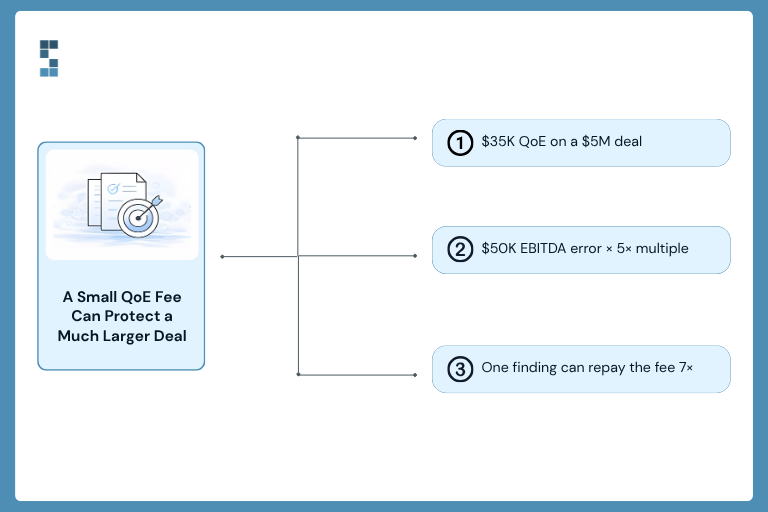
On a $5M deal at 5x EBITDA, a $35,000 full-scope QoE is 0.7% of purchase price. A single disallowed add-back of $50,000 in EBITDA moves the price by $250,000 at that multiple. One finding pays for the report seven times over, and it almost always finds something.
I have watched diligence findings reprice deals by full turns of EBITDA. Measured against what it protects, the QoE is the cheapest insurance in the entire transaction, including your legal spend. For the broader context, see our Quality of Earnings guide.
Who pays, and when
The buyer commissions and pays for a buy-side QoE, and the report is the buyer’s work product. Payment typically lands during exclusivity, after the LOI and before close. If the deal dies because of what the QoE finds, the fee was the best money you ever spent; that is the report doing its job.
Two softeners worth knowing: many SBA lenders allow diligence costs to be included in the loan’s use of proceeds, so the fee can effectively be financed at close. And if you are an independent sponsor or searcher, the QoE fee is a standard deal expense your capital partners expect to see in the budget.
Frequently asked questions
How much does a quality of earnings report cost?
Typically $10,000–$20,000 for a QoE Lite scope on deals under $5M, and $25,000–$50,000 for a full-scope report from a boutique firm on typical lower-middle-market deals. National firms start around $100,000.
Is a QoE priced fixed-fee or hourly?
Both exist in the market. Push for fixed-fee: it caps your cost, transfers overrun risk to the provider, and forces a real scoping conversation up front.
Is a QoE worth it on a small deal?
Yes, scoped correctly. A $10,000–$20,000 QoE Lite on a $2M deal is 0.5–1% of purchase price protecting the other 99%. Skipping diligence to save five figures on a seven-figure decision is a false economy.
Can the QoE cost be financed?
Often. Many SBA lenders permit diligence costs in the loan’s use of proceeds, and equity investors treat the QoE as a standard deal expense in the transaction budget.
Get a fixed-fee quote in one call
Send us the CIM or the seller’s P&L and we will come back with a recommended scope, a fixed fee, exactly who would do the work, and the earliest start date. If QoE Lite is all your deal needs, that is what we will quote.
Get a fixed-fee QoE quote from System Six.