Most explanations of a quality of earnings report are written by firms that sell them, for an audience they assume already knows the vocabulary. I came to this from the other direction. I spent years in private equity reading QoE reports, then spent a year as a searcher trying to buy a company with my own money on the line, and then actually bought one. I have been the person staring at a seller’s adjusted EBITDA wondering which add-backs were real, with an exclusivity window burning down and a lender asking for third-party validation. Three times now, since we’ve done two add-on acquisitions.
So this guide covers what a quality of earnings report actually is, what’s inside one, what it costs, how long it takes, and how to choose who does yours, written the way I wish someone had written it for me before my first deal.
What a quality of earnings report is (and is not)
A quality of earnings report, or QoE for short, is an independent analysis of a company’s financial performance, built for one purpose: a transaction. If you are asking what QoE means in finance, it is this: a third-party examination of whether the earnings a seller is showing you are real, recurring, and transferable to a new owner.
Those three words carry the whole engagement. Real means the revenue and expenses tie to cash or correct accrual concepts, not to optimistic bookkeeping. Recurring means the EBITDA you are paying a multiple on will keep showing up after close, rather than being propped up by one-time projects, a COVID bump, or a customer that just churned. Transferable means the earnings don’t walk out the door with the seller: they aren’t dependent on the owner’s relationships, below-market rent from a building the seller keeps, below-market wages or benefits, missing PTO accruals, and so on. Will the earnings the seller is showing you actually show up in Month 1?
A QoE is just as defined by what it is not. It is not an audit: no legal opinion is issued, and it does not certify GAAP compliance, but it will certainly look for inconsistencies. Just know it can’t catch everything. If you don’t trust your seller, don’t rely on your QoE to 100% protect you. It is not a valuation; it will not tell you what the business is worth, though it gives you the corrected earnings number you apply your multiple to. And it is not a guarantee; it is a diligence tool that converts “trust me” into schedules you can verify.
In the lower middle market, where most sellers have never had audited statements and the books are kept on a cash basis by a part-time bookkeeper, the QoE is usually the first time anyone has rigorously tested the numbers at all. That is exactly why buyers, lenders, and investors insist on it. And if anyone you are working with is not insisting on it, you may want to consider how good of a partner they really are.
QoE vs. audit vs. review: what’s actually different
This is the most common point of confusion, so let me be precise. An audit answers: do these historical financial statements fairly present the company’s position under GAAP? A review is a lighter version of the same question. A quality of earnings analysis answers a different question entirely: can you, the buyer, rely on these earnings to price and finance this deal?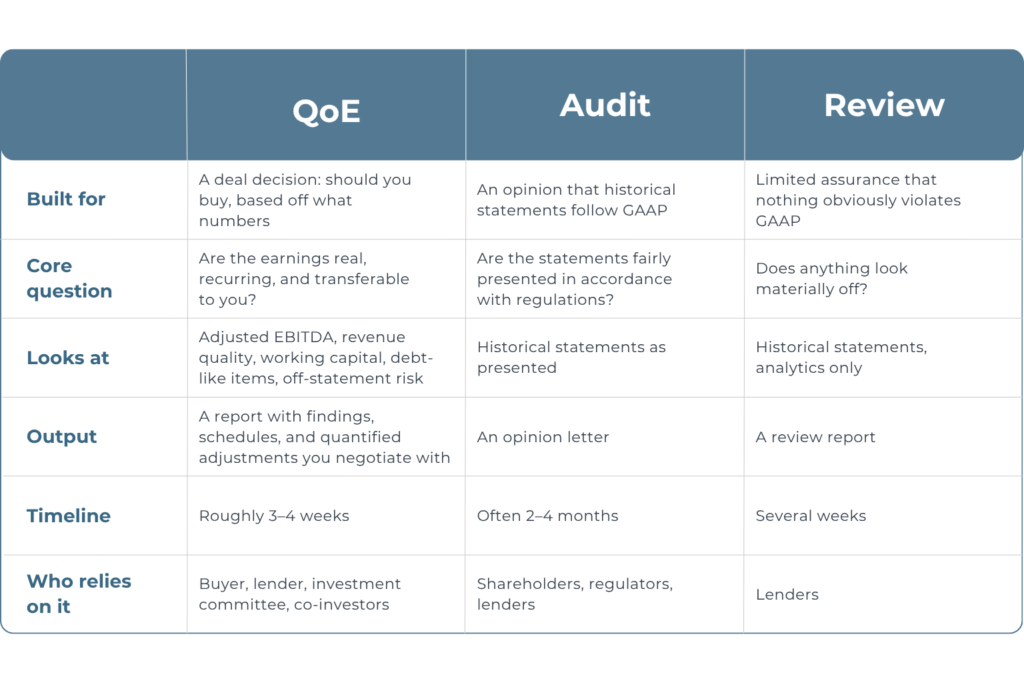 The practical implication: an audit can be clean and the deal can still be terrible. Audited statements can fairly present earnings that are entirely dependent on one customer, stuffed with owner expenses, or about to fall off a cliff. The QoE exists to catch precisely the things an audit is not designed to look for. If a seller tells you “we have audited financials, you don’t need a QoE,” that is a misunderstanding at best.
What’s inside a QoE report, section by section
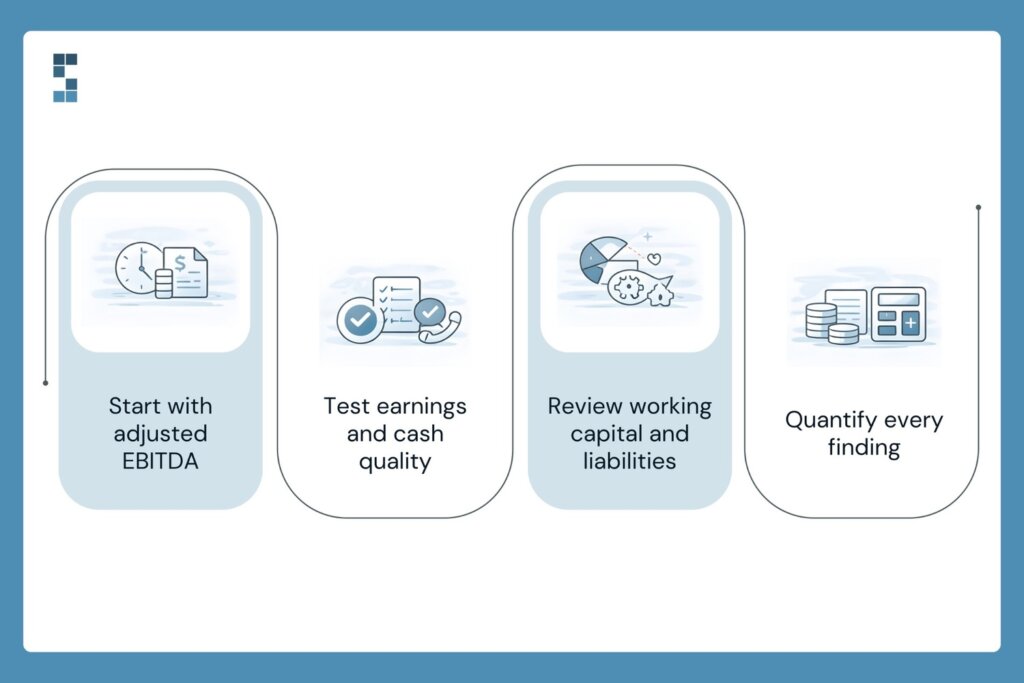
A good quality of earnings report follows a recognizable anatomy. Here is what each section does and why you should care about it.
Executive summary. The first two pages should lead with the answer: here is reported EBITDA, here is what we think true adjusted EBITDA is, here is the bridge between them, and here are the findings that should change how you think about price and terms. If a provider buries the conclusion on page 40, that tells you who the report was really written for.
The EBITDA bridge and adjustments schedule. This is the heart of the report: a line-by-line walk from reported EBITDA to adjusted EBITDA. Every seller’s add-back gets tested. Owner compensation is normalized to market rate, personal expenses run through the business get flagged, one-time legal or moving costs get isolated, and related-party rent gets marked to market. Some adjustments cut in your favor; plenty cut against the seller’s number. On a 4–7x multiple, every dollar of EBITDA that doesn’t survive scrutiny is four to seven dollars of purchase price.
Revenue quality and customer analysis. Recurring versus one-time revenue, customer concentration, cohort and retention trends, pricing versus volume growth. A company growing entirely through price increases on a shrinking customer base looks identical to a healthy grower on the P&L summary, and completely different here.
Proof of cash. The analysis ties reported revenue and earnings back to actual bank activity. For lower-middle-market companies with unaudited, cash-basis books, this is the single most important credibility test in the report. If earnings can’t be traced to the bank, nothing else in the data room matters.
Net working capital analysis. The report establishes what normal working capital looks like across the trailing twelve months, which becomes the basis for the NWC peg, the target that determines whether you get a credit or write another check at close. Buyers consistently underestimate this section; the peg quietly moves real dollars. I can’t overstate enough how important this is. I’ve seen too many buyers buy a decent business but then come to really struggle as they come into a cash crunch from oversights related to QoE.
Debt and debt-like items. Beyond the obvious bank debt: deferred revenue, unpaid payroll taxes, customer deposits, accrued PTO, pending sales-tax exposure. These are dollar-for-dollar price reductions hiding in the balance sheet, and sellers rarely volunteer them.
Findings and considerations. The issues that don’t fit a schedule: GAAP departures, related-party entanglements, off-balance-sheet liabilities, accounting changes that flatter the trend. Each finding should be quantified where possible; a finding without a dollar figure is an anecdote, not a negotiating position.
Who actually needs a quality of earnings report
The short answer: anyone buying a business with their own money or someone else’s, and anyone whose capital depends on the deal being what the seller says it is.
Buyers, from individual searchers to independent sponsors to funds. If you are acquiring a company in the lower middle market, the QoE is your primary defense against overpaying. You are typically buying unaudited books, and you are personally guaranteeing debt or investing the bulk of your net worth. I have watched findings from diligence reprice deals by full turns of EBITDA. The report pays for itself the first time it finds something, and it almost always finds something. The QoE often does double duty: it protects you, and it is the trust instrument that makes your deal credible to family offices and co-investors who weren’t in the room. An LP-ready report from a recognized provider travels with the deal.
Lenders. SBA lenders, senior lenders, and private credit funds increasingly require an independent QoE before committing financing, particularly when the borrower is a first-time buyer. The bank is underwriting the same earnings you are; they want third-party validation, not the seller’s spreadsheet.
Sellers, sometimes. Sell-side QoE exists. Owners commission one before going to market to find the problems first and defend their number. This guide is written for the buy side, but if you are a seller reading this: every issue covered here will be found eventually. Better that you find it.
What a quality of earnings report costs
Pricing follows scope, deal size, and the state of the seller’s books, but the market clusters into three tiers.
- Focused-scope QoE / QoE Lite: roughly $10,000–$20,000 for smaller deals (<$5M). A concentrated look at proof of cash, the major add-backs, and the obvious risks. Appropriate for smaller deals and first-pass screening. There are services below $10,000, but my advice is to shy away from those. This is for many the most important financial decision of your life, or Top 3 (marriage, house, business acquisition). Don’t skimp on the very work that may save you from blowing it all up.
- Full-scope QoE from a boutique or regional firm: roughly $25,000–$50,000 for typical lower-middle-market deals. The full anatomy described above, sized to the complexity of the business.
- National and Big-4 firms: $100,000+, with the work frequently performed by junior staff under a recognizable brand. For LMM deals, you are often paying for a logo your lender doesn’t actually require. You shouldn’t be spending this much.
Two pricing structures exist: fixed-fee and hourly. Push hard for fixed-fee. Diligence on a messy company expands to fill whatever budget is available, and an hourly engagement puts the timeline risk and the cost risk on you simultaneously. A provider who has seen enough LMM books can scope fixed-fee with confidence; reluctance to do so is information.
One more framing that matters: on a $5M deal at 5x, a $35,000 QoE is 0.7% of purchase price. A single disallowed add-back of $50,000 in EBITDA moves price by $250,000. The asymmetry is the whole argument.
How long a QoE takes
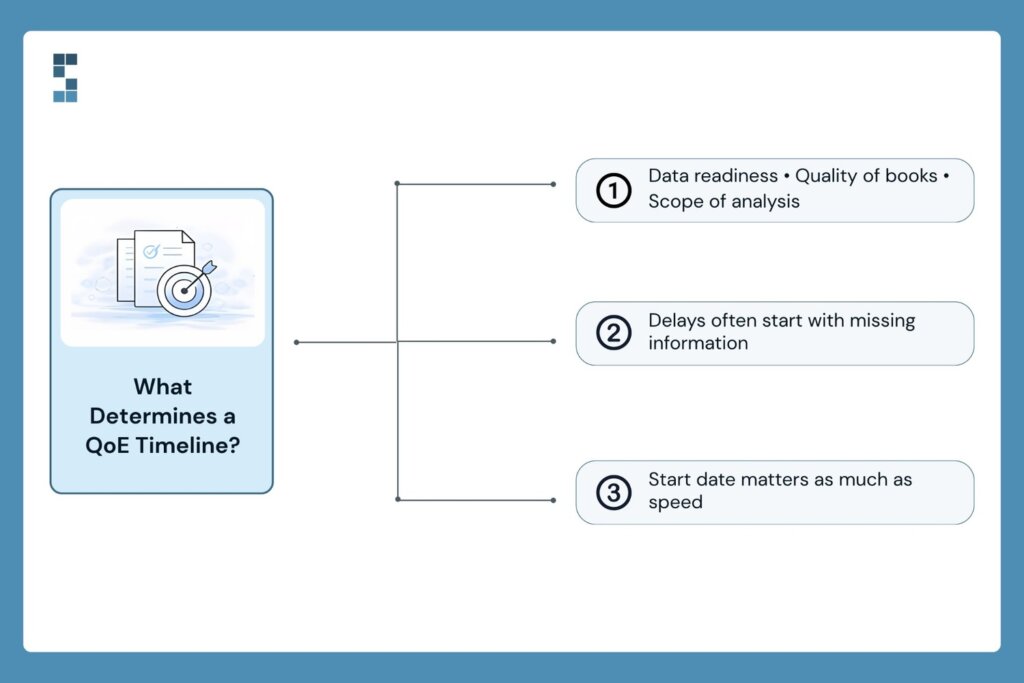
The honest range is three to four weeks from data delivery to draft report for a typical lower-middle-market deal, with three things driving where you land in that range.
First, data readiness. The clock starts when the seller delivers the day-one request list: financial statements, trial balances, bank statements, customer-level revenue, payroll detail. A seller who takes three weeks to produce bank statements adds three weeks to your timeline. Get the request list to the seller the day the LOI is signed. Make sure it’s only the most important things you request. Don’t kill the deal immediately with a massive, overwhelming diligence list.
Second, the state of the books. Clean accrual books in QuickBooks Online move fast. Cash-basis books with commingled personal expenses and an inventory number nobody believes move slower, because the team is reconstructing reality before they can analyze it.
Third, scope. A QoE Lite engagement can land inside ten business days; a full-scope analysis of a multi-entity company with deferred revenue takes the full month.
The reason timeline matters so much: most LOIs grant 60–90 days of exclusivity, and financing, legal, and confirmatory diligence all queue behind the QoE. A provider who quotes six to eight weeks because of staffing backlog is consuming your negotiating window. Ask about the start date, not just the duration. A fast team that can’t start for a month is slower than a steady one that starts Monday.
QoE Lite vs. full-scope: which one you actually need
A QoE Lite covers the kill-shot questions: does cash tie out, are the major add-backs real, is there a customer concentration or revenue-quality problem severe enough to walk away from, and some simple working capital analysis. It is the right tool when the deal is small, the books are simple, or you want a cheap early answer before committing to full diligence.
Full scope adds the complete working capital analysis, debt-like items inventory, detailed revenue cohorts, and quantified findings: the material you need to negotiate the peg, size an escrow, and satisfy a lender or investment committee. If you are using bank debt outside SBA, raising outside capital, or paying anything above a small-deal multiple, full scope is often where you will need to be.
A sensible pattern for cost-conscious buyers: start QoE Lite, with a pre-agreed upgrade path to full scope if the deal survives the first pass and if the deal is large enough. QoE Lite will work well for many deals.
Good providers will structure the engagement that way and credit the QoE Lite work against the full-scope fee. We scope this way deliberately. It puts the diligence spend where the deal risk actually is.
How to choose a QoE provider
Bookkeeping taught me that low barriers to entry produce enormous quality variance, and transaction diligence is no different. Six criteria separate providers who protect buyers from providers who produce shelf documents.
- Who does the work? The industry’s open secret is partner-sold, analyst-delivered: a partner wins the engagement and a rotating bench of juniors performs it. Ask exactly who will touch your deal, and whether the person in the sales call will be in the workpapers.
- Lower-middle-market fluency. A team calibrated on $500M companies will misread a $4M one, flagging normal owner-operator behavior as chaos while missing the actual LMM risks: payroll-tax exposure, related-party rent, cash revenue leakage.
- The sample-report test. Ask for a redacted sample before engaging. You are looking for an executive summary that leads with the answer, quantified findings, and schedules a lender can use. If the sample reads like a compliance document, your report will too.
- Defensibility under scrutiny. Your report will be attacked, by the seller’s accountant disputing adjustments and by your lender’s credit committee testing assumptions. Ask the provider how their adjustments have held up in retrades and whether lenders have accepted their reports without re-work.
- Fixed fee and a real timeline commitment. Scope, fee, and start date in writing. You are buying certainty inside an exclusivity window; a provider unwilling to commit to either is reserving the right to consume your deal clock.
- A relationship, not a transaction. The best diligence engagements are conversations: findings surfaced as they emerge, not detonated in a final readout. You want a partner who picks up the phone when the seller’s CFO says something odd on a Tuesday. This is the difference between white-glove diligence and a PDF.
Notice what is not on the list: brand prestige. In the lower middle market, lenders and investment committees care that the work is independent, rigorous, and legible, not that it carries a Big-4 logo and a Big-4 invoice.
Frequently asked questions
What is QoE in finance?
QoE stands for quality of earnings: an independent analysis, performed during M&A diligence, of whether a company’s reported earnings are accurate, sustainable, and transferable to a buyer. The deliverable is a quality of earnings report.
What does a quality of earnings report show?
A bridge from reported to adjusted EBITDA, tested add-backs, revenue and customer quality, proof that earnings tie to bank activity, normalized working capital, debt-like items, and quantified findings that affect price and deal terms.
Is a QoE the same as an audit?
No. An audit issues an opinion on whether historical statements follow GAAP. A QoE evaluates whether the earnings are real, recurring, and transferable for a transaction. Audited financials do not eliminate the need for a QoE.
How much does a quality of earnings report cost?
Typically $10,000–$20,000 for a QoE Lite scope and $25,000–$50,000 for full scope from a boutique firm in the lower middle market; national firms run substantially higher. Fixed-fee pricing is preferable to hourly.
How long does a QoE take?
Generally three to four weeks from receipt of complete data, depending on scope and the condition of the seller’s books. Seller responsiveness is the biggest variable.
Who pays for the QoE in an acquisition?
The party that commissions it. Buy-side QoE is paid by the buyer and is the buyer’s work product; sell-side QoE is commissioned and paid for by the seller before going to market.
Do lenders require a quality of earnings report?
Increasingly, yes: SBA lenders, senior lenders, and private credit funds commonly require an independent QoE as a condition of financing, especially for first-time buyers and deals above roughly $1M in EBITDA.
Talk to the people who will actually do the work
If you are heading into diligence, don’t start with a sales pitch. Start with the deal. Bring us the CIM or the seller’s P&L, and we will tell you what we see, what we would scope, exactly who would do the work, and what it would cost as a fixed fee. If a QoE Lite pass is all the deal needs, that is what we will recommend.
Book a diligence scoping call with System Six.
About System Six
System Six is a Seattle-based bookkeeping and financial services firm that helps small and mid-sized businesses streamline their financial operations. We specialize in providing technology-driven financial management solutions for consulting firms, enabling owners to focus on growing their businesses without worrying about cash flow, payroll, or compliance. Our team of over 40 professionals brings an average of 10+ years of accounting experience to every client relationship, serving more than 175 businesses across the U.S. With a 9.5/10 NPS score, we deliver the financial clarity and peace of mind that consulting firm owners need to thrive. Learn more at www.systemsix.com.