
by Chris Williams | Aug 11, 2025 | Blog
It’s Tuesday afternoon, and the finance lead at a growing consulting firm is toggling between five browser tabs. A project manager needs updated billables. The managing partner wants this quarter’s burn rate. A client just flagged a duplicate invoice. The numbers are there, somewhere, but pulling them together feels like solving a puzzle.
This isn’t about disorganization. It’s the natural outcome of scaling faster than your financial systems. What used to work for a lean team starts breaking down when headcount increases and client demands grow more complex.
Most firm owners don’t notice the shift right away. But it shows up in the form of late nights, missed hours, and stalled decisions. Your team can’t forecast with confidence. And the tools that once felt flexible now feel fragile.
If this sounds familiar, it might be time to take a closer look at your financial systems. Not just how they function, but whether they can keep up with where your business is headed.
1. You’re Still Relying on Spreadsheets for Core Financial Workflows
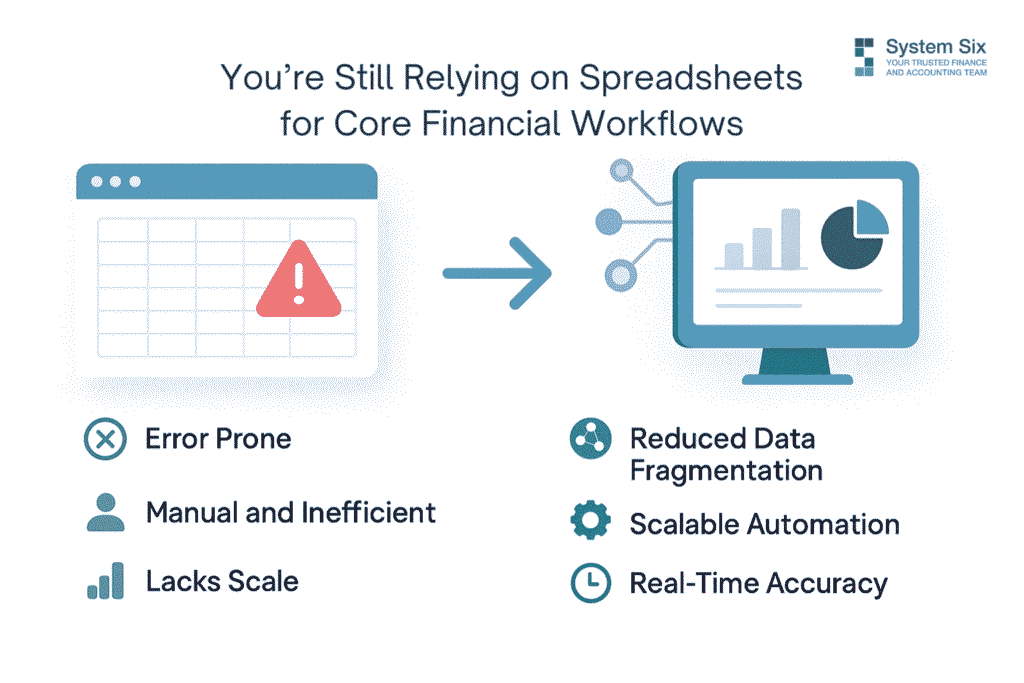
Spreadsheets often work well in the early stages. You can track expenses, create budgets, and monitor cash flow with enough customization to match your workflow. But as your consulting firm grows, those same spreadsheets start to limit visibility and delay decisions.
Every manual update increases the risk of error. A single misplaced formula or outdated data point can throw off forecasts, billing, and reporting. A study by PhysOrg found that nearly 94% of spreadsheets contain errors. When your financial systems rely on multiple linked spreadsheets, small mistakes tend to multiply.
Spreadsheets also slow things down. Data must be copied from one system to another before it becomes usable. You lose time double-checking numbers and chasing version control. This makes real-time insight almost impossible.
The more your business scales, the more touchpoints each financial process involves. One spreadsheet for client billing, another for cash flow, and a third for project profitability often means your team works harder to keep the numbers straight. That time could be spent on pricing strategies, margin analysis, or planning headcount.
Even when spreadsheets seem flexible, they cannot support the volume, complexity, or speed that scaling firms need. When financial accuracy depends on weekend maintenance or manual checks, the system has already outgrown its use.
Replace Manual Spreadsheets with Connected Financial Tools
Firms that grow without friction usually rely on systems that eliminate manual entry and reduce data fragmentation. When tools speak to each other, billing flows into forecasting, and expenses update reports in real time. This type of setup gives you a single source of truth that reflects the current state of your business.
Automation doesn’t mean giving up control. It means reducing the burden of repetitive updates so you can spend more time interpreting data instead of assembling it. Instead of reconciling spreadsheets before every meeting, you get financial reports that are already up to date.
Replacing spreadsheets with integrated systems also improves accuracy. Rules-based automation can categorize expenses, allocate billable hours, and flag inconsistencies long before they reach your clients or decision-makers. That clarity allows for faster approvals, cleaner audits, and stronger planning.
Firms that outgrow spreadsheets often need systems designed for scale. We help consulting firms move from spreadsheet-heavy workflows to connected tools that sync data across billing, forecasting, and reporting.
2. Billable Hours Are Falling Through the Cracks
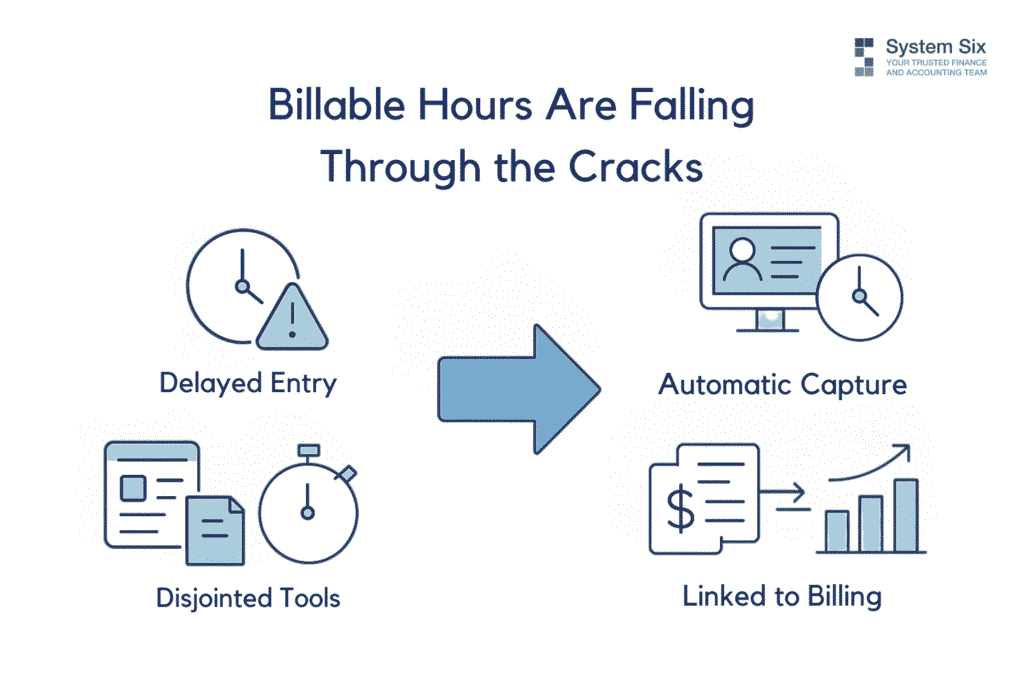
In a growing consulting firm, billable time often becomes harder to track. As projects scale and more team members contribute, hours slip through when time tracking depends on memory, manual logs, or disjointed tools.
Missed hours directly impact revenue. A study by ABA estimated that firms lose up to 50% of potential billables due to poor time tracking. That loss compounds when billing cycles rely on inconsistent inputs or when team members delay submitting time altogether.
When hours get recorded late, invoices go out slower. Revenue takes longer to reach your account. Over time, this delay affects your ability to forecast cash flow or reinvest in new work. Billing gaps can also erode client trust if invoices lack clear detail or include errors.
Firms often try to patch the process with spreadsheets or standalone trackers. But these tools rarely scale well. Hours get buried in email threads, inconsistent formats, or separate platforms. By the time everything is reviewed, your team has spent hours chasing data instead of doing billable work.
Stronger firms rely on integrated systems that simplify time capture and connect it directly to billing. Here’s what that looks like in practice:
- Time logs stay linked to client projects automatically. Team members enter hours within the same system used for project management or delivery. This ensures billable time is attached to the right client and task, without relying on memory or later clarification.
- Recorded hours flow directly into invoicing tools. When time entries sync with your billing system, you no longer need to copy and paste across tools or double-check spreadsheet formulas. Invoices can be prepared faster and reflect actual work completed.
- Systems flag gaps or low-entry days before invoices are sent. You get clear signals when a team member’s time log looks incomplete or falls short of expectations. This helps you catch missed hours early without having to audit manually.
- You gain better insight into profitability and planning. With cleaner time data, you can analyze how long projects actually take, spot clients with tighter margins, and make stronger decisions about pricing and staffing. That insight supports better resource allocation and long-term planning.
A system like this helps protect revenue without adding more administrative steps. It also frees your team to focus on project delivery instead of chasing down missing time.
Corporate cards that attach receipts to transactions in real time help ensure that project expenses align perfectly. This makes it easier to bill clients accurately and surface any missed costs before invoices go out.
3. Month-End Close Takes More Than a Week
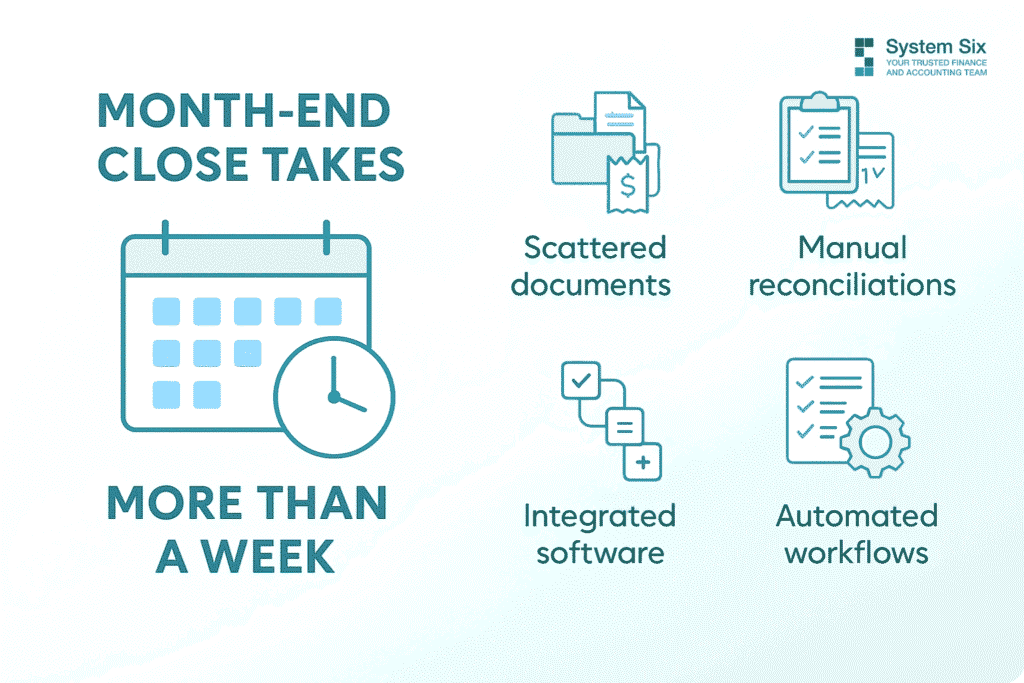
When your firm starts spending a full week or more closing the books, it usually points to deeper workflow problems. The delays often come from scattered data, manual reconciliations, and missing documentation. These bottlenecks grow worse as transaction volume increases or when multiple systems are not connected.
Every manual step adds risk. When receipts live in inboxes, invoices sit in drafts, or coding happens in bulk at the end of the month, the close process turns reactive. Errors creep in when teams rely on memory or rush through last-minute updates. Reviews take longer, and rework adds hours to every close.
Over time, a slow close limits financial visibility. Leadership decisions begin to lag behind actual performance. You lose the chance to correct course early or act on new opportunities while they are still relevant.
Build a Close Process That Runs in the Background
A faster close starts with structure. The goal is not to rush through the process but to spread the work evenly across the month. This means shifting from a reactive cycle to a continuous one where inputs, reviews, and reconciliations happen as the work gets done.
Integrated systems play a key role in making this possible. When your expense management, accounting software, and payroll tools talk to each other, you no longer depend on end-of-month scrambles to pull in data. Information flows in throughout the month and stays categorized from the start.
Rules-based automation supports consistency. Transactions get labeled the same way every time. Approvals follow the same path for every department. These steps reduce friction and make each close more predictable.
With the right setup, your month-end close becomes a reflection of how well your systems run, not a recurring fire drill that eats into every calendar cycle.
4. Forecasts Are Based on Gut Instinct And Not Real-Time Data
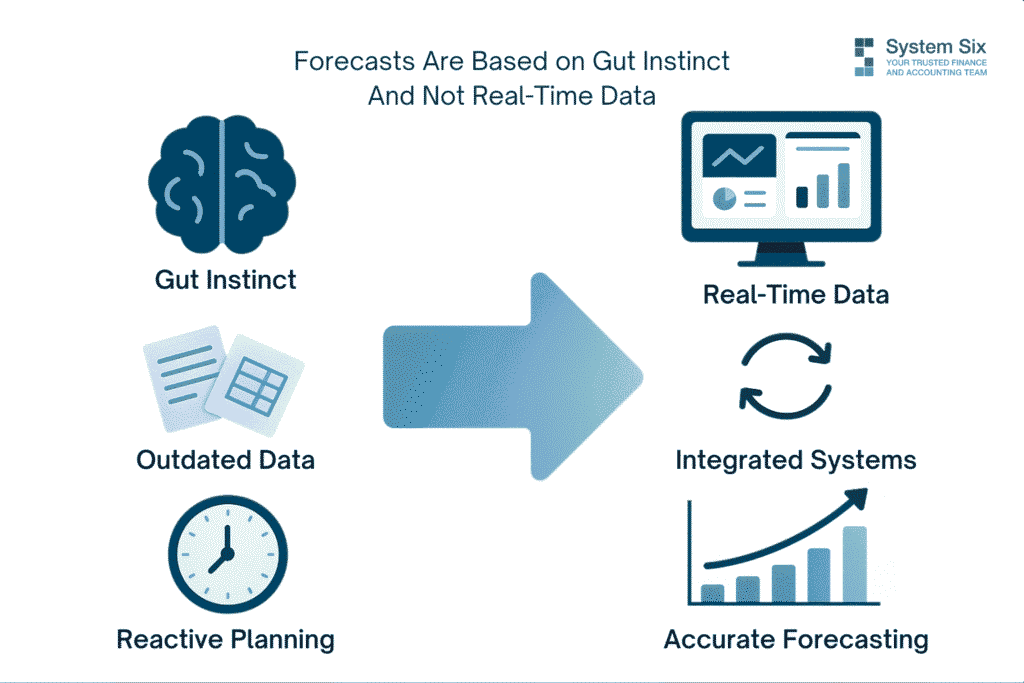
Strong forecasts rely on up-to-date numbers. But when financial inputs are scattered or delayed, many consulting firms default to intuition instead. Estimates are based on past experience rather than current conditions, and planning becomes reactive instead of intentional.
This disconnect often shows up in staffing, project timing, and cash flow. Without accurate forecasts, you risk overcommitting or underutilizing your team. You might delay a hire too long or take on too many projects at once. Each of these choices affects delivery, margins, and long-term growth.
In a CFO study, 43% of finance leaders said their forecasts often miss the mark because they rely on outdated or incomplete data. This gap makes it harder to respond to change, even when early signs are visible in your operations.
Manual data entry creates lag. By the time spreadsheets are updated, your numbers no longer reflect current activity. When forecasts are built on static reports, they can no longer support decisions that require speed or precision.
Build Forecasts That React to the Present
Accurate forecasting starts with systems that update as the business moves. Real-time data means your projections shift with actual performance rather than staying fixed until the next manual update.
When your financial systems connect directly to your CRM, project tools, and accounting software, forecasts begin pulling from live inputs. New contracts, delayed payments, and updated costs reflect instantly in your reports. This gives you a clearer view of revenue timing, upcoming expenses, and available capacity.
Predictive models become more reliable when built on structured data. Instead of basing forecasts on gut instinct, you can use historical patterns layered with current trends. This helps you plan with more confidence and less guesswork.
At System Six, we support firms with rolling cash flow forecasts and scenario planning tools that pull directly from live project and billing data. This helps leaders move from gut-driven decisions to data-backed planning.
When forecasts become a real-time tool rather than a periodic spreadsheet, you get faster answers to the questions that matter. This allows your firm to stay flexible and make decisions based on current circumstances, not just what happened last quarter.
5. Your Systems Can’t Scale with Headcount or Client Volume
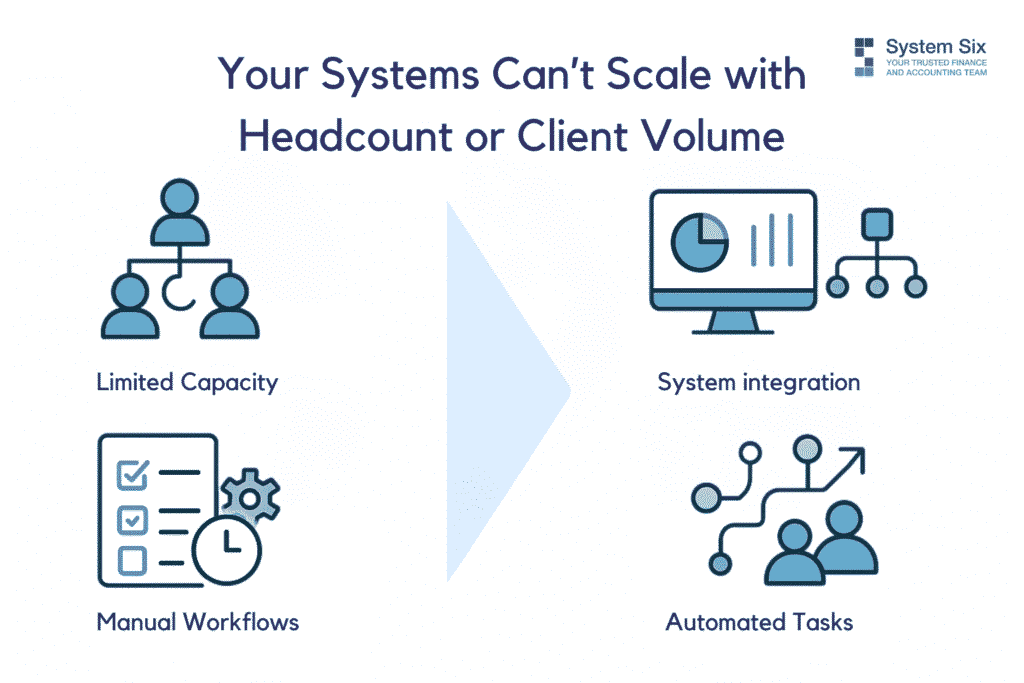
Growing firms face more complexity with each new client or hire. More projects increase the number of invoices, time entries, expenses, and financial reviews. Without the right systems, these moving parts begin to strain your team and delay core workflows.
Systems that worked for a five-person team often start breaking down once you reach ten. Processes built around manual entry or loosely connected tools become harder to manage. Work slows down as your team spends more time maintaining tools than serving clients.
You might notice approvals taking longer, project data becoming harder to reconcile, or reporting deadlines being missed. Each delay signals a system that can no longer keep pace with demand.
Cost of Reactive Fixes Versus Proactive System Design
When systems break under pressure, most firms respond with quick fixes. A new spreadsheet to track hours. Or another login for a billing tool. These short-term solutions often solve immediate issues but create more friction over time.
Reactive fixes add complexity and slow down your decision-making process. Proactive system design focuses on building workflows that hold up as your firm grows.
Here’s how the two approaches compare:
- Workflow structure: Reactive fixes create scattered processes that require extra steps and individual workarounds. Proactive systems standardize how work gets done, making it easier to train new team members and maintain consistency across projects.
- Data access: Reactive fixes rely on manual exports and spreadsheets that delay insight. Proactive systems pull live data from connected tools, giving you real-time visibility without additional work.
- Workload management: Reactive fixes increase administrative overhead and require frequent check-ins to stay on track. Proactive systems automate repetitive tasks, freeing up time for analysis and planning.
- Team knowledge: Reactive fixes often depend on a few people who know how to manage exceptions and workarounds. Proactive systems reduce this dependency by creating shared, transparent processes.
- Growth readiness: Reactive fixes fall apart under pressure as volume increases. Proactive systems scale alongside your business, so adding clients or team members does not require redesigning your workflows.
Build a Scalable Financial Stack That Supports Your Growth
Stronger firms invest in systems that grow with them. These systems handle more volume without adding more complexity. When your billing, expense, time tracking, and reporting tools are connected, your team can move faster with fewer errors.
A scalable financial stack reduces the number of decisions your team needs to make just to keep things running. Financial reports pull from a single data source. Invoices and time entries follow the same structure across every client.
The right setup gives your team structure without rigidity. As new clients come in or roles shift internally, your systems continue to support day-to-day work without disruption. This foundation allows your firm to focus on delivery and planning, not on fixing what broke behind the scenes.
Why Financial Systems Should Grow With You?
Financial systems that grow alongside your business create space for focus, speed, and control. As you take on more clients, launch new services, or expand your team, your workflows shift. A system that scales with those shifts gives your team the structure it needs to stay confident through change.
Growth introduces more decisions. Whether you are adjusting pricing, planning capacity, or reviewing profitability, those choices depend on timely, accurate information. A flexible system makes that information available without extra work. It updates with your business and reflects what is happening now, not what happened last quarter.
About System Six
System Six is a remote bookkeeping and financial services firm that helps small and mid-sized businesses streamline their financial operations. We specialize in providing technology-driven financial management solutions for consulting firms, allowing owners to focus on growing their businesses without worrying about cash flow, payroll, or compliance issues.
Our team of over 40 professionals brings an average of 10+ years of accounting experience to every client relationship, serving more than 200 businesses across the U.S. From accurate bookkeeping to cash flow forecasting, we deliver the financial clarity and peace of mind that consulting firm owners need to thrive. Learn more at www.systemsix.com.

by Chris Williams | Aug 4, 2025 | Blog
Jennifer closes her laptop with a frustrated sigh. It’s Saturday morning, and she’s just spent three hours updating five different Excel spreadsheets to prepare Monday’s financial reports for her HR consulting firm. The irony isn’t lost on her—she advises companies on operational efficiency while manually copying data from QuickBooks to a cash flow spreadsheet, then to a client profitability tracker, then to a budget variance analysis.
Each manual transfer feels necessary. The cash flow projection helps her plan hiring decisions. The client profitability analysis guides pricing strategies. The budget variance report keeps her accountable to financial goals. But what started as simple tracking has evolved into a complex web of interconnected spreadsheets that demands weekend maintenance sessions.
This scenario illustrates what I call the “spreadsheet spiral”—a predictable pattern that occurs when businesses outgrow basic accounting software but haven’t yet implemented integrated automation. What begins as reasonable flexibility quickly becomes an administrative burden that consumes time exponentially as companies grow.
Understanding automation isn’t about replacing human judgment with robotic processes. It’s about eliminating repetitive data manipulation that doesn’t require human intelligence, freeing your cognitive resources for activities that truly need your expertise and decision-making capabilities.
Let me teach you how to recognize when you’ve entered the spreadsheet spiral, understand the hidden costs it creates, and implement automated solutions that restore your weekends while improving your financial visibility and accuracy.
Understanding the Spreadsheet Spiral

The spreadsheet spiral emerges predictably in growing consulting firms because each decision seems logical and necessary. You start with basic bookkeeping software that handles transactions and basic reporting. Then you need cash flow projections, so you create a spreadsheet that pulls data from your accounting system. Project profitability becomes essential, so you build another spreadsheet that combines time tracking with expense data. Budget planning requires yet another spreadsheet that compares projected to actual performance.
Think of this like building a house of cards. Each addition makes the structure more impressive and functional, but it also becomes more fragile and time-consuming to maintain. Eventually, you’re spending more time keeping the structure than benefiting from its capabilities.
The warning signs are easy to recognize once you know what to look for. You find yourself saying things like “I just need to update my spreadsheets before we can discuss the numbers.” You postpone financial decisions because getting current data requires too much manual work. You discover discrepancies between different reports because data has been updated in one place but not in another.
Here’s what makes this particularly insidious for consulting firms: spreadsheets feel like the natural evolution beyond basic bookkeeping because they offer complete flexibility and customization. You can create the exact analysis you want, formatted precisely as you prefer it. The problem isn’t using spreadsheets for analysis—it’s feeding them manually with data that could flow automatically.
Understanding data redundancy helps clarify why this becomes problematic. When the same information exists in multiple places, it must be manually synchronized or it becomes inconsistent. Your revenue might be recorded in QuickBooks, summarized in a cash flow spreadsheet, analyzed in a profitability tracker, and compared in a budget variance report. Each location requires manual updating, and each manual update introduces potential errors.
Error propagation compounds this challenge because mistakes in manual data entry multiply through interconnected systems. If you mistype an invoice amount in your cash flow projection, that error affects your hiring decisions, spending plans, and growth strategies until you discover and correct it.
The opportunity cost might be the most expensive aspect of all. Time spent manipulating data represents time not spent on client work, business development, or strategic planning. When Jennifer spends Saturday morning updating spreadsheets, she’s not just losing personal time—she’s foregoing revenue-generating activities that could transform her business.
The Hidden Costs of Manual Financial Management

Most consulting firm owners dramatically underestimate the actual cost of manual financial management because individual tasks seem manageable, and the cumulative impact remains invisible until it is measured systematically.
Let me guide you through calculating the actual time investment. Track your financial management activities for two weeks, noting every instance of data entry, spreadsheet updates, report preparation, and error correction. Include the “quick” tasks that feel insignificant individually but add up substantially over time.
Most business owners discover they’re spending fifty to one hundred percent more time on financial management than they realized. What feels like “just twenty minutes” updating cash flow projections daily actually represents two and a half hours weekly, or 130 hours annually—equivalent to more than three full work weeks dedicated to data manipulation.
Consider the mathematics from Jennifer’s point of view. Suppose she earns two hundred dollars per hour when doing client work but spends ten hours monthly on manual financial tasks. In that case, she’s sacrificing $24,000 annually in revenue potential. That’s before accounting for the business development and strategic planning that doesn’t happen because her administrative burden consumes available time.
Error costs create another layer of hidden expense. Manual data entry introduces mistakes at predictable rates that multiply through interconnected systems. Transcription errors, formula mistakes, version control problems, and synchronization failures require correction time that often exceeds the original task duration.
These errors can damage client relationships when they affect external reporting or billing accuracy. I’ve seen consulting firms lose client confidence because of manual errors in time tracking, which led to billing discrepancies that required uncomfortable conversations and relationship repair.
The stress and decision-making costs might be the most significant hidden expense. Constant awareness of pending financial tasks creates cognitive load that reduces focus on client work. Poor financial visibility leads to delayed or suboptimal business decisions that compound over time.
When you can’t quickly access current financial information because it requires manual compilation, you postpone essential decisions about hiring, investments, and growth strategies. This hesitation costs opportunities that might be worth multiples of the time saved through automation.
The Architecture of Automated Bookkeeping

Understanding how automated bookkeeping works helps demystify the transition from manual processes to integrated systems. Think of automation like installing plumbing in your house. Instead of manually carrying water from a well every time you need it, automation creates direct connections that provide continuous flow without manual intervention.
The foundation involves data flow automation that eliminates manual data transfer by creating direct connections between different systems. Your bank transactions are automatically imported into accounting software, which updates cash flow projections, client profitability reports, and budget variance analyses—the human role shifts from data manipulation to data interpretation and decision-making.
Transaction processing automation follows a logical hierarchy that builds confidence through progressive implementation. Start with transaction capture, where bank feeds automatically import purchases, payments, and deposits into your accounting system. Then advance to automated categorization using rules-based systems that learn from patterns and improve accuracy over time.
Begin with obvious categories, such as rent, utilities, and payroll, which follow predictable patterns. As the system learns your preferences and business patterns, it can expand to more complex project-based categorizations that require a nuanced understanding of your service offerings and client relationships.
Integrated reporting systems represent the next level of sophistication, pulling data directly from transaction systems to create real-time financial insights. Instead of manually updating multiple spreadsheets with outdated information, automated systems generate reports instantly with current data.
Cash flow projections update automatically as invoices get paid and expenses get recorded. Client profitability reports reflect real-time project costs without manual data entry. Budget variance analyses compare actual performance to projected performance using current information, rather than relying on last week’s manual compilation.
This real-time capability enables proactive decision-making rather than reactive problem-solving. When Jennifer can see her cash position, project profitability, and budget performance instantly, she can make informed decisions about hiring, investments, and client relationships without waiting for weekend update sessions.
Workflow integration creates systematic connections between different business processes, eliminating manual hand-offs between time tracking, project costing, client billing, and financial reporting. Each integration point represents time savings and error reduction opportunities that compound as your business grows.
The key insight involves striking a balance between automation and analytical flexibility. Automated systems can accommodate business-specific needs without requiring custom programming, but they should focus on automating data processing while preserving your ability to perform unique analysis and modeling.
Utilize automation for repetitive data manipulation while maintaining spreadsheet capabilities for specialized analyses that require human judgment and creativity. The goal is to reduce manual work, not eliminate your analytical capabilities or constrain your ability to understand your business deeply.
Implementation Roadmap for Spreadsheet Elimination

Successful automation implementation requires systematic progression that builds confidence through early wins rather than overwhelming your operations with too much change simultaneously.
Begin with comprehensive assessment of your current spreadsheet usage and manual processes. Map the data flow from sources like bank accounts, time tracking systems, and project management tools through your various spreadsheets to final reports and decisions.
Identify which spreadsheets provide unique analytical value versus those that reformat data from other systems. Focus your automation efforts first on eliminating spreadsheets that primarily serve as data transfer mechanisms rather than those that perform complex analysis requiring human judgment.
Foundation automation should start with transaction processing before advancing to sophisticated reporting systems. Implement automatic bank feeds first, ensuring that your financial transactions are imported directly into your accounting software without requiring manual entry. Then add automated categorization rules that assign transactions to appropriate accounts based on vendor, amount, or description patterns.
Master each level of automation thoroughly before introducing additional complexity. This progressive approach builds confidence while ensuring that foundational systems work reliably, allowing you to depend on them for more sophisticated functions.
Integration and optimization connect different automated systems to eliminate remaining manual data transfer points. Link time tracking to project costing, client billing, and financial reporting in seamless workflows that update automatically as work is completed and billed.
Utilize automation to facilitate more advanced analysis, rather than merely replacing existing processes. When data flows automatically, you can perform analysis that was previously too time-consuming to attempt regularly, providing insights that improve decision-making and business performance.
Track time savings, error reduction, and decision-making speed improvements to validate your automation investments and guide further optimization. Most consulting firms achieve seventy to eighty percent reduction in financial management time within ninety days of proper implementation.
Consider professional implementation support when the complexity exceeds your expertise or when expert guidance will accelerate your progress. System Six specializes in helping consulting firms eliminate spreadsheet dependence while preserving analytical capabilities, typically achieving full automation faster than DIY attempts while ensuring proper integration between systems.
Your Path to Automated Freedom

Spreadsheet elimination isn’t about reducing your analytical capabilities—it’s about automating data processing to enable better analysis with less manual effort. Every hour you spend manipulating data represents time that could be directed toward activities requiring your unique expertise and generating revenue for your business.
Start by auditing your current spreadsheet usage to identify automation opportunities with the highest time-saving potential. Implement foundation automation around transaction processing before advancing to complex integrations that connect multiple business systems.
Measure your time savings and redirect that recovered capacity toward revenue-generating activities, such as client acquisition, service delivery, and strategic planning. The goal extends beyond efficiency to enable the kind of growth and client service that spreadsheet maintenance prevents.
Transform your weekend financial administration into automated background processes that provide better information with less effort, enabling you to build a consulting practice that supports your life rather than consuming it.
About System Six
System Six is a Seattle-based bookkeeping and financial services firm that helps small and mid-sized businesses streamline their financial operations. We specialize in providing technology-driven financial management solutions for consulting firms, allowing owners to focus on growing their businesses without worrying about cash flow, payroll, or compliance issues. Our team of over 35 professionals brings an average of 10+ years of accounting experience to every client relationship, serving more than 175 businesses across the U.S. From accurate bookkeeping to cash flow forecasting, we deliver the financial clarity and peace of mind that consulting firm owners need to thrive. Learn more at www.systemsix.com.
Committed to Giving You Time Back
Get clarity with System six


by Chris Williams | Jul 25, 2025 | Blog
Elena closed her laptop with a frustrated sigh. It was 9 PM on Sunday, and she’d just spent two hours categorizing last week’s expenses for her management consulting firm. In the next room, her family was watching a movie together—the kind of simple evening she’d been promising herself she’d join once she “caught up” on administrative work.
But here’s what Elena didn’t realize: she wasn’t catching up on anything. She was trapped in a cycle of what I call “productive procrastination”—doing work that feels necessary and important but doesn’t require her unique expertise or judgment.
Think about it this way. Elena has fifteen years of strategic consulting experience, an MBA from a top-tier program, and deep expertise that clients pay $300 per hour to access. Yet she was spending her Sunday evening doing data entry that a computer could complete in seconds with greater accuracy than she could achieve manually.
This scenario illustrates a fundamental confusion that plagues most consulting firm owners: mistaking “being busy” with “being productive” when it comes to administrative tasks. The false economy of “doing it yourself” feels responsible, but it’s one of the most expensive mistakes you can make as a business owner.
Understanding automation isn’t about being lazy—it’s about recognizing that human intelligence should be directed toward activities that genuinely require human intelligence. By mastering these eight automation opportunities, you’ll transform weekend administrative tasks into quality family time while enhancing the accuracy and efficiency of your business operations.
Understanding the Automation Opportunity

Before we explore specific automation opportunities, let’s establish a clear learning foundation that will help you think systematically about administrative efficiency.
Automation functions like hiring a tireless assistant who never makes calculation errors, never forgets deadlines, and works around the clock without needing supervision or management. But understanding how to deploy this “assistant” effectively requires recognizing that administrative tasks fall into three distinct categories.
First, you have data processing tasks—activities such as expense categorization, invoice generation, and financial reporting — where you’re essentially moving information from one format or location to another. These tasks follow predictable rules and rarely require judgment calls, making them ideal candidates for automation.
Second, you encounter repetitive communication tasks such as client updates, meeting reminders, and progress reports. While these communications serve important relationship-building purposes, the actual process of creating and sending them often follows standard templates and timing patterns.
Third, you are responsible for compliance monitoring activities, including tracking tax deadlines, contract renewals, and regulatory requirements. These tasks are critical for avoiding penalties and maintaining good standing, but they primarily involve systematic tracking rather than complex decision-making.
Here’s a simple framework to guide your automation thinking: if you perform a task manually three times in essentially the same way, it’s likely automatable. This “Rule of Three” helps you distinguish between truly custom work that requires your judgment and routine processes that can be systematized.
I often encounter three common obstacles that business owners face when considering automation. The first is “I don’t have time to set up automation.” But consider this: if you spend two hours monthly on expense tracking, investing four hours to automate the process will pay for itself within two months and save you twenty hours annually in the future.
The second obstacle is “My business is too unique for standard automation.” While your services and clients may be unique, most administrative tasks follow remarkably similar patterns across consulting firms. Invoice generation, expense tracking, and compliance monitoring work the same way regardless of whether you’re a strategy consultant or an IT specialist.
The third obstacle involves technical intimidation: “Automation is too complicated for someone like me.” Modern automation tools are designed specifically for non-technical business owners. You don’t need programming skills—you need systematic thinking and patience to set up processes correctly.
To illustrate the transformation possible, consider a System Six client who reduced monthly administrative time from twenty hours to three hours through strategic automation. This wasn’t about expensive enterprise software or complex technical implementations. It was about systematically identifying repetitive manual work and replacing it with automated processes that run reliably in the background.
The 8 High-Impact Automation Opportunities

Let me walk you through eight specific automation opportunities, building from simpler implementations toward more sophisticated systems that will transform your administrative efficiency.
Expense categorization and receipt processing represent the most accessible starting point for most consulting firms. Manual expense sorting typically consumes two to three hours monthly, involving the tedious process of photographing receipts, entering amounts, and categorizing purchases according to your chart of accounts.
Modern expense automation tools can photograph receipts and automatically extract vendor information, amounts, and relevant categories with over 90% accuracy. The learning approach here involves starting with one expense category—perhaps office supplies or software subscriptions—before expanding to comprehensive automation. One System Six client reduced expense processing time from four hours monthly to fifteen minutes of review, redirecting those saved hours toward business development activities.
Invoice generation and payment tracking eliminate another significant time drain while improving cash flow management. Manual invoicing requires remembering different client billing cycles, accurately calculating project costs, and monitoring payment status across multiple accounts.
Template-based automation systems can generate invoices automatically based on time tracking data or project milestones, then monitor payment status and send follow-up reminders according to your preferences. Begin implementation with your most predictable clients—those on monthly retainer arrangements—before expanding to complex project-based billing. The typical time savings ranges from six to eight hours monthly on billing administration alone.
Accounts payable and bill management prevent the expensive errors that occur when vendor bills get overlooked or paid incorrectly. Manual bill tracking involves capturing invoices from various sources, routing them for approval, and scheduling payments to avoid late fees and duplicate payments.
Automated systems can capture bills electronically, route them through predefined approval workflows, and schedule payments automatically according to your cash flow preferences. Start with recurring monthly bills, such as rent, utilities, and software subscriptions, where the amounts and timing remain relatively predictable. This automation prevents late fees while enabling you to take advantage of early payment discounts.
Payroll processing and tax compliance eliminate the risk factors associated with manual wage calculations and regulatory compliance. Payroll errors create legal compliance issues, erode employee trust, and can lead to costly penalties from multiple government agencies.
Integrated payroll systems calculate wages, deductions, and tax withholdings automatically while maintaining compliance across different state requirements as your business grows. Begin with basic payroll automation before adding complexity, such as commission calculations or project-based bonuses. The outcome includes the elimination of payroll errors and automatic compliance reporting, which saves hours during tax season.
Client communication and project updates streamlines the ongoing relationship management that consumes significant time but follows predictable patterns. Keeping clients informed requires regular progress updates, scheduling meetings, and notifying them of milestones.
Automated communication systems can send project status emails, meeting reminders, and completion notifications based on project timelines and predefined triggers. Create templates for common communication scenarios, and then automate the delivery timing to ensure consistent client engagement without requiring manual coordination efforts. This builds client confidence through reliable communication while freeing your time for substantive client work.
Time tracking and project cost analysis addresses the revenue leakage that occurs when billable time gets forgotten or inaccurately recorded. Manual time tracking leads to undercharging clients and poor project profitability analysis.
Automated tracking systems capture billable time as you work and connect it directly to project budgets and client billing processes. Begin with simple time capture before incorporating sophisticated project analytics that display profitability trends and resource utilization patterns. The result is improved project profitability visibility and more accurate client billing that often increases revenue by five to ten percent.
Cash flow forecasting and financial reporting streamline the monthly financial close, transforming it from a multi-day process into an automated report generation. Understanding your financial position traditionally requires manually compiling data from multiple sources and creating reports that become outdated as soon as they are finished.
Automated reporting systems compile real-time financial dashboards that show cash position, accounts receivable aging, and profitability trends, updated continuously as transactions occur. Begin with basic cash flow tracking before developing comprehensive financial reporting that provides immediate visibility into business performance.
Compliance monitoring and deadline management eliminates the expensive penalties that result from missing tax deadlines, contract renewals, or licensing requirements. Manual deadline tracking relies on memory and calendar entries that can be overlooked during busy periods.
Automated compliance systems track requirements systematically and send alerts well in advance of deadlines, providing sufficient time to complete necessary actions without stress. Start with the highest-risk compliance areas, such as tax deadlines and insurance renewals, before expanding coverage to all regulatory requirements.
Implementation Strategy: Your Path Forward

Successful automation implementation requires a systematic approach that builds confidence through early wins, rather than overwhelming your current operations with too much change at once.
Begin by assessing and prioritizing opportunities for automation by tracking your administrative time for two weeks to identify the areas that have the highest impact. Use the “pain times frequency” calculation—tasks that are both painful to complete and occur frequently offer the best return on investment for automation. Focus initially on tasks that currently consume the most time or cause the most stress.
Start small and build confidence by choosing one automation project to prove the concept before expanding your efforts. I recommend starting with expense tracking or invoice generation, as they offer immediate, measurable time savings that demonstrate the value of automation. Master one system completely before adding complexity or additional tools.
The integration and scaling phase involves connecting your automated systems so that data flows seamlessly between processes—for example, linking time tracking to invoicing and project profitability reporting for complete workflow automation. Regularly review and refine your automated processes to maximize efficiency gains as you become more comfortable with the technology.
Measure your success through specific metrics, such as the time saved weekly, the number of errors reduced, and the improvement in stress levels. System Six clients typically see seventy to eighty percent reduction in administrative time within ninety days of implementation. View automation as an investment in your business capacity rather than just a time-saving tool.
Recognize when professional implementation will accelerate your results and provide better long-term outcomes. System Six specializes in helping consulting firms implement comprehensive automation strategies that typically pay for themselves within sixty to ninety days through time savings alone.
Your Transformation Starts Now

Administrative automation isn’t about mastering technology—it’s about applying strategic thinking to eliminate repetitive tasks that don’t require your unique expertise and judgment. Every hour you spend on automatable tasks represents an hour not spent on activities that only you can perform effectively.
Select your highest-impact automation opportunity from the eight we’ve explored and implement it thoroughly before proceeding to the next one. Measure your time savings and reinvest that recovered capacity into revenue-generating activities, such as cultivating client relationships, driving business development, and fostering strategic growth.
The goal extends beyond simply saving time. You’re redirecting your energy toward activities that leverage your professional expertise and create genuine business value. Imagine having fifteen to twenty extra hours each month to focus on the work that truly requires your consulting experience and strategic judgment.
Transform your administrative burden from a Sunday night obligation into automated background processes that run reliably and efficiently. At the same time, you focus on building the consulting practice you envisioned when you started your business.
About System Six
System Six is a Seattle-based bookkeeping and financial services firm that helps small and mid-sized businesses streamline their financial operations. We specialize in providing technology-driven financial management solutions for consulting firms, allowing owners to focus on growing their businesses without worrying about cash flow, payroll, or compliance issues. Our team of over 35 professionals brings an average of 10+ years of accounting experience to every client relationship, serving more than 175 businesses across the U.S. From accurate bookkeeping to cash flow forecasting, we deliver the financial clarity and peace of mind that consulting firm owners need to thrive. Learn more at www.systemsix.com.

by Chris Williams | Jul 18, 2025 | Blog
Marcus closed his laptop with a frustrated sigh. It was March, and he was staring at the annual budget he’d carefully crafted for his IT consulting firm back in December. The document may have been a work of science fiction.
He’d projected steady monthly revenue of $85,000, assuming his team would maintain their current client roster while gradually adding new projects. Instead, February brought three unexpected large contracts that pushed revenue to $140,000, while March saw their biggest client unexpectedly pause their retainer to reassess their technology strategy.
His meticulously planned budget now sat somewhere between wildly optimistic and uselessly conservative, offering him zero guidance for the critical decisions he needed to make. Should he hire the additional consultant he’d been considering? Could he afford the new project management software his team had been requesting? Was it safe to move forward with the office expansion they’d been planning?
This scenario highlights the fundamental issue that traditional budgeting poses for service-based businesses. Unlike manufacturing companies or retail operations, which typically have relatively predictable patterns, service firms face inherently volatile revenue streams shaped by project timing, client retention variables, and market fluctuations that resist annual prediction.
The solution lies in abandoning the fantasy of annual certainty and embracing a different approach entirely. Rolling forecasts transform budgeting from guesswork into dynamic financial navigation, creating what I call “zero-guess budgeting”—replacing wild estimates with data-driven projections that evolve with your business reality.
By the end of this exploration, you’ll understand how to build forecasting systems that guide decision-making rather than gathering dust in a file folder.
Understanding Rolling Forecasts vs. Traditional Budgets

Let me start by clarifying the fundamental differences between these two approaches, because this distinction forms the foundation for everything else we’ll discuss.
Traditional budgets operate like planning a cross-country road trip using last year’s route without checking for current road construction, weather conditions, or changes in your destination. You create them annually based on previous performance plus growth assumptions, then treat them as fixed throughout the year unless you formally revise them. The focus remains on hitting predetermined targets regardless of how dramatically your business environment might shift.
Rolling forecasts function more like GPS navigation, continuously recalculating your route based on current traffic, road conditions, and real-time data. You update them regularly—monthly or quarterly—with fresh information, and they extend forward from your current position to maintain a consistent planning horizon. Most importantly, they adapt to actual business conditions rather than clinging to outdated assumptions.
This distinction becomes crucial for service firms due to the unique challenges they face. Project timing rarely follows neat quarterly patterns. Client payment cycles vary dramatically. Resource utilization fluctuates in response to project demands and market conditions. Traditional budgets cannot accommodate this inherent unpredictability.
Consider what happens when Marcus lands that unexpected six-month contract in April. A traditional budget treats this as a deviation from plan, creating confusion about whether performance is “good” or “bad.” A rolling forecast immediately incorporates this new reality, recalculating forward projections to reflect the changed landscape and providing clear guidance for resource and investment decisions.
The philosophical shift here transforms how you think about financial planning. Traditional budgets ask “Are we hitting our targets?” while rolling forecasts ask “What’s going to happen, and how should we respond?” This change in perspective enables proactive management rather than reactive damage control.
Rolling forecasts serve as management tools designed to improve decision-making, rather than performance measurement systems intended to create accountability. Understanding this distinction helps you use them effectively rather than getting trapped in the accuracy expectations that make traditional budgets so frustrating for service businesses.
The Anatomy of a Service Firm Rolling Forecast

Now let me break down the essential components that make rolling forecasts work effectively for service businesses, building complexity gradually so you can understand how each piece contributes to the complete picture.
Revenue forecasting for service businesses requires a layered approach that acknowledges different levels of certainty. I recommend thinking in terms of confidence layers that stack on top of each other to create realistic projections.
Your foundation layer consists of confirmed contracts and recurring revenue—work you know will happen with 90-100% confidence. This includes signed agreements, ongoing retainers, and projects already in progress. For Marcus’s IT consulting firm, this might consist of monthly support contracts and multi-phase implementations where phase one is already underway.
The second layer encompasses proposals submitted and verbal commitments, where the probability ranges from 50% to 80%. These represent opportunities where significant groundwork has been completed but contracts haven’t been signed yet. You should weigh these based on your historical conversion rates and the specific circumstances of each opportunity.
The third layer covers active prospects and pipeline opportunities with twenty to fifty percent probability. This includes qualified leads, networking connections that have expressed interest, and referral possibilities. While individually uncertain, these opportunities collectively provide essential insight into potential revenue flows.
System Six clients who implement this layered approach often discover they can forecast revenue with surprising accuracy once they weigh opportunities appropriately and track their historical conversion patterns.
Expense forecasting requires understanding the different behaviors that costs exhibit in service businesses. Fixed costs remain constant regardless of revenue fluctuations—things like office rent, insurance, and base salaries. Variable costs scale directly with business activity, such as project-specific software licenses or contractor fees. But service firms also face “stepped” expenses that don’t scale smoothly—you can’t hire three-tenths of a person when workload increases by thirty percent.
Cash flow timing considerations add another crucial dimension because service businesses often experience significant gaps between earning revenue and collecting cash. Marcus might complete a consulting project in March, send the invoice in April, and receive payment in May. Understanding these timing patterns becomes essential for accurate forecasting.
You’ll need to analyze your accounts receivable aging patterns and model different client payment behaviors. Some clients consistently pay within the Net 30 terms, while others habitually stretch their payments to Net 60 or beyond. Milestone-based projects introduce timing complexities that require careful modeling.
Resource planning integration connects your financial forecasts to capacity decisions. Should you hire additional consultants before confirming new contracts, or wait until revenue is secured? Rolling forecasts help you model these scenarios by showing the financial implications of different timing decisions.
When all these components work together, they create a comprehensive view of your business trajectory. Imagine Marcus creating a thirteen-week rolling forecast that shows confirmed project revenue, weighted pipeline opportunities, realistic expense timing, and cash collection patterns. This gives him a dynamic tool for making informed decisions about hiring, investments, and growth strategies.
Building Your Rolling Forecast System Step-by-Step

Let me guide you through the methodical process of implementing rolling forecasts, beginning with foundational decisions and progressing to sophisticated applications.
Your first step involves establishing the rhythm and horizon that match your business characteristics. Most service firms benefit from thirteen-week horizons because this timeframe aligns with quarterly business cycles, providing sufficient visibility for strategic decisions without sacrificing accuracy to uncertainty.
Update frequency depends on your business volatility and management bandwidth. If you’re running a stable consulting practice with long-term client relationships, monthly updates might suffice. However, if you’re in a project-based business with frequent proposal activity, providing weekly or bi-weekly updates offers better support for informed decision-making.
Start conservatively with monthly updates and increase frequency as the system proves valuable. The key is consistency rather than perfection in early implementations.
Building your revenue forecasting foundation requires methodical client-by-client analysis. Create detailed breakdowns showing existing client revenue, contract end dates, and renewal probabilities. Then layer in your pipeline opportunities using the confidence-based weighting system we discussed earlier.
Establish clear criteria for your probability classifications. “A” prospects might be those where you’ve submitted proposals and are in final negotiations. “B” prospects could be qualified opportunities where you’re preparing proposals. “C” prospects represent early-stage discussions or referral possibilities.
Include seasonality patterns based on historical analysis. One System Six client discovered their technology consulting revenue was consistently thirty percent higher in the first quarter due to year-end budget spending and new-year planning projects. Incorporating this pattern dramatically improved their forecasting accuracy.
Mapping expense patterns requires categorizing costs by their behavior characteristics. Fixed expenses, such as rent and insurance, are straightforward to project. Variable expenses need careful analysis of their relationship to revenue or activity levels. Stepped expenses require judgment about timing and trigger points for increases.
Pay particular attention to expense timing rather than just expense recognition. You might incur contractor costs in March but not pay them until April. Understanding the timing of cash outflows becomes crucial for accurate cash flow projections.
Creating cash flow bridges connects your revenue forecasts to actual cash collection timing, ensuring a seamless transition between the two. Analyze your historical collection patterns to understand the percentage of invoices that are typically paid within thirty days, sixty days, and beyond. Factor in seasonal variations—many clients pay more slowly during holiday periods or summer vacation seasons.
Build contingency scenarios for collection delays. What happens to cash flow if your largest client extends their payment cycle from Net 30 to Net 60? How would this affect your ability to meet payroll or make planned investments?
The review and refinement process transforms forecasting from a prediction exercise into a management system. Establish regular variance analysis to understand why actual results differed from projections. These insights enhance future accuracy by identifying business patterns that you might otherwise miss.
Create decision triggers based on variance levels. A ten percent revenue shortfall triggers a review of discretionary spending, while a twenty percent variance initiates more significant operational adjustments.
This systematic approach builds forecasting capability over time, providing immediate value for informed business decisions.
Using Rolling Forecasts for Better Business Decisions

The actual value of rolling forecasts emerges when you transform predictions into actionable business intelligence. Let me show you how this financial visibility guides specific management decisions.
Hiring decisions become much more confident when supported by rolling forecasts. Instead of guessing whether you can afford additional staff, you can see sustained revenue increases projected over eight to twelve weeks. Marcus might notice that his weighted pipeline shows a strong probability of landing two significant contracts over the next ten weeks, providing clear justification for bringing on the additional consultant he has been considering.
Investment decisions benefit from cash flow timing projections. That new project management software might cost $5,000 upfront plus $800 monthly, but your rolling forecast shows strong cash generation over the next quarter, making the timing appropriate. Without this visibility, you might either miss growth opportunities or create unnecessary cash flow stress.
Client acceptance decisions involve more than just pricing considerations. Rolling forecasts help you understand capacity constraints and profitability implications. If accepting a large project would require declining other opportunities or stretching your team beyond sustainable utilization levels, the forecast helps you model these trade-offs systematically.
Scenario planning represents one of the most potent applications of rolling forecasts. You can model multiple possible futures to prepare for various outcomes. What happens if Marcus lands that big prospect he’s been pursuing? The forecast shows the revenue impact, resource requirements, and cash flow implications, helping him prepare for success rather than scrambling to respond.
Conversely, what if his largest client reduces their retainer? The forecast immediately shows the financial impact and timeline for replacement revenue, enabling proactive rather than reactive responses.
Performance management integration requires understanding that forecasts inform decisions rather than replace accountability systems. Variance analysis becomes a learning tool that improves business operations rather than a punishment mechanism for missing targets.
One System Six client discovered through consistent variance analysis that they had chronically under-forecasted fourth-quarter revenue because they didn’t account for clients accelerating projects to utilize their remaining annual budgets. This insight led to better resource planning and more confident year-end decision-making.
Communication with stakeholders improves dramatically when you can present realistic, regularly updated forecasts rather than optimistic static budgets. Partners, investors, and lenders prefer transparent updates based on current conditions over carefully crafted annual projections that quickly become obsolete.
Building credibility through forecast accuracy and honest variance explanations fosters trust, which pays dividends when you need stakeholder support for growth investments or during challenging periods.
The transformation from reactive to proactive management represents the ultimate payoff from rolling forecasts. Instead of wondering “Can we afford this?” you develop confidence in knowing “Here’s when we can afford this.” Gut-feeling decisions get replaced with data-informed choices that compound into sustained competitive advantages.
From Guessing to Knowing

Traditional budgeting forces service firm owners like Marcus to make critical decisions based on outdated assumptions and annual guesswork. Rolling forecasts provide the dynamic, reality-based financial visibility that service businesses need to thrive.
The implementation doesn’t require sophisticated software or complex modeling. Start with a simple thirteen-week cash flow forecast that you update monthly. Focus on accuracy over sophistication in early versions, utilizing variance analysis to enhance your forecasting capabilities continually.
The learning curve is manageable if you approach it systematically. Begin with revenue forecasting since that’s usually the most challenging component. Add expense modeling next, then refine cash flow timing based on your actual collection patterns.
The payoff extends far beyond better financial management. Improved decision-making leads to enhanced profitability and reduced stress. Rolling forecasts transform financial planning from a source of anxiety into a competitive advantage that enables confident growth.
Remember that perfect prediction isn’t the goal—better decision-making through improved financial visibility is what matters. When you can see thirteen weeks ahead with reasonable accuracy, you gain the perspective needed to build a more successful and sustainable service business.
About System Six
System Six is a Seattle-based bookkeeping and financial services firm that helps small and mid-sized businesses streamline their financial operations. We specialize in providing technology-driven financial management solutions for consulting firms, allowing owners to focus on growing their businesses without worrying about cash flow, payroll, or compliance issues. Our team of over 35 professionals brings an average of 10+ years of accounting experience to every client relationship, serving more than 175 businesses across the U.S. From accurate bookkeeping to cash flow forecasting, we deliver the financial clarity and peace of mind that consulting firm owners need to thrive. Learn more at www.systemsix.com.

by Chris Williams | Jul 11, 2025 | Blog
Sarah stared at the proposal in front of her, calculator in hand. The financial management system would cost her consulting firm $800 monthly. That seemed like a substantial amount of money for a 15-person operation that was already profitable.
But then she started thinking about last month. She’d spent an entire Sunday reconciling accounts because three client payments got misallocated. Her project manager had wasted half a day tracking down expense receipts that should’ve been automatically categorized. And they’d nearly missed a tax deadline because nobody was properly tracking compliance requirements across their multi-state client base.
What Sarah was experiencing is the ROI confusion that costs consulting firms thousands of dollars in hidden expenses every year. She was focused on the obvious cost—that $800 monthly fee—while completely missing the expensive chaos her current “free” system was creating.
Here’s what most consulting firm owners don’t realize: ROI isn’t just about what you spend on financial tools. It’s about what you gain, what you save, and what you avoid losing. And when you understand this distinction, the math becomes crystal clear.
Think about it this way. You’dn’t evaluate a new hire solely by looking at their salary. You’d consider what they can produce, what problems they can solve, and what opportunities they can help you capture. Financial management investments work similarly.
Let’s walk through how to calculate true ROI for financial management tools, identify the hidden costs that make “cheap” solutions expensive, and build a framework for maximizing returns on every dollar you invest.
Understanding True ROI: Beyond the Price Tag

Most people think about ROI backwards. They see a $500 monthly software fee and think, “That’s expensive.” But complete ROI thinking looks different: “This software costs $500 monthly but saves us $2,000 in time and prevents $1,500 in errors, so our ROI is 400%.”
Let me teach you the three components that make up true financial management ROI.
First component: direct cost savings. This includes time, labor, and operational efficiencies. When you automate invoice generation, you’re not just saving the fifteen minutes it takes to create each invoice. You’re eliminating the mental switching cost, reducing errors, and freeing up cognitive bandwidth for higher-value work.
Second component: risk mitigation value. What do you save by avoiding penalties, errors, and missed opportunities? One System Six client was unknowingly paying $700 monthly in unnecessary bank fees because poor cash flow tracking meant they kept hitting overdraft triggers. That’s $8,400 annually—enough to pay for sophisticated financial management tools and still come out ahead.
Third component: growth enablement value. This is the big one most firms miss. Better financial systems don’t just improve efficiency—they unlock previously impossible revenue opportunities.
Here’s a real example that illustrates all three components. A strategy consulting firm was spending 20 hours monthly on financial administration. At their owner’s $200 hourly rate, that represented $4,000 monthly in opportunity cost. After implementing automated systems, they reduced this to 3 hours per month of reviewing automated reports—a $600 time investment.
The math is straightforward. They saved $3,400 per month in recovered billable time while paying $800 per month for the system. That’s a 325% return on investment before we even consider error prevention or growth opportunities.
But here’s where it gets interesting. That $3,400 in monthly savings equals $40,800 annually in recovered revenue potential. Compound this over multiple years, and you’re looking at hundreds of thousands in additional earning capacity.
This example doesn’t even account for the compliance errors they avoided or the larger clients they could now serve, as their financial infrastructure could handle the complexity. The total ROI becomes exponentially higher when you factor in these additional benefits.
Now, I know what you’re thinking. “But I can do it myself for free.” This is the most expensive myth in small business finance. “Free” manual processes often have hidden costs, including time, errors, stress, and opportunity costs, that can exceed the price of professional solutions by factors of three to five.
The Hidden Cost Categories That Skew ROI Calculations

Most consulting firms significantly underestimate their current financial management costs because these expenses are often distributed and invisible in daily operations. Let’s conduct a systematic audit to uncover your actual spending.
The first hidden cost category is opportunity cost of owner time. Here’s how to calculate it: multiply the hours you spend monthly on financial tasks by your effective hourly rate. If you’re spending 15 hours a month on bookkeeping and your effective rate is $300 per hour, you’re looking at $4,500 a month in hidden costs.
Think about what else you could accomplish with those 180 hours annually. Business development that brings in new clients. Strategic planning that improves operations. Or simply having the mental bandwidth to focus on high-value client work instead of wrestling with expense categorization.
The second category is error costs and compliance risks. Manual systems breed mistakes. Missed invoices, payment delays, tax errors, payroll mistakes—each one carries real financial consequences.
Consider this example from a System Six client. They discovered they’d been making a simple bookkeeping error that was costing them $700 monthly in bank fees. That single mistake was eating $8,400 annually—more than enough to pay for professional financial management with money left over.
Compliance risks carry even higher stakes. Late tax filing penalties can run thousands of dollars. Missed payroll tax deadlines trigger automatic penalties plus interest. And if you’re unlucky enough to face an audit because of poor record-keeping, you’re looking at professional fees that can easily hit five figures.
The third category is growth limitation costs. This is the most complex concept, but it is often the most expensive. Poor financial systems create invisible ceilings on business growth.
Here’s what I mean. A consulting firm had the opportunity to take on a $200,000 contract—their largest ever. But the project required detailed financial tracking, milestone billing, and multi-phase budget management. Their current systems couldn’t handle the complexity, so they had to pass on the opportunity.
How do you calculate the cost of missed opportunities like this? It’s not just the immediate revenue loss. It’s the compound effect of what that growth could have enabled: larger teams, better clients, increased market presence, and exponential expansion possibilities.
The fourth category is team productivity drains. Financial chaos doesn’t just affect the owner—it ripples through the entire organization. Project managers spend time on expense reconciliation rather than focusing on client work. Team members worry about whether payroll will be cleared on time. Strategic discussions get derailed by basic financial questions that should have clear answers.
One System Six client put it perfectly: “Our team was spending so much mental energy worrying about whether we’d make payroll that client work suffered. It wasn’t just about the time—it was about the cognitive load that was dragging down everything we did.”
When you add up all these hidden costs, most consulting firms discover they’re already spending $3,000 to $8,000 monthly on financial management—they don’t realize it because the costs are disguised as “normal business operations.”
The ROI Optimization Framework: A Step-by-Step Approach

Now that we understand actual costs, let’s build a systematic approach to maximize ROI on financial management investments.
Step one is baseline assessment. You need to know your starting point before you can measure improvement. Track everything for two weeks: time spent on financial tasks, errors that require correction, and opportunities missed due to financial limitations.
Create a simple log. Every time you or a team member touches something financial—invoicing, expense management, payment tracking, compliance tasks—write down how long it takes. You’ll be shocked at what you discover.
Step two is value-based feature prioritization. Not all financial management features deliver equal ROI. Focus on functionality that addresses your specific pain points rather than impressive capabilities you don’t need.
High-ROI features for most consulting firms include automated invoicing, cash flow forecasting, project profitability tracking, and multi-client payment management. These directly address the time drains and error sources we identified earlier.
Medium-ROI features include advanced reporting, integration capabilities, and mobile access. Nice to have, but not transformative unless they solve specific problems you’re facing.
Lower-ROI features often include complex customization and industry-specific tools that sound impressive but don’t address core operational inefficiencies.
Step three is implementation strategy. How you implement new financial systems dramatically affects ROI. A System Six client attempted a DIY implementation and spent six months getting basic functionality up and running. When they switched to professional implementation, similar functionality was operational in four weeks.
The lesson here is that implementation time has a direct impact on ROI. Every month you spend struggling with setup is a month you’re not capturing the efficiency gains and error reductions that justify the investment.
Step four is ongoing ROI measurement and optimization. Establish baseline metrics before implementation: time spent on financial tasks, error rates, cash flow visibility, and decision-making speed. Then track improvements monthly.
Create simple dashboards that show ROI in real-time. When you can see that you’re saving 12 hours monthly and avoiding $500 in errors, the investment value becomes tangible and motivating.
Step five is scaling ROI through strategic growth. This is where sophisticated financial management pays exponential dividends. Better cash flow visibility enables confident hiring decisions. Accurate project profitability data helps you focus on high-margin work. Real-time financial insights support strategic expansion.
A System Six client employed this approach to increase revenue from $2 million to $4 million over a 18-month period. The financial clarity didn’t just improve operations—it enabled growth that wouldn’t have been possible with their previous systems.
Building Your Business Case: Making ROI Tangible and Compelling

Let’s transform this understanding of ROI into actionable decision-making tools. Create a simple spreadsheet that models your current costs versus projected investment returns. Include quantifiable factors like time savings, error reduction, and compliance cost avoidance. However, don’t forget the qualitative benefits: stress reduction, growth facilitation, and competitive advantage.
When working with partners or investors, use conservative estimates to establish credibility. It’s better to project 200% ROI and deliver 400% than to overpromise and underdeliver.
Address the “what if it doesn’t work” concerns directly with break-even analysis. At what point does the investment pay for itself? For most consulting firms, break-even happens within three to six months when you account for time savings alone.
Remember that ROI compounds over time. Minor monthly improvements become substantial annual returns. The 15 hours you save monthly doesn’t just free up time—it creates capacity for revenue-generating activities that multiply the initial investment.
Consider this: if recovering 15 hours monthly allows you to take on one additional small project quarterly, that could represent $50,000 to $100,000 in annual revenue growth. The financial management investment becomes self-sustaining within months and generates profits for years.
Your ROI Optimization Action Plan

ROI optimization isn’t a one-time decision—it’s an ongoing process that gets more valuable as your business grows.
Please start with the baseline assessment we discussed. Calculate your actual current financial management costs using the hidden cost framework from section two. Most firm owners are genuinely surprised by what they discover.
Identify your top three pain points that represent the highest ROI improvement opportunities. These are typically time drains, such as manual invoicing, stress points like cash flow uncertainty, or growth constraints, including inadequate financial reporting.
Then take action. The highest returns come from systematic improvement rather than ad-hoc fixes. Treat financial management as a strategic investment that enables you to accomplish everything else you want to achieve.
Here’s the question that will guide your decision-making: What could your firm achieve with 20 extra hours monthly and complete financial clarity? The answer to that question is your ROI potential.
The consulting firms that thrive are those that treat financial management as a strategic advantage, not a necessary evil. They understand that every dollar invested in better systems returns multiple dollars in time savings, error prevention, and growth opportunities.
Your financial management investment isn’t just about today’s efficiency—it’s about tomorrow’s possibilities.
About System Six
System Six is a Seattle-based bookkeeping and financial services firm that helps small and mid-sized businesses streamline their financial operations. We specialize in providing technology-driven financial management solutions for consulting firms, allowing owners to focus on growing their businesses without worrying about cash flow, payroll, or compliance issues. Our team of over 35 professionals brings an average of 10+ years of accounting experience to every client relationship, serving more than 175 businesses across the U.S. From accurate bookkeeping to cash flow forecasting, we deliver the financial clarity and peace of mind that consulting firm owners need to thrive. Learn more at www.systemsix.com.

by Chris Williams | Jul 4, 2025 | Blog
Marcus thought he had this whole consulting thing figured out. His environmental consulting firm had grown from 3 to 15 clients over two years, and everything felt manageable. Sure, he spent Sunday evenings organizing invoices and tracking payments, but that seemed like the price of success.
Then something strange happened. In just eight months, his client roster jumped from 15 to 30. He expected the workload to double. Instead, it quadrupled.
Suddenly, he wasn’t just managing twice as many invoices—he was juggling 30 different payment schedules, 12 different billing cycles, and what felt like 200 different variables. Some clients paid Net 15, others Net 60. Some wanted monthly retainers, others preferred project milestones. And don’t get him started on the compliance nightmare of having clients across eight different states.
If this sounds familiar, you’re not alone. There’s a hidden math to client growth that blindsides even the smartest consulting firm owners. The assumption that “more clients just means more of the same work” is dangerously wrong. Each new client doesn’t just add one more invoice to your pile—they bring unique payment terms, billing cycles, project structures, and compliance requirements that multiply your administrative complexity exponentially.
Here’s what most firms don’t realize until it’s too late: going from 10 to 100 clients isn’t about scaling up—it’s about managing an entirely different level of financial complexity.
The Client Growth Complexity Curve

Let’s talk math for a minute. But not the boring kind.
When you have 10 clients, you might think you’re managing 10 different payment scenarios. In reality, you’re tracking closer to 30 variables. Each client has their preferred payment method, billing cycle, project type, and possibly some special terms they have negotiated.
Now scale that to 50 clients. You’re not looking at 150 variables—you’re managing potentially 500 or more different combinations. Different billing cycles (monthly, quarterly, project-based, retainer plus expenses). Varying payment terms that range from the reasonable Net 30 to the dreaded Net 90. Multiple project types within single client relationships. And if you’re successful, geographic complications arise as you pick up clients in different states or countries.
I’ve seen the pattern play out hundreds of times with consulting firms. Here’s how it typically unfolds:
At 1-10 clients, everything feels manageable. You’re probably using spreadsheets and basic systems, maybe QuickBooks for the essentials. You know each client personally, remember their quirks, and can keep track of everything in your head.
At 10-25 clients, the first cracks begin to appear. You occasionally miss an invoice. Payment tracking gets messy. You find yourself staying later on Sunday nights to get everything organized for the week ahead.
At 25-50 clients, cash flow forecasting becomes nearly impossible because you’ve got too many variables to track manually. Compliance becomes daunting as you realize you have clients in multiple states with varying tax requirements. This is where most firms tend to panic.
Beyond 50 clients? Without proper systems, you’re essentially running a financial circus—and not the fun kind.
One SystemSix client put it perfectly: “We went from 12 to 35 clients in eight months. I thought I was scaling up, but suddenly I needed to track 200+ different payment scenarios. I realized I wasn’t growing a consulting business anymore—I was accidentally becoming a full-time accountant.”
The hidden costs here are brutal. Administrative time doesn’t scale linearly—it compounds. Error rates increase exponentially when you’re trying to manage everything manually. And here’s the kicker: you start turning down good clients because you literally can’t handle the administrative load.
That’s not growth. That’s a trap.
The Five Complexity Multipliers That Ambush Growing Firms

Let me walk you through the specific areas where complexity explodes as your client base grows. Think of these as the five multipliers that turn manageable growth into administrative chaos.
First multiplier: Payment Term Chaos. This one sneaks up on you. Your first few clients were probably happy with standard Net 30 terms. However, as you grow, clients begin to negotiate. Some want Net 15 because their industry operates at a rapid pace. Others demand Net 60 or even Net 90 because that’s how their procurement process works. Before you know it, you’re tracking 30 different payment schedules manually.
I worked with a strategy consulting firm that had clients ranging from Net 15 to Net 90, plus some paying on project milestones that could be anywhere from two weeks to six months out. Try forecasting cash flow with that mess. Their CFO spent more time on payment tracking than actual financial analysis.
Second multiplier: Billing Cycle Misalignment. Monthly retainers may seem simple until you realize that not all months are created equal. Some clients prefer to be billed on the 1st, while others prefer the 15th. Some prefer quarterly payments. Others want project-based billing that doesn’t align with any specific calendar.
Picture this: trying to generate 47 different invoices across 12 different billing schedules each month. When billing gets complex, everything downstream suffers. Cash flow becomes unpredictable. Planning becomes impossible. You spend more time managing the billing process than delivering value to clients.
Third multiplier: Project Type Proliferation. Here’s what happens when you’re good at what you do—clients start asking for more. That HR consulting firm that began with basic compliance work? Now they’re handling recruitment, training, policy development, and organizational design. Each service type requires different tracking, pricing, and delivery methods.
How do you measure profitability when you’re running 15 different service lines? How do you know which clients are worth the effort and which are just keeping you busy? Without proper systems, successful firms often discover that they’re generating less revenue because they can’t identify what’s profitable.
Fourth multiplier: Geographic Compliance Complexity. Success breeds geographic expansion. That client in California leads to a referral in Texas, which opens doors in New York. Sounds great, right?
Until you realize each state has different tax requirements. Multi-state payroll gets complicated when you have remote team members. International clients bring currency issues, tax treaties, and compliance requirements you never saw coming.
One SystemSix client told me, “We had clients in 12 states before we realized we needed different tax strategies for each one. What started as a simple expansion became a compliance nightmare that was costing us thousands in penalties and consultant fees.”
Fifth multiplier: Relationship Management Overhead. Different clients want different things. Some prefer detailed monthly reports. Others wish for quarterly summaries. Some communicate via email, others through project management platforms. Some pay by check, others by wire transfer, and a few still insist on purchase orders for everything.
Each customization feels reasonable in isolation. But when you multiply these preferences across dozens of clients, you’re not running a consulting business anymore—you’re running a custom service factory. And that’s expensive.
The scary part? These multipliers don’t just add up—they multiply each other. When all five hit simultaneously, complexity doesn’t double or triple. It explodes exponentially. I’ve seen firms transition from a comfortable state with 20 clients to complete chaos with 40 clients within six months.
Strategic Approaches to Tame Client Growth Complexity
 But here’s the good news. This complexity is manageable if you approach it strategically. The key is getting ahead of the curve instead of reacting to chaos.
Start with standardization at scale. I know, I know. Every client wants to feel special. But you can make clients feel valued without creating administrative nightmares. Develop template payment terms and billing cycles for new clients. Create service packages that limit customization chaos.
Instead of bespoke pricing for every client, consider offering three standard service tiers. Most clients will find something that works, and you’ll save countless hours on custom billing arrangements. One SystemSix client restructured their entire service offering in this manner and reduced their administrative time by 60% while increasing client satisfaction.
Invest in automation that scales with volume. Moving from manual invoice creation to automated billing cycles isn’t just about efficiency—it’s about accuracy and sanity. When you’re managing dozens of different payment schedules, human error becomes inevitable. Automated systems don’t forget deadlines or mix up payment terms.
The results speak for themselves. “Our billing process went from taking two full days monthly to about three hours,” one client shared. “And we’re handling three times as many clients now.”
Create financial segmentation and grouping systems. Instead of treating every client as a unique snowflake, organize them into manageable financial categories. Group clients by billing cycle, service type, or payment terms. This makes reporting cleaner, forecasting more accurate, and management significantly easier.
Think of it like organizing your closet. You could hang everything randomly, but it’s much more efficient to group similar items together. The same principle applies to client financial management.
Set up early warning systems. The worst financial problems are the ones you don’t see coming. Modern systems can alert you to payment delays, billing errors, or cash flow issues before they become crises.
“We now spot cash flow issues six weeks in advance instead of discovering them when it’s too late,” shared another SystemSix client. “That early warning has saved us from some uncomfortable conversations with our bank.”
Know when to bring in professionals. There’s a point where DIY financial management stops being scrappy and starts being expensive. The question isn’t whether you can figure out complex multi-client financial systems—it’s whether that’s the best use of your time.
Consider this: a consulting firm was spending 25 hours monthly on financial administration. After partnering with SystemSix, they now spend 3 hours reviewing automated reports. That’s 22 hours monthly they can dedicate to client work or business development. At typical consulting rates, that’s anywhere from $4,000 to $6,000 in recovered billable time every month.
Building Your Client-Growth Financial Strategy
 So where do you start? The key is building systems for where you’re going, not where you are right now.
First, assess your current complexity level honestly. How many different billing cycles are you managing? How many payment terms? How many service types? If you’re struggling to answer these questions quickly, that’s already a red flag.
Next, identify your breaking point. At what client count do things start feeling chaotic? Most firm owners know this instinctively—there’s a number where comfortable growth turns into administrative scrambling.
Then map your growth trajectory. If current trends continue, where will you be in 12 months? Two years? Don’t just think about revenue—think about the operational complexity that comes with it.
Here’s the crucial part: if you want 50 clients, build systems that can handle 75. Don’t just scale your current processes—redesign them for complexity. One SystemSix client told me, “We built systems for 100 clients when we had 30. Best decision we ever made. When growth happened, we were ready for it instead of scrambling to catch up.”
The long-term vision is to grow from 25 to 75 clients without a proportional increase in administrative burden. Having clear visibility into cash flow, profitability, and client relationships at scale and making growth decisions based on financial clarity instead of gut feelings.
When you get this correct, proper client complexity management becomes a competitive advantage. You can take on clients that competitors can’t handle administratively. You can grow faster because your systems support growth rather than constrain it.
The Choice Ahead
 Client growth complexity is inevitable for any successful consulting firm. But chaos isn’t.
Every firm that’s made it past the small boutique stage has faced this challenge. The difference between firms that thrive and those that plateau isn’t talent, market opportunity, or even client relationships. It’s preparation.
You can either build systems now while you have breathing room, or you can rebuild them under pressure later when you’re drowning in administrative chaos. I’ve seen both approaches. The first one is significantly less stressful.
Take a few minutes this week to honestly assess your current situation. Count your complexity multipliers. Map your growth trajectory. Identify which systems need attention before you double your client base.
Your next 50 clients are counting on the systems you build today. Don’t let financial complexity limit your growth.
About System Six
System Six is a Seattle-based bookkeeping and financial services firm that helps small and mid-sized businesses streamline their financial operations. We specialize in providing technology-driven financial management solutions for consulting firms, allowing owners to focus on growing their businesses without worrying about cash flow, payroll, or compliance issues. Our team of over 35 professionals brings an average of 10+ years of accounting experience to every client relationship, serving more than 175 businesses across the U.S. From accurate bookkeeping to cash flow forecasting, we deliver the financial clarity and peace of mind that consulting firm owners need to thrive. Learn more at www.systemsix.com.

by Chris Williams | Jun 16, 2025 | Blog
It’s Sunday night. Again. The laptop screen casts a blue glow across your dining room table as you categorize last week’s expenses, reconcile accounts, and prepare invoices. Your family’s movie night continues in the next room without you. Sound familiar?
I spoke with Sarah, a management consultant who has lived this reality for years. “Every Sunday night, I’d spread papers across my dining room table and dig through email receipts, trying to make sense of the week’s transactions while my family watched movies in the next room,” she says. “I knew I was losing thousands in billable hours, but I didn’t see another way.”
Most consulting firm owners understand the irony. We advise clients on efficiency, optimization, and strategic growth, yet our financial processes often remain stubbornly manual and time-consuming. We implement sophisticated systems for clients, while our own financial management runs on spreadsheets, manual data entry, and weekend catch-up sessions.
What if there was a better way? Let’s explore the real, measurable ROI of financial automation for consulting firms – and why making the switch might be your most profitable move this year.
The Hidden Cost Calculator: What Manual Financial Processes Cost
 Most consulting firm owners underestimate the actual cost of their manual financial processes. Here’s the real math:
Time spent × your hourly rate + error costs + opportunity cost = actual cost of manual financial management
In real numbers? Most consulting firm owners spend 15-20 hours monthly on financial administration. At typical consulting rates ($200-300/hour), that’s $3,000-6,000 in lost billable time every month – or up to $72,000 annually.
“I was spending every Monday morning sorting through the previous week’s transactions,” admits Tom, a strategy consultant who partnered with System Six. “That’s half a day I wasn’t spending with clients or developing new business. It was costing me a new client every quarter.”
The three biggest time drains typically include:
- Transaction categorization and reconciliation – Manually sorting through credit card statements, receipts, and bank feeds
- Invoice creation and collections – Creating custom invoices, tracking payments, and following up on overdue accounts
- Compliance management – Tracking deadlines, gathering documentation, and preparing for tax filings.
But the cost goes beyond lost billable time. The mental load of financial management—that background anxiety about whether you’re missing something important—takes a toll on your focus, creativity, and client relationships. Your best strategic thinking doesn’t happen when you’re knee-deep in expense reports.
The Automation Advantage: Key Financial Processes Worth Automating
 So what exactly can you automate, and what’s the payoff? Here are the key areas where consulting firms see the most significant ROI:
Transaction Categorization and Reconciliation
The old way: Manually sorting transactions, matching receipts, and reconciling accounts weekly or monthly.
The automated way: Cloud-based systems that automatically categorize transactions with 90%+ accuracy, reconcile accounts daily, and flag only exceptions that need your attention.
The ROI: 3-5 hours saved weekly, improved accuracy, and real-time financial visibility. One System Six client reported: “I went from spending Sunday afternoons on bookkeeping to spending 15 minutes reviewing automated reports on Monday mornings.”
Expense Report Processing
The old way: Collecting physical receipts, manually entering data, checking compliance, and reimbursing employees.
The automated way: Mobile apps that capture receipts instantly, automated approval workflows, and direct integration with accounting systems.
The ROI: 80% reduced processing time and virtually eliminated lost receipts. “Since implementing automated expense tracking through System Six, we’ve cut our processing time by 80%,” reports a consulting firm owner. “No more lost receipts or delayed reimbursements.”
Invoice Creation and Collection
The old way: Creating custom invoices in Word or Excel, manually tracking payment status, and sending individual follow-ups.
The automated way: Template-based invoice generation, automated payment reminders, and real-time payment tracking.
The ROI: 70% less time spent on invoicing, plus improved cash flow through faster payments. “Our average payment time dropped from 45 to 22 days after implementing automated invoice reminders,” shares another client.
Compliance and Tax Management
The old way: Manually tracking deadlines, scrambling to gather documentation, and risking missed filings.
The automated way: Automated deadline tracking, systematic documentation collection, and proactive alerts.
The ROI: Eliminated late fees and penalties, plus reduced tax preparation costs. “System Six has done wonders for my stress level,” shares another client. “They’ve created automated systems that track every deadline and requirement. I no longer worry about compliance — it’s all handled automatically.”
Financial Reporting
 The old way: Hours spent in spreadsheets creating outdated reports almost immediately.
The automated way: Real-time dashboards showing key metrics, automated reporting on a regular schedule, and exception alerts.
The ROI: Better decisions through timely data, plus 2-3 hours saved weekly. “Now I understand our numbers,” says a System Six client. “Instead of wrestling with basic bookkeeping, I’m using financial insights to drive decisions.”
Calculating Your Automation ROI: The Framework
Unlike many business investments, financial automation typically delivers immediate and long-term returns. Here’s a simple framework for calculating your potential ROI:
One-time costs:
- System setup and configuration
- Data migration from legacy systems
- Team training and adoption
Ongoing costs:
- Monthly software subscriptions
- Professional services/support
Direct financial benefits:
- Time savings (hours saved × your hourly rate)
- Error reduction (cost of past errors × estimated reduction percentage)
- Cash flow improvement (average outstanding receivables × your cost of capital)
Indirect benefits:
- Improved decision-making through real-time data
- Reduced stress and mental load
- Enhanced client service through freed-up time
- Better work-life balance
For most consulting firms, the break-even point is within 2-3 months, and the total first-year ROI often exceeds 300%.
But the most significant impact often comes from reinvesting that saved time into business development. One extra client meeting per week, made possible by automation, can translate to tens of thousands in additional annual revenue.
Real-World ROI Stories: Consulting Firms That Transformed

Let’s look at how real consulting firms have transformed through financial automation:
Case Study: Mark’s Environmental Consulting Firm
Before automation: Mark spent 12-15 hours weekly on financial tasks, including manual expense categorization, invoice creation, and basic reporting.
After automation: System Six implemented automated transaction categorization, streamlined invoicing workflows, and real-time financial dashboards.
The ROI: Mark reclaimed 10+ hours weekly, redirecting that time to client work and business development. His firm grew 40% the following year while maintaining the exact administrative headcount.
“Working with System Six to automate our finances changed everything,” Mark shares. “Now I can pull up real-time insights from my phone between client meetings. We’ve grown significantly because I can focus on clients instead of paperwork.”
Case Study: Elena’s Strategy Consulting Practice
Before automation: Elena’s 12-person firm struggled with project profitability tracking and cash flow visibility. Month-end close took 12-15 days, and financial reports were perpetually outdated.
After automation: Full automation of transaction processing, project-based accounting, and financial reporting reduced month-end to less than a week.
The ROI: Elena’s team gained clear visibility into project profitability, leading to better pricing decisions and a 22% increase in average project margin. Cash flow forecasting improved, allowing strategic hiring ahead of demand rather than in reaction to it.
“The clarity we gained gave us the confidence to open a second office and hire three new consultants,” Elena reports. “We knew exactly which project types to pursue and had the cash flow visibility to make these moves confidently.”
Implementation Guide: How to Maximize Your Automation ROI
 The difference between disappointing and exceptional ROI often comes down to implementation. Here’s how to ensure success:
1. Start with process, not technology. Document your current workflows and identify inefficiencies before selecting automation tools. The goal isn’t to automate bad processes – it’s to improve them through automation.
2. Consider expertise vs. DIY. While the DIY approach might seem cost-effective initially, improperly configured systems often create more problems than they solve. Working with experts like System Six ensures your automation is optimized specifically for consulting firms.
3. Plan for integration. Financial systems shouldn’t exist in isolation. Ensure your automation strategy includes integration with your time tracking, project management, and client relationship tools.
4. Prioritize adoption. The best system delivers zero ROI if your team doesn’t use it. Invest in proper training and create clear expectations for system usage.
5. Start with high-impact areas. Don’t try to automate everything at once. Begin with the processes causing the most pain or offering the quickest returns.
Your Next Steps: Moving from Manual to Automated
Ready to calculate your potential automation ROI? Start here:
- Track your time for one week. How many hours are you spending on financial tasks that could be automated?
- Multiply those hours by your effective hourly rate to quantify the opportunity cost.
- Add up recent costs from errors, missed deadlines, or cash flow issues.
- Consider what business goals you could achieve with that reclaimed time and mental energy.
The question isn’t whether you can afford to automate your financial processes. For most consulting firms, whether you can afford not to.
After all, you became a consultant to solve complex client problems – not to become an amateur accountant wrestling with reconciliations on Sunday nights. Automation doesn’t just save time and money; it gives you back your weekends, reduces your stress, and lets you focus on what you do best.
What would you do with an extra 15-20 hours each month? The most successful consulting firm owners already know the answer – they’d grow their business.
About System Six
System Six is a Seattle-based bookkeeping and financial services firm that helps small and mid-sized businesses streamline their financial operations. We specialize in providing technology-driven financial management solutions for consulting firms, allowing owners to focus on growing their businesses without worrying about cash flow, payroll, or compliance issues. Our team of 40+ professionals brings an average of 10+ years of accounting experience to every client relationship, serving over 200 businesses across the U.S. We operate on a fixed fee model, charging weekly for recurring work without long-term contracts because we believe in constantly earning your business. Learn more at www.systemsix.com.

by Chris Williams | Jun 13, 2025 | Blog
The desk lamp casts a lonely glow across scattered receipts and expense reports. It’s 9 PM, and instead of preparing tomorrow’s client presentation, you’re wrestling with reconciliations. Sound familiar?
This was Sarah’s reality. Her environmental consulting firm had grown from 3 to 15 consultants in 18 months, but her financial systems hadn’t kept pace. “I started this business to solve complex environmental challenges,” she told me, “not to become an amateur accountant working weekends.”
Sarah’s story isn’t unique. Many consulting firm owners find that the financial systems that worked perfectly well when they were small become painful bottlenecks as they grow. The spreadsheets, manual processes, and basic bookkeeping that sufficed for a boutique operation simply cannot scale.
Let’s explore how to build financial systems that grow with your consulting firm rather than hold it back.
When Your Financial Systems Can’t Keep Up
How do you know if your financial systems are becoming a constraint? Look for these warning signs:
You’re spending more time on administration than on clients. The over reliance on humans has created the need for consulting firms to develop new talent recruiting methods. The pool of qualified candidates remains small, and reliance on human workers only makes inflated costs to achieve completed workloads. When financial tasks consume evenings and weekends, it’s a clear sign your systems aren’t scaling.
 Cash flow surprises keep you up at night. Marcus checks his phone during a client meeting break, and his stomach tightens. There are three overdue invoice reminders from his contractors, two urgent messages from his office manager about upcoming payroll, and an email from his biggest client requesting a project timeline extension — with payment terms to match. Without real-time visibility, growing firms often lurch from feast to famine.
Project profitability remains a mystery. Tom, a strategy consultant partnered with System Six, says, “We thought we were making money on every project until we dug into the numbers. We had no reliable way to track time against projects, so we couldn’t see which engagements were profitable.”
Compliance deadlines create panic. As your business grows, so do your regulatory obligations. Missing deadlines isn’t just stressful—it can be costly.
Consider this: most consulting firm owners spend 15-20 hours monthly on financial administration. That’s not just time lost—it’s revenue sacrificed. At typical consulting rates, those hours could generate $3,000-5,000 in billable work.
Building the Foundation for Scalable Financial Management

Growing consulting firms need financial systems that provide clarity, save time, ensure compliance, and support strategic decisions. Here’s what that foundation looks like:
Standardized processes come first, not last. Many firms make the mistake of trying to automate chaotic processes. Mark’s environmental consulting firm struggled with questions like “How profitable was that project?” or “Can we hire another consultant?” Financial data lived in various spreadsheets, and no one trusted the numbers.
Before adding technology, define consistent processes for expense management, time tracking, invoicing, and financial reporting. Document these processes so team members can follow them beyond just you.
Robust project economics are non-negotiable. Forward-thinking consulting firms are implementing robust project economic tracking. Modern cloud-based systems make tracking time, resources, and project profitability easier. When considering tools, prioritize those that connect time tracking directly to financial reporting.
One System Six client shared: “System Six revamped our whole accounting system into accurate and dependable practices. Now I can pull up real-time insights about project profitability from my phone between client meetings.”
Automation eliminates administrative burdens. Modern automation transforms invoice creation and collection. As one System Six client notes, “They’ve automated our invoicing workflow completely. Now I can generate professional invoices with one click, and the system tracks payment status automatically.”
Technology Solutions That Grow With Your Firm
 The right technology stack creates a scalable foundation. Here’s what to consider:
Cloud-based accounting forms your foundation. QuickBooks Online is System Six’s top recommendation for most consulting firms. “QuickBooks Online forms the backbone of our client’s financial systems,” explains Timfrom System Six. Its robust feature set and extensive integration capabilities make it ideal for consulting firms.” The software excels at project and class tracking, offers strong reporting capabilities, and grows alongside your firm.
Time tracking connects to project profitability. Time is your inventory as a consultant. Your financial systems must track it accurately and connect it directly to your profitability reporting.
Expense management eliminates receipt headaches. “Since implementing automated expense tracking through System Six, we’ve cut our processing time by 80%,” reports a consulting firm owner. “No more lost receipts or delayed reimbursements.”
Automated compliance tracking prevents penalties. “System Six has done wonders for my stress level,” shares another client. “They’ve created automated systems that track every deadline and requirement. I no longer worry about compliance — it’s all handled automatically.”
But remember: Having the right software is just the beginning – the implementation transforms it from a tool into a game-changer. As one System Six client shares, “They take on the entire setup and effectively act as consultants until your accounting operations run smoothly.”
Practical Steps to Transform Your Financial Operations
 Ready to build financial systems that scale with your consulting firm? Start here:
1. Assess your current pain points honestly. Where are you spending the most time? Which financial tasks cause the most stress? Begin with these high-impact areas.
2. Document your existing processes. Before changing systems, understand your current workflows. This will reveal inefficiencies and ensure nothing falls through the cracks during the transition.
3. Prioritize improvements based on ROI. Focus first on changes that free up the most time or provide incredible visibility. For most firms, this means:
- Automating transaction categorization
- Streamlining expense management
- Implementing proper project tracking
- Setting up regular financial reporting
4. Get expert implementation help. Many firms stumble by trying to configure these tools without proper expertise. Working with experienced partners like System Six ensures your chart of accounts reflects consulting industry best practices, your project tracking captures the right metrics, and your automation saves time rather than creating headaches.
5. Plan for quarterly financial system reviews. “Your software needs will evolve as your firm grows. Quarterly reviews of your financial systems help ensure they continue supporting your business effectively. “I don’t have to think about my accounting anymore,” one System Six client notes. “It’s just taken care of seamlessly.”
Building for the Future, Not Just Today
The most successful consulting firms don’t just solve today’s financial challenges—they build systems readyfor tomorrow’s growth.
Imagine walking into your office tomorrow knowing your finances practically manage themselves – and the ove rsight needed is handled by a great third party partner. Your books are always current, your tax deadlines are tracked automatically, and you can instantly access any financial insight you need. What would you do with those extra 15-20 hours each month?
One consulting firm owner told me, “Since automating our finances, I’ve landed three new major clients. Those deals happened because I could focus on relationships instead of reconciliations.”
As you prepare your consulting firm for growth, remember that your financial systems should be enablers, not constraints. They should provide the visibility you need to make confident decisions and the efficiency that lets you focus on what truly matters—delivering exceptional value to your clients.
After all, you became a consultant to solve complex client problems, not to become an amateur accountant struggling with spreadsheets on Sunday nights.
What will you do with the time and clarity that scalable financial systems give back to you?
About System Six
System Six is a bookkeeping and financial management firm located in Seattle, WA that simplifies the financial operations of small and mid-sized businesses. We help consulting firm owners grow their businesses with proper monetary management, technology solutions, cash flow, payroll, compliance issues, etc. With a team of40+, we average 10+ years of accounting experience per client relationship, serving over 200 businesses around the U.S. From accurate bookkeeping to buzz of cash flow forecasting, we provide consulting firm owners with the financial clarity and peace of mind they need to succeed. Learn more at www.systemsix.com.

by Chris Williams | Jun 9, 2025 | Blog
Marcus checks his phone during a client break, and his stomach drops. Three urgent messages from his office manager about payroll complications. Two emails from contractors asking about delayed payments. And one text from his biggest client requesting a detailed financial breakdown for their upcoming board meeting—due tomorrow morning.
His IT consulting firm just doubled in size over six months. Great news, right? His financial systems are held together with digital duct tape and weekend overtime. What worked perfectly for four employees is now buckling under the weight of twelve.
Sound familiar? Here’s the thing: growing consulting firms face a challenge that most business advice glosses over. The financial tools that got you here won’t get you there. And the difference between firms that scale smoothly and those that hit painful growth plateaus isn’t talent or market opportunity. It’s having flexible financial solutions that bend without breaking as you grow.
The Growth Trap Most Consulting Firms Fall Into

The uncomfortable truth most consulting firm owners discover too late is that you’re always one big project away from a financial systems crisis.
The progression looks predictable from the outside. Start with spreadsheets because they’re free and familiar. It works great when you’re flying solo. Upgrade to basic accounting software when you hire your first employee. Add Band-Aid solutions as new problems pop up—a separate payroll service here and a project tracking tool there. Everything limps until you land that game-changing client or hire your tenth employee.
Then it all falls apart.
Suddenly, you’re spending nights manually reconciling data between systems that don’t talk to each other. Your cash flow becomes a mystery because invoicing, expenses, and payroll live in different digital worlds. Compliance gets scary when handling employees across multiple states with varying tax requirements. And worst of all? You’re burning 15-20 hours monthly on financial administration instead of serving clients.
“We had to pass on a major contract last year because we didn’t have the financial infrastructure to scale up quickly,” one consulting firm owner told me recently. “Our systems worked fine for existing clients, but couldn’t handle the complexity of a larger engagement. That decision cost us six figures.”
The real kicker? While wrestling with administrative nightmares, your competitors are landing the deals you can’t handle. They’re not necessarily more intelligent or more talented. They just built systems that scale.
So, what separates firms that grow smoothly from those that stumble over their success?
The Four Pillars of Flexible Financial Solutions

When we talk about “flexible” financial solutions, we’re not talking about software that does everything for everyone. That’s a recipe for bloated, complicated systems nobody wants to use.
Real flexibility means building on four key pillars for growing consulting firms.
First pillar: Modular capabilities. Your financial system should add features as needed, not force you to buy everything upfront. Think building blocks, not monoliths. Start with basic bookkeeping and payroll. Add project tracking when you land your first complex engagement. Layer in multi-state compliance when you expand geographically. Each piece should integrate seamlessly with what you already have.
Second pillar: Multi-entity support. This one bites consulting firms hard. Your local systems work fine until you land a client in another state. Suddenly, you’re dealing with different tax requirements, payroll regulations, and compliance needs. Flexible systems handle this complexity behind the scenes, so you don’t have to become a fifty-state tax expert overnight.
Third pillar: Project complexity scaling. Simple monthly retainers are different from complex, multi-phase projects with milestone billing and multiple stakeholders. Your financial system should equally handle the straightforward billing of a solo consultant and the intricate project accounting of a large firm.
Fourth pillar: Integration ecosystem. Here’s where most firms get stuck. Your financial tools should match project management software, CRMs, time tracking, and other business tools. There should be no more manual data entry between systems and no more wondering if your numbers match across platforms.
Consider David’s strategy consulting firm. It started with QuickBooks and Excel spreadsheets, which worked beautifully for local clients paying monthly retainers. But when it landed its first Fortune 500 client, requiring detailed project tracking, milestone billing, and multi-department reporting, everything crumbled. It spent more time managing its systems than managing its client relationships.
The breakthrough came when they implemented truly integrated solutions. “System Six revamped our whole accounting system into accurate and dependable practices,” David explains. “Now I can pull up real-time insights from my phone between client meetings. We’ve grown 40% this year because I can focus on clients instead of paperwork.”
The key insight? Flexibility isn’t about having every feature from day one. It’s about having a foundation that evolves with your needs without requiring complete overhauls every eighteen months.
The Hidden Costs of Inflexible Systems
 Let me paint you a picture. It’s Friday at 6 PM. Your team should be heading home to their families, but instead, they’re huddled around computers in your conference room. The weekend deadline looms. Three people manually pull data from different systems, cross-referencing spreadsheets, and build a financial report that should take thirty minutes but will consume their entire evening.
The coffee’s gone cold. Frustrated sighs fill the air. And everyone’s thinking the same thing: there has to be a better way.
That scene plays out in consulting firms across the country every week. The cost isn’t just overtime hours—though those add up fast. It’s the opportunity cost of brilliant people doing manual labor instead of strategic thinking. It’s the errors that creep in when humans are copying data between systems at 9 PM. The client presentations get delayed because you can’t quickly access the information you need.
“Before we got our cash flow under control, we lost several excellent contractors because of payment delays,” shares one firm owner. “Word spreads fast in our industry. It took months to rebuild those relationships and our reputation as a reliable partner.”
But here’s the part that stings: inflexible systems don’t just slow you down today. They limit your tomorrow. Each workaround becomes harder to maintain as you grow. Each manual process becomes a bigger bottleneck. Each system integration challenge makes you think twice about taking on complex projects that could transform your business.
You make decisions based on your operational limitations instead of your market opportunities. That’s backward thinking that keeps good firms small.
Building for Growth: What Flexible Financial Solutions Enable
Now imagine a different Friday evening. Your team wraps up client work by 5:30 PM because financial reporting happens automatically. Monthly close takes hours, not days—cash flow forecasting updates in real-time as invoices get paid and expenses are recorded. Project profitability data is always current because time tracking, fees, and billing are connected.
That’s not fantasy. Lisa’s environmental consulting firm experienced this after implementing flexible financial solutions. “We’ve grown from eight to twenty-five employees in eighteen months,” she explains. Our financial system scaled seamlessly with us, so I never worry about operational capacity limiting our growth anymore.”
Here’s what that transformation looks like in practice. Real-time dashboards show cash position, upcoming expenses, and project profitability without manual calculations. Automated payroll handles new hires across multiple states without missing compliance requirements. Project intelligence tracks profitability by client, project type, or team member so you can make data-driven decisions about where to focus your energy.
The psychological shift is massive. You can say yes to bigger opportunities when you’re not constantly worried about operational limitations. When financial reporting happens automatically, you can spend time on partner-level activities.
“Since automating our finances, I’ve landed three new major clients,” reports one System Six client. “Those deals happened because I could focus on relationships instead of reconciliations.”
But the real magic happens when flexible systems remove decision-making friction. Should you take on that complex multi-state project? Your systems can handle it. Want to experiment with milestone billing for a significant engagement? No problem. Considering a strategic partnership that requires detailed profit-sharing calculations? Your infrastructure supports it.
Flexible financial solutions don’t just handle growth—they enable it.
Your Next Steps Toward Financial Flexibility
Your firm’s financial infrastructure should amplify your competitive advantages, not create limitations you must work around.
Right now, you have a choice: Continue patching together systems that sort of work, spending evenings and weekends wrestling with reconciliations and manual reporting, or build a foundation that grows with your ambitions and frees you to focus on what you do best—solving complex problems for clients.
Start with an honest audit of your current pain points. Which financial tasks consume the most time each month? Where do bottlenecks emerge when you’re busy? What keeps you up at night during tax season? Those pressure points tell you exactly where inflexibility costs you money and peace of mind.
The consulting firms thriving in 2025 won’t necessarily have the fanciest offices or the most enormous marketing budgets. They’ll be the ones that build flexible, scalable operations that let them focus entirely on delivering exceptional client value.
Your expertise deserves better than Sunday night spreadsheet sessions and Friday evening data reconciliation marathons. The question isn’t whether you can afford flexible financial solutions. The question is whether you can afford to keep growing without them.
About System Six
System Six is a Seattle-based bookkeeping and financial services firm specializing in scalable solutions for growing consulting firms. Our team of 40+ professionals brings an average of 10+ years of accounting experience to every client relationship, serving over 200 wbusinesses across the U.S. We understand that consulting firms need financial systems that grow with them—from solo practices to multi-state operations. Our technology-driven approach, built around QuickBooks Online and integrated automation, provides the flexibility and real-time insights that growing firms need. From accurate bookkeeping to cash flow forecasting, we deliver the financial clarity that lets you focus on what you do best. Learn more at www.systemsix.com.
Page 6 of 12« First«...45678...»Last »