
The short answer: The first 90 days with a new bookkeeping provider follow a recognizable arc. Month one brings relief as the backlog clears and someone else owns the books. Month two brings trust, as the numbers start arriving on time and proving accurate. Month three brings a shift in how you use your books, from checking the past to steering the business. Clients typically report a 70 to 80 percent reduction in administrative time within 90 days, and many say the service pays for itself in that window on time savings alone.
Wesley signed the engagement letter and then, for about a week, quietly wondered if he’d just made an expensive mistake. He’d heard the pitch. Clean books, time back, clarity. But he’d heard pitches before. What he actually wanted to know was simpler and harder to get: what does this look like in three months, from someone who isn’t selling me anything?
Fair question. Marketing copy tells you what a service promises. Clients tell you what it delivers. So instead of another list of features, here’s the honest arc of the first 90 days, built from what System Six clients have actually said about it. Some of it is what you’d expect. Some of it isn’t. And the most interesting part, the thing almost nobody anticipates, doesn’t show up until month three.
What happens in the first 30 days?
Month one is about relief, and it arrives faster than most people expect.
The first thing that happens is that the backlog stops being yours. Someone else takes over the monthly bookkeeping and reconciliation, cleans up the errors sitting in your existing data, and gets automated workflows running for payables, receivables, and payroll. You get secure, cloud-based access so you can actually see your own numbers without asking anyone. Most of this happens without much input from you, which is itself a novelty if you’ve been the bottleneck for years.
What clients describe in this window is less about spreadsheets and more about their nervous systems. Betsy, who runs an investor-backed business, said System Six had done wonders for her stress level, that it finally felt like this was all taken care of with a professional partner. That’s month one. Not a dashboard. A dropped weight. The mental background process that had been running for years — are the books okay, did I miss something — finally switches off.
Is everything perfect by day 30? No. You’re still learning each other’s rhythms, and the cleanup often turns up things nobody knew were wrong. But the direction of travel is obvious immediately, and that’s what makes the first month feel like a decision you got right.
What changes by day 60?
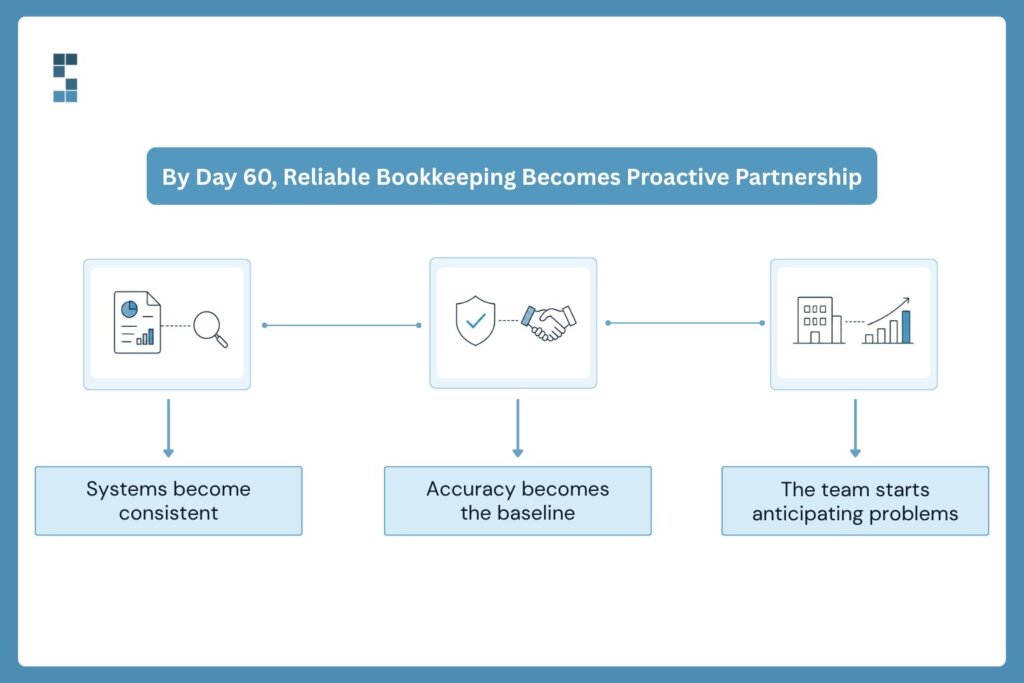
Month two is where relief hardens into trust, and trust is a different thing entirely. Relief is emotional. Trust is earned, repeatedly, by numbers that show up on time and turn out to be right.
By this point the systems built in month one are running. Bank feeds flow automatically, categorization follows rules tuned to your business, and reporting arrives with current data instead of last quarter’s. The close gets faster. The reports stop being a thing you chase and start being a thing that appears.
But here’s what clients actually talk about at the 60-day mark, and it’s rarely the software. It’s the behavior of the people. Marcus, who works with the team on an investor-backed business, said he feels he’s in good hands and especially appreciates how they’re inquisitive, ask follow-on questions, and look around corners. John put it even more bluntly, telling the team to mark him down as an 11 out of 10 on any internal satisfaction tracking, calling the team awesome and proactive and exactly what he needed.
Notice what both of those are describing. Not accuracy, which they take as table stakes by now, but anticipation. The difference between a bookkeeper who records what happened and a partner who notices what’s about to happen. That’s the month-two revelation for most clients: they hired someone to keep the books and got someone who watches the road ahead.
There’s an external signal that tends to land around this point too, and it carries unusual weight. One client mentioned that System Six had been recommended by their CPA as the best firm in the business for a company their size. Think about why that matters. Your CPA has no incentive to flatter your bookkeeper; if anything, sloppy books make their job harder and their fees higher. When the person who has to work downstream of your bookkeeping vouches for it, that’s a professional endorsement rather than a marketing claim. By day 60 you’re usually not the only one who has noticed things got better.
What does month three look like?
Month three is when the relationship changes character, and this is the part people don’t see coming.
For the first two months, you use your books to answer questions about the past. What did we spend? Did that client pay? By day 90 something flips. The numbers are current and reliable enough that you start using them to make decisions about the future. Which service line deserves more attention. Whether you can afford the next hire. Whether that big opportunity is actually as profitable as it looks. Orlan described System Six as their secret weapon when it comes to getting their finances in order, and “secret weapon” is a telling phrase. Nobody calls a bookkeeper a weapon. They call a competitive advantage a weapon.
The numbers back up the vibe shift. Clients typically see a 70 to 80 percent reduction in administrative time within 90 days, and the automation work often pays for itself inside 60 to 90 days on recovered time alone. But the more interesting result is what people do with that capacity. Trevor, looking back over the first year, simply said his firm was in a much better place than it had been twelve months earlier because of the improvements made to their bookkeeping process. That’s the quiet compounding: fix the foundation, and everything built on it gets steadier.
And there’s a trust dividend that shows up at the far end. Paul told the team that hiring them was the best decision he made at the start of his business, and that after their 2022 audit the auditors found exactly zero errors. Not only had the team been mistake-free, he said, they’d been proactive about catching his mistakes and spotting challenges coming down the road. An auditor finding nothing is the most boring possible outcome, and boring, when it comes to your books, is the entire point.
What the pattern tells you
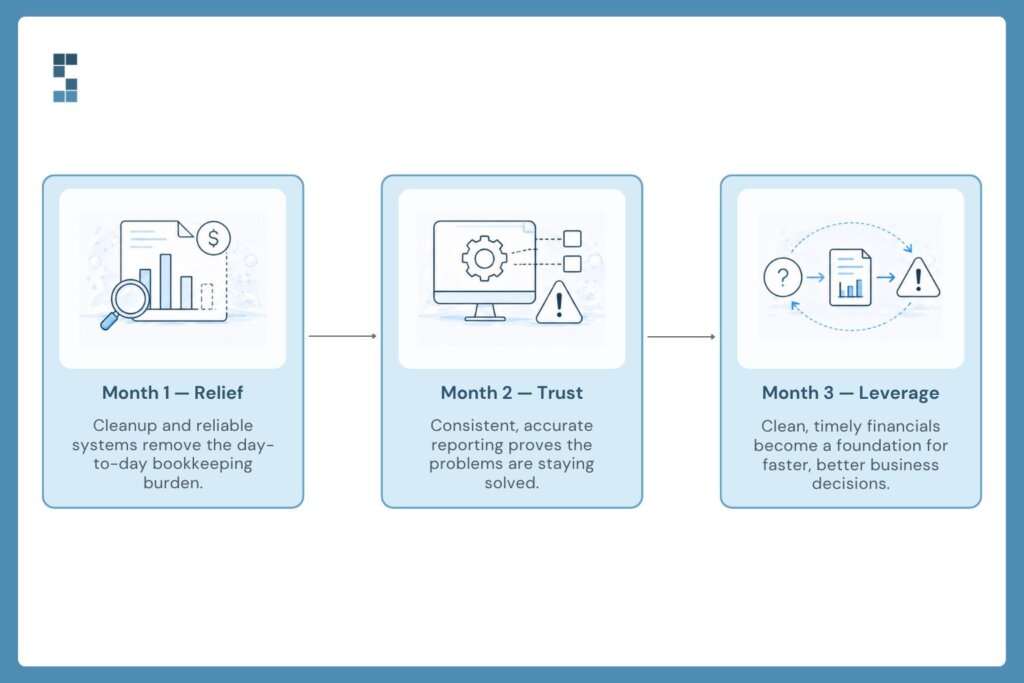
Read those experiences together and a shape emerges. Relief, then trust, then leverage. Month one takes the weight off. Month two proves the weight stays off. Month three turns clean books into better decisions.
It’s worth saying that not every relationship is identical. Firms arriving with messier books spend more of month one on cleanup. Firms already on solid systems move faster. But the sequence holds, because it’s less about the software than about what it takes for a person to stop worrying about something. You have to feel the burden lift, then watch it stay lifted, before you’ll start building on top of it.
That pattern is also why the strongest proof isn’t a statistic — it’s the fact that clients keep saying it out loud. Over half of System Six’s new clients each year come by referral, and existing clients rate the firm an average 9.5 out of 10 when asked whether they’d recommend it. Mari, after working with the team, described being impressed by how knowledgeable, thorough, thoughtful, and detailed they were. People don’t refer competence. They refer relief.
So back to Wesley’s question, the one worth asking before you sign anything. Not “what does this service promise?” but “what will I actually be feeling in three months?” Based on what clients say: lighter in month one, confident in month two, and by month three, a little annoyed you didn’t do it sooner.
Frequently asked questions
How long does it take to see results from a new bookkeeping provider?
Relief usually comes within the first 30 days, once the backlog is cleared and someone else owns the monthly bookkeeping and reconciliation. Measurable results follow quickly after: clients typically report a 70 to 80 percent reduction in administrative time within 90 days. Firms arriving with messier books spend more of the first month on cleanup, but the overall arc holds.
What results do bookkeeping clients actually report?
The most common reported outcomes are reduced administrative time, faster and more reliable monthly reporting, and significantly lower stress. Clients frequently highlight proactive service, being asked the right questions and having problems caught early, as much as they highlight accuracy. One client reported an external audit that found zero errors in the firm’s work.
How quickly does outsourced bookkeeping pay for itself?
For many firms, within 60 to 90 days on recovered time alone, before counting avoided errors or penalties. The payback comes from owner and staff hours redirected away from manual financial administration and back into billable or growth work. Firms with larger administrative burdens before the switch tend to see the fastest payback.
What should I expect in the first 90 days with a new provider?
Expect a three-stage arc. The first month centers on cleanup, system setup, and immediate relief from the administrative load. The second month builds trust as reporting becomes timely and accurate and the team starts flagging issues proactively. By the third month, most clients shift from using their books to review the past to using them to make forward-looking decisions about hiring, pricing, and growth.
About System Six
System Six is a Seattle-based bookkeeping and financial services firm that helps small and mid-sized businesses streamline their financial operations. We specialize in providing technology-driven financial management solutions for consulting firms, enabling owners to focus on growing their businesses without worrying about cash flow, payroll, or compliance. Our team of over 40 professionals brings an average of 10+ years of accounting experience to every client relationship, serving more than 175 businesses across the U.S. With a 9.5/10 NPS score, we deliver the financial clarity and peace of mind that consulting firm owners need to thrive. Learn more at www.systemsix.com.