The short answer: Switching bookkeeping providers takes about 30 days and moves through four weekly stages. Week one is handoff and access: gather your logins, statements, and prior books. Week two is cleanup and migration, where the new provider corrects errors and sets up your chart of accounts. Week three is parallel running, where old and new overlap so nothing drops. Week four is go-live, with the new provider fully owning your books. Handled well, the switch happens quietly in the background while you keep working, and you never miss a payroll run or a close.
Grace had wanted to fire her bookkeeper for six months before she actually did it. The reports were late, the numbers felt shaky, and every question turned into a three-day email chain. But she kept stalling, and the reason was always the same fear: what if switching is worse than staying? What if payroll breaks mid-transition, or half her financial history vanishes into some export that never quite imports? So she white-knuckled it with a provider she’d already outgrown, held hostage by the dread of the move itself.
If that’s you, take a breath. Changing financial providers isn’t the cliff-jump it feels like from the edge. Done properly, it’s a calm, staged 30-day handoff where the new team does the heavy lifting and your day-to-day barely flinches. The fear isn’t irrational; plenty of switches have gone badly, but bad switches almost always come from having no plan. So here’s the plan: four weeks, four stages, and a smooth landing.
Why does switching bookkeeping providers feel so risky?
Let’s name the fear before we dismantle it, because pretending it isn’t there doesn’t help. What actually keeps owners with a provider they’ve outgrown?
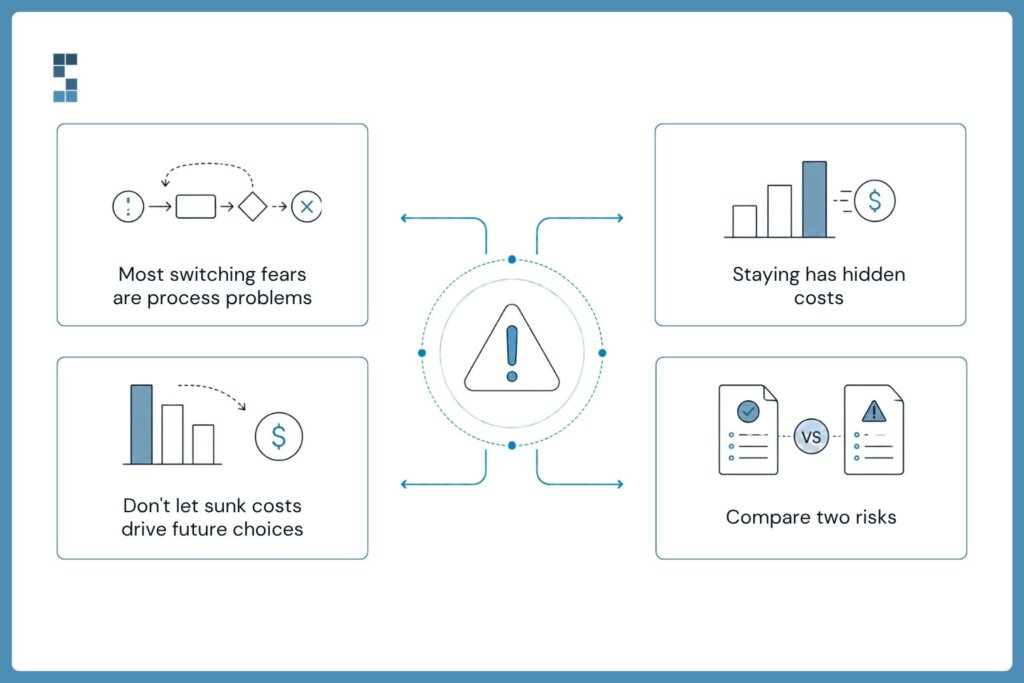
Three things, mostly. First, continuity: your books are the financial memory of your business, and the thought of a gap, a missing month, a payroll that doesn’t run, feels genuinely dangerous. Second, the hassle: you assume switching means hours you don’t have, digging up logins and re-explaining your whole operation to strangers. Third, the sunk-cost pull: you’ve invested time getting this provider up to speed, and starting over feels like setting that on fire.
Here’s the reframe. Every one of those fears is really a fear of doing it without a system. A gap only happens if nobody plans the overlap. The hassle only balloons if there’s no clear checklist of what to hand over. And the sunk cost? That’s money already spent, and clinging to a provider that produces late, shaky numbers keeps spending it. The right question isn’t “what did I invest to get here?” It’s “What is staying here costing me every month?” Once you’ve got a real plan, the danger drains out of the whole thing. So let’s walk the four weeks.
And that second question deserves a real answer, because the cost of staying is easy to underestimate. Late reports mean you’re making decisions on old information or no information. Shaky numbers mean every figure carries a little asterisk of doubt, so you double-check things you shouldn’t have to and hesitate on moves you should make with confidence. The three-day email chains are hours of your month, quietly gone. None of that shows up as a line item, which is exactly why it’s so easy to tolerate for another quarter, and another. The fear of switching is loud and immediate; the cost of not switching is silent and ongoing. That asymmetry is the trap, and naming it is how you climb out.
What are the four stages of a smooth bookkeeping transition?
Week one is handoff and access. This is the gather-everything week, and it’s lighter than you’d think. You pull together the essentials: logins to your accounting software, recent bank and credit card statements, payroll records, and access to your existing books. A good incoming provider hands you a simple checklist so you’re not guessing what matters. Your job here is mostly to open doors, not to do the work. The new team takes it from there.
Week two is cleanup and migration. Now the new provider goes to work under the hood, and this is where a good one earns their fee immediately. They review your existing books, clean up errors the old setup left behind, and build a proper chart of accounts tuned to how your business actually runs. If you’re already on QuickBooks Online, this moves fast, sometimes fast enough to compress the whole timeline. This cleanup step is quietly one of the biggest wins of switching: you don’t just get a new bookkeeper, you get your history straightened out on the way in.
Week three is parallel running. This is the stage that kills the continuity fear. For a short window, the new system runs alongside the old one instead of flipping a switch and hoping. Transactions get processed in the new setup, reconciliations get checked against the prior books, and everyone confirms the numbers tie out before anything is turned off. Nothing gets dropped because nothing is ever unsupported. The overlap is the safety net.
It’s worth sitting on why this stage matters so much, because it’s the single thing that separates a smooth switch from a scary one. Most horror stories about changing providers, the vanished month, the payroll that bounced, the reports that didn’t reconcile, trace back to a hard cutover: someone turned the old system off before proving the new one was ready. Parallel running makes that failure mode impossible by design. You’re not trusting a promise that everything transferred correctly; you’re watching it transfer correctly, in real time, with the old books still there to check against. By the time the overlap ends, the new setup has already been doing the job for a couple of weeks. Go-live isn’t a leap of faith. It’s a formality.
Week four is go-live and ownership. The new provider takes full control. Bank feeds flow in automatically, categorization runs on rules built for your business, and reporting switches on with current data. The old provider is thanked and released. You wake up on day 30 with clean books, a team that answers questions the same day, and the quiet realization that the thing you dreaded for months just… happened, in the background, while you ran your business.
Will switching disrupt payroll, taxes, or my CPA relationship?
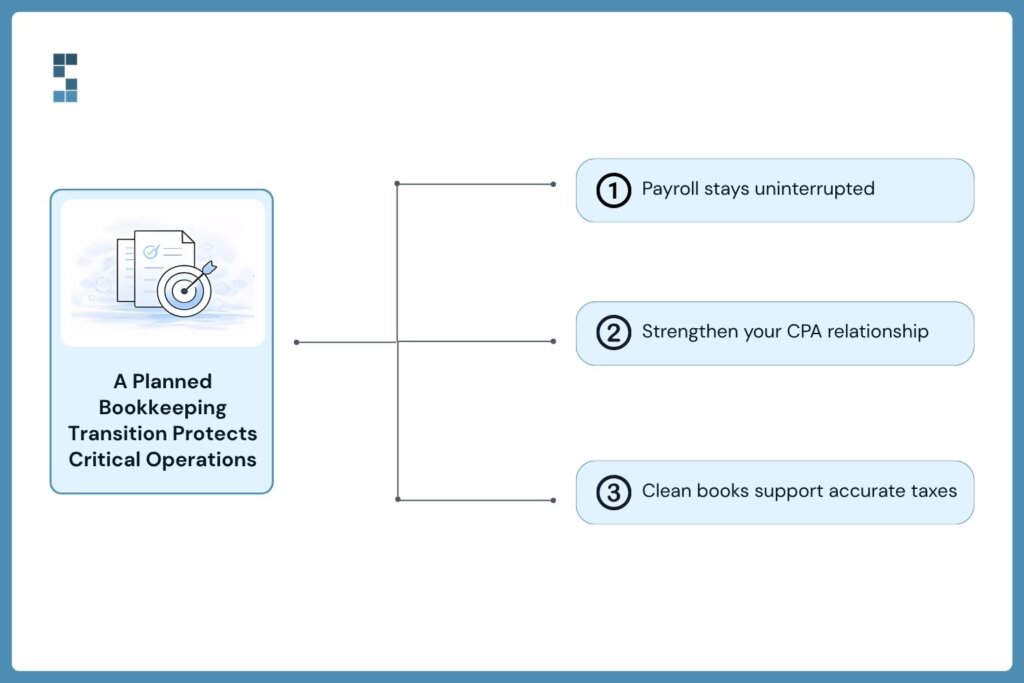
This is the practical worry underneath the big fear, so let’s hit it head-on. The three things owners guard most, payroll, taxes, and their CPA relationship, are exactly the things a staged transition is built to protect.
Payroll is precisely why week three exists. You never move payroll cold; you run it through the overlap until it’s confirmed clean, so your team gets paid on time throughout. Taxes stay safe because the cleanup in week two produces organized, accurate books, which is what your tax preparer actually wants. And your CPA relationship doesn’t just survive the switch, it usually improves, because a good bookkeeping provider coordinates directly with your tax preparer and hands them clean books that make their job easier and often reduce their fees. Many CPAs specifically ask their clients to work with a provider like this for exactly that reason. Switching your bookkeeper doesn’t threaten these relationships. It reinforces them.
Make the call before another month leaks away.
If you’ve been stalling like Grace, here’s the one move that matters: separate the decision from the dread. You already know whether your current provider is serving you. The only thing holding you back is the imagined chaos of the switch, and now you can see it isn’t chaos, it’s a checklist. Four weeks, mostly handled for you, with an overlap that guarantees nothing breaks.
Most firms are fully up and running with a new provider within about four weeks, faster if the books are already in decent shape. That’s the whole cost of escaping late reports and shaky numbers: roughly one month of a well-run process, most of it invisible to your day. This is the kind of onboarding System Six runs for the consulting firms, search funds, and growing businesses it serves: cleanup, migration, and a clean handoff, with the overlap that keeps payroll and reporting steady the entire way. It’s part of why over half of new clients come by referral, and why existing ones rate the firm an average of 9.5 out of 10. People refer to the relief of a switch that turned out to be painless.
So here’s the question worth answering honestly. If the switch itself is only 30 mostly-hands-off days, what exactly are you waiting for, and what is that wait costing you? The provider you’ve outgrown isn’t getting better. But the path to a better one is shorter and smoother than the fear has been telling you. Start the clock.
Frequently asked questions
How long does it take to switch bookkeeping providers?
Most firms are fully operational with a new provider within about four weeks. The timeline covers handoff and access, cleanup and migration, a parallel-running overlap, and go-live. If your books are already on QuickBooks Online and in reasonable shape, the process can often be compressed to two or three weeks.
Will I lose my financial history when I change providers?
No, not with a staged transition. Your existing books and records are gathered during the handoff week and migrated into the new setup, so your history moves with you rather than disappearing. The parallel-running stage adds a safety net: the new system runs alongside the old one, and the numbers are confirmed to tie out before anything is turned off.
Will switching bookkeepers disrupt my payroll?
It shouldn’t, because the overlap stage specifically protects payroll. Rather than moving payroll cold, a good transition runs it through the new system alongside the old until it’s confirmed clean, so your team keeps getting paid on time throughout the switch. Payroll continuity is one of the main reasons the transition is staged over several weeks instead of being flipped all at once.
Can a new bookkeeper work with my existing CPA?
Yes, and it usually makes the relationship better. A good bookkeeping provider coordinates directly with your tax preparer and delivers organized, accurate books that make their job easier and can reduce their fees. Many CPAs specifically request that their clients work with a dedicated bookkeeping provider for exactly this reason.
About System Six
System Six is a Seattle-based bookkeeping and financial services firm that helps small and mid-sized businesses streamline their financial operations. We specialize in providing technology-driven financial management solutions for consulting firms, enabling owners to focus on growing their businesses without worrying about cash flow, payroll, or compliance. Our team of over 40 professionals brings an average of 10+ years of accounting experience to every client relationship, serving more than 175 businesses across the U.S. With a 9.5/10 NPS score, we deliver the financial clarity and peace of mind that consulting firm owners need to thrive. Learn more at www.systemsix.com.