
by Chris Williams | Aug 25, 2025 | Blog
David’s consulting firm just landed their biggest client yet—a Fortune 500 company considering a major digital transformation. The contract? Seven figures. The opportunity? Career-defining.
Three weeks into the engagement, his project manager pulls him aside with panic written across her face. “We can’t process the invoicing for the client’s board meeting tomorrow. Our accounting system crashed, and we don’t have backup financial reports ready.”
David watches his credibility crumble in real time as he calls the client to explain the delay. The conversation that should’ve been about strategic insights becomes an awkward apology about “technical difficulties.” The client’s silence on the other end says everything.
Here’s what most consulting firm owners don’t realize: your financial operations aren’t just back-office functions. They’re direct reflections of your professional competence. Clients who trust you with million-dollar strategic decisions expect the same precision in how you handle invoices, expenses, and financial reporting.
And they’re watching. Every delayed invoice. Every billing confusion. Every expense report mix-up. It all adds up to a picture of who you are as a business partner.
Why Financial Reliability Equals Professional Credibility
Think about it this way. You wouldn’t hire a marketing consultant whose own website looks like it was built in 1995. You wouldn’t trust a strategy consultant who can’t organize their presentation slides. So why would clients trust consultants who can’t handle their financial operations smoothly?
The connection runs deeper than you might think.
“From day one, they have brought a professional approach to managing our finances and interacting with our staff and clients,” shares one business owner about their experience with System Six. “As a small business owner, I see them as a valued member of our team and not just another vendor.”
That’s the difference between transactional relationships and trusted partnerships. When your financial operations run like clockwork, clients start viewing you differently. You become the consultant who has their act together. The one who sweats the details. The strategic partner they can count on.
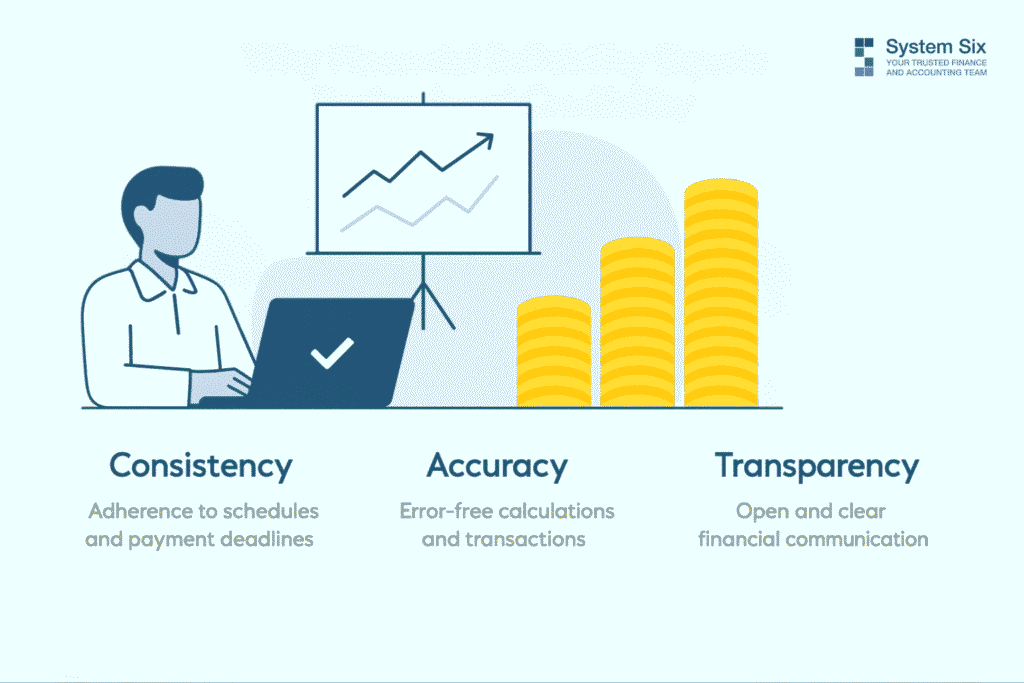
But what does financial reliability look like? Three pillars hold it up:
Consistency means your invoices arrive on schedule, and your expense reports follow predictable patterns. Clients can plan around your processes because they know what to expect and when.
Accuracy means the numbers add up the first time, every time. No awkward follow-up calls about billing errors or mysterious line items that require explanation.
Transparency means that your financial communication is clear enough for clients to understand and verify everything easily. No confusion, no guesswork, no surprises.
Here’s where it gets interesting. When clients trust your financial operations, they begin to trust you with more significant decisions. They approve budget increases without extensive scrutiny. They refer you to other decision-makers in their network. They extend contract terms based on demonstrated reliability. They stop viewing you as just another vendor and start seeing you as a strategic partner.
What Sloppy Financial Operations Cost You

Rebecca’s environmental consulting firm learned this lesson the hard way. She lost a $200,000 contract renewal—not because of poor project results but because of a three-month billing dispute that led the client to question her firm’s attention to detail.
Think about that for a moment. Excellent work. Happy client. Lost contract. Why? Because messy financial operations created doubt about everything else.
The hidden reputation killers lurk in places you might not expect:
Late or incorrect invoicing creates cash flow anxiety for clients managing budgets. Worse, it suggests poor project management capabilities. When clients have to do extra work reconciling your mistakes, they start wondering what else you might be getting wrong.
Inconsistent expense reporting raises questions about your cost control. It creates budget planning difficulties and signals potential scope creep issues down the road.
Poor financial communication leaves clients uncertain about project costs, creates surprises that damage relationships, and makes future budget approvals more challenging.
But here’s the part that stings: financial unreliability doesn’t just affect current clients. It creates a ripple effect that touches everything.
One System Six client discovered this firsthand: “Before we got our cash flow under control, we lost several excellent contractors because of payment delays. Word spreads quickly in professional networks when you can’t pay people on time. It took months to rebuild those relationships.”
The damage spreads beyond individual relationships. Clients won’t recommend firms they view as disorganized. Team members lose confidence when operations feel chaotic and cluttered. Growth opportunities disappear because you can’t scale without a solid operational foundation. And forget about premium pricing—it’s harder to justify high rates when clients have operational questions.
The Professional Standards That Set You Apart

So, what does financial excellence look like in practice? Let’s get specific.
Start with proactive financial communication. Don’t wait for clients to ask questions—provide regular project financial summaries that show precisely where their investment is going. Share cost breakdowns that help them understand value delivery. Document and communicate any scope or cost adjustments immediately before they become surprises.
“They work with my CPA directly, so all I have to do is review and approve,” explains one consultant about their System Six partnership. “I don’t want to run my business without them.”
That’s the standard you’re aiming for. Seamless operation that makes everyone’s life easier.
Your invoicing should impress, not just inform. Professional formatting that reflects your brand quality. Detailed breakdowns that justify every line item. Consistent timing that helps clients with budget planning. Clear payment terms and easy payment options that remove friction from the process.
Expense management becomes a way to demonstrate control rather than create confusion. It enables real-time expense tracking and reporting. Clear categories that align with client budgets. Documentation that supports every expense claim. Proactive flagging of budget variances before they become problems.
Financial reporting should build confidence, not raise questions. One System Six client puts it this way: “They provide 100% accuracy in monthly accounting.” Regular financial summaries that highlight project ROI. Clear variance explanations when budgets shift. Forward-looking insights that help clients plan their next moves.
But what happens when things go wrong? Crisis-proof reliability means having systems that function even when individual personnel are unavailable. “System Six has done wonders for my stress level,” shares another client. “They’ve created automated systems that track every deadline and requirement. I no longer worry about compliance—it’s all handled automatically.”
That’s the kind of reliability that builds trust. Not just when things go smoothly but especially when they don’t.
Making Financial Excellence Your Competitive Advantage
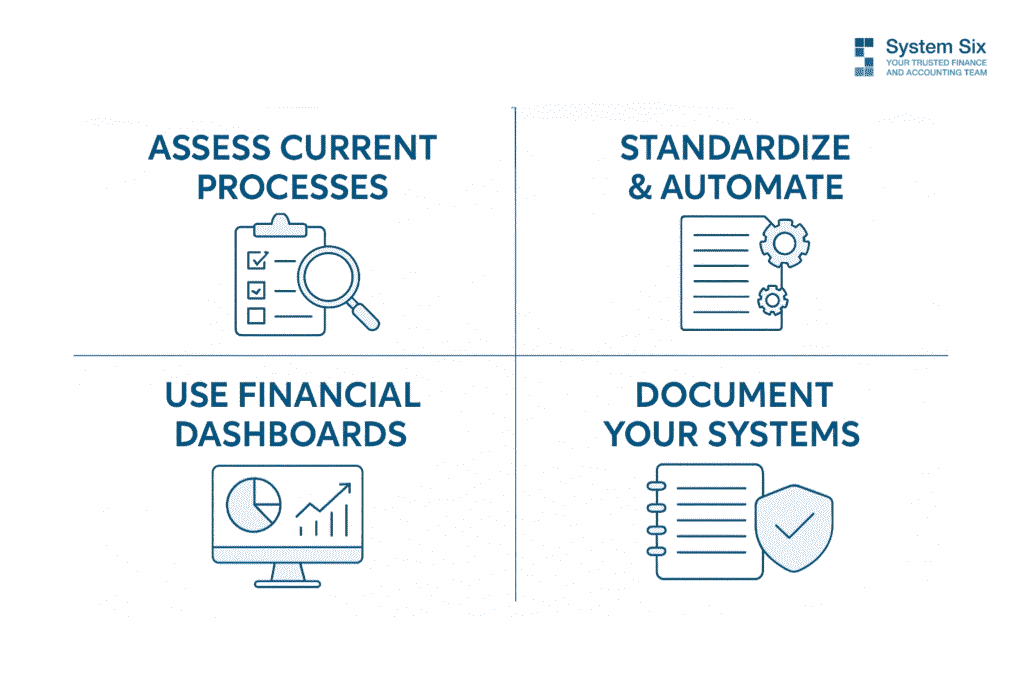
Ready to turn your financial operations into a trust-building machine? Start with an honest assessment.
How long does it take you to produce a financial summary for any project? When was the last time you had a billing dispute with a client? Can you confidently predict your cash flow 90 days out? Do clients ever ask follow-up questions about your invoices?
Your answers tell you where to focus first.
Quick wins create immediate impact. Standardize your invoicing with templates that reflect your brand and include necessary details—Automate routine processes so consistency doesn’t depend on memory or motivation. Create financial dashboards that give you and your clients real-time visibility into project economics.
However, the most crucial part is to document everything. Build systems that function independently of individual knowledge or availability.
“I don’t have to think about my accounting anymore,” notes one System Six client. “It’s just taken care of seamlessly.”
That seamless operation becomes your competitive advantage. While other firms struggle with billing disputes and cash flow surprises, you’re building trust through reliability and consistency. While competitors apologize for operational mistakes, you’re earning referrals through professional excellence.
The most successful consulting firms treat financial operations as a competitive advantage, not a necessary burden. They understand that operational excellence directly translates to client confidence and premium pricing power.
Your Financial Operations Are Your Brand
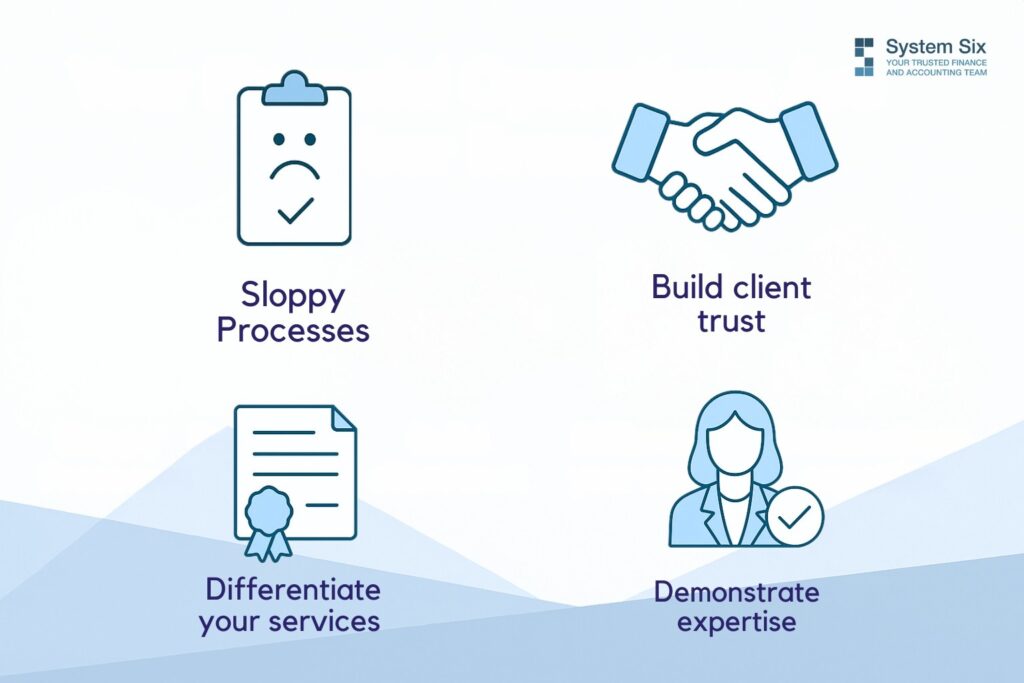
Your financial operations either build or erode client trust every single day. There’s no neutral ground here. Sloppy processes actively damage your reputation, while reliable systems become powerful differentiators that set you apart from every other consultant competing for the same clients.
“System Six isn’t just a vendor; they are friends who feel like part of our team,” explains one client. That’s the kind of trust and partnership reliable financial services create—not just for your financial provider but for how clients view your entire operation.
What would change about your client relationships if they viewed your financial operations as evidence of your strategic excellence rather than a source of occasional frustration?
When was the last time a client complimented your invoicing process? It may be time to make your financial operations a competitive advantage rather than a potential liability.
After all, you became a consultant to solve complex problems and drive transformation. Your financial operations should reinforce that expertise, not undermine it.
About System Six
System Six is a Seattle-based bookkeeping and financial services firm that helps small and mid-sized businesses streamline their financial operations. We specialize in providing technology-driven financial management solutions for consulting firms, allowing owners to focus on growing their businesses without worrying about cash flow, payroll, or compliance issues. Our team of over 35 professionals brings an average of 10+ years of accounting experience to every client relationship, serving more than 175 businesses across the U.S. From accurate bookkeeping to cash flow forecasting, we deliver the financial clarity and peace of mind that consulting firm owners need to thrive. Learn more at www.systemsix.com.

by Chris Williams | Aug 11, 2025 | Blog
It’s Tuesday afternoon, and the finance lead at a growing consulting firm is toggling between five browser tabs. A project manager needs updated billables. The managing partner wants this quarter’s burn rate. A client just flagged a duplicate invoice. The numbers are there, somewhere, but pulling them together feels like solving a puzzle.
This isn’t about disorganization. It’s the natural outcome of scaling faster than your financial systems. What used to work for a lean team starts breaking down when headcount increases and client demands grow more complex.
Most firm owners don’t notice the shift right away. But it shows up in the form of late nights, missed hours, and stalled decisions. Your team can’t forecast with confidence. And the tools that once felt flexible now feel fragile.
If this sounds familiar, it might be time to take a closer look at your financial systems. Not just how they function, but whether they can keep up with where your business is headed.
1. You’re Still Relying on Spreadsheets for Core Financial Workflows
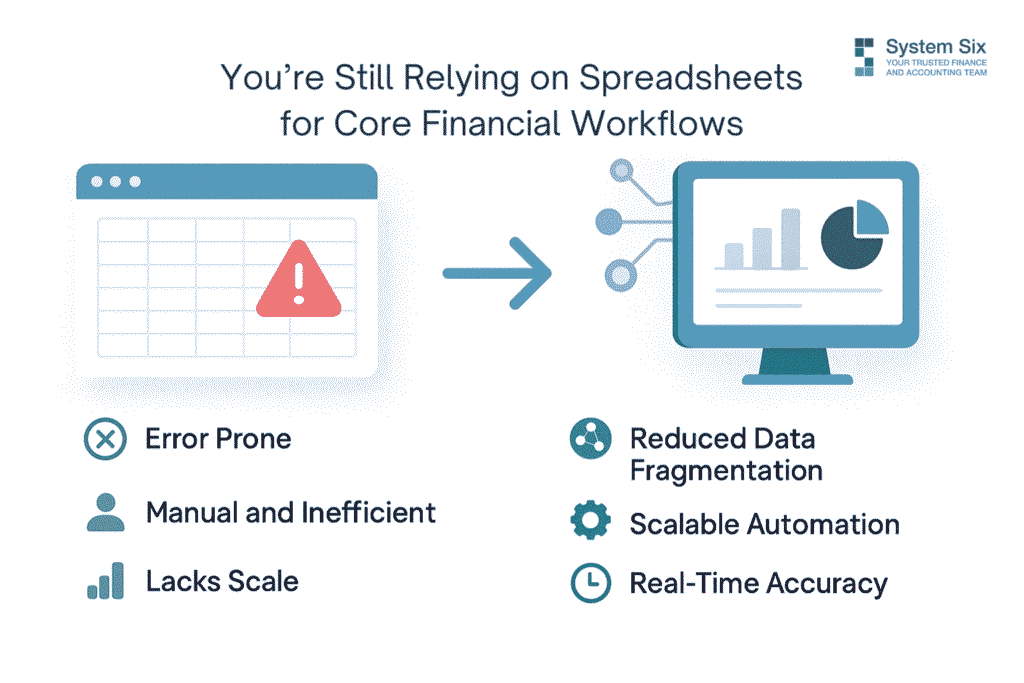
Spreadsheets often work well in the early stages. You can track expenses, create budgets, and monitor cash flow with enough customization to match your workflow. But as your consulting firm grows, those same spreadsheets start to limit visibility and delay decisions.
Every manual update increases the risk of error. A single misplaced formula or outdated data point can throw off forecasts, billing, and reporting. A study by PhysOrg found that nearly 94% of spreadsheets contain errors. When your financial systems rely on multiple linked spreadsheets, small mistakes tend to multiply.
Spreadsheets also slow things down. Data must be copied from one system to another before it becomes usable. You lose time double-checking numbers and chasing version control. This makes real-time insight almost impossible.
The more your business scales, the more touchpoints each financial process involves. One spreadsheet for client billing, another for cash flow, and a third for project profitability often means your team works harder to keep the numbers straight. That time could be spent on pricing strategies, margin analysis, or planning headcount.
Even when spreadsheets seem flexible, they cannot support the volume, complexity, or speed that scaling firms need. When financial accuracy depends on weekend maintenance or manual checks, the system has already outgrown its use.
Replace Manual Spreadsheets with Connected Financial Tools
Firms that grow without friction usually rely on systems that eliminate manual entry and reduce data fragmentation. When tools speak to each other, billing flows into forecasting, and expenses update reports in real time. This type of setup gives you a single source of truth that reflects the current state of your business.
Automation doesn’t mean giving up control. It means reducing the burden of repetitive updates so you can spend more time interpreting data instead of assembling it. Instead of reconciling spreadsheets before every meeting, you get financial reports that are already up to date.
Replacing spreadsheets with integrated systems also improves accuracy. Rules-based automation can categorize expenses, allocate billable hours, and flag inconsistencies long before they reach your clients or decision-makers. That clarity allows for faster approvals, cleaner audits, and stronger planning.
Firms that outgrow spreadsheets often need systems designed for scale. We help consulting firms move from spreadsheet-heavy workflows to connected tools that sync data across billing, forecasting, and reporting.
2. Billable Hours Are Falling Through the Cracks
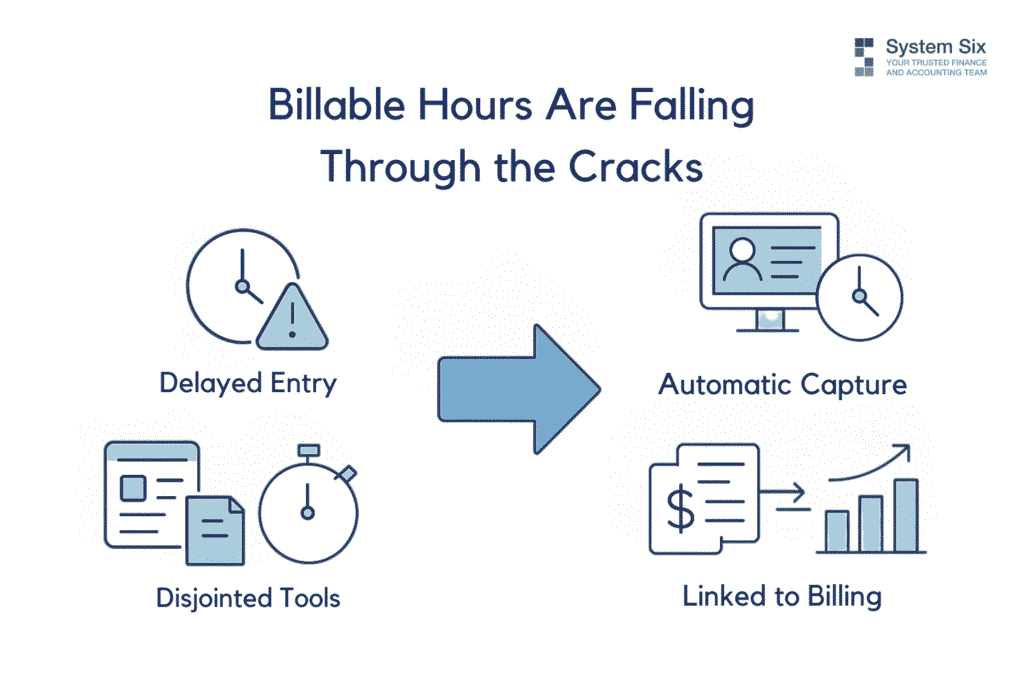
In a growing consulting firm, billable time often becomes harder to track. As projects scale and more team members contribute, hours slip through when time tracking depends on memory, manual logs, or disjointed tools.
Missed hours directly impact revenue. A study by ABA estimated that firms lose up to 50% of potential billables due to poor time tracking. That loss compounds when billing cycles rely on inconsistent inputs or when team members delay submitting time altogether.
When hours get recorded late, invoices go out slower. Revenue takes longer to reach your account. Over time, this delay affects your ability to forecast cash flow or reinvest in new work. Billing gaps can also erode client trust if invoices lack clear detail or include errors.
Firms often try to patch the process with spreadsheets or standalone trackers. But these tools rarely scale well. Hours get buried in email threads, inconsistent formats, or separate platforms. By the time everything is reviewed, your team has spent hours chasing data instead of doing billable work.
Stronger firms rely on integrated systems that simplify time capture and connect it directly to billing. Here’s what that looks like in practice:
- Time logs stay linked to client projects automatically. Team members enter hours within the same system used for project management or delivery. This ensures billable time is attached to the right client and task, without relying on memory or later clarification.
- Recorded hours flow directly into invoicing tools. When time entries sync with your billing system, you no longer need to copy and paste across tools or double-check spreadsheet formulas. Invoices can be prepared faster and reflect actual work completed.
- Systems flag gaps or low-entry days before invoices are sent. You get clear signals when a team member’s time log looks incomplete or falls short of expectations. This helps you catch missed hours early without having to audit manually.
- You gain better insight into profitability and planning. With cleaner time data, you can analyze how long projects actually take, spot clients with tighter margins, and make stronger decisions about pricing and staffing. That insight supports better resource allocation and long-term planning.
A system like this helps protect revenue without adding more administrative steps. It also frees your team to focus on project delivery instead of chasing down missing time.
Corporate cards that attach receipts to transactions in real time help ensure that project expenses align perfectly. This makes it easier to bill clients accurately and surface any missed costs before invoices go out.
3. Month-End Close Takes More Than a Week
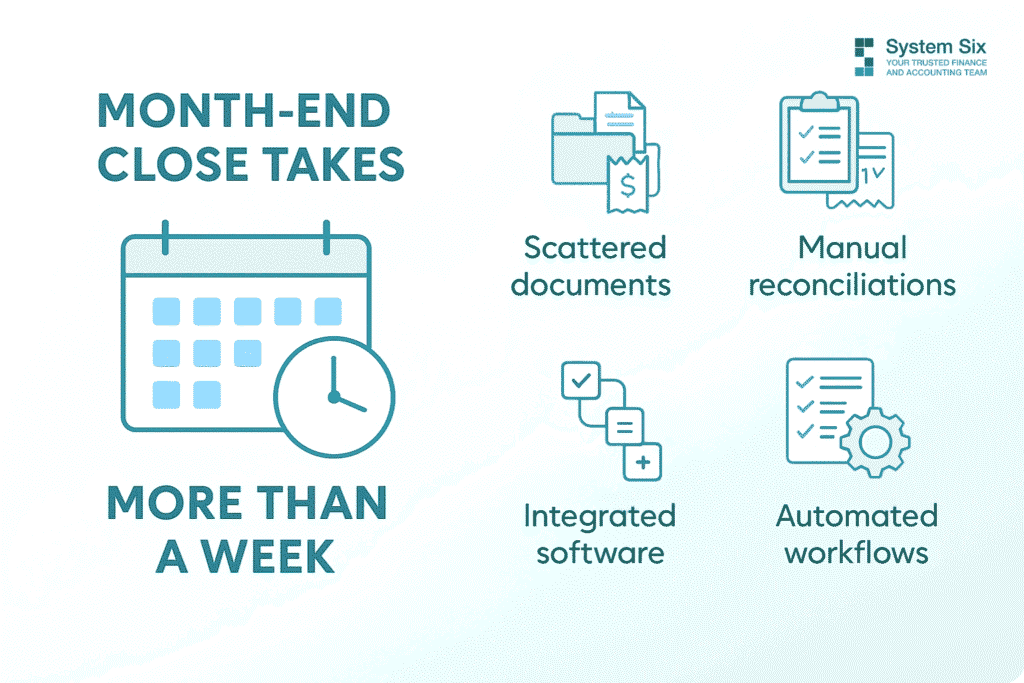
When your firm starts spending a full week or more closing the books, it usually points to deeper workflow problems. The delays often come from scattered data, manual reconciliations, and missing documentation. These bottlenecks grow worse as transaction volume increases or when multiple systems are not connected.
Every manual step adds risk. When receipts live in inboxes, invoices sit in drafts, or coding happens in bulk at the end of the month, the close process turns reactive. Errors creep in when teams rely on memory or rush through last-minute updates. Reviews take longer, and rework adds hours to every close.
Over time, a slow close limits financial visibility. Leadership decisions begin to lag behind actual performance. You lose the chance to correct course early or act on new opportunities while they are still relevant.
Build a Close Process That Runs in the Background
A faster close starts with structure. The goal is not to rush through the process but to spread the work evenly across the month. This means shifting from a reactive cycle to a continuous one where inputs, reviews, and reconciliations happen as the work gets done.
Integrated systems play a key role in making this possible. When your expense management, accounting software, and payroll tools talk to each other, you no longer depend on end-of-month scrambles to pull in data. Information flows in throughout the month and stays categorized from the start.
Rules-based automation supports consistency. Transactions get labeled the same way every time. Approvals follow the same path for every department. These steps reduce friction and make each close more predictable.
With the right setup, your month-end close becomes a reflection of how well your systems run, not a recurring fire drill that eats into every calendar cycle.
4. Forecasts Are Based on Gut Instinct And Not Real-Time Data
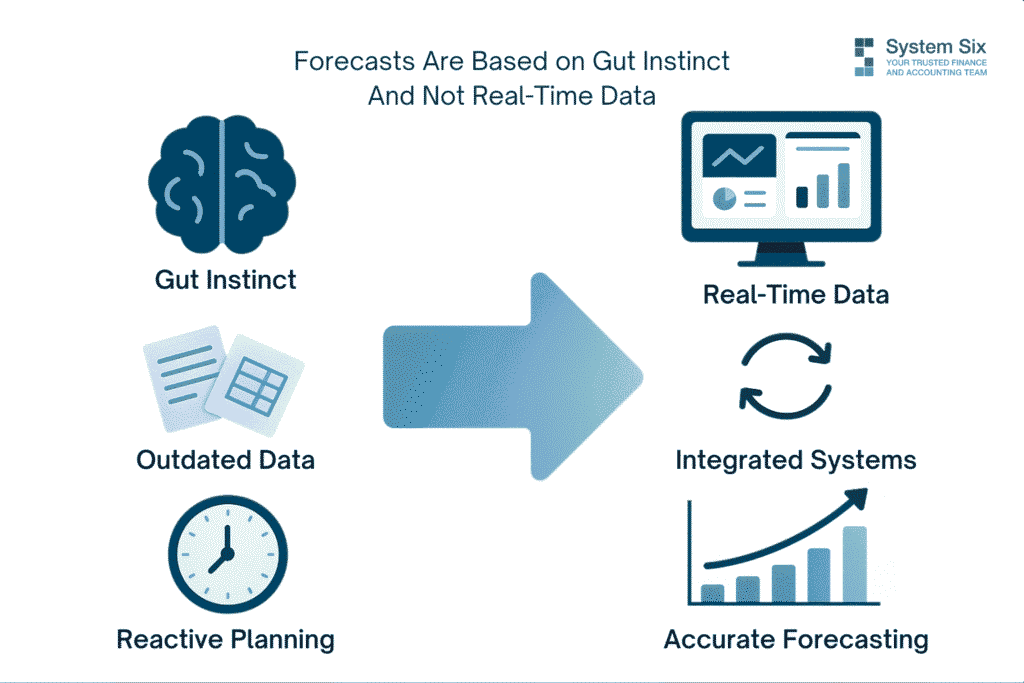
Strong forecasts rely on up-to-date numbers. But when financial inputs are scattered or delayed, many consulting firms default to intuition instead. Estimates are based on past experience rather than current conditions, and planning becomes reactive instead of intentional.
This disconnect often shows up in staffing, project timing, and cash flow. Without accurate forecasts, you risk overcommitting or underutilizing your team. You might delay a hire too long or take on too many projects at once. Each of these choices affects delivery, margins, and long-term growth.
In a CFO study, 43% of finance leaders said their forecasts often miss the mark because they rely on outdated or incomplete data. This gap makes it harder to respond to change, even when early signs are visible in your operations.
Manual data entry creates lag. By the time spreadsheets are updated, your numbers no longer reflect current activity. When forecasts are built on static reports, they can no longer support decisions that require speed or precision.
Build Forecasts That React to the Present
Accurate forecasting starts with systems that update as the business moves. Real-time data means your projections shift with actual performance rather than staying fixed until the next manual update.
When your financial systems connect directly to your CRM, project tools, and accounting software, forecasts begin pulling from live inputs. New contracts, delayed payments, and updated costs reflect instantly in your reports. This gives you a clearer view of revenue timing, upcoming expenses, and available capacity.
Predictive models become more reliable when built on structured data. Instead of basing forecasts on gut instinct, you can use historical patterns layered with current trends. This helps you plan with more confidence and less guesswork.
At System Six, we support firms with rolling cash flow forecasts and scenario planning tools that pull directly from live project and billing data. This helps leaders move from gut-driven decisions to data-backed planning.
When forecasts become a real-time tool rather than a periodic spreadsheet, you get faster answers to the questions that matter. This allows your firm to stay flexible and make decisions based on current circumstances, not just what happened last quarter.
5. Your Systems Can’t Scale with Headcount or Client Volume
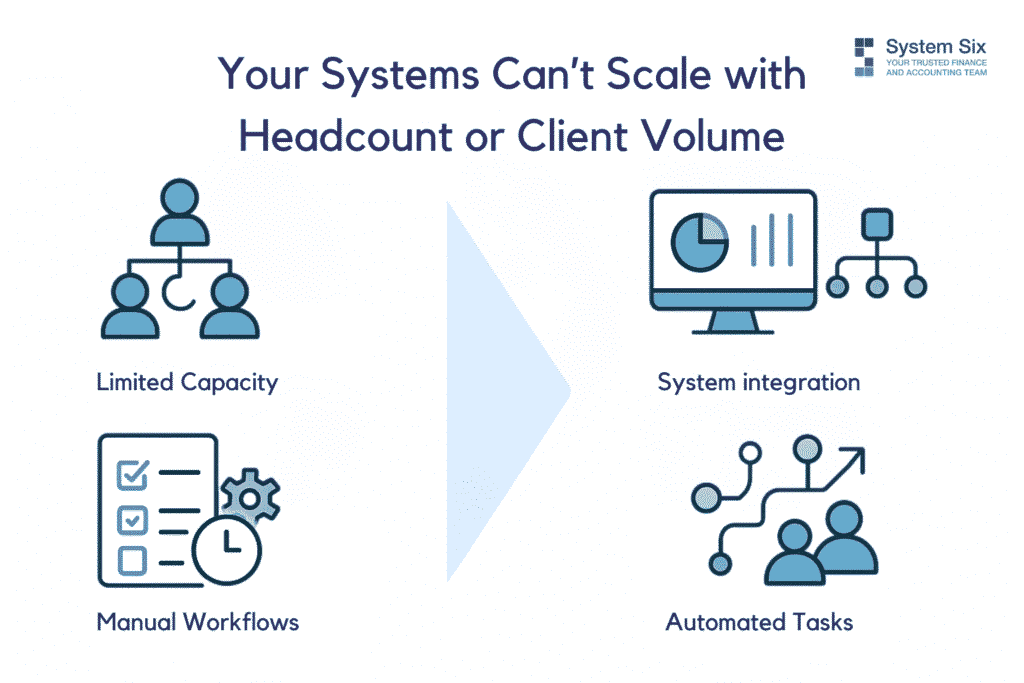
Growing firms face more complexity with each new client or hire. More projects increase the number of invoices, time entries, expenses, and financial reviews. Without the right systems, these moving parts begin to strain your team and delay core workflows.
Systems that worked for a five-person team often start breaking down once you reach ten. Processes built around manual entry or loosely connected tools become harder to manage. Work slows down as your team spends more time maintaining tools than serving clients.
You might notice approvals taking longer, project data becoming harder to reconcile, or reporting deadlines being missed. Each delay signals a system that can no longer keep pace with demand.
Cost of Reactive Fixes Versus Proactive System Design
When systems break under pressure, most firms respond with quick fixes. A new spreadsheet to track hours. Or another login for a billing tool. These short-term solutions often solve immediate issues but create more friction over time.
Reactive fixes add complexity and slow down your decision-making process. Proactive system design focuses on building workflows that hold up as your firm grows.
Here’s how the two approaches compare:
- Workflow structure: Reactive fixes create scattered processes that require extra steps and individual workarounds. Proactive systems standardize how work gets done, making it easier to train new team members and maintain consistency across projects.
- Data access: Reactive fixes rely on manual exports and spreadsheets that delay insight. Proactive systems pull live data from connected tools, giving you real-time visibility without additional work.
- Workload management: Reactive fixes increase administrative overhead and require frequent check-ins to stay on track. Proactive systems automate repetitive tasks, freeing up time for analysis and planning.
- Team knowledge: Reactive fixes often depend on a few people who know how to manage exceptions and workarounds. Proactive systems reduce this dependency by creating shared, transparent processes.
- Growth readiness: Reactive fixes fall apart under pressure as volume increases. Proactive systems scale alongside your business, so adding clients or team members does not require redesigning your workflows.
Build a Scalable Financial Stack That Supports Your Growth
Stronger firms invest in systems that grow with them. These systems handle more volume without adding more complexity. When your billing, expense, time tracking, and reporting tools are connected, your team can move faster with fewer errors.
A scalable financial stack reduces the number of decisions your team needs to make just to keep things running. Financial reports pull from a single data source. Invoices and time entries follow the same structure across every client.
The right setup gives your team structure without rigidity. As new clients come in or roles shift internally, your systems continue to support day-to-day work without disruption. This foundation allows your firm to focus on delivery and planning, not on fixing what broke behind the scenes.
Why Financial Systems Should Grow With You?
Financial systems that grow alongside your business create space for focus, speed, and control. As you take on more clients, launch new services, or expand your team, your workflows shift. A system that scales with those shifts gives your team the structure it needs to stay confident through change.
Growth introduces more decisions. Whether you are adjusting pricing, planning capacity, or reviewing profitability, those choices depend on timely, accurate information. A flexible system makes that information available without extra work. It updates with your business and reflects what is happening now, not what happened last quarter.
About System Six
System Six is a remote bookkeeping and financial services firm that helps small and mid-sized businesses streamline their financial operations. We specialize in providing technology-driven financial management solutions for consulting firms, allowing owners to focus on growing their businesses without worrying about cash flow, payroll, or compliance issues.
Our team of over 40 professionals brings an average of 10+ years of accounting experience to every client relationship, serving more than 200 businesses across the U.S. From accurate bookkeeping to cash flow forecasting, we deliver the financial clarity and peace of mind that consulting firm owners need to thrive. Learn more at www.systemsix.com.

by Chris Williams | Aug 4, 2025 | Blog
Jennifer closes her laptop with a frustrated sigh. It’s Saturday morning, and she’s just spent three hours updating five different Excel spreadsheets to prepare Monday’s financial reports for her HR consulting firm. The irony isn’t lost on her—she advises companies on operational efficiency while manually copying data from QuickBooks to a cash flow spreadsheet, then to a client profitability tracker, then to a budget variance analysis.
Each manual transfer feels necessary. The cash flow projection helps her plan hiring decisions. The client profitability analysis guides pricing strategies. The budget variance report keeps her accountable to financial goals. But what started as simple tracking has evolved into a complex web of interconnected spreadsheets that demands weekend maintenance sessions.
This scenario illustrates what I call the “spreadsheet spiral”—a predictable pattern that occurs when businesses outgrow basic accounting software but haven’t yet implemented integrated automation. What begins as reasonable flexibility quickly becomes an administrative burden that consumes time exponentially as companies grow.
Understanding automation isn’t about replacing human judgment with robotic processes. It’s about eliminating repetitive data manipulation that doesn’t require human intelligence, freeing your cognitive resources for activities that truly need your expertise and decision-making capabilities.
Let me teach you how to recognize when you’ve entered the spreadsheet spiral, understand the hidden costs it creates, and implement automated solutions that restore your weekends while improving your financial visibility and accuracy.
Understanding the Spreadsheet Spiral

The spreadsheet spiral emerges predictably in growing consulting firms because each decision seems logical and necessary. You start with basic bookkeeping software that handles transactions and basic reporting. Then you need cash flow projections, so you create a spreadsheet that pulls data from your accounting system. Project profitability becomes essential, so you build another spreadsheet that combines time tracking with expense data. Budget planning requires yet another spreadsheet that compares projected to actual performance.
Think of this like building a house of cards. Each addition makes the structure more impressive and functional, but it also becomes more fragile and time-consuming to maintain. Eventually, you’re spending more time keeping the structure than benefiting from its capabilities.
The warning signs are easy to recognize once you know what to look for. You find yourself saying things like “I just need to update my spreadsheets before we can discuss the numbers.” You postpone financial decisions because getting current data requires too much manual work. You discover discrepancies between different reports because data has been updated in one place but not in another.
Here’s what makes this particularly insidious for consulting firms: spreadsheets feel like the natural evolution beyond basic bookkeeping because they offer complete flexibility and customization. You can create the exact analysis you want, formatted precisely as you prefer it. The problem isn’t using spreadsheets for analysis—it’s feeding them manually with data that could flow automatically.
Understanding data redundancy helps clarify why this becomes problematic. When the same information exists in multiple places, it must be manually synchronized or it becomes inconsistent. Your revenue might be recorded in QuickBooks, summarized in a cash flow spreadsheet, analyzed in a profitability tracker, and compared in a budget variance report. Each location requires manual updating, and each manual update introduces potential errors.
Error propagation compounds this challenge because mistakes in manual data entry multiply through interconnected systems. If you mistype an invoice amount in your cash flow projection, that error affects your hiring decisions, spending plans, and growth strategies until you discover and correct it.
The opportunity cost might be the most expensive aspect of all. Time spent manipulating data represents time not spent on client work, business development, or strategic planning. When Jennifer spends Saturday morning updating spreadsheets, she’s not just losing personal time—she’s foregoing revenue-generating activities that could transform her business.
The Hidden Costs of Manual Financial Management

Most consulting firm owners dramatically underestimate the actual cost of manual financial management because individual tasks seem manageable, and the cumulative impact remains invisible until it is measured systematically.
Let me guide you through calculating the actual time investment. Track your financial management activities for two weeks, noting every instance of data entry, spreadsheet updates, report preparation, and error correction. Include the “quick” tasks that feel insignificant individually but add up substantially over time.
Most business owners discover they’re spending fifty to one hundred percent more time on financial management than they realized. What feels like “just twenty minutes” updating cash flow projections daily actually represents two and a half hours weekly, or 130 hours annually—equivalent to more than three full work weeks dedicated to data manipulation.
Consider the mathematics from Jennifer’s point of view. Suppose she earns two hundred dollars per hour when doing client work but spends ten hours monthly on manual financial tasks. In that case, she’s sacrificing $24,000 annually in revenue potential. That’s before accounting for the business development and strategic planning that doesn’t happen because her administrative burden consumes available time.
Error costs create another layer of hidden expense. Manual data entry introduces mistakes at predictable rates that multiply through interconnected systems. Transcription errors, formula mistakes, version control problems, and synchronization failures require correction time that often exceeds the original task duration.
These errors can damage client relationships when they affect external reporting or billing accuracy. I’ve seen consulting firms lose client confidence because of manual errors in time tracking, which led to billing discrepancies that required uncomfortable conversations and relationship repair.
The stress and decision-making costs might be the most significant hidden expense. Constant awareness of pending financial tasks creates cognitive load that reduces focus on client work. Poor financial visibility leads to delayed or suboptimal business decisions that compound over time.
When you can’t quickly access current financial information because it requires manual compilation, you postpone essential decisions about hiring, investments, and growth strategies. This hesitation costs opportunities that might be worth multiples of the time saved through automation.
The Architecture of Automated Bookkeeping

Understanding how automated bookkeeping works helps demystify the transition from manual processes to integrated systems. Think of automation like installing plumbing in your house. Instead of manually carrying water from a well every time you need it, automation creates direct connections that provide continuous flow without manual intervention.
The foundation involves data flow automation that eliminates manual data transfer by creating direct connections between different systems. Your bank transactions are automatically imported into accounting software, which updates cash flow projections, client profitability reports, and budget variance analyses—the human role shifts from data manipulation to data interpretation and decision-making.
Transaction processing automation follows a logical hierarchy that builds confidence through progressive implementation. Start with transaction capture, where bank feeds automatically import purchases, payments, and deposits into your accounting system. Then advance to automated categorization using rules-based systems that learn from patterns and improve accuracy over time.
Begin with obvious categories, such as rent, utilities, and payroll, which follow predictable patterns. As the system learns your preferences and business patterns, it can expand to more complex project-based categorizations that require a nuanced understanding of your service offerings and client relationships.
Integrated reporting systems represent the next level of sophistication, pulling data directly from transaction systems to create real-time financial insights. Instead of manually updating multiple spreadsheets with outdated information, automated systems generate reports instantly with current data.
Cash flow projections update automatically as invoices get paid and expenses get recorded. Client profitability reports reflect real-time project costs without manual data entry. Budget variance analyses compare actual performance to projected performance using current information, rather than relying on last week’s manual compilation.
This real-time capability enables proactive decision-making rather than reactive problem-solving. When Jennifer can see her cash position, project profitability, and budget performance instantly, she can make informed decisions about hiring, investments, and client relationships without waiting for weekend update sessions.
Workflow integration creates systematic connections between different business processes, eliminating manual hand-offs between time tracking, project costing, client billing, and financial reporting. Each integration point represents time savings and error reduction opportunities that compound as your business grows.
The key insight involves striking a balance between automation and analytical flexibility. Automated systems can accommodate business-specific needs without requiring custom programming, but they should focus on automating data processing while preserving your ability to perform unique analysis and modeling.
Utilize automation for repetitive data manipulation while maintaining spreadsheet capabilities for specialized analyses that require human judgment and creativity. The goal is to reduce manual work, not eliminate your analytical capabilities or constrain your ability to understand your business deeply.
Implementation Roadmap for Spreadsheet Elimination

Successful automation implementation requires systematic progression that builds confidence through early wins rather than overwhelming your operations with too much change simultaneously.
Begin with comprehensive assessment of your current spreadsheet usage and manual processes. Map the data flow from sources like bank accounts, time tracking systems, and project management tools through your various spreadsheets to final reports and decisions.
Identify which spreadsheets provide unique analytical value versus those that reformat data from other systems. Focus your automation efforts first on eliminating spreadsheets that primarily serve as data transfer mechanisms rather than those that perform complex analysis requiring human judgment.
Foundation automation should start with transaction processing before advancing to sophisticated reporting systems. Implement automatic bank feeds first, ensuring that your financial transactions are imported directly into your accounting software without requiring manual entry. Then add automated categorization rules that assign transactions to appropriate accounts based on vendor, amount, or description patterns.
Master each level of automation thoroughly before introducing additional complexity. This progressive approach builds confidence while ensuring that foundational systems work reliably, allowing you to depend on them for more sophisticated functions.
Integration and optimization connect different automated systems to eliminate remaining manual data transfer points. Link time tracking to project costing, client billing, and financial reporting in seamless workflows that update automatically as work is completed and billed.
Utilize automation to facilitate more advanced analysis, rather than merely replacing existing processes. When data flows automatically, you can perform analysis that was previously too time-consuming to attempt regularly, providing insights that improve decision-making and business performance.
Track time savings, error reduction, and decision-making speed improvements to validate your automation investments and guide further optimization. Most consulting firms achieve seventy to eighty percent reduction in financial management time within ninety days of proper implementation.
Consider professional implementation support when the complexity exceeds your expertise or when expert guidance will accelerate your progress. System Six specializes in helping consulting firms eliminate spreadsheet dependence while preserving analytical capabilities, typically achieving full automation faster than DIY attempts while ensuring proper integration between systems.
Your Path to Automated Freedom

Spreadsheet elimination isn’t about reducing your analytical capabilities—it’s about automating data processing to enable better analysis with less manual effort. Every hour you spend manipulating data represents time that could be directed toward activities requiring your unique expertise and generating revenue for your business.
Start by auditing your current spreadsheet usage to identify automation opportunities with the highest time-saving potential. Implement foundation automation around transaction processing before advancing to complex integrations that connect multiple business systems.
Measure your time savings and redirect that recovered capacity toward revenue-generating activities, such as client acquisition, service delivery, and strategic planning. The goal extends beyond efficiency to enable the kind of growth and client service that spreadsheet maintenance prevents.
Transform your weekend financial administration into automated background processes that provide better information with less effort, enabling you to build a consulting practice that supports your life rather than consuming it.
About System Six
System Six is a Seattle-based bookkeeping and financial services firm that helps small and mid-sized businesses streamline their financial operations. We specialize in providing technology-driven financial management solutions for consulting firms, allowing owners to focus on growing their businesses without worrying about cash flow, payroll, or compliance issues. Our team of over 35 professionals brings an average of 10+ years of accounting experience to every client relationship, serving more than 175 businesses across the U.S. From accurate bookkeeping to cash flow forecasting, we deliver the financial clarity and peace of mind that consulting firm owners need to thrive. Learn more at www.systemsix.com.
Committed to Giving You Time Back
Get clarity with System six


by Chris Williams | Jul 25, 2025 | Blog
Elena closed her laptop with a frustrated sigh. It was 9 PM on Sunday, and she’d just spent two hours categorizing last week’s expenses for her management consulting firm. In the next room, her family was watching a movie together—the kind of simple evening she’d been promising herself she’d join once she “caught up” on administrative work.
But here’s what Elena didn’t realize: she wasn’t catching up on anything. She was trapped in a cycle of what I call “productive procrastination”—doing work that feels necessary and important but doesn’t require her unique expertise or judgment.
Think about it this way. Elena has fifteen years of strategic consulting experience, an MBA from a top-tier program, and deep expertise that clients pay $300 per hour to access. Yet she was spending her Sunday evening doing data entry that a computer could complete in seconds with greater accuracy than she could achieve manually.
This scenario illustrates a fundamental confusion that plagues most consulting firm owners: mistaking “being busy” with “being productive” when it comes to administrative tasks. The false economy of “doing it yourself” feels responsible, but it’s one of the most expensive mistakes you can make as a business owner.
Understanding automation isn’t about being lazy—it’s about recognizing that human intelligence should be directed toward activities that genuinely require human intelligence. By mastering these eight automation opportunities, you’ll transform weekend administrative tasks into quality family time while enhancing the accuracy and efficiency of your business operations.
Understanding the Automation Opportunity

Before we explore specific automation opportunities, let’s establish a clear learning foundation that will help you think systematically about administrative efficiency.
Automation functions like hiring a tireless assistant who never makes calculation errors, never forgets deadlines, and works around the clock without needing supervision or management. But understanding how to deploy this “assistant” effectively requires recognizing that administrative tasks fall into three distinct categories.
First, you have data processing tasks—activities such as expense categorization, invoice generation, and financial reporting — where you’re essentially moving information from one format or location to another. These tasks follow predictable rules and rarely require judgment calls, making them ideal candidates for automation.
Second, you encounter repetitive communication tasks such as client updates, meeting reminders, and progress reports. While these communications serve important relationship-building purposes, the actual process of creating and sending them often follows standard templates and timing patterns.
Third, you are responsible for compliance monitoring activities, including tracking tax deadlines, contract renewals, and regulatory requirements. These tasks are critical for avoiding penalties and maintaining good standing, but they primarily involve systematic tracking rather than complex decision-making.
Here’s a simple framework to guide your automation thinking: if you perform a task manually three times in essentially the same way, it’s likely automatable. This “Rule of Three” helps you distinguish between truly custom work that requires your judgment and routine processes that can be systematized.
I often encounter three common obstacles that business owners face when considering automation. The first is “I don’t have time to set up automation.” But consider this: if you spend two hours monthly on expense tracking, investing four hours to automate the process will pay for itself within two months and save you twenty hours annually in the future.
The second obstacle is “My business is too unique for standard automation.” While your services and clients may be unique, most administrative tasks follow remarkably similar patterns across consulting firms. Invoice generation, expense tracking, and compliance monitoring work the same way regardless of whether you’re a strategy consultant or an IT specialist.
The third obstacle involves technical intimidation: “Automation is too complicated for someone like me.” Modern automation tools are designed specifically for non-technical business owners. You don’t need programming skills—you need systematic thinking and patience to set up processes correctly.
To illustrate the transformation possible, consider a System Six client who reduced monthly administrative time from twenty hours to three hours through strategic automation. This wasn’t about expensive enterprise software or complex technical implementations. It was about systematically identifying repetitive manual work and replacing it with automated processes that run reliably in the background.
The 8 High-Impact Automation Opportunities

Let me walk you through eight specific automation opportunities, building from simpler implementations toward more sophisticated systems that will transform your administrative efficiency.
Expense categorization and receipt processing represent the most accessible starting point for most consulting firms. Manual expense sorting typically consumes two to three hours monthly, involving the tedious process of photographing receipts, entering amounts, and categorizing purchases according to your chart of accounts.
Modern expense automation tools can photograph receipts and automatically extract vendor information, amounts, and relevant categories with over 90% accuracy. The learning approach here involves starting with one expense category—perhaps office supplies or software subscriptions—before expanding to comprehensive automation. One System Six client reduced expense processing time from four hours monthly to fifteen minutes of review, redirecting those saved hours toward business development activities.
Invoice generation and payment tracking eliminate another significant time drain while improving cash flow management. Manual invoicing requires remembering different client billing cycles, accurately calculating project costs, and monitoring payment status across multiple accounts.
Template-based automation systems can generate invoices automatically based on time tracking data or project milestones, then monitor payment status and send follow-up reminders according to your preferences. Begin implementation with your most predictable clients—those on monthly retainer arrangements—before expanding to complex project-based billing. The typical time savings ranges from six to eight hours monthly on billing administration alone.
Accounts payable and bill management prevent the expensive errors that occur when vendor bills get overlooked or paid incorrectly. Manual bill tracking involves capturing invoices from various sources, routing them for approval, and scheduling payments to avoid late fees and duplicate payments.
Automated systems can capture bills electronically, route them through predefined approval workflows, and schedule payments automatically according to your cash flow preferences. Start with recurring monthly bills, such as rent, utilities, and software subscriptions, where the amounts and timing remain relatively predictable. This automation prevents late fees while enabling you to take advantage of early payment discounts.
Payroll processing and tax compliance eliminate the risk factors associated with manual wage calculations and regulatory compliance. Payroll errors create legal compliance issues, erode employee trust, and can lead to costly penalties from multiple government agencies.
Integrated payroll systems calculate wages, deductions, and tax withholdings automatically while maintaining compliance across different state requirements as your business grows. Begin with basic payroll automation before adding complexity, such as commission calculations or project-based bonuses. The outcome includes the elimination of payroll errors and automatic compliance reporting, which saves hours during tax season.
Client communication and project updates streamlines the ongoing relationship management that consumes significant time but follows predictable patterns. Keeping clients informed requires regular progress updates, scheduling meetings, and notifying them of milestones.
Automated communication systems can send project status emails, meeting reminders, and completion notifications based on project timelines and predefined triggers. Create templates for common communication scenarios, and then automate the delivery timing to ensure consistent client engagement without requiring manual coordination efforts. This builds client confidence through reliable communication while freeing your time for substantive client work.
Time tracking and project cost analysis addresses the revenue leakage that occurs when billable time gets forgotten or inaccurately recorded. Manual time tracking leads to undercharging clients and poor project profitability analysis.
Automated tracking systems capture billable time as you work and connect it directly to project budgets and client billing processes. Begin with simple time capture before incorporating sophisticated project analytics that display profitability trends and resource utilization patterns. The result is improved project profitability visibility and more accurate client billing that often increases revenue by five to ten percent.
Cash flow forecasting and financial reporting streamline the monthly financial close, transforming it from a multi-day process into an automated report generation. Understanding your financial position traditionally requires manually compiling data from multiple sources and creating reports that become outdated as soon as they are finished.
Automated reporting systems compile real-time financial dashboards that show cash position, accounts receivable aging, and profitability trends, updated continuously as transactions occur. Begin with basic cash flow tracking before developing comprehensive financial reporting that provides immediate visibility into business performance.
Compliance monitoring and deadline management eliminates the expensive penalties that result from missing tax deadlines, contract renewals, or licensing requirements. Manual deadline tracking relies on memory and calendar entries that can be overlooked during busy periods.
Automated compliance systems track requirements systematically and send alerts well in advance of deadlines, providing sufficient time to complete necessary actions without stress. Start with the highest-risk compliance areas, such as tax deadlines and insurance renewals, before expanding coverage to all regulatory requirements.
Implementation Strategy: Your Path Forward

Successful automation implementation requires a systematic approach that builds confidence through early wins, rather than overwhelming your current operations with too much change at once.
Begin by assessing and prioritizing opportunities for automation by tracking your administrative time for two weeks to identify the areas that have the highest impact. Use the “pain times frequency” calculation—tasks that are both painful to complete and occur frequently offer the best return on investment for automation. Focus initially on tasks that currently consume the most time or cause the most stress.
Start small and build confidence by choosing one automation project to prove the concept before expanding your efforts. I recommend starting with expense tracking or invoice generation, as they offer immediate, measurable time savings that demonstrate the value of automation. Master one system completely before adding complexity or additional tools.
The integration and scaling phase involves connecting your automated systems so that data flows seamlessly between processes—for example, linking time tracking to invoicing and project profitability reporting for complete workflow automation. Regularly review and refine your automated processes to maximize efficiency gains as you become more comfortable with the technology.
Measure your success through specific metrics, such as the time saved weekly, the number of errors reduced, and the improvement in stress levels. System Six clients typically see seventy to eighty percent reduction in administrative time within ninety days of implementation. View automation as an investment in your business capacity rather than just a time-saving tool.
Recognize when professional implementation will accelerate your results and provide better long-term outcomes. System Six specializes in helping consulting firms implement comprehensive automation strategies that typically pay for themselves within sixty to ninety days through time savings alone.
Your Transformation Starts Now

Administrative automation isn’t about mastering technology—it’s about applying strategic thinking to eliminate repetitive tasks that don’t require your unique expertise and judgment. Every hour you spend on automatable tasks represents an hour not spent on activities that only you can perform effectively.
Select your highest-impact automation opportunity from the eight we’ve explored and implement it thoroughly before proceeding to the next one. Measure your time savings and reinvest that recovered capacity into revenue-generating activities, such as cultivating client relationships, driving business development, and fostering strategic growth.
The goal extends beyond simply saving time. You’re redirecting your energy toward activities that leverage your professional expertise and create genuine business value. Imagine having fifteen to twenty extra hours each month to focus on the work that truly requires your consulting experience and strategic judgment.
Transform your administrative burden from a Sunday night obligation into automated background processes that run reliably and efficiently. At the same time, you focus on building the consulting practice you envisioned when you started your business.
About System Six
System Six is a Seattle-based bookkeeping and financial services firm that helps small and mid-sized businesses streamline their financial operations. We specialize in providing technology-driven financial management solutions for consulting firms, allowing owners to focus on growing their businesses without worrying about cash flow, payroll, or compliance issues. Our team of over 35 professionals brings an average of 10+ years of accounting experience to every client relationship, serving more than 175 businesses across the U.S. From accurate bookkeeping to cash flow forecasting, we deliver the financial clarity and peace of mind that consulting firm owners need to thrive. Learn more at www.systemsix.com.

by Chris Williams | Jul 18, 2025 | Blog
Marcus closed his laptop with a frustrated sigh. It was March, and he was staring at the annual budget he’d carefully crafted for his IT consulting firm back in December. The document may have been a work of science fiction.
He’d projected steady monthly revenue of $85,000, assuming his team would maintain their current client roster while gradually adding new projects. Instead, February brought three unexpected large contracts that pushed revenue to $140,000, while March saw their biggest client unexpectedly pause their retainer to reassess their technology strategy.
His meticulously planned budget now sat somewhere between wildly optimistic and uselessly conservative, offering him zero guidance for the critical decisions he needed to make. Should he hire the additional consultant he’d been considering? Could he afford the new project management software his team had been requesting? Was it safe to move forward with the office expansion they’d been planning?
This scenario highlights the fundamental issue that traditional budgeting poses for service-based businesses. Unlike manufacturing companies or retail operations, which typically have relatively predictable patterns, service firms face inherently volatile revenue streams shaped by project timing, client retention variables, and market fluctuations that resist annual prediction.
The solution lies in abandoning the fantasy of annual certainty and embracing a different approach entirely. Rolling forecasts transform budgeting from guesswork into dynamic financial navigation, creating what I call “zero-guess budgeting”—replacing wild estimates with data-driven projections that evolve with your business reality.
By the end of this exploration, you’ll understand how to build forecasting systems that guide decision-making rather than gathering dust in a file folder.
Understanding Rolling Forecasts vs. Traditional Budgets

Let me start by clarifying the fundamental differences between these two approaches, because this distinction forms the foundation for everything else we’ll discuss.
Traditional budgets operate like planning a cross-country road trip using last year’s route without checking for current road construction, weather conditions, or changes in your destination. You create them annually based on previous performance plus growth assumptions, then treat them as fixed throughout the year unless you formally revise them. The focus remains on hitting predetermined targets regardless of how dramatically your business environment might shift.
Rolling forecasts function more like GPS navigation, continuously recalculating your route based on current traffic, road conditions, and real-time data. You update them regularly—monthly or quarterly—with fresh information, and they extend forward from your current position to maintain a consistent planning horizon. Most importantly, they adapt to actual business conditions rather than clinging to outdated assumptions.
This distinction becomes crucial for service firms due to the unique challenges they face. Project timing rarely follows neat quarterly patterns. Client payment cycles vary dramatically. Resource utilization fluctuates in response to project demands and market conditions. Traditional budgets cannot accommodate this inherent unpredictability.
Consider what happens when Marcus lands that unexpected six-month contract in April. A traditional budget treats this as a deviation from plan, creating confusion about whether performance is “good” or “bad.” A rolling forecast immediately incorporates this new reality, recalculating forward projections to reflect the changed landscape and providing clear guidance for resource and investment decisions.
The philosophical shift here transforms how you think about financial planning. Traditional budgets ask “Are we hitting our targets?” while rolling forecasts ask “What’s going to happen, and how should we respond?” This change in perspective enables proactive management rather than reactive damage control.
Rolling forecasts serve as management tools designed to improve decision-making, rather than performance measurement systems intended to create accountability. Understanding this distinction helps you use them effectively rather than getting trapped in the accuracy expectations that make traditional budgets so frustrating for service businesses.
The Anatomy of a Service Firm Rolling Forecast

Now let me break down the essential components that make rolling forecasts work effectively for service businesses, building complexity gradually so you can understand how each piece contributes to the complete picture.
Revenue forecasting for service businesses requires a layered approach that acknowledges different levels of certainty. I recommend thinking in terms of confidence layers that stack on top of each other to create realistic projections.
Your foundation layer consists of confirmed contracts and recurring revenue—work you know will happen with 90-100% confidence. This includes signed agreements, ongoing retainers, and projects already in progress. For Marcus’s IT consulting firm, this might consist of monthly support contracts and multi-phase implementations where phase one is already underway.
The second layer encompasses proposals submitted and verbal commitments, where the probability ranges from 50% to 80%. These represent opportunities where significant groundwork has been completed but contracts haven’t been signed yet. You should weigh these based on your historical conversion rates and the specific circumstances of each opportunity.
The third layer covers active prospects and pipeline opportunities with twenty to fifty percent probability. This includes qualified leads, networking connections that have expressed interest, and referral possibilities. While individually uncertain, these opportunities collectively provide essential insight into potential revenue flows.
System Six clients who implement this layered approach often discover they can forecast revenue with surprising accuracy once they weigh opportunities appropriately and track their historical conversion patterns.
Expense forecasting requires understanding the different behaviors that costs exhibit in service businesses. Fixed costs remain constant regardless of revenue fluctuations—things like office rent, insurance, and base salaries. Variable costs scale directly with business activity, such as project-specific software licenses or contractor fees. But service firms also face “stepped” expenses that don’t scale smoothly—you can’t hire three-tenths of a person when workload increases by thirty percent.
Cash flow timing considerations add another crucial dimension because service businesses often experience significant gaps between earning revenue and collecting cash. Marcus might complete a consulting project in March, send the invoice in April, and receive payment in May. Understanding these timing patterns becomes essential for accurate forecasting.
You’ll need to analyze your accounts receivable aging patterns and model different client payment behaviors. Some clients consistently pay within the Net 30 terms, while others habitually stretch their payments to Net 60 or beyond. Milestone-based projects introduce timing complexities that require careful modeling.
Resource planning integration connects your financial forecasts to capacity decisions. Should you hire additional consultants before confirming new contracts, or wait until revenue is secured? Rolling forecasts help you model these scenarios by showing the financial implications of different timing decisions.
When all these components work together, they create a comprehensive view of your business trajectory. Imagine Marcus creating a thirteen-week rolling forecast that shows confirmed project revenue, weighted pipeline opportunities, realistic expense timing, and cash collection patterns. This gives him a dynamic tool for making informed decisions about hiring, investments, and growth strategies.
Building Your Rolling Forecast System Step-by-Step

Let me guide you through the methodical process of implementing rolling forecasts, beginning with foundational decisions and progressing to sophisticated applications.
Your first step involves establishing the rhythm and horizon that match your business characteristics. Most service firms benefit from thirteen-week horizons because this timeframe aligns with quarterly business cycles, providing sufficient visibility for strategic decisions without sacrificing accuracy to uncertainty.
Update frequency depends on your business volatility and management bandwidth. If you’re running a stable consulting practice with long-term client relationships, monthly updates might suffice. However, if you’re in a project-based business with frequent proposal activity, providing weekly or bi-weekly updates offers better support for informed decision-making.
Start conservatively with monthly updates and increase frequency as the system proves valuable. The key is consistency rather than perfection in early implementations.
Building your revenue forecasting foundation requires methodical client-by-client analysis. Create detailed breakdowns showing existing client revenue, contract end dates, and renewal probabilities. Then layer in your pipeline opportunities using the confidence-based weighting system we discussed earlier.
Establish clear criteria for your probability classifications. “A” prospects might be those where you’ve submitted proposals and are in final negotiations. “B” prospects could be qualified opportunities where you’re preparing proposals. “C” prospects represent early-stage discussions or referral possibilities.
Include seasonality patterns based on historical analysis. One System Six client discovered their technology consulting revenue was consistently thirty percent higher in the first quarter due to year-end budget spending and new-year planning projects. Incorporating this pattern dramatically improved their forecasting accuracy.
Mapping expense patterns requires categorizing costs by their behavior characteristics. Fixed expenses, such as rent and insurance, are straightforward to project. Variable expenses need careful analysis of their relationship to revenue or activity levels. Stepped expenses require judgment about timing and trigger points for increases.
Pay particular attention to expense timing rather than just expense recognition. You might incur contractor costs in March but not pay them until April. Understanding the timing of cash outflows becomes crucial for accurate cash flow projections.
Creating cash flow bridges connects your revenue forecasts to actual cash collection timing, ensuring a seamless transition between the two. Analyze your historical collection patterns to understand the percentage of invoices that are typically paid within thirty days, sixty days, and beyond. Factor in seasonal variations—many clients pay more slowly during holiday periods or summer vacation seasons.
Build contingency scenarios for collection delays. What happens to cash flow if your largest client extends their payment cycle from Net 30 to Net 60? How would this affect your ability to meet payroll or make planned investments?
The review and refinement process transforms forecasting from a prediction exercise into a management system. Establish regular variance analysis to understand why actual results differed from projections. These insights enhance future accuracy by identifying business patterns that you might otherwise miss.
Create decision triggers based on variance levels. A ten percent revenue shortfall triggers a review of discretionary spending, while a twenty percent variance initiates more significant operational adjustments.
This systematic approach builds forecasting capability over time, providing immediate value for informed business decisions.
Using Rolling Forecasts for Better Business Decisions

The actual value of rolling forecasts emerges when you transform predictions into actionable business intelligence. Let me show you how this financial visibility guides specific management decisions.
Hiring decisions become much more confident when supported by rolling forecasts. Instead of guessing whether you can afford additional staff, you can see sustained revenue increases projected over eight to twelve weeks. Marcus might notice that his weighted pipeline shows a strong probability of landing two significant contracts over the next ten weeks, providing clear justification for bringing on the additional consultant he has been considering.
Investment decisions benefit from cash flow timing projections. That new project management software might cost $5,000 upfront plus $800 monthly, but your rolling forecast shows strong cash generation over the next quarter, making the timing appropriate. Without this visibility, you might either miss growth opportunities or create unnecessary cash flow stress.
Client acceptance decisions involve more than just pricing considerations. Rolling forecasts help you understand capacity constraints and profitability implications. If accepting a large project would require declining other opportunities or stretching your team beyond sustainable utilization levels, the forecast helps you model these trade-offs systematically.
Scenario planning represents one of the most potent applications of rolling forecasts. You can model multiple possible futures to prepare for various outcomes. What happens if Marcus lands that big prospect he’s been pursuing? The forecast shows the revenue impact, resource requirements, and cash flow implications, helping him prepare for success rather than scrambling to respond.
Conversely, what if his largest client reduces their retainer? The forecast immediately shows the financial impact and timeline for replacement revenue, enabling proactive rather than reactive responses.
Performance management integration requires understanding that forecasts inform decisions rather than replace accountability systems. Variance analysis becomes a learning tool that improves business operations rather than a punishment mechanism for missing targets.
One System Six client discovered through consistent variance analysis that they had chronically under-forecasted fourth-quarter revenue because they didn’t account for clients accelerating projects to utilize their remaining annual budgets. This insight led to better resource planning and more confident year-end decision-making.
Communication with stakeholders improves dramatically when you can present realistic, regularly updated forecasts rather than optimistic static budgets. Partners, investors, and lenders prefer transparent updates based on current conditions over carefully crafted annual projections that quickly become obsolete.
Building credibility through forecast accuracy and honest variance explanations fosters trust, which pays dividends when you need stakeholder support for growth investments or during challenging periods.
The transformation from reactive to proactive management represents the ultimate payoff from rolling forecasts. Instead of wondering “Can we afford this?” you develop confidence in knowing “Here’s when we can afford this.” Gut-feeling decisions get replaced with data-informed choices that compound into sustained competitive advantages.
From Guessing to Knowing

Traditional budgeting forces service firm owners like Marcus to make critical decisions based on outdated assumptions and annual guesswork. Rolling forecasts provide the dynamic, reality-based financial visibility that service businesses need to thrive.
The implementation doesn’t require sophisticated software or complex modeling. Start with a simple thirteen-week cash flow forecast that you update monthly. Focus on accuracy over sophistication in early versions, utilizing variance analysis to enhance your forecasting capabilities continually.
The learning curve is manageable if you approach it systematically. Begin with revenue forecasting since that’s usually the most challenging component. Add expense modeling next, then refine cash flow timing based on your actual collection patterns.
The payoff extends far beyond better financial management. Improved decision-making leads to enhanced profitability and reduced stress. Rolling forecasts transform financial planning from a source of anxiety into a competitive advantage that enables confident growth.
Remember that perfect prediction isn’t the goal—better decision-making through improved financial visibility is what matters. When you can see thirteen weeks ahead with reasonable accuracy, you gain the perspective needed to build a more successful and sustainable service business.
About System Six
System Six is a Seattle-based bookkeeping and financial services firm that helps small and mid-sized businesses streamline their financial operations. We specialize in providing technology-driven financial management solutions for consulting firms, allowing owners to focus on growing their businesses without worrying about cash flow, payroll, or compliance issues. Our team of over 35 professionals brings an average of 10+ years of accounting experience to every client relationship, serving more than 175 businesses across the U.S. From accurate bookkeeping to cash flow forecasting, we deliver the financial clarity and peace of mind that consulting firm owners need to thrive. Learn more at www.systemsix.com.