
It’s Tuesday afternoon, and the finance lead at a growing consulting firm is toggling between five browser tabs. A project manager needs updated billables. The managing partner wants this quarter’s burn rate. A client just flagged a duplicate invoice. The numbers are there, somewhere, but pulling them together feels like solving a puzzle.
This isn’t about disorganization. It’s the natural outcome of scaling faster than your financial systems. What used to work for a lean team starts breaking down when headcount increases and client demands grow more complex.
Most firm owners don’t notice the shift right away. But it shows up in the form of late nights, missed hours, and stalled decisions. Your team can’t forecast with confidence. And the tools that once felt flexible now feel fragile.
If this sounds familiar, it might be time to take a closer look at your financial systems. Not just how they function, but whether they can keep up with where your business is headed.
1. You’re Still Relying on Spreadsheets for Core Financial Workflows
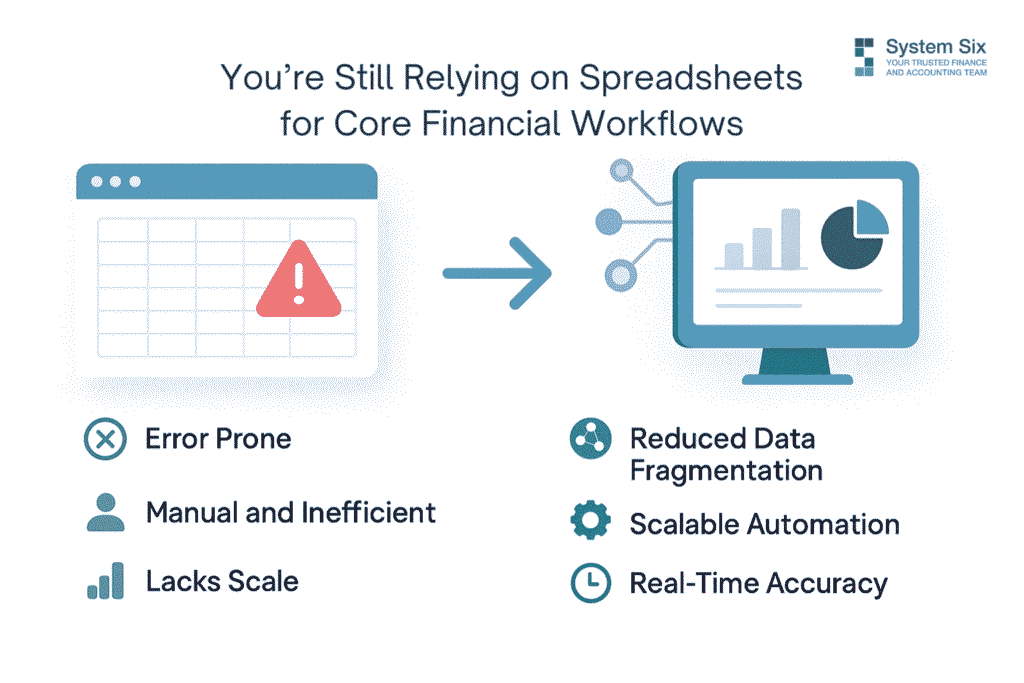
Spreadsheets often work well in the early stages. You can track expenses, create budgets, and monitor cash flow with enough customization to match your workflow. But as your consulting firm grows, those same spreadsheets start to limit visibility and delay decisions.
Every manual update increases the risk of error. A single misplaced formula or outdated data point can throw off forecasts, billing, and reporting. A study by PhysOrg found that nearly 94% of spreadsheets contain errors. When your financial systems rely on multiple linked spreadsheets, small mistakes tend to multiply.
Spreadsheets also slow things down. Data must be copied from one system to another before it becomes usable. You lose time double-checking numbers and chasing version control. This makes real-time insight almost impossible.
The more your business scales, the more touchpoints each financial process involves. One spreadsheet for client billing, another for cash flow, and a third for project profitability often means your team works harder to keep the numbers straight. That time could be spent on pricing strategies, margin analysis, or planning headcount.
Even when spreadsheets seem flexible, they cannot support the volume, complexity, or speed that scaling firms need. When financial accuracy depends on weekend maintenance or manual checks, the system has already outgrown its use.
Replace Manual Spreadsheets with Connected Financial Tools
Firms that grow without friction usually rely on systems that eliminate manual entry and reduce data fragmentation. When tools speak to each other, billing flows into forecasting, and expenses update reports in real time. This type of setup gives you a single source of truth that reflects the current state of your business.
Automation doesn’t mean giving up control. It means reducing the burden of repetitive updates so you can spend more time interpreting data instead of assembling it. Instead of reconciling spreadsheets before every meeting, you get financial reports that are already up to date.
Replacing spreadsheets with integrated systems also improves accuracy. Rules-based automation can categorize expenses, allocate billable hours, and flag inconsistencies long before they reach your clients or decision-makers. That clarity allows for faster approvals, cleaner audits, and stronger planning.
Firms that outgrow spreadsheets often need systems designed for scale. We help consulting firms move from spreadsheet-heavy workflows to connected tools that sync data across billing, forecasting, and reporting.
2. Billable Hours Are Falling Through the Cracks
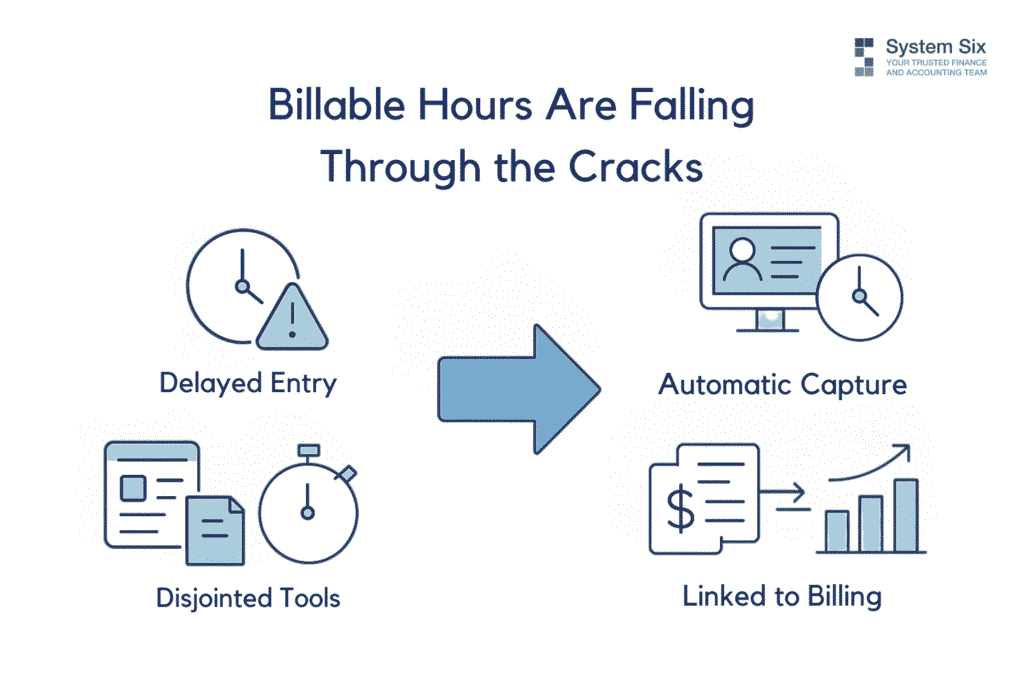
In a growing consulting firm, billable time often becomes harder to track. As projects scale and more team members contribute, hours slip through when time tracking depends on memory, manual logs, or disjointed tools.
Missed hours directly impact revenue. A study by ABA estimated that firms lose up to 50% of potential billables due to poor time tracking. That loss compounds when billing cycles rely on inconsistent inputs or when team members delay submitting time altogether.
When hours get recorded late, invoices go out slower. Revenue takes longer to reach your account. Over time, this delay affects your ability to forecast cash flow or reinvest in new work. Billing gaps can also erode client trust if invoices lack clear detail or include errors.
Firms often try to patch the process with spreadsheets or standalone trackers. But these tools rarely scale well. Hours get buried in email threads, inconsistent formats, or separate platforms. By the time everything is reviewed, your team has spent hours chasing data instead of doing billable work.
Stronger firms rely on integrated systems that simplify time capture and connect it directly to billing. Here’s what that looks like in practice:
- Time logs stay linked to client projects automatically. Team members enter hours within the same system used for project management or delivery. This ensures billable time is attached to the right client and task, without relying on memory or later clarification.
- Recorded hours flow directly into invoicing tools. When time entries sync with your billing system, you no longer need to copy and paste across tools or double-check spreadsheet formulas. Invoices can be prepared faster and reflect actual work completed.
- Systems flag gaps or low-entry days before invoices are sent. You get clear signals when a team member’s time log looks incomplete or falls short of expectations. This helps you catch missed hours early without having to audit manually.
- You gain better insight into profitability and planning. With cleaner time data, you can analyze how long projects actually take, spot clients with tighter margins, and make stronger decisions about pricing and staffing. That insight supports better resource allocation and long-term planning.
A system like this helps protect revenue without adding more administrative steps. It also frees your team to focus on project delivery instead of chasing down missing time.
Corporate cards that attach receipts to transactions in real time help ensure that project expenses align perfectly. This makes it easier to bill clients accurately and surface any missed costs before invoices go out.
3. Month-End Close Takes More Than a Week
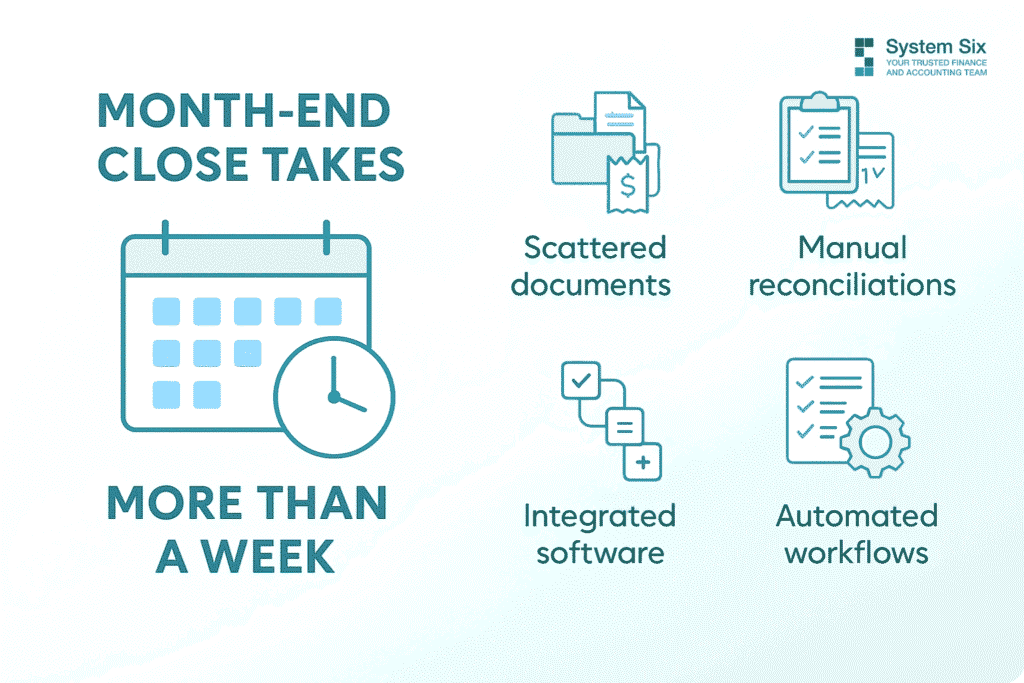
When your firm starts spending a full week or more closing the books, it usually points to deeper workflow problems. The delays often come from scattered data, manual reconciliations, and missing documentation. These bottlenecks grow worse as transaction volume increases or when multiple systems are not connected.
Every manual step adds risk. When receipts live in inboxes, invoices sit in drafts, or coding happens in bulk at the end of the month, the close process turns reactive. Errors creep in when teams rely on memory or rush through last-minute updates. Reviews take longer, and rework adds hours to every close.
Over time, a slow close limits financial visibility. Leadership decisions begin to lag behind actual performance. You lose the chance to correct course early or act on new opportunities while they are still relevant.
Build a Close Process That Runs in the Background
A faster close starts with structure. The goal is not to rush through the process but to spread the work evenly across the month. This means shifting from a reactive cycle to a continuous one where inputs, reviews, and reconciliations happen as the work gets done.
Integrated systems play a key role in making this possible. When your expense management, accounting software, and payroll tools talk to each other, you no longer depend on end-of-month scrambles to pull in data. Information flows in throughout the month and stays categorized from the start.
Rules-based automation supports consistency. Transactions get labeled the same way every time. Approvals follow the same path for every department. These steps reduce friction and make each close more predictable.
With the right setup, your month-end close becomes a reflection of how well your systems run, not a recurring fire drill that eats into every calendar cycle.
4. Forecasts Are Based on Gut Instinct And Not Real-Time Data
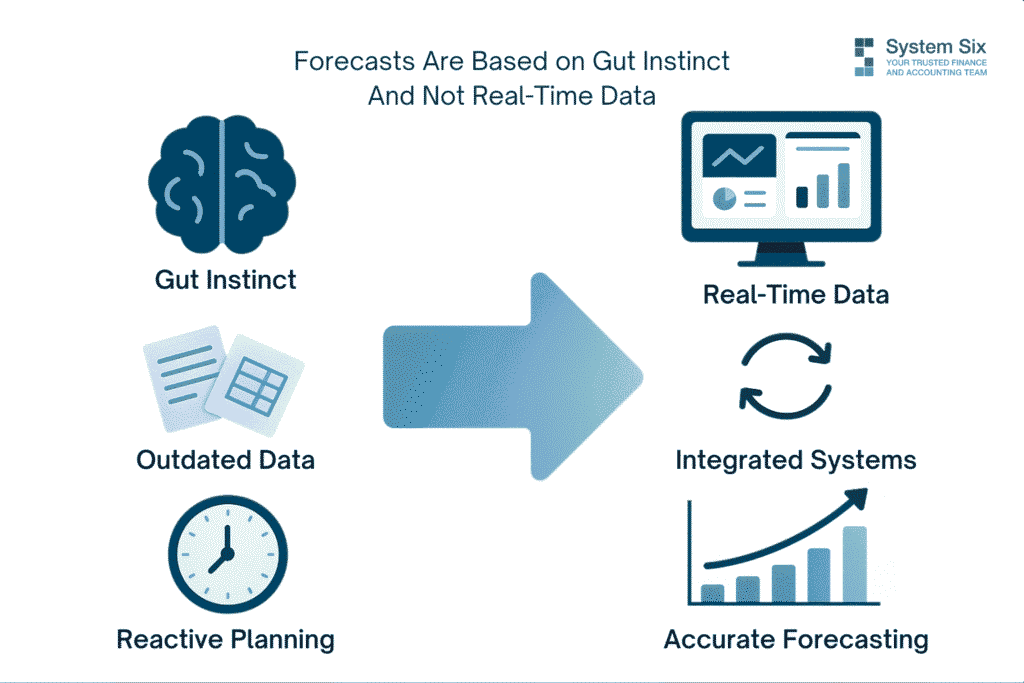
Strong forecasts rely on up-to-date numbers. But when financial inputs are scattered or delayed, many consulting firms default to intuition instead. Estimates are based on past experience rather than current conditions, and planning becomes reactive instead of intentional.
This disconnect often shows up in staffing, project timing, and cash flow. Without accurate forecasts, you risk overcommitting or underutilizing your team. You might delay a hire too long or take on too many projects at once. Each of these choices affects delivery, margins, and long-term growth.
In a CFO study, 43% of finance leaders said their forecasts often miss the mark because they rely on outdated or incomplete data. This gap makes it harder to respond to change, even when early signs are visible in your operations.
Manual data entry creates lag. By the time spreadsheets are updated, your numbers no longer reflect current activity. When forecasts are built on static reports, they can no longer support decisions that require speed or precision.
Build Forecasts That React to the Present
Accurate forecasting starts with systems that update as the business moves. Real-time data means your projections shift with actual performance rather than staying fixed until the next manual update.
When your financial systems connect directly to your CRM, project tools, and accounting software, forecasts begin pulling from live inputs. New contracts, delayed payments, and updated costs reflect instantly in your reports. This gives you a clearer view of revenue timing, upcoming expenses, and available capacity.
Predictive models become more reliable when built on structured data. Instead of basing forecasts on gut instinct, you can use historical patterns layered with current trends. This helps you plan with more confidence and less guesswork.
At System Six, we support firms with rolling cash flow forecasts and scenario planning tools that pull directly from live project and billing data. This helps leaders move from gut-driven decisions to data-backed planning.
When forecasts become a real-time tool rather than a periodic spreadsheet, you get faster answers to the questions that matter. This allows your firm to stay flexible and make decisions based on current circumstances, not just what happened last quarter.
5. Your Systems Can’t Scale with Headcount or Client Volume
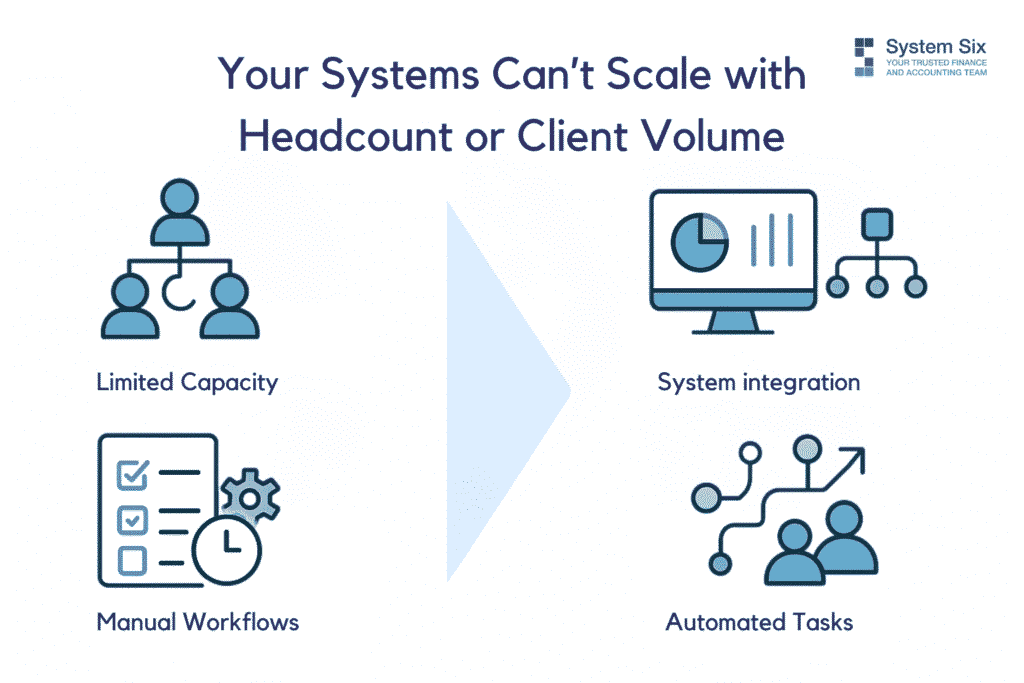
Growing firms face more complexity with each new client or hire. More projects increase the number of invoices, time entries, expenses, and financial reviews. Without the right systems, these moving parts begin to strain your team and delay core workflows.
Systems that worked for a five-person team often start breaking down once you reach ten. Processes built around manual entry or loosely connected tools become harder to manage. Work slows down as your team spends more time maintaining tools than serving clients.
You might notice approvals taking longer, project data becoming harder to reconcile, or reporting deadlines being missed. Each delay signals a system that can no longer keep pace with demand.
Cost of Reactive Fixes Versus Proactive System Design
When systems break under pressure, most firms respond with quick fixes. A new spreadsheet to track hours. Or another login for a billing tool. These short-term solutions often solve immediate issues but create more friction over time.
Reactive fixes add complexity and slow down your decision-making process. Proactive system design focuses on building workflows that hold up as your firm grows.
Here’s how the two approaches compare:
- Workflow structure: Reactive fixes create scattered processes that require extra steps and individual workarounds. Proactive systems standardize how work gets done, making it easier to train new team members and maintain consistency across projects.
- Data access: Reactive fixes rely on manual exports and spreadsheets that delay insight. Proactive systems pull live data from connected tools, giving you real-time visibility without additional work.
- Workload management: Reactive fixes increase administrative overhead and require frequent check-ins to stay on track. Proactive systems automate repetitive tasks, freeing up time for analysis and planning.
- Team knowledge: Reactive fixes often depend on a few people who know how to manage exceptions and workarounds. Proactive systems reduce this dependency by creating shared, transparent processes.
- Growth readiness: Reactive fixes fall apart under pressure as volume increases. Proactive systems scale alongside your business, so adding clients or team members does not require redesigning your workflows.
Build a Scalable Financial Stack That Supports Your Growth
Stronger firms invest in systems that grow with them. These systems handle more volume without adding more complexity. When your billing, expense, time tracking, and reporting tools are connected, your team can move faster with fewer errors.
A scalable financial stack reduces the number of decisions your team needs to make just to keep things running. Financial reports pull from a single data source. Invoices and time entries follow the same structure across every client.
The right setup gives your team structure without rigidity. As new clients come in or roles shift internally, your systems continue to support day-to-day work without disruption. This foundation allows your firm to focus on delivery and planning, not on fixing what broke behind the scenes.
Why Financial Systems Should Grow With You?
Financial systems that grow alongside your business create space for focus, speed, and control. As you take on more clients, launch new services, or expand your team, your workflows shift. A system that scales with those shifts gives your team the structure it needs to stay confident through change.
Growth introduces more decisions. Whether you are adjusting pricing, planning capacity, or reviewing profitability, those choices depend on timely, accurate information. A flexible system makes that information available without extra work. It updates with your business and reflects what is happening now, not what happened last quarter.
About System Six
System Six is a remote bookkeeping and financial services firm that helps small and mid-sized businesses streamline their financial operations. We specialize in providing technology-driven financial management solutions for consulting firms, allowing owners to focus on growing their businesses without worrying about cash flow, payroll, or compliance issues.
Our team of over 40 professionals brings an average of 10+ years of accounting experience to every client relationship, serving more than 200 businesses across the U.S. From accurate bookkeeping to cash flow forecasting, we deliver the financial clarity and peace of mind that consulting firm owners need to thrive. Learn more at www.systemsix.com.