
The short answer
When money you take out of the business as an owner gets recorded as an expense, your profit and loss statement shows the business earning less than it really does. Day to day, nobody notices. But the moment a lender, a buyer or an investor relies on those numbers, the understatement shrinks your loan, your valuation and your credibility. Finding it takes about five minutes. Fixing it now is far easier than fixing it in the middle of a deal.
I spent years in private equity reading quality-of-earnings reports. Hundreds of pages, most of them dull, written by accountants whose whole job is to figure out what a business really earns. And one finding showed up so often I could almost predict it: the owner’s own money was sitting in the expense accounts.
It never looked dramatic. A line called “Consulting — G. Ruiz.” A “Misc” account with a suspiciously steady $10,000 a month. Small things. But small things in the wrong account have a way of turning up at the worst possible moment.
Let me show you why, and how to check your own books before anyone else does.
Why does this happen?
Picture the end of the month. Your bookkeeper is working through the bank feed, and there’s a $10,000 transfer to your personal checking account. Money left the business. Something has to be coded. The software wants a category, and “expense” is the easiest box to tick. It’s the path of least resistance, so it wins.
Nobody’s hiding anything. Often the bookkeeper simply wasn’t told what the transfer was, or the chart of accounts never had an owner’s equity account set up in the first place. Personal charges on the company card get the same treatment — your kid’s tuition lands in “Office expense” because there was nowhere else to put it.
And because the money really did leave, the bank balance still reconciles. The books look clean. They’re just wrong.
What does it cost you?
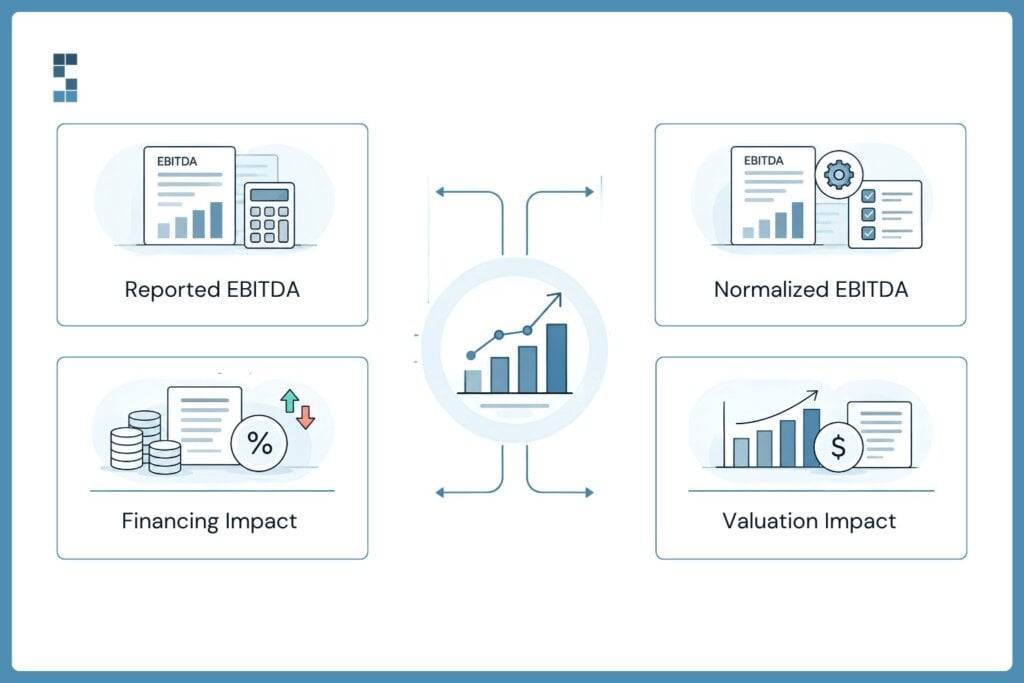
Here’s the part that surprises owners: on a normal Tuesday, it costs almost nothing. Your cash is your cash, wherever it’s coded. (It can create a tax problem, since a draw isn’t deductible, so it’s worth raising with your CPA.) The real cost arrives when someone outside the business has to trust your P&L.
Let’s use round numbers. Gabe runs a $2 million engineering consulting firm. His P&L shows $200,000 of EBITDA (earnings before interest, taxes, depreciation and amortization, a common stand-in for operating profit). Buried in his expenses is $120,000 he took home as draws over the year. His real EBITDA is $320,000.
Now watch what happens.
A lender sizing a loan at three times EBITDA offers him $600,000 instead of $960,000. A buyer paying four times earnings starts at $800,000 instead of $1.28 million — a $480,000 gap, before anyone negotiates a thing. To be fair, a buyer will also subtract what it would cost to pay someone to do Gabe’s job, so the true figure lands somewhere in between. But that conversation starts from his real numbers, not from a mistake. And a bank calculating debt-service coverage, with $160,000 of annual payments on the table, sees 1.25 times coverage on his reported numbers, right on the line many lenders draw. On his real numbers it’s 2.0 times, a comfortable yes.
Same business. Same clients. Same people. A very different answer.
How do you check your books in five minutes?
Open your trailing-12-month P&L. Scan the expense accounts and look for anything that reads like a person rather than a vendor. A name. An account called “Misc” or “Reimbursement.” One large, round number that shows up every single month, like clockwork. Vendors send invoices with odd amounts. Owners transfer round ones.
Then flip to the balance sheet. Look in the equity section for an owner’s draw or distribution account. Does it have real activity — a balance that grows across the year? If there’s nothing there, but you know money has clearly been leaving the business for your benefit, the draws are in the wrong place. That’s the tell.
That’s it. Five minutes, maybe ten if you pour a coffee first.
How do you fix it?
Start by reclassifying the draws. Your bookkeeper pulls the transactions out of the expense accounts and moves them to equity, month by month, with a short note on each. Go back at least as far as the period a lender or buyer will review, usually the last two or three years.
Next, set up the right equity accounts for your entity type, because the label matters. If you’re a sole proprietor or a single-member LLC, you’ll use an owner’s draw account that rolls into owner’s equity at year-end. In a multi-member LLC taxed as a partnership, each member gets their own draw and capital account. One wrinkle: guaranteed payments to partners for their work are deductible, so not every payment to a partner is a draw. If you’re an S corporation, your pay for working in the business runs through payroll as a reasonable W-2 salary, and that is an expense. Anything you take above it is a shareholder distribution, recorded in equity.
Finally, ask your bookkeeper to keep it clean going forward. A simple rule works: every transfer to an owner gets coded to equity unless someone documents a business reason. When we clean up a client’s books, this is usually one of the first changes. One of them, Trevor, put the result simply: “We are in a much better place today than we were twelve months ago.” That’s what this fix buys you. Not drama. Just numbers you can stand behind.
Why is it harder to untangle mid-deal?
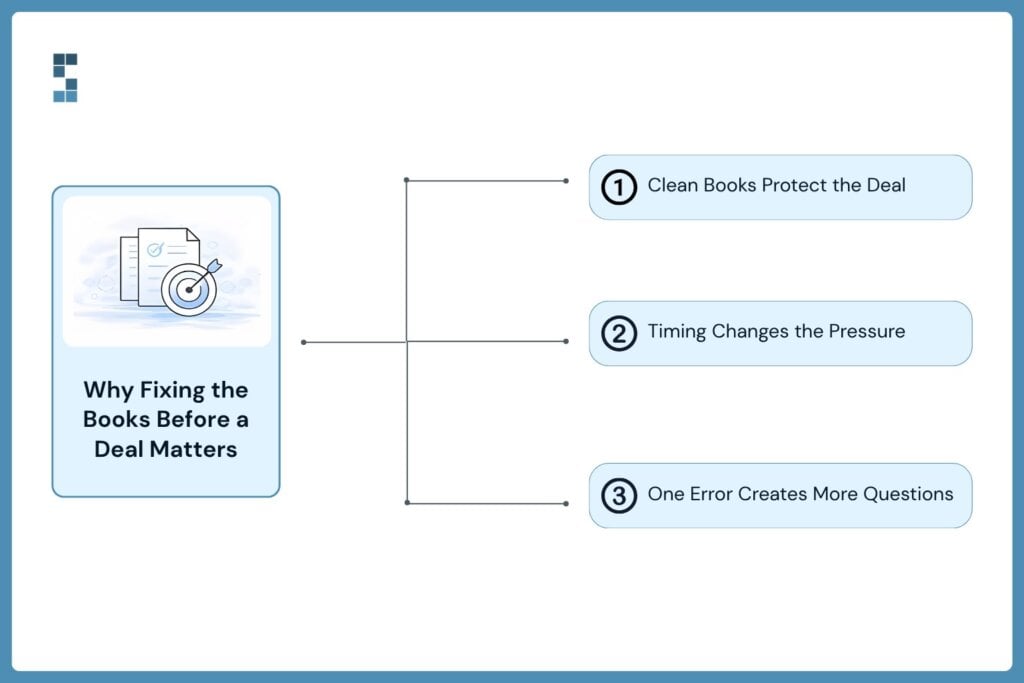
Because a deal changes who’s asking and how much time you have.
In private equity, I watched diligence teams turn over every account in the general ledger. When they found owner spending in the expense lines, they didn’t just take the seller’s word for it. Each item had to be proven with bank statements, receipts and an explanation, often for three years at once, on a deadline, while the owner was also trying to run the company. Anything they couldn’t verify, they left out. And once a buyer finds one miscoded account, they start wondering about the others. The questions multiply. The timeline stretches. Sometimes the price gets renegotiated.
I saw it from the other side, too. When I bought System Six with an SBA loan, the bank underwrote the deal from the seller’s financials, line by line. Clean books made that process faster and calmer for everyone.
Here’s the thing: the work to fix this is identical whether you do it now or during diligence. Now, you do it calmly, on your own schedule, with no one watching. During a deal, you do it under a microscope with money on the line. Which would you rather?
If you’re thinking about a sale or an investment, our guide to quality-of-earnings reports walks through what a diligence team will look for. And if you’d like us to run the five-minute check with you and tell you what we find, we’re happy to: systemsix.com/get-started.
Frequently asked questions
Are owner draws a deductible business expense?
No. A draw or distribution is the owner taking money out of the business, not a cost of running it. W-2 salary paid to an S corporation owner through payroll and guaranteed payments to partners are treated differently, so ask your CPA how your entity type applies.
Is it called a draw or a distribution?
It depends on your entity. Sole proprietors and LLC members typically take draws. S corporation shareholders take distributions. Either way, it belongs in the equity section of the balance sheet, not on the P&L.
If I reclassify past draws, do I need to amend old tax returns?
Possibly, if the change affects the taxable income on a return you’ve already filed. That’s a question for your tax preparer, and it’s another reason to catch the problem early.
This post offers general information for owners of US small businesses. It isn’t tax or legal advice, and the right treatment depends on your entity type and circumstances. Talk with your CPA or attorney before making changes to your books or filed returns.