You spent weeks vetting your bookkeeping provider. You compared pricing, checked reviews, and asked about software integrations. But here’s the question most consulting firm owners never think to ask: who else can see your books?
Think about what’s actually sitting in your financial management system. Payroll records with every employee’s salary. Client invoices that reveal your billing rates and biggest accounts. Bank feeds with your cash position laid bare. Tax filings. Expense reports. The full financial anatomy of your business, open and readable — somewhere on someone’s server.
Most business owners scrutinize pricing before they scrutinize security. That’s understandable. Pricing is easy to compare; security practices take a few more questions. But the wrong provider — one with lax access controls, no formal compliance standards, or vague data policies — can expose your firm to breaches, regulatory liability, and the kind of reputational damage that doesn’t go away quickly.
The good news: you don’t need to become a cybersecurity expert to protect yourself. You just need to know which questions to ask.
What’s Actually at Risk
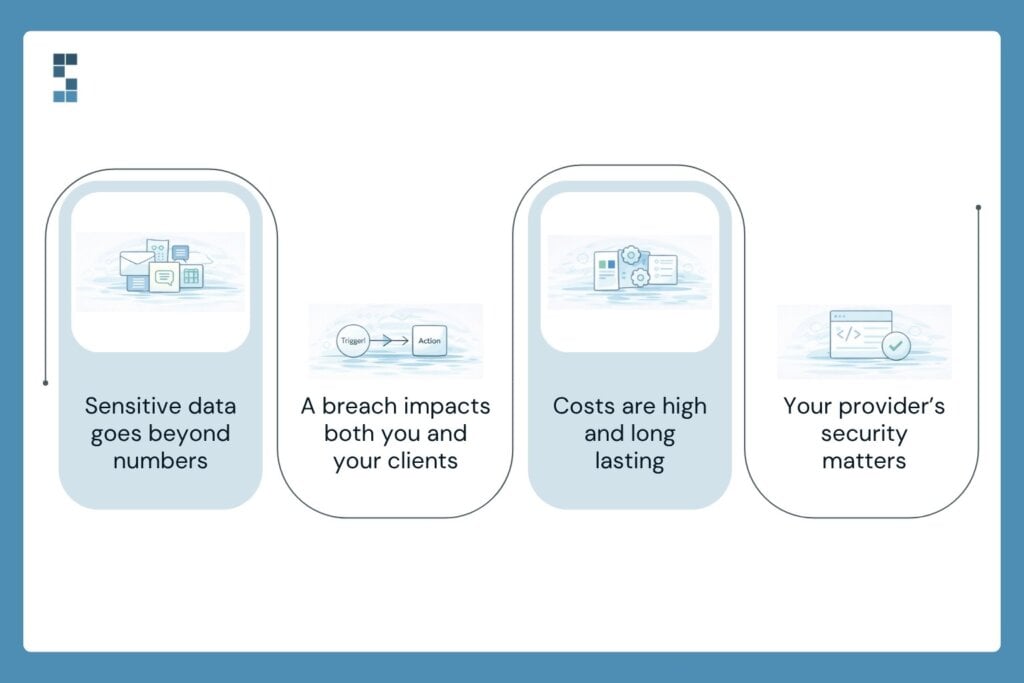
“Financial data” sounds abstract until you list out what it actually contains. Payroll files. Employee tax IDs. Vendor contracts. Bank account numbers. Profit margins. Cash flow projections—client billing history.
For a consulting firm, the stakes go beyond your own exposure. Your clients trust you with their business, and your financial records often reflect that relationship — engagement fees, scope of work, duration of contracts. A breach doesn’t just hurt you. It ripples outward.
And the costs aren’t theoretical. According to IBM’s Cost of a Data Breach Report, the average breach for a small business now runs well into six figures when you factor in forensics, notification requirements, regulatory fines, and lost business. For a firm operating in a trust-driven industry — and consulting is exactly that — the reputational toll can outlast the financial one.
The question isn’t whether your data is worth protecting. It obviously is. The question is whether your current provider takes that seriously.
The Questions You Should Be Asking (But Probably Aren’t)
Most providers won’t volunteer this information upfront. You have to ask. Here’s what to put on your list.
How is my data encrypted — in transit and at rest? This is the baseline. Data in transit means information moving between your systems and theirs; data at rest means information stored on their servers. You want encryption at both stages. If a provider can’t give you a clear answer here, that tells you something.
Who on your team has access to my accounts, and how is that controlled? The biggest security risks are often internal, not external. A well-run provider restricts access on a need-to-know basis — only the team members actually working on your account should be able to see your data. Ask whether they use role-based access controls and whether access is logged and audited.
Are you SOC 2 compliant, or do you follow an equivalent security standard? SOC 2 compliance — developed by the American Institute of CPAs — is the gold standard for service organizations handling sensitive client data. It requires third-party audits of a firm’s security, availability, and confidentiality controls. Not every bookkeeping provider will be SOC 2 certified. Still, the question itself is useful: a provider who understands what it means and has given it serious thought is a different animal from one who’s never heard of it.
What happens to my data if I decide to leave? This one surprises people. A surprising number of firms have no clear policy on data offboarding — meaning your financial records might sit on their servers indefinitely after you’ve moved on. You want a provider who can give you a clean data export and confirm deletion within a defined timeframe.
How do you handle a breach or security incident? No system is perfectly immune. What matters is how a provider responds when something goes wrong. Ask whether they have an incident response plan, how quickly they notify clients, and what remediation looks like. Vague answers here are a red flag.
What Good Answers Look Like
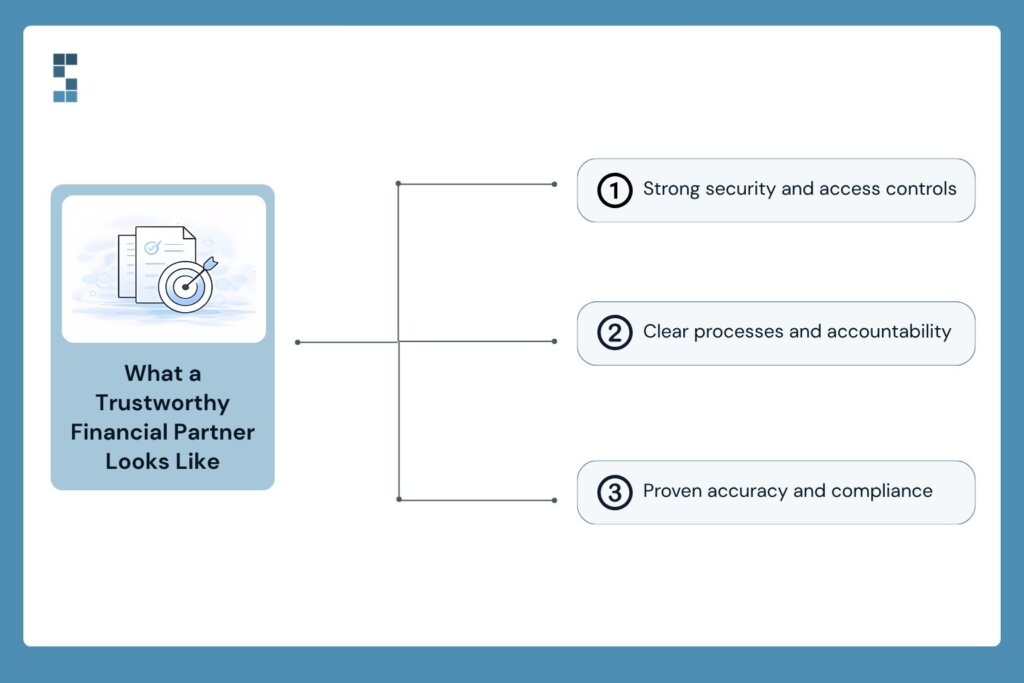
Ask those questions, and you’ll quickly learn to read the room. A provider worth trusting will answer them without hesitation — and often with specifics.
Bank-level encryption for data in transit and at rest. Role-based access controls so your account isn’t visible to everyone on a 40-person team. Signed confidentiality agreements for every staff member who touches client data. A clear, documented process for data export and deletion when an engagement ends. And some form of formal security framework guiding how they operate.
System Six, for instance, uses bank-level security with encrypted data transmission, secure cloud infrastructure, and comprehensive access controls. Every team member signs a strict confidentiality agreement. These aren’t marketing bullet points — they’re the baseline that any firm managing six-figure payrolls and sensitive financial records should be able to demonstrate.
The outcomes speak for themselves. Paul, a search fund operator who uses System Six, put it plainly:
“We just finished our 2022 audit, and the auditors found exactly 0 errors by S6. Not only have they been mistake-free, but S6 has also been proactive at catching mistakes I’ve made or seeing challenges coming down the pike and asking me the right questions to keep the books updated.”
Zero errors in an external audit isn’t just an accuracy story — it’s a compliance story. It means the systems are clean, the controls are working, and nothing is being glossed over. That’s what security and accuracy look like in practice.
It’s worth noting that System Six earns a 9.5 out of 10 NPS from its clients — and more than half of new clients come from referrals. In a trust-driven industry, that number doesn’t happen by accident.
The Foundation Is Trust
Here’s the thing about financial data security: it’s not just an IT issue. It’s a trust issue. Your clients trust you. You should be able to trust the people managing your finances.
The firms that ask these questions before signing are the ones that avoid the firms that deserve to be avoided. You now have the questions. Use them in your next provider conversation—or to evaluate the one you already have.
And if you’re looking for a provider who’s already thought through the answers, we’d be glad to walk you through how System Six approaches security, compliance, and client confidentiality—no long-term contracts. No runaround. Just straight answers.
About System Six
System Six is a Seattle-based bookkeeping and financial services firm that helps small and mid-sized businesses streamline their financial operations. We specialise in providing technology-driven financial management solutions for consulting firms, enabling owners to focus on growing their businesses without worrying about cash flow, payroll, or compliance. Our team of over 40 professionals brings an average of 10+ years of accounting experience to every client relationship, serving more than 175 businesses across the U.S. With a 9.5/10 NPS score, we deliver the financial clarity and peace of mind that consulting firm owners need to thrive. Learn more at www.systemsix.com.