It’s 11 PM on a Thursday, and your phone buzzes. It’s a client—one of your biggest—asking if you’ve seen the news about the data breach at a firm similar to yours. “Our board wants to know about your security protocols,” they say. “Can you send documentation by morning?”
Your stomach drops. Not because you’ve done anything wrong, but because you’re not entirely sure you can answer their questions with confidence.
Here’s the thing about running a consulting firm: you spend your days advising clients on risk management, strategic planning, and operational excellence. You know their businesses inside and out. But when’s the last time you took a hard look at your own financial data security?
You’re handling incredibly sensitive information every day. Client strategies that could move markets. Financial projections for acquisitions that aren’t public yet. Proprietary methodologies that took you years to develop. Your payroll data. Their billing details. All of it sitting somewhere in the cloud, accessed by your team from coffee shops, home offices, and airport lounges.
And in 2025, with AI tools and automation becoming standard practice in consulting operations, the questions around data privacy aren’t just theoretical anymore. They’re operational. Every time you or your team inputs financial data into a new platform or AI tool, you’re making security decisions—whether you realize it or not.
Protecting client confidentiality isn’t just about checking compliance boxes. It’s about preserving the trust that makes your consulting relationships possible in the first place.
The Stakes Are Higher for Consulting Firms
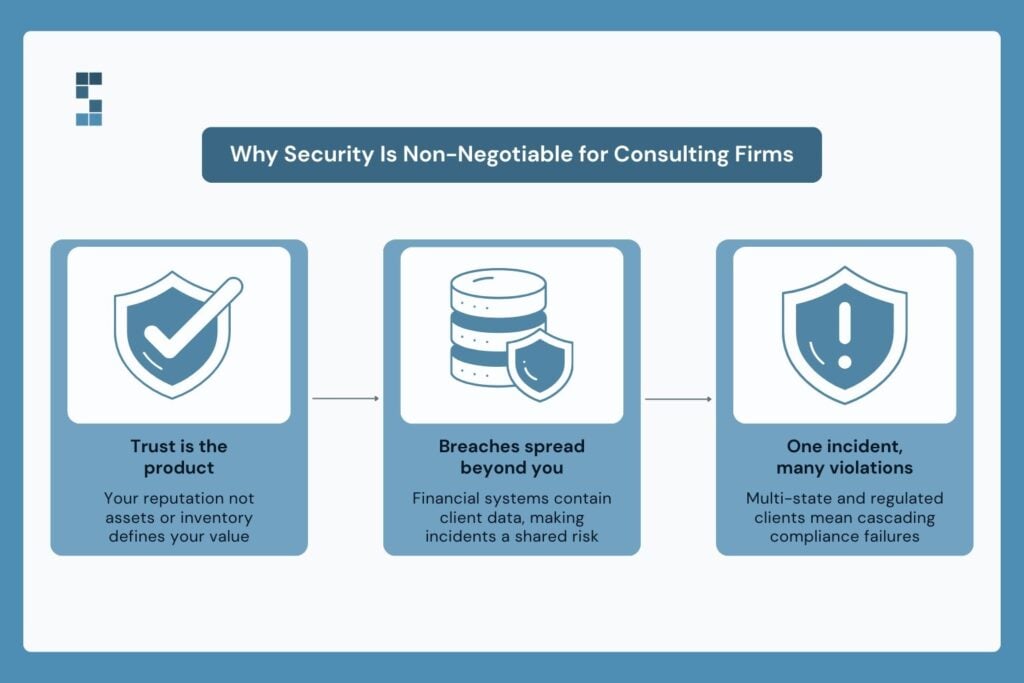
Let’s be honest about what you’re really selling. Unlike product businesses, you don’t have inventory, patents, or physical assets that define your value. Your reputation IS your business. And that reputation is built entirely on trust—the kind of trust that lets clients reveal their competitive vulnerabilities, their expansion plans, their financial weaknesses.
Think about what’s in your financial systems right now. Not just your own firm’s data, but the interconnected web of client information embedded in project billing, expense reports, and invoices. A breach of your financial data isn’t just your problem. It’s potentially their problem too.
The regulatory landscape makes this even more complex. If you’re operating across multiple states—and most growing consulting firms are—you’re navigating a patchwork of different data protection laws. Got clients in healthcare? Financial services? Government contracting? Each of those industries brings its own security requirements that flow down to you. One breach doesn’t just trigger direct costs like forensic investigations and legal fees. It triggers a cascade of compliance violations across multiple jurisdictions and industries.
Then there are the costs most firms don’t see coming. Sure, you can calculate what cyber insurance might cover. But what about the proposals you don’t win because prospects chose a competitor with more robust security? The clients who quietly move on after learning about your weak data controls? The competitive disadvantage of not being able to answer security questions in RFPs confidently?
And here’s what keeps security experts up at night: consulting firms are increasingly attractive targets. You’re handling data from larger clients but often without enterprise-level security budgets. Cybercriminals know this gap exists. They’re counting on it.
Where the Gaps Usually Hide
Most consulting firm owners fall into what I call the DIY trap. Your financial data lives scattered across spreadsheets for projections, QuickBooks for accounting, separate systems for payroll, and maybe some PDFs floating around in email. Multiple team members access these systems from personal devices. Passwords get shared informally. And suddenly you’ve got a dozen potential entry points for problems.
There’s this persistent myth that small businesses are “too small to target.” Wrong. Automated cyberattacks don’t discriminate by firm size. They’re looking for vulnerabilities, not company headcount. Your financial software isn’t isolated—it’s a gateway to everything else in your operation, including client project data.
Walk through your current setup honestly. Do you have unsecured cloud storage where financial documents live? Are team members emailing sensitive payroll information as attachments? How many people have admin access to your accounting software—and do they all still need it? Is your data encrypted when it’s transmitted? Can you track who accessed which client’s billing information last Tuesday?
These aren’t theoretical questions. I’m talking about the consultant who discovered a former employee still had full access to their financial systems four months after leaving. Or the firm that couldn’t answer basic questions about data access during a client’s security audit and lost a $500K project because of it.
And now there’s the AI question. Consulting firms are rushing to adopt AI tools for efficiency—and they should. The technology can genuinely free you up to do more valuable work. But are you thinking through the security implications before you start feeding confidential financial data into these platforms? Many firms aren’t. They’re so focused on the productivity gains that they haven’t established clear policies on what data can go into AI systems and what can’t.
What Bank-Level Security Actually Means
You’ve probably seen vendors promise “bank-level security.” But what does that actually mean when you translate it from marketing jargon into operational reality?
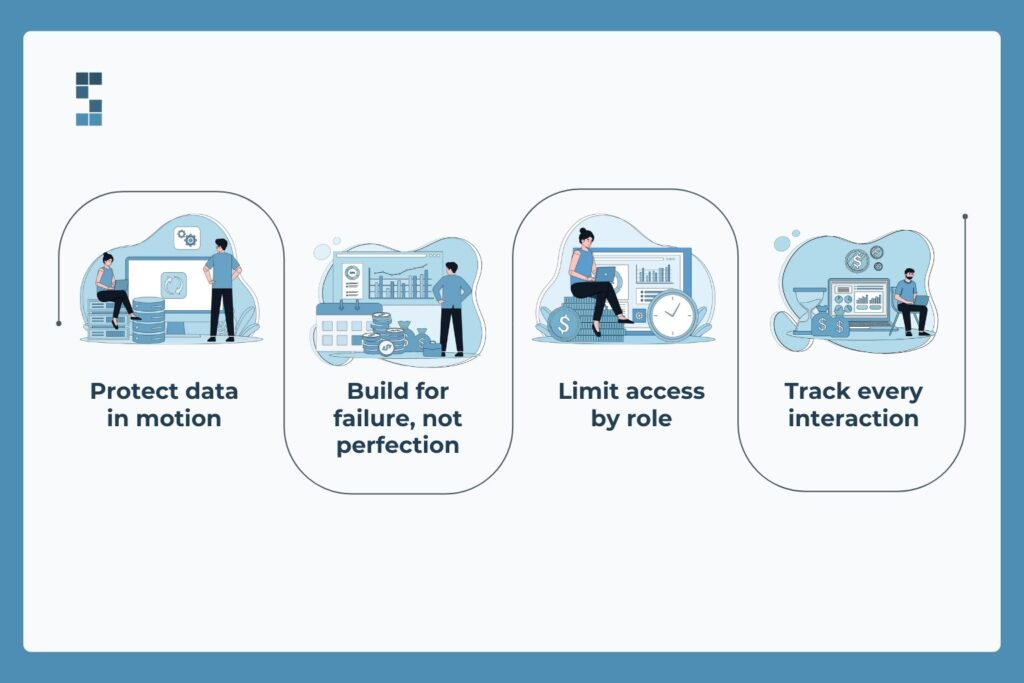
Start with encrypted data transmission. Your financial data should be scrambled when it moves between systems—think of it like sending a locked safe instead of a postcard. This matters tremendously for remote teams accessing systems from wherever they happen to be working. That coffee shop WiFi? If your data isn’t encrypted in transit, you’re vulnerable.
Secure cloud infrastructure isn’t just about having data “in the cloud.” It’s about using infrastructure with real redundancy, automatic backups, and regular security audits. Your data should be recoverable if something goes wrong, not just accessible when everything works perfectly.
Restricted access protocols mean different people see different things based on their roles. Your bookkeeper doesn’t need access to strategic client data. Project managers don’t need to see everyone’s payroll. Multi-factor authentication should be standard, not optional. Sessions should timeout automatically. And someone should be reviewing who has access to what at least quarterly, removing access that’s no longer needed.
Comprehensive audit trails give you the ability to answer the question “who accessed this data, when, and from where?” in real time. This isn’t paranoia—it’s essential for compliance and investigation if something goes wrong. Consulting firms that work with clients in regulated industries know this firsthand. One firm noted they’re “experienced with consulting firms serving regulated industries” precisely because they understand these requirements aren’t negotiable.
And yes, your team should sign confidentiality agreements. But so should your financial service providers. If they’re handling your data, they’re part of your security perimeter.
These security measures aren’t optional extras—they’re competitive necessities. Client due diligence is getting more rigorous every year. Insurance requirements are tightening. And increasingly, prospects ask detailed security questions in RFPs. One firm I know has maintained a perfect record—zero audit errors across hundreds of clients—precisely because they took security seriously from day one.
Building Your Strategy Without Becoming an IT Expert
Here’s the good news: you don’t need to become a cybersecurity expert any more than you need to become a lawyer or a website developer. You need to know enough to ask the right questions and make informed decisions about whom you trust with this work.
Start with your financial service providers. Don’t just ask “Are you secure?” Ask specific questions. What encryption standards do you use? How do you handle access control? What’s your incident response protocol if something goes wrong? Do you work with firms in regulated industries, and if so, what does that experience teach you about security requirements?
But delegation doesn’t mean abdication. There are internal practices you can and should control. Use a password manager for your team—it’s 2025, there’s no excuse for weak passwords anymore. Establish device security policies. Train your team regularly on phishing and social engineering. Create clear protocols for handling financial documents.
And you need an AI policy now, not later. Before anyone on your team inputs client or financial data into AI tools, establish clear guidelines. Which AI tools are approved for use? What data can never be input into these systems? How will you verify AI outputs for accuracy? What’s your disclosure policy to clients about AI use? Taking this proactive approach isn’t just about risk management—it differentiates you from competitors who are figuring this out reactively, often after problems emerge.
Don’t forget regular security audits—review who has access to what at least quarterly. Test your backup and recovery procedures annually—because a backup you’ve never tested is just a comforting theory. Update your incident response plan as your firm grows and your systems evolve.
Security as Strategic Advantage
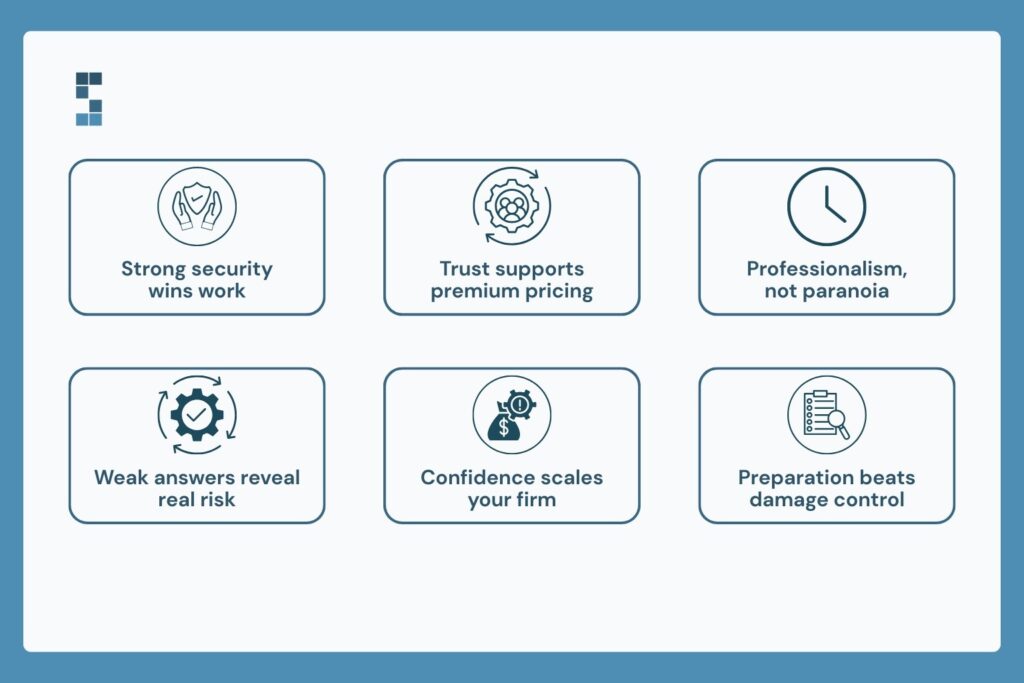
It’s time to reframe how you think about cybersecurity. This isn’t just defensive—it’s a competitive advantage. You can win more proposals by demonstrating security rigor. You can command higher fees with clients who value confidentiality and understand what it takes to protect it. You can sleep better knowing your firm’s foundation is solid.
Your clients trust you with their strategic decisions, their financial vulnerabilities, and their growth plans. That trust naturally extends to how you handle the economic data behind those decisions. Security isn’t about paranoia. It’s about professionalism. It’s about living up to the same standards you’d recommend to your own clients.
Don’t wait for a security incident to take this seriously. Start with one conversation: ask your current financial services provider the hard questions about encryption, access controls, incident response, and audit trails. If they can’t give you confident, specific answers, that’s your signal.
You built your consulting firm on expertise and trust. Your financial data security should reflect those same values. What could your business achieve with financial systems you trust completely—systems secure enough that you’d never hesitate when a client asks about your protocols at 11 PM on a Thursday?
About System Six
System Six is a Seattle-based bookkeeping and financial services firm that helps small and mid-sized businesses streamline their financial operations. We specialize in providing technology-driven financial management solutions for consulting firms, enabling owners to focus on growing their businesses without worrying about cash flow, payroll, or compliance. Our team of over 35 professionals brings an average of 10+ years of accounting experience to every client relationship, serving more than 175 businesses across the U.S. With a 9.5/10 NPS score, we deliver the financial clarity and peace of mind that consulting firm owners need to thrive. Learn more at www.systemsix.com.