
The short answer: Probably, yes. Most growing firms accumulate finance tools one subscription at a time until they’re paying for overlapping features, seats nobody uses, and apps that solve problems they no longer have. The fix isn’t just canceling the obvious dead weight. It’s consolidating around a core system that does more of the work, so you stop paying several tools to do one job badly and stop paying yourself to shuttle data between them. The subscription line is the small cost. The real one is the manual work a scattered stack quietly creates.
Miriam sat down to review her firm’s expenses and got a small shock. Her IT consulting practice was paying for two different expense tools, because the team had switched a year ago and nobody ever canceled the first one. There was a project management app that three people had licenses for and none of them opened anymore. A standalone invoicing tool that mostly duplicated what her accounting software already did. And a reporting subscription she’d bought for one board meeting and forgotten. None of it was expensive on its own. All of it, added up, was a car payment she was making every single month for software that was half dead.
If you haven’t looked lately, you probably have a version of Miriam’s stack too. Finance tools have a way of accumulating quietly, one reasonable decision at a time, until you’re paying for a pile of overlap nobody’s using. So let’s do the audit. Where does the money actually leak, why does the stack sprawl in the first place, and what does fixing it really involve? Because the subscription fees, it turns out, are the least of it.
Why do finance software costs pile up unnoticed?
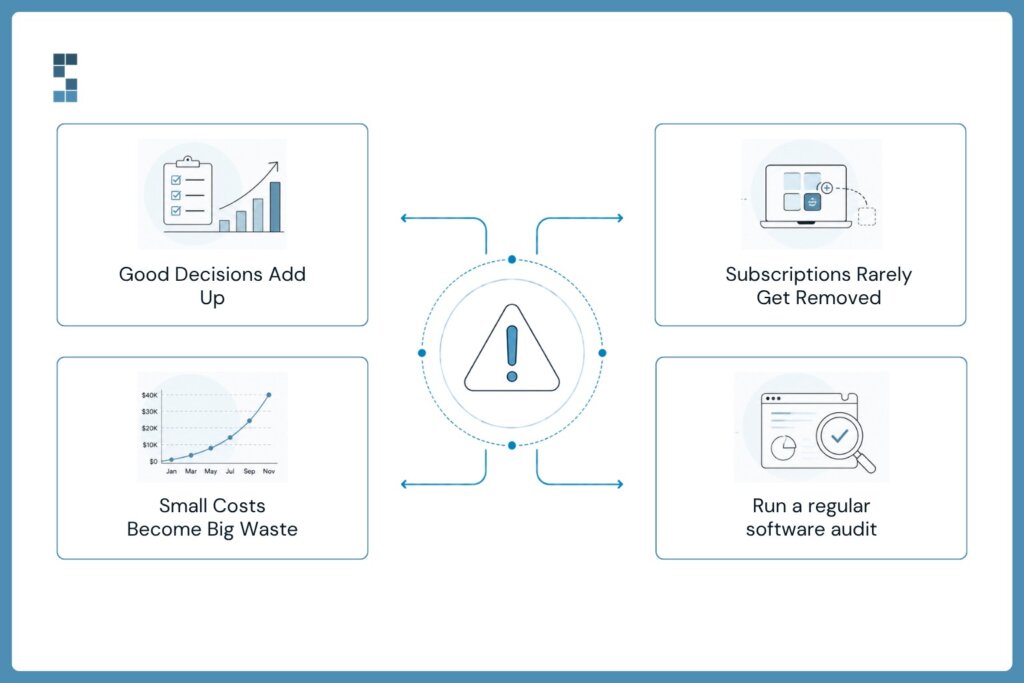
Software sprawl doesn’t happen through bad decisions. It happens through a series of good ones. You add a time-tracking tool because you need to bill accurately. Then a project management app because work is getting complex. Then a CRM, because leads are slipping through the cracks. Then an expense platform, a separate invoicing tool, a reporting add-on. Each one solved a real problem the day you bought it.
The trouble is that nobody ever runs the process in reverse. Tools get added; they almost never get removed. Your needs change, a new app absorbs what an old one did, the team migrates to something better, but the old subscription keeps quietly billing because canceling it is nobody’s job. Consulting firms in the $1M to $5M range typically budget $10,000 to $25,000 a year for financial and payroll services, and the SaaS tools stack on top of that. It’s genuinely easy for a chunk of that spend to be pure waste, redundant seats, overlapping features, zombie subscriptions, and never feel it, because no single charge is big enough to trigger a second look. Sprawl hides in its own smallness.
What’s the real cost of a scattered finance stack?
Here’s the part that matters, and it’s the part almost everyone misses when they think about software costs. The subscription fees are the visible tip. The far bigger cost is what a scattered stack does to your time.
When your financial tools don’t talk to each other, you become the integration. Your revenue lives in your accounting software, gets re-keyed into a cash flow spreadsheet, summarized again in a profitability tracker, and compared once more in a budget report. Each tool holds a piece, and you, or someone you pay, manually carries data between them. That’s not a software cost. That’s a labor cost, and it dwarfs the subscriptions.
And it compounds in two nasty ways. First, error: every manual transfer between disconnected tools is a chance to fat-finger a number, and one wrong figure propagates through every report downstream until someone catches it. Second, drift: when the same number lives in five places, those places fall out of sync, and you end up with reports that disagree and no fast way to know which one is right. Owners routinely find, once they track it, that they’re spending fifty to a hundred percent more time on financial admin than they’d assumed, much of it just moving data between tools that should have been talking on their own. A cheaper stack that’s disconnected can quietly cost far more than a pricier one that’s integrated. Sticker price is not the same as total cost.
How do you consolidate finance tools without losing what works?
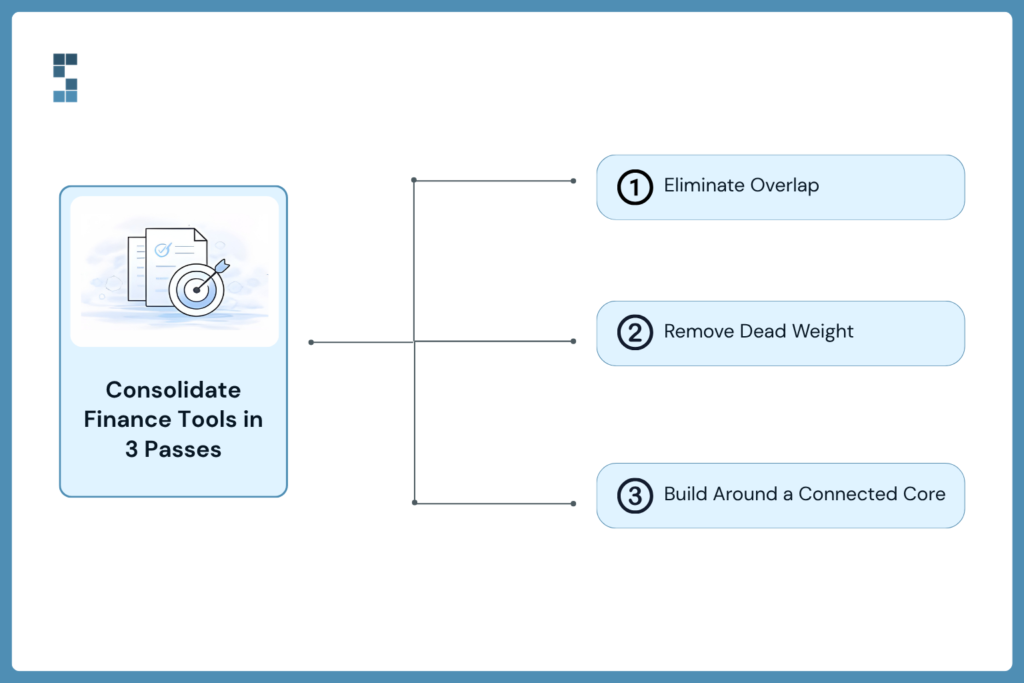
So how do you fix it without blowing up systems your team actually relies on? Not by ripping everything out. By consolidating deliberately, in three passes.
First pass, find the dead weight. Pull every finance-related subscription into one list, what it costs, who uses it, and when someone last actually opened it. This alone is clarifying, and a little alarming. You’ll spot the duplicate expense tool, the licenses assigned to people who left, the app you’re paying for out of pure inertia. Cancel the obvious zombies. That’s found money in the first afternoon.
Second pass, find the overlap. Now look at what’s left and ask which tools are doing jobs another tool already does. A standalone invoicing app when your accounting platform invoices natively. A separate reporting subscription for numbers your core system can produce. This is subtler than killing zombies, because these tools work, they’re just redundant. The question isn’t “does this do something?” It’s “does this do something I’m not already paying for elsewhere?”
Third pass, consolidate around a connected core. This is where the real savings live, and it’s the step people skip. Instead of many tools loosely bolted together, you build around a core accounting system, QuickBooks Online, say, with the tools you genuinely need integrated directly into it, so data flows automatically instead of by hand. The categories most firms actually need are few: solid accounting at the center, and cleanly connected tools for the specific jobs that remain, such as time tracking, expense management, or payroll through platforms like Ramp or Gusto. The goal isn’t the fewest possible tools. It’s the fewest possible disconnected tools.
What you actually save
Add up what consolidation returns and it lands in two buckets, one obvious and one much larger.
The obvious bucket is the canceled subscriptions, the zombies and the overlaps, real dollars back every month starting immediately. Nice, but it’s the small bucket. The large bucket is the time. When your stack is integrated and data flows on its own, the hours you were pouring into manual transfer, reconciliation, and chasing down which report is correct simply evaporate. Firms that move from scattered manual processes to properly integrated systems commonly cut their financial admin time by seventy to eighty percent within about ninety days. That recovered time, redirected to client work, is worth multiples of the subscription savings. The canceled apps get you a rebate. The integration gets you your weeks back.
There’s a quieter dividend, too: clarity. A consolidated, connected stack produces one set of numbers everyone trusts, instead of five that argue. You stop wondering which report is right because there’s one source of truth. That confidence is hard to price, but any owner who’s tried to make a decision on numbers they didn’t quite believe knows exactly what it’s worth. This is the shift System Six builds for the firms it serves, cutting tool sprawl and wiring the essentials into a clean, automated core, and it’s part of why over half of new clients arrive by referral and existing ones rate the firm an average 9.5 out of 10. People don’t refer a shorter software bill. They refer the relief of a stack that finally just works.
So the honest question to close on. When did you last actually look, line by line, at every finance tool you’re paying for, and ask whether it’s earning its keep or just quietly billing you? If you can’t remember, that’s your answer, and the audit will almost certainly pay for itself before lunch. The subscriptions are the small leak. The manual work they create is the flood. Fix both.
Frequently asked questions
How can a small firm reduce its software costs?
Start by listing every finance-related subscription with its cost, active users, and last-used date, then cancel unused “zombie” tools and eliminate ones that duplicate features you already pay for elsewhere. The bigger savings, though, come from consolidating around a connected core system so your tools share data automatically. That removes the manual work a scattered stack creates, which typically costs far more than the subscriptions themselves.
What finance tools does a small consulting firm actually need?
Most firms need fewer tools than they think: a solid core accounting system such as QuickBooks Online, plus cleanly integrated tools for the specific jobs that remain, commonly time tracking, expense management, and payroll through platforms like Ramp or Gusto. The priority isn’t the fewest tools, but the fewest disconnected tools. What matters most is that whatever you use shares data automatically rather than requiring manual transfer.
Is it cheaper to use one integrated system or several separate tools?
An integrated setup is usually cheaper in total cost, even when the software itself costs a similar amount, because it eliminates the hidden labor of manually moving data between disconnected tools. Separate tools create re-keying, reconciliation, and errors that consume far more time than the subscriptions cost. Firms moving to integrated systems often cut financial admin time by 70 to 80 percent, which typically outweighs any difference in software price.
How do I know if I’m paying for software I don’t need?
The clearest test is a line-by-line audit of every finance subscription: if a tool has no active users, duplicates something another tool already does, or hasn’t been opened in months, you’re likely paying for software you don’t need. Overlapping features and licenses assigned to former employees are the most common culprits. If you can’t remember the last time you reviewed the full list, that alone is a strong sign it’s worth doing now.
About System Six
System Six is a Seattle-based bookkeeping and financial services firm that helps small and mid-sized businesses streamline their financial operations. We specialize in providing technology-driven financial management solutions for consulting firms, enabling owners to focus on growing their businesses without worrying about cash flow, payroll, or compliance. Our team of over 40 professionals brings an average of 10+ years of accounting experience to every client relationship, serving more than 175 businesses across the U.S. With a 9.5/10 NPS score, we deliver the financial clarity and peace of mind that consulting firm owners need to thrive. Learn more at www.systemsix.com.