Picture this. You’re reviewing your quarterly numbers, feeling pretty good about things. Your biggest client—the one you’ve poured countless hours into—looks like it should be your most profitable relationship. Then you dig deeper. Factor in the partner’s time on those “quick” status calls. The proposal revisions that weren’t billed. The scope creep you absorbed to keep them happy. Suddenly, that flagship engagement is barely breaking even.
Sound familiar? You’re not alone. Most consulting firms are flying blind when it comes to true project profitability. They track time in one system. They run accounting in another. And somewhere in the gap between those two systems, profit quietly leaks out.
Here’s the thing: when time tracking and accounting actually talk to each other, you stop guessing and start knowing. You see which projects genuinely make money—and which ones are slowly eating your margins while looking healthy on the surface.
The Expensive Gap Between Time and Money
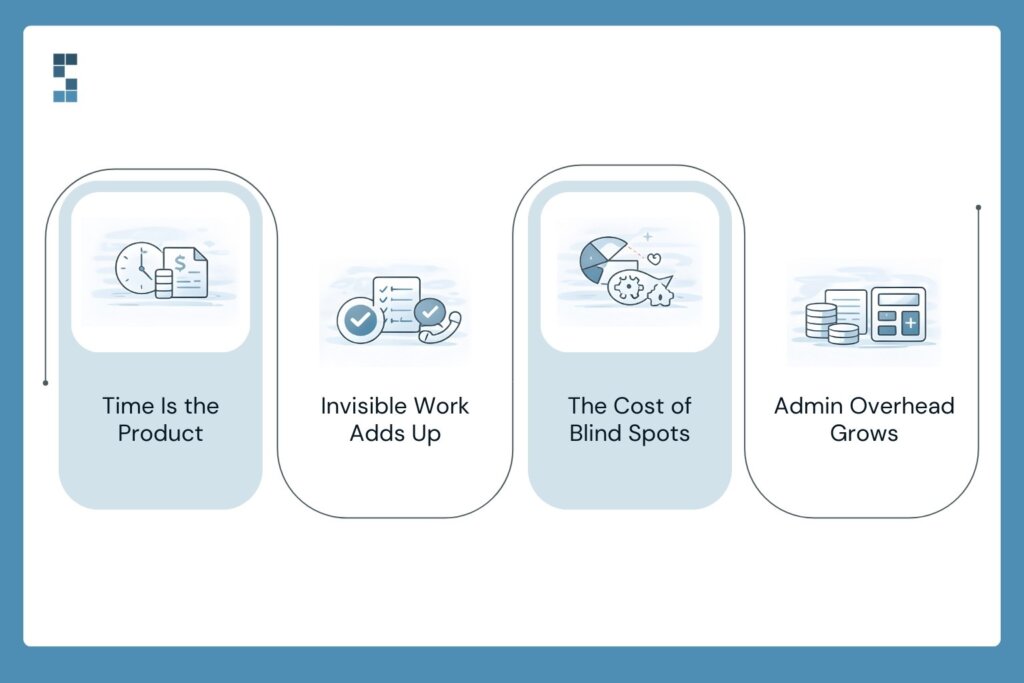
Your inventory, as a consulting firm, is time. That’s it. Unlike product businesses with warehouses full of widgets, you sell hours and expertise. Yet most firms treat time data and financial data as completely separate worlds. They log hours in Toggl or Harvest, run invoices through QuickBooks, and never quite connect the two in any meaningful way.
The costs that slip through this gap are insidious. Partner time on “quick reviews” that somehow stretch into hours. Proposal development that nobody thinks to track. Scope management conversations. Unbilled client calls. Internal meetings about the project that never make it onto anyone’s timesheet. These aren’t dramatic line items anyone notices. They accumulate quietly, like water damage behind a wall.
This profit blindness typically costs firms 15-25% of their potential margins. That’s not a typo. A quarter of your profits, potentially, vanishes into the space between two systems that don’t communicate.
One founding partner at a consulting firm put it bluntly after finally connecting their systems: “We had no idea our large regulatory projects were actually break-even when you factored in all the partner time.” Their most significant, most prestigious engagements—the ones they’d been proudly featuring in marketing materials—were barely keeping the lights on.
And there’s another cost beyond the profit leakage: your time. Most consulting firm owners spend 15-20 hours monthly on financial administration. That’s the late nights cross-referencing Toggl exports with QuickBooks reports, trying to figure out why the numbers don’t quite match. Phones ringing. Spreadsheets multiplying. The nagging feeling that something’s off, but you can’t pinpoint what.
What Real Integration Actually Looks Like
Let’s be clear about what we mean by integration. We’re not talking about exporting a CSV file from your time-tracking tool and importing it into your accounting software once a month. That’s manual data transfer with extra steps. Real integration means seamless, automatic flow between operational reality and financial truth.
Modern systems can sync directly with tools like Harvest, Toggl, Clockify, and TimeCamp. Every hour, your team’s logs are automatically logged into project profitability calculations. No exports. No imports. No reconciliation headaches.
This transforms time tracking from a billing function into a costing function. Instead of just knowing what to invoice, you know what the project actually costs—including the hours that weren’t billable but were definitely real—the senior consultant who reviewed deliverables. The admin time spent coordinating schedules—the project manager’s weekly check-ins.
The difference between real-time visibility and month-end reporting is the difference between steering a ship and reading about where it went. When your systems are integrated, you see margin erosion in real time. You catch the project that’s running hot before it becomes a problem, not thirty days after the damage is done.
Proper integration also means accurate overhead allocation. Non-billable time—admin work, marketing, and professional development—is appropriately spread across projects. You stop pretending these costs don’t exist and start understanding their real impact on each engagement.
One client described the shift this way: “System Six revamped our whole accounting system into accurate and dependable practices. Now I can pull up real-time insights about project profitability from my phone between client meetings.” That’s not a nice-to-have. That’s the information you need to make wise decisions in the moment—whether to push back on scope creep, when to have a pricing conversation, and which opportunities deserve your best people.
The Ripple Effects of Margin Clarity
Knowing your proper project margins isn’t just about understanding the past. It transforms how you make decisions about the future.
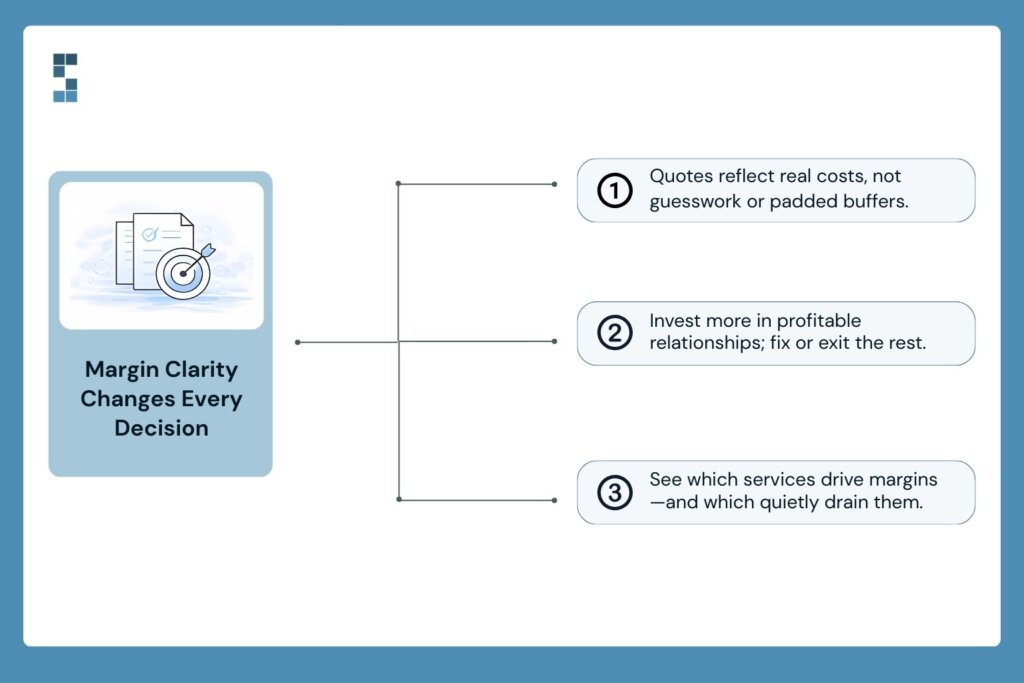
Start with pricing. When you know your actual costs, you quote with confidence instead of hope. No more underpricing because you forgot to account for all the invisible work. No more padding estimates with arbitrary buffers because you’re not sure what things really cost. You price based on reality.
Then there’s client portfolio optimization. Which relationships deserve more investment? Which ones need a frank conversation about scope or rates? Without accurate margin data, these decisions are gut feelings. With it, they’re strategic choices backed by numbers.
Service line analysis becomes possible, too. You might discover that your strategy work generates twice the margin of your implementation projects—or the opposite. You find out which consulting offerings actually drive profits and which ones you’ve been subsidizing without realizing it.
And hiring? Hiring decisions grounded in data rather than anxiety. One firm gained such clear visibility into project profitability that they saw a 22% increase in average project margin simply by making better decisions about which work to pursue. That clarity gave them the confidence to open a second office and hire three new consultants. They knew exactly which project types to chase and had the cash flow visibility to make bold moves without holding their breath.
Here’s a quick gut check: can you answer “which of my projects had the best margin last quarter” within thirty seconds? If you’re reaching for a spreadsheet or mentally calculating, your systems aren’t integrated. That information should be at your fingertips.
Making It Happen
So how do you move from disconnected systems to genuine integration? Start with the process before the technology. Document your current workflows. Identify where time data and financial data diverge. Understand the gaps before you try to bridge them.
When evaluating tools, prioritize those that connect time tracking directly to financial reporting—not just export capabilities, but real-time sync. The difference matters more than you might think.
Be wary of the DIY trap. Improperly configured integrations often create more problems than they solve. You end up with data that looks connected but tells conflicting stories, which is arguably worse than having separate systems that you know don’t talk to each other. Working with experts who understand consulting firm economics—who know what project costing should actually look like in this industry—saves months of trial and error.
As one client put it: “I don’t have to think about my accounting. It’s just taken care of seamlessly.” That’s the goal. Not another system to manage, but one less thing demanding your attention so you can focus on the work that actually generates revenue.
The Bottom Line
Imagine walking into the next quarter knowing—with confidence—exactly which projects deserve your best people. Which clients merit a pricing conversation? Which service lines are worth expanding, and which need rethinking?? No more late-night spreadsheet archaeology. No more nagging uncertainty about whether you’re actually making money on your biggest engagements.
Your competitors aren’t necessarily more intelligent or more talented than you. Some of them have just built systems that show them the truth about their business. They see profit leaks before they become crises. They price with precision instead of hope. They make hiring decisions based on data, not anxiety.
For consulting firm owners ready to stop guessing and start knowing, connecting time tracking and accounting isn’t just an efficiency play. It’s a margin multiplier. And in an industry where your only inventory is time, knowing precisely what that time is worth might be the most valuable insight you can have.
About System Six
System Six is a Seattle-based bookkeeping and financial services firm that helps small and mid-sized businesses streamline their financial operations. We specialize in providing technology-driven financial management solutions for consulting firms, enabling owners to focus on growing their businesses without worrying about cash flow, payroll, or compliance. Our team of over 40 professionals brings an average of 10+ years of accounting experience to every client relationship, serving more than 175 businesses across the U.S. With a 9.5/10 NPS score, we deliver the financial clarity and peace of mind that consulting firm owners need to thrive. Learn more at www.systemsix.com.