Somewhere in almost every deal I have been part of, someone says a version of the same sentence: the company has audited financials, so we can skip the quality of earnings work. It sounds reasonable. It is also one of the more expensive misunderstandings in small-company M&A.
An audit and a QoE are not competing versions of the same product. They answer different questions, for different audiences, under different standards. I have bought companies three times now, and I would not rely on either one to do the other’s job. Here is the difference, and how to know which one your situation actually calls for.
Two different questions
An audit answers: do these historical financial statements fairly present the company’s position, in accordance with regulations? It is an opinion product. The auditor tests the statements the company prepared and issues a formal legal opinion for shareholders, regulators, and lenders. It is backward-looking by design, and it takes the business as it is, under its current owner.
A quality of earnings analysis answers a different question entirely: can you, the buyer, rely on these earnings to price and finance this deal? It is a decision product. Nobody issues an opinion; instead you get schedules, findings, and a bridge from reported EBITDA to what the earnings really are once owner perks, one-time items, and accounting choices are stripped out. It is forward-looking in intent, because the whole point is what transfers to you after close.
The one-line version: an audit tells you the books follow the rules. A QoE tells you whether the earnings are real, recurring, and transferable, and whether they will actually show up in Month 1 under your ownership.
Side by side
| Quality of Earnings (QoE) | Audit | |
| Built for | A deal decision: should you buy, based off what numbers | An opinion that historical statements are fairly presented in accordance with regulations |
| Core question | Are the earnings real, recurring, and transferable to a new owner? | Do the statements follow GAAP? |
| Commissioned by | The buyer (or seller, pre-market), for the transaction | The company, for shareholders, regulators, and lenders |
| Looks at | Adjusted EBITDA, add-backs, revenue quality, working capital, debt-like items, off-statement risk | Historical statements as presented |
| Standard applied | Professional judgment about deal risk; no opinion issued | GAAS audit standards; formal legal opinion issued |
| Output | A report with findings, schedules, and quantified adjustments you negotiate with | An opinion letter attached to the financial statements |
| Timeline | Roughly 3–4 weeks | Often 2–4 months |
| Typical LMM cost | $10K–$20K (QoE Lite) to $25K–$50K (full scope) | $20K–$75K+ annually, depending on size and complexity |
A note on reviews and compilations, since they come up in the same conversations: a review is a lighter cousin of the audit, offering limited assurance based on analytics. A compilation offers no assurance at all; the accountant simply assembles the statements. Neither one tests whether earnings survive a change of ownership, which is the question a buyer is paying to answer.
Why a clean audit can still hide a bad deal
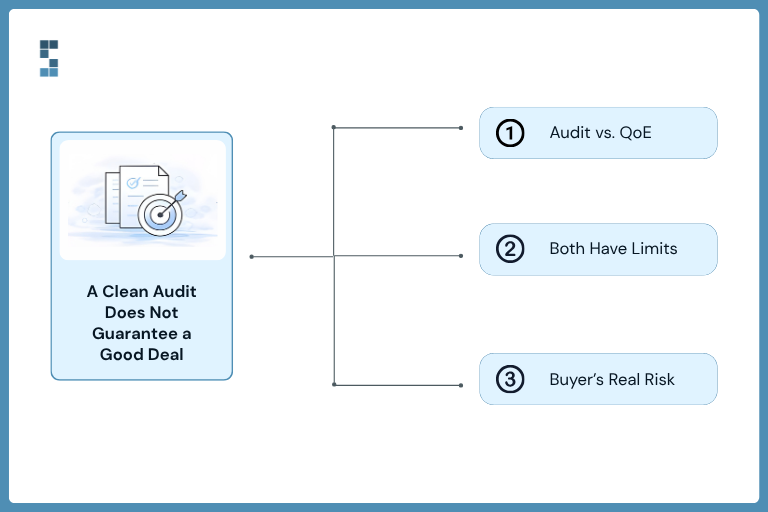
This is the part buyers most often get wrong, so let me be concrete. Audited statements can fairly present, in full compliance with GAAP, a company where 60% of revenue comes from one customer on a handshake. They can fairly present $400,000 of owner compensation booked at half the market rate for the replacement you will have to hire. They can fairly present rent paid to the seller’s own LLC at below-market rates, wages and benefits below what it will take to retain the team, and PTO accruals that simply are not on the books. Every one of those is a GAAP-clean statement and a real reduction in the earnings you are buying.
None of that is the auditor’s failure. Those things are simply not what an audit is for. The QoE exists precisely to catch what the audit is not designed to look for.
The reverse is also true, and worth saying plainly: a QoE is not a substitute for an audit either. No legal opinion is issued, and while a good QoE team will absolutely chase inconsistencies, it cannot certify compliance and it cannot catch everything. If you fundamentally do not trust your seller, no report of any kind will 100% protect you.
The lower-middle-market reality: usually there is no audit anyway
For most deals under $25M, the audit question is theoretical. The typical seller has never been audited. The books are cash-basis or loosely accrual, kept in QuickBooks by a part-time bookkeeper, and the first rigorous test those numbers ever face is your diligence.
That makes the QoE not just different from an audit but, in this market, the only independent look anyone has ever taken at the earnings. It is why lenders and equity partners insist on one. And if anyone you are working with is not insisting on it, you may want to consider how good of a partner they really are.
Which one you need, by situation
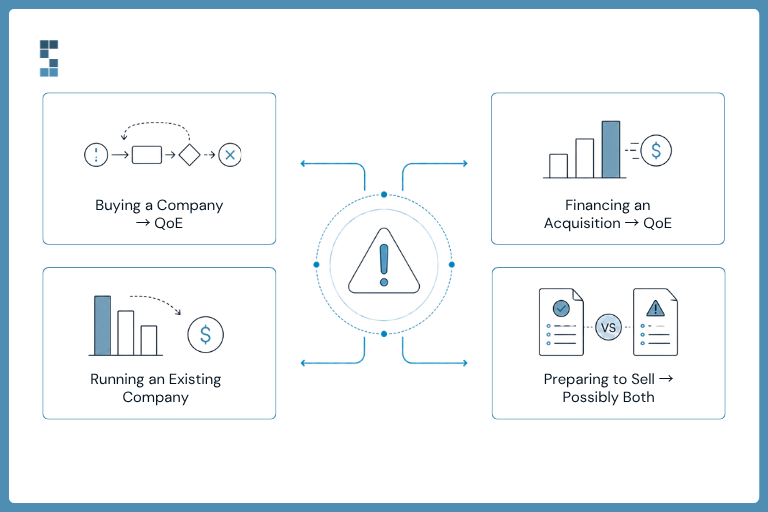
Buying a company: QoE, full stop. Whether or not audited statements exist. If the target is audited, your QoE team will happily use the audit workpapers as raw material, and the engagement often moves faster because the books are cleaner. The audit is an input to diligence, not a replacement for it.
Financing an acquisition: QoE. SBA lenders, senior lenders, and private credit funds want independent validation of the earnings that service their debt. What they almost never require for an LMM acquisition is a full audit of the target.
Running the company you already own: sometimes an audit. Post-close, an audit becomes relevant when a stakeholder requires that opinion: a bank covenant, an insurance or bonding requirement, outside investors, or an eventual exit process where audited history adds credibility.
Selling in a few years: possibly both. A sell-side QoE before going to market finds the problems while you can still fix them, and one or two years of audited or reviewed statements can strengthen a future buyer’s confidence. Which combination makes sense depends on your exit timeline and buyer universe.
Frequently asked questions
Is a QoE the same as an audit?
No. An audit issues a formal opinion on whether historical statements follow GAAP. A QoE evaluates whether earnings are real, recurring, and transferable for a transaction, and issues findings rather than an opinion.
QoE vs. audit: which do I need to buy a business?
A QoE. Lenders and investors expect independent transaction diligence, and audited statements, even when they exist, do not test the things a buyer needs tested: add-backs, revenue durability, working capital, and debt-like items.
Do audited financials make a QoE unnecessary?
No. Audited statements make the QoE faster and cheaper because the books are cleaner, but they answer a compliance question, not a deal question. A GAAP-clean company can still carry customer concentration, under-market owner comp, and off-book obligations.
Is a QoE cheaper than an audit?
Usually, yes. A lower-middle-market QoE runs $10K–$20K for a QoE Lite scope and $25K–$50K for full scope, delivered in three to four weeks. Audits are annual engagements that often cost as much or more and take months.
What about reviewed financial statements?
A review provides limited assurance that nothing obviously violates GAAP, based mostly on analytics. It sits between a compilation and an audit, and like both, it does not evaluate earnings quality for a transaction.
Talk it through with someone who has sat in your seat
If you are staring at a CIM wondering whether the seller’s audited or reviewed statements change what diligence you need, that is a fifteen-minute conversation. Bring us the deal and we will tell you what the existing statements actually cover, what they don’t, and what scope fills the gap. No pitch, just the map.
Talk to a QoE partner at System Six.