It’s Tuesday night, you’re three coffees deep, and you’re staring at two browser tabs. One’s got a job posting template for a staff accountant. The other is showing you proposals from outsourced accounting firms. Your business is growing—actually growing—and you know your current financial setup is held together with spreadsheets and hope. You need help. But which kind?
Here’s the thing everyone gets wrong about this decision. They think it’s about comparing salary numbers. It’s not. This choice shapes how your business scales, how fast you can move, and whether you’ll spend the next two years managing someone or actually running your company. Let’s cut through the noise.
The Real Question Isn’t “Which Is Cheaper?”
Most business owners I talk to lead with cost. “What’s a staff accountant’s salary versus outsourcing?” Wrong question.
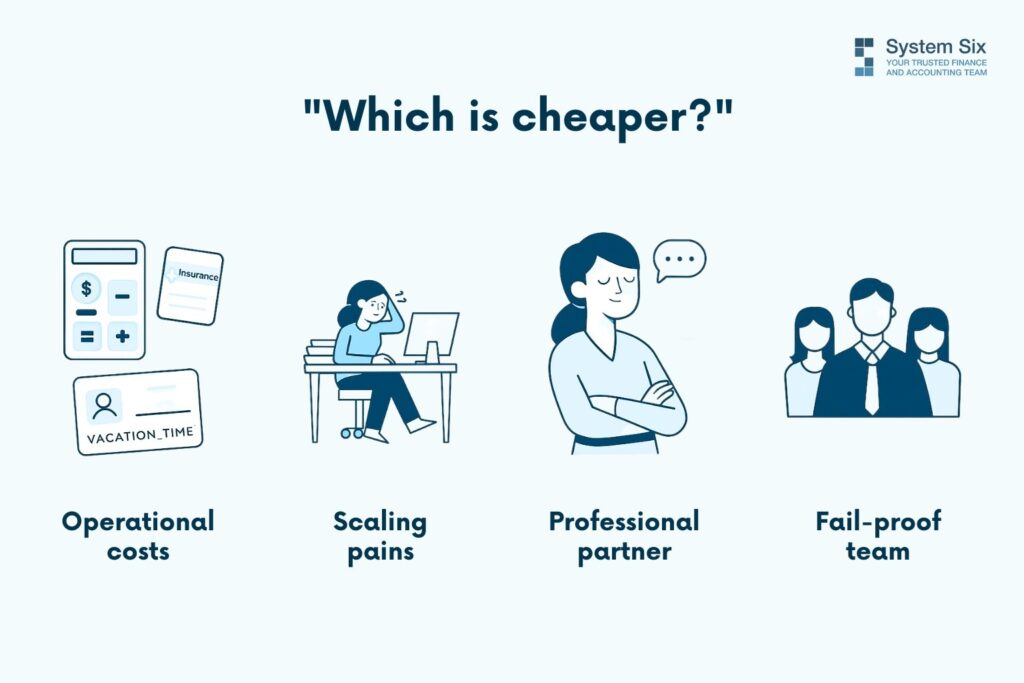
Think about what you’re actually buying. A staff accountant costs $50-70K in salary, sure. But then there’s health insurance, payroll taxes, PTO, that fancy standing desk everyone wants now, software licenses, training time, and—here’s the one nobody mentions—your time managing them. You’re not just hiring someone to do accounting. You’re hiring someone you need to supervise, review, motivate, and cover for when they’re out sick or on vacation.
Now look at the outsourced controller option. Yeah, it might run you $3,000-$6,000 monthly, depending on your complexity. More, right? But you’re getting a whole team—multiple people who know your books. Someone’s always available. They bring systems you’d spend months building internally. And when tax season hits or you need scenario modeling for a big decision? That expertise is just there.
Here’s what really matters, though: scalability. Growth changes everything fast. Betsy, who runs an investor-backed business, said—System Six has done wonders for my stress level to feel like this is all now taken care of with a professional partner.” That peace of mind during rapid scaling? You can’t expense that, but it’s worth real money.
One staff accountant creates a single point of failure. They go on maternity leave, and suddenly you’re three months behind. They quit, and you’re starting over. Your needs double next year, and they’re overwhelmed. It’s not their fault. It’s just what happens when you build critical operations around one person.
So if cost isn’t the deciding factor, what is? Where are you actually right now?
The Growth Stage Litmus Test
Look at where you are right now. Not where you hope to be in three years. Right now.
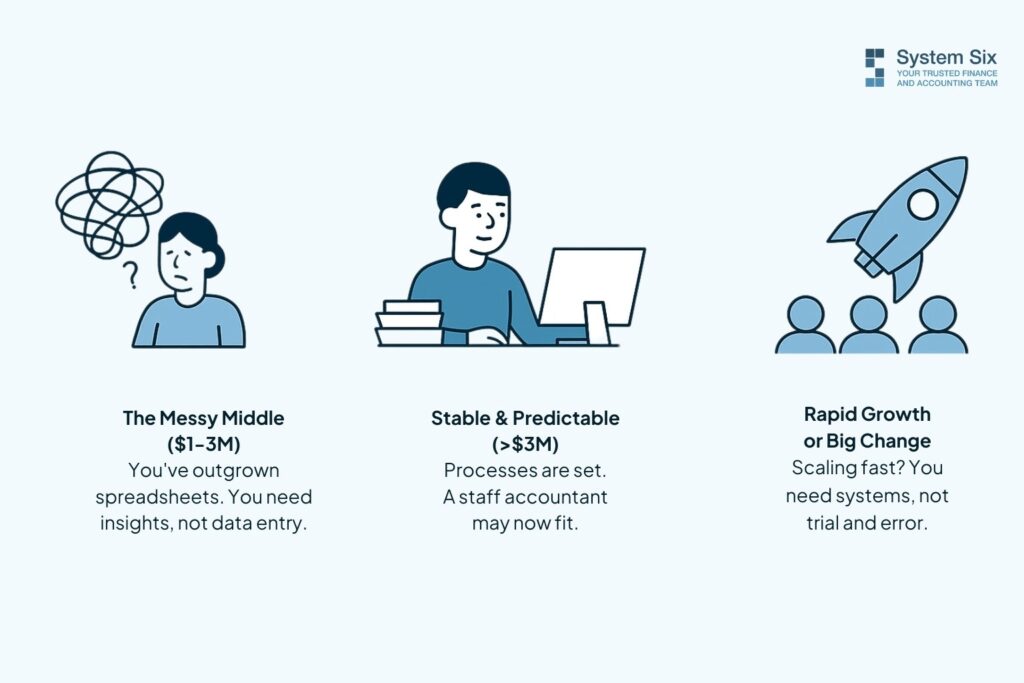
You’re in the messy middle. Revenue’s somewhere between $1-3M. You’ve outgrown spreadsheets, but hiring a CFO seems insane. You can’t quickly answer whether that big project was actually profitable. Invoice payments slip through the cracks. Someone asked about your cash flow forecast last week, and you made something up.
This is where outsourced wins, and it’s not even close. You don’t need someone to enter transactions. You need controller-level strategic guidance. The kind of insight that shows you which service lines actually make money, after accounting for all the hidden costs. One consulting firm discovered, through careful analysis, that its large regulatory projects were break-even—they’d been pursuing the wrong work for years. That revelation alone justified the investment many times over.
Your needs also fluctuate like crazy at this stage. Some months, you’re drowning in complexity. Others are quiet. A staff accountant costs the same either way. Flexibility matters when you’re still figuring things out.
You’re stable and predictable. You may be past $3M with steady patterns. Established processes. The same basic financial tasks every month. This is the zone where a staff accountant starts making sense—if, and this is huge, you have the management bandwidth to supervise them properly. Do you? Really? Because most founders think they do until they’re suddenly spending six hours a week answering questions and reviewing work.
You’re about to explode. Got acquisition talks happening? Major contract on the table? Funding round closing? Everything’s about to change fast, and the last thing you need is onboarding someone new into chaos. Manish shared how his business was saved from “falling into operational ruins” after a freelance bookkeeper had mishandled payroll taxes—System Six’s team came in and fixed what would’ve been catastrophic. When things are volatile, you need proven systems and deep expertise, not someone learning as they go.
Which of these sounds like your Tuesday morning?
What Nobody Tells You About Staff Accountants
Everyone says, “Hire in-house for control.” Let’s be honest about what you’re actually getting.
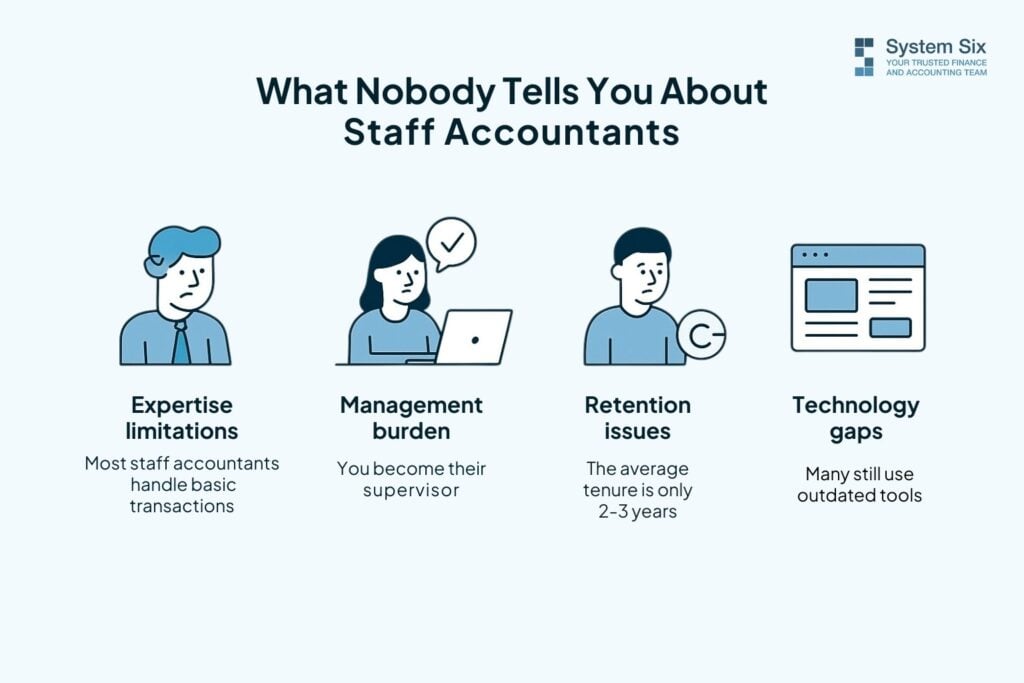
The expertise ceiling is real. Most staff accountants handle transactions. They’re great at recording what happened. But strategy? Cash flow forecasting? Multi-state compliance? Acquisition accounting? That’s a different territory. You end up paying someone to learn on your dime, and when truly complex issues arise, you’re hiring consultants anyway. One business owner noted that when they initially went the cheap-freelancer route, it “hurt in the long-term”—the pricing seemed fair until payroll mistakes added up.
You also become their manager. Weekly check-ins. Performance reviews. Figuring out who covers their work when they’re out. Most founders don’t have bandwidth for this, but nobody talks about it during the hiring process. You’re excited about financial help, not realizing you’ve just added “accounting manager” to your job description.
Then there’s retention. The average tenure for staff accountants is 2-3 years. When they’re fully trained, they leave for more money or a controller title somewhere else. Now you’re recruiting again while your books fall behind. The cycle repeats.
And technology? Many staff accountants use the tools they learned in school—maybe QuickBooks basics, definitely Excel. But modern financial operations require automation, system integration, and real-time dashboards that inform decision-making. Building that infrastructure isn’t typically in their wheelhouse. Multiple reviewers noted that System Six’s technology-driven approach and automated workflows were game changers compared to manual processes.
Look, I’m not saying staff accountants aren’t valuable. They absolutely are. But figuring out if you actually need one versus wanting the comfort of someone sitting in your office—that’s the trick.
The Outsourced Controller Advantage (When It Works)
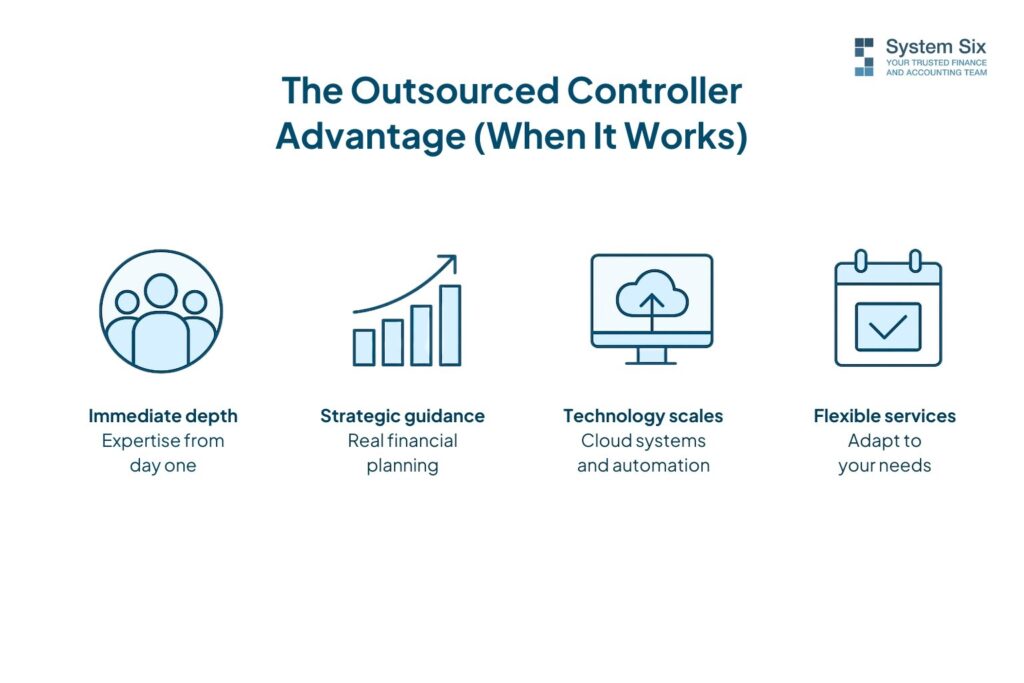
Here’s what changes when you’ve got an entire team in your corner.
You get immediate depth. Day one, you’ve got expertise that would cost $150K+ to hire internally. A multi-person team means redundancy is built in—someone’s always available. As one client put it, their financial operations are “just taken care of seamlessly” with “great service, great value.” That’s not marketing speak. That’s what happens when you’re not dependent on a single person’s vacation schedule.
But it’s more than execution. You get strategic guidance. Real financial planning. Scenario modeling for big decisions: What if we hire three people? What if we open that second location? What if we pursue this acquisition? One consulting firm principal discovered, through proper project profitability tracking, that their mid-sized projects were 40% more profitable than their large engagements. That insight completely shifted where they focused business development efforts.
The technology scales with you, too. Modern cloud systems, automated workflows, integration with your existing tools—time tracking, project management, CRM, all feeding real-time data into your financial picture. Not a month-old report you’re trying to make decisions from. When surveyed, over 95% of customers gave their outsourced provider a 9.5 out of 10 likelihood-to-recommend score. That kind of satisfaction usually means something’s working.
Services flex with your needs. Busy season? They handle it. Slower quarter? You’re not paying idle salary. Growing fast? The team expands to fill the roles, so you don’t have to post jobs.
But here’s the catch, and I’ll be straight with you: there’s less face time. They’re not in your office for impromptu hallway conversations. This requires some trust in a partnership model. If you genuinely need someone at daily standups or you manage through constant in-person interaction, outsourcing might feel uncomfortable. Rebecca noted her team “isn’t just a vendor, they are friends who feel like part of our team”—but building that relationship takes intention when they’re not physically present.
How to Actually Decide (Without Losing Sleep)
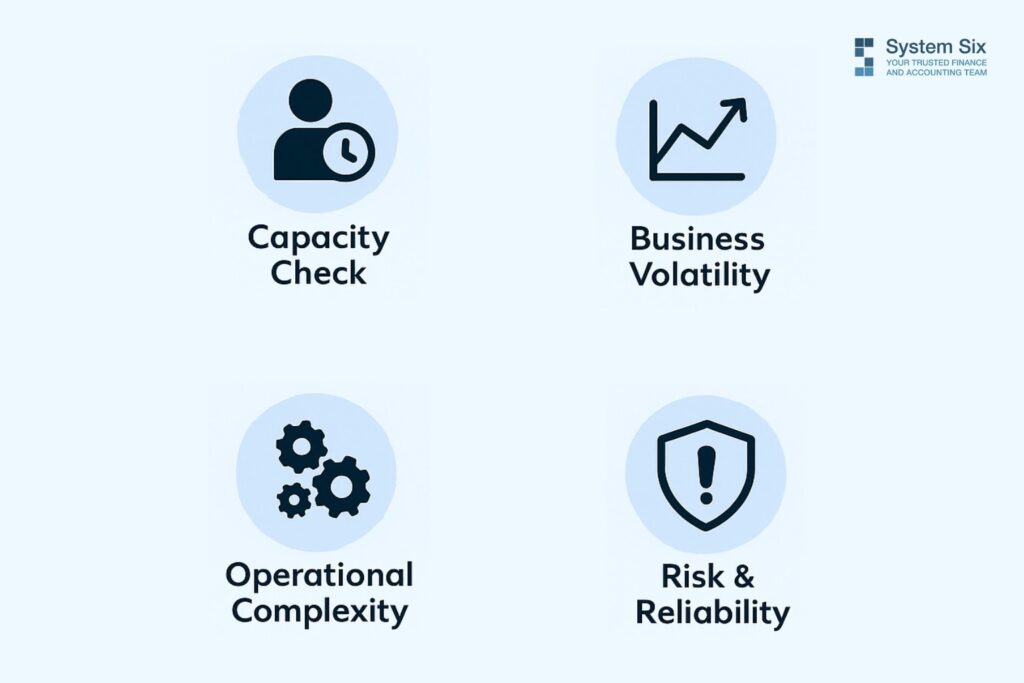
Stop overthinking. Ask yourself these five questions.
Can you genuinely manage another employee right now? Not “should you”—can you? Do you have time for weekly check-ins, training, reviews, and supervision? If you’re already stretched thin, adding management responsibility might break you.
How fast are things changing? If your revenue, team size, or service offerings shift quarterly, flexibility wins. Stable and predictable favors in-house. Volatile and growing favors outsourced.
What’s your actual complexity level? Multiple states? Various revenue streams? Contractor management? Complex project accounting? Investor reporting? High-complexity projects require specialized teams with broad expertise. A capable individual can perform simple operations.
What’s your risk tolerance for financial mistakes? Payroll tax errors cost real money. Compliance issues damage your reputation. Single-person operations carry a higher error risk—nobody is checking their work. One founder emphasized how affordable the expertise became after experiencing what happens when things go wrong: “I would pay for this expertise without hesitation.”
What does your growth trajectory actually require? Be honest. Are you building toward $10M or stabilizing around $3M? Different futures need different financial infrastructure. If you’re staying small and steady, one great person might be perfect. If you’re scaling aggressively, you need systems that won’t break.
One thing people forget: hybrid approaches exist. Some businesses use both—an outsourced controller for strategy and monthly close, plus a part-time internal coordinator for day-to-day stuff. Others start outsource and transition later when it makes sense. There’s no law saying you have to choose once and be stuck forever.
The Choice That Fits Your Growth
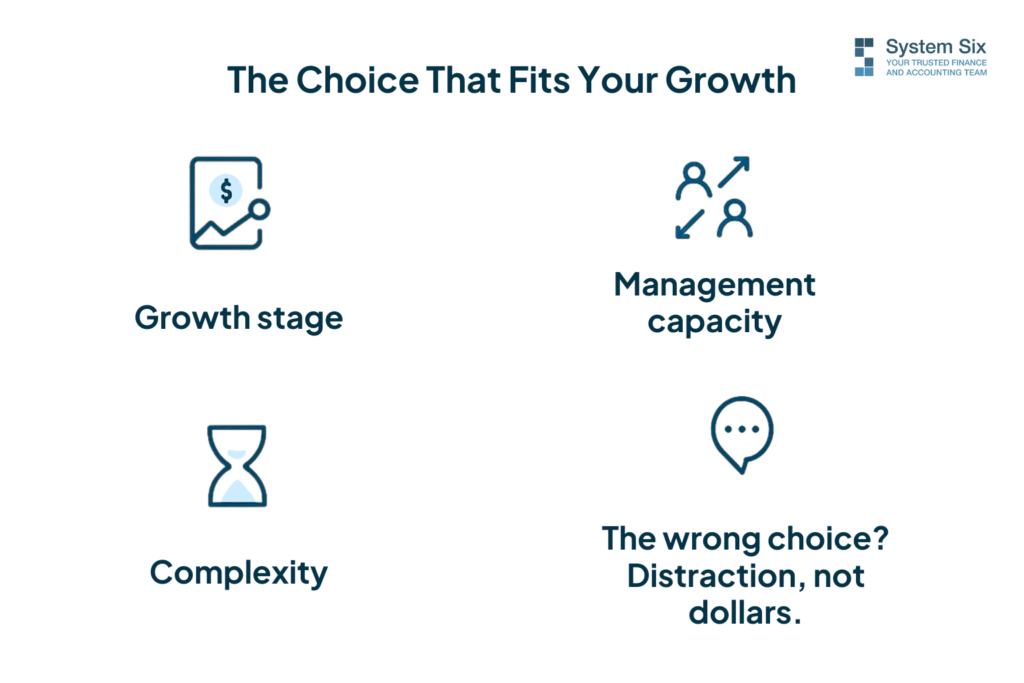
The staff accountant versus outsourced controller decision isn’t about which option is “better.” It’s about honest self-assessment of where you are and where you’re heading.
Remember that late-night stress about making the wrong choice? You’ve got a framework now. Look at your growth stage. Evaluate your management capacity. Consider your complexity. Match the solution to your actual situation, not your ideal fantasy of how organized you wish you were.
Your business is growing. Your financial operations should make that easier, not harder. Whether that means a desk in your office or a team you’ll never meet in person—pick the option that gives you back your time and your clarity.
Still stuck? Talk to people who’ve walked this path. Ask what they wish they’d known earlier. And trust your gut—you didn’t build a business without decent instincts.
What’s the real cost of the wrong choice? Not the dollars. The months of distraction when you should be focused on growth.
About System Six
System Six is a Seattle-based bookkeeping and financial services firm that helps small and mid-sized businesses streamline their financial operations. We specialize in providing technology-driven financial management solutions for consulting firms, allowing owners to focus on growing their businesses without worrying about cash flow, payroll, or compliance issues. Our team of over 35 professionals brings an average of 10+ years of accounting experience to every client relationship, serving more than 175 businesses across the U.S. From accurate bookkeeping to cash flow forecasting, we deliver the financial clarity and peace of mind that consulting firm owners need to thrive. Learn more at www.systemsix.com.