From 5 to 50 Employees: One Firm’s Financial Scaling Journey
When Nathan started his strategy consulting firm in 2018, he knew exactly where every dollar went. He had to. With four colleagues in a co-working space and a single QuickBooks login, the financial side of his business fit on one Excel tab. He’d reconcile accounts on Sunday nights with a glass of wine. It felt manageable. Almost charming.
Six years later, his firm has 50 employees across 3 states, 14 active client engagements, and a finance function that bears no resemblance to that cozy spreadsheet. The journey from there to here wasn’t a straight line. It was a series of breaking points, each one forcing Nathan to rebuild something he thought was already working.
This is his story. Or really, it’s the story of every consulting firm that’s tried to grow past the boutique stage because the financial systems that get you to ten employees won’t get you to fifty. And the ones that get you to fifty look almost nothing like what you started with.
The Five-Employee Era: When Everything Fits in Your Head
In the early days, Nathan ran his finances by feel. Invoices went out when projects wrapped. Expenses got reimbursed when someone remembered to submit them. Payroll was a Wednesday afternoon ritual. His “cash flow forecast” was a mental note about which clients owed what.
This worked. Not beautifully, but it worked. When you can name every client and remember every contract value, you don’t need infrastructure. You need attention. And Nathan had plenty of that.
But here’s the thing about boutique-stage finance: it’s deceptive. The simplicity isn’t a feature. It’s a function of size. The moment your firm grows past the point where one person can hold every detail in working memory, the cracks start to show. They just don’t show all at once.
The Fifteen-Employee Breaking Point
Nathan’s first reckoning came around employee fifteen.
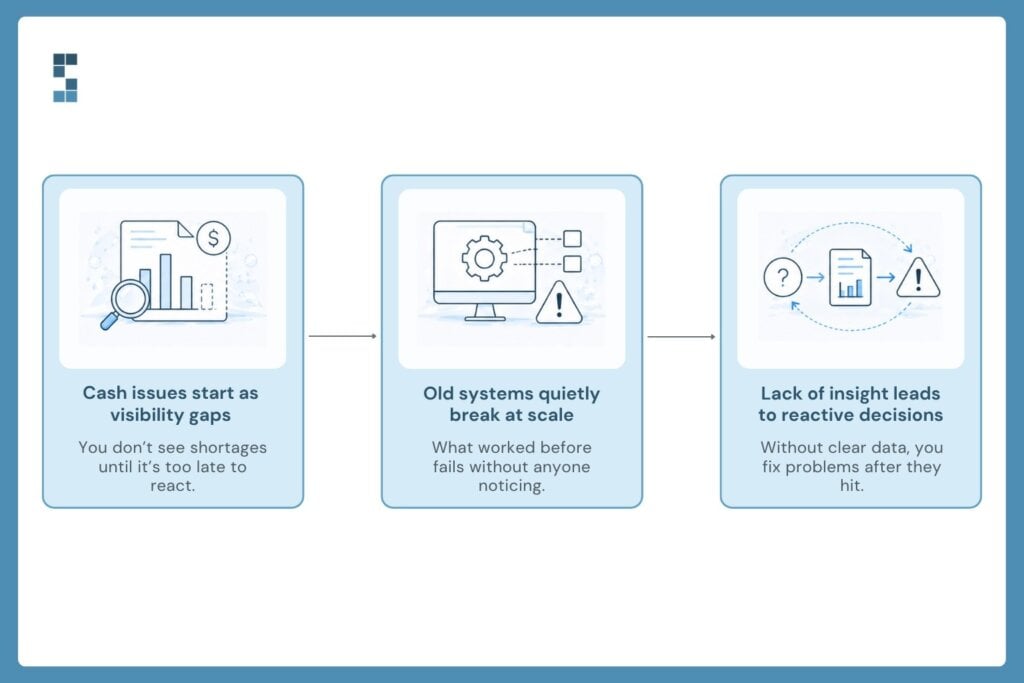
He was on a call with a prospective client when his office manager texted: payroll wouldn’t run because the operating account was $8,000 short. Two large invoices were stuck in the client’s AP department. A vendor had auto-debited a renewal he’d forgotten about. The math caught up with him.
He moved money from his personal savings that day. He’d done it before. But this time, something shifted. He realized he hadn’t just had a cash flow problem. He’d had a visibility problem. By the time he saw the shortfall, it was already happening.
This is the part of the scaling story most owners don’t talk about. The crisis doesn’t announce itself. It hides inside processes that worked yesterday but stopped working sometime last quarter, and nobody noticed because everyone was busy serving clients.
Around the same time, one of Nathan’s senior consultants ran a margin analysis on a project they thought was their crown jewel. Six months of work for a Fortune 500 logistics company. Big logo, bigger billings. When she factored in partner oversight, scope creep, and the proposal time nobody had tracked, the project margin came in at seven percent. They’d been celebrating a loser.
That’s when Nathan called System Six.
Building the Systems for the Firm You’re Becoming
The first thing System Six did was something Nathan hadn’t expected. They didn’t fix his books. They asked about his next two years.
How many employees did he plan to hire? Which service lines was he investing in? What did his ideal client mix look like? The questions felt strange coming from an accounting firm. But the logic was simple: there’s no point building financial infrastructure for the firm you have today. You have to build for the firm you’re becoming.
Over the next twelve weeks, the transformation moved in phases. Real-time project profitability tracking came first, so Nathan could finally see which engagements made money after capturing every cost. Then came twelve-month cash flow forecasting tied to his project pipeline, the kind that would have flagged that payroll shortfall weeks in advance. Automated workflows replaced the manual reconciliation Nathan used to do on Sundays. Multi-state payroll compliance got handled before he hired his first remote employee in Texas.
One System Six client put it this way after a similar transformation: “Hiring them was the best decision I made at the start of the business. We just finished our 2022 audit, and the auditors found exactly zero errors.” Nathan didn’t believe a clean audit was possible until he had one. System Six has run this same kind of transformation for more than 175 businesses, and the firm’s net promoter score sits at 9.5 out of 10. The pattern isn’t an accident.
What Fifty Employees Actually Looks Like
Today, Nathan runs a different kind of business. Not because the work is different. The work is recognizably the same. But the operating system underneath has been rebuilt.
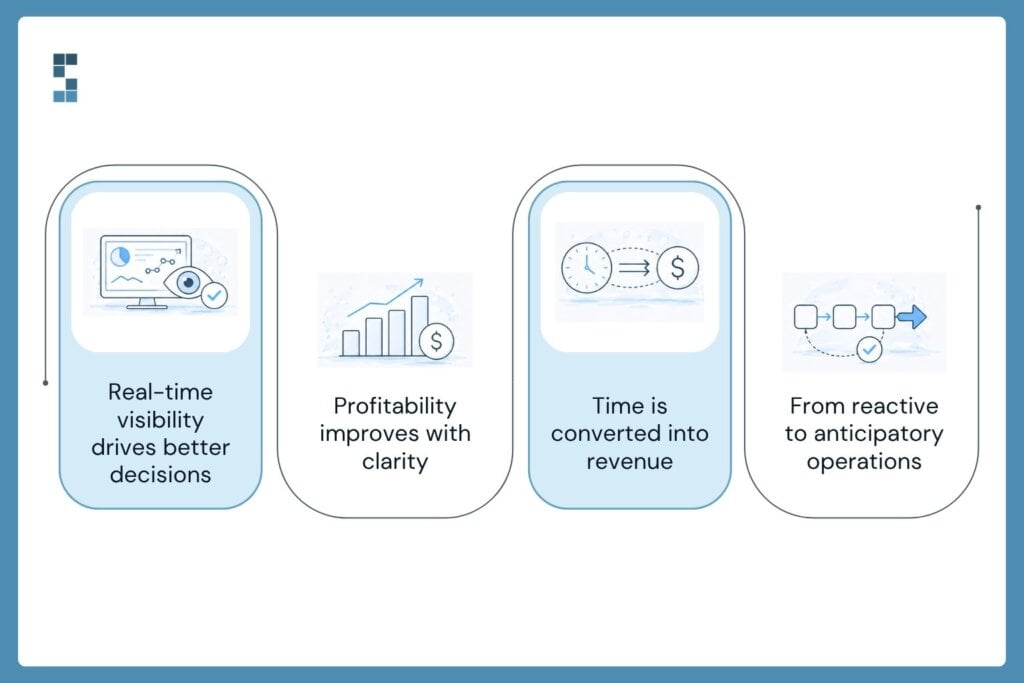
He knows his project margins by Friday afternoon, not three weeks after engagements close. He knows which clients are profitable enough to take more of, and which need contract restructuring before he renews. He knows his cash position twelve months out, with confidence intervals he actually trusts. When a senior consultant pitches him on a new hire, he can model the decision in twenty minutes instead of agonizing for a quarter.
The numbers tell part of the story. Nathan’s firm has reclaimed roughly fifteen hours a month from administrative work, which at his blended rate translates to six figures in recovered billable capacity each year. Project margins are up twenty-two percent because the unprofitable work is finally visible. Cash flow surprises, the kind that used to wake him up at 4 AM, have effectively stopped.
But the part he talks about most isn’t financial. It’s the silence. The mental bandwidth that used to go toward worrying about reconciliations, payroll, and whether that big invoice had cleared. That bandwidth is back. He uses it to think about his clients, his team, and what the firm should look like with a hundred employees.
One System Six client said something that stuck with Nathan: he appreciated how the team was inquisitive, asked follow-up questions, and looked around corners. That phrase, look around corners, captures something important. Good financial infrastructure isn’t reactive. It’s anticipatory. It catches the problems before they become emergencies.
The Lesson Hidden in the Story
Here’s what Nathan would tell you if you caught him on a good day. Every consulting firm that scales past the boutique stage hits the same wall. The wall isn’t a market problem. It isn’t a talent problem. It’s a financial visibility problem dressed up as something else.
You can either rebuild your systems before you hit the wall, or rebuild them while you’re hitting the wall. Both options eventually get you through. Only one of them lets you sleep.
So if you’re somewhere on the path between five employees and fifty, and your finances still fit on a spreadsheet, ask yourself an honest question. What’s your version of Sunday night reconciliation? What’s the cash flow surprise that hasn’t happened yet? What’s the project you think is profitable that isn’t?
The answers are worth more than you think. And the firm you’re trying to build is counting on you to find them.
About System Six
System Six is a Seattle-based bookkeeping and financial services firm that helps small and mid-sized businesses streamline their financial operations. We specialise in providing technology-driven financial management solutions for consulting firms, enabling owners to focus on growing their businesses without worrying about cash flow, payroll, or compliance. Our team of over 40 professionals brings an average of 10+ years of accounting experience to every client relationship, serving more than 175 businesses across the U.S. With a 9.5/10 NPS score, we deliver the financial clarity and peace of mind that consulting firm owners need to thrive. Learn more at www.systemsix.com.