The short answer
Only if you were going to buy it anyway. A deduction returns your marginal tax rate, not the full purchase price, so spending money you didn’t need to spend still leaves you poorer. Where year-end spending does pay off is timing: pulling a purchase you’d make in the new year into December. And some of the best year-end moves don’t involve buying anything at all.
Picture Joel on December 28th. He runs a small marketing agency, and he’s standing in a computer store with a cart full of gear: two new monitors, a laptop he’ll probably give to an intern, a standing desk still in the box. Somebody told him he should “spend some money for taxes.” So here he is.
I get it. Nobody likes writing a check to the IRS, and buying something feels better than paying a bill. But before you load up the cart, let’s do the math most people skip.
What’s the math people skip?
A deduction doesn’t give you back what you spent. It gives you back your marginal tax rate on what you spent. That’s it.
Say your combined federal and state rate is roughly 30%. You spend $10,000 on things you didn’t need. The deduction saves you about $3,000 in tax. So you’re about $7,000 worse off than if you’d done nothing. Plus you own a standing desk you didn’t want.
Put another way: you just spent a dollar to save thirty cents. Would you do that anywhere else in your business?
That’s why the honest answer to “Should I spend money to save taxes?” is almost always no. Spending to save taxes is like paying for a meal you’re not hungry for because the restaurant offered a discount. The discount is real. The meal still costs you.
Where does year-end spending actually work?
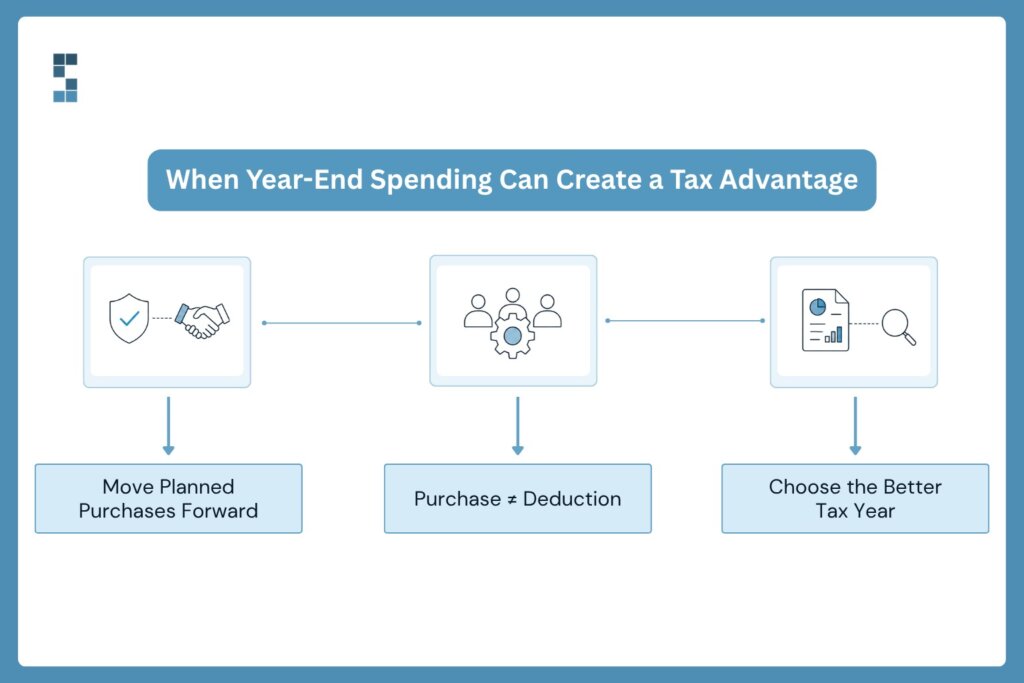
Timing. That’s where the real money is.
If a purchase is already on next year’s list, and you’d buy it in February no matter what, pulling it into December can move the deduction a full year earlier. You were spending the money either way. Now you get the tax benefit twelve months sooner, which means more cash in your pocket while you need it.
What kinds of purchases? Equipment you’ve already planned to replace: the aging laptops, the server, the furniture for the new hire starting in January. Software or subscriptions you’d renew anyway, prepaid within the allowed window. For a cash-basis business, that generally means the benefit doesn’t run past twelve months or the end of next year, whichever comes first. And everyday supplies you burn through on a predictable schedule.
There are a few catches. Equipment usually has to be placed in service by December 31, not just ordered or paid for. A laptop sitting in a warehouse doesn’t count. Whether you can deduct the full cost this year depends on the rules for immediate expensing, called Section 179 and bonus depreciation, and those limits have changed more than once lately. Your accounting method matters, too. If you’re on the accrual basis, paying in December doesn’t automatically pull the deduction forward the way it does on a cash basis. So confirm the current limits and how they apply to you with a tax professional before you buy.
One more wrinkle worth knowing. If you expect next year to be a much bigger year, a deduction might be worth more next year than this one. Pulling it forward isn’t automatically a win. It’s a judgment call, and it’s worth making on purpose.
What else can you do that doesn’t involve buying things?
Quite a lot, actually. These are often the better moves.
The first is timing invoices and collections. If you file on a cash basis, income counts when you receive it. Sending a few invoices on January 2nd instead of December 20th can shift that income into next year. There’s a limit, though. If a client hands you a check in December, you can’t just leave it in a drawer and call it January income. The IRS treats money you could have collected as received.
The second is retirement contributions. A contribution to a retirement plan can lower your taxable income without buying anything you don’t need, and the money stays yours. Deadlines differ by plan type. Some plans need to be in place before year-end for certain contributions, while others can be set up and funded later. That’s exactly why you want to ask early.
The third is paying bonuses on time. A cash-basis business deducts bonuses in the year it pays them, so a bonus run in December lands this year and one in January lands next year. Accrual-basis businesses can sometimes deduct bonuses earned this year if they pay them within two and a half months after year-end, though the rules differ for owners and their families. Either way, payroll has to actually run, and that takes planning.
Why does this conversation belong in early November?
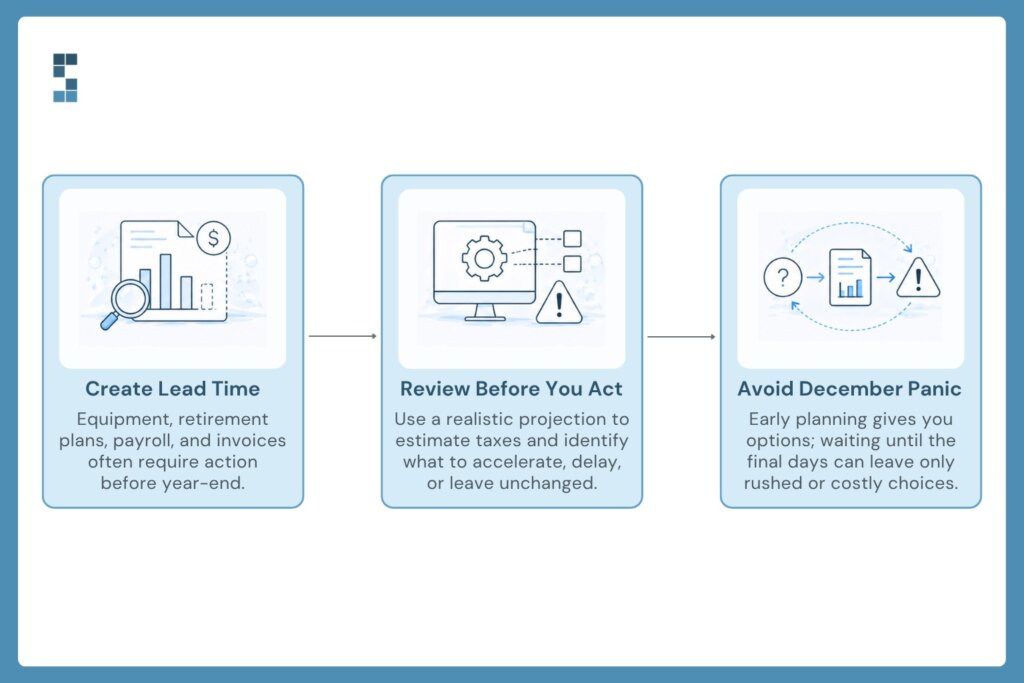
Because by December 30th, the only options left are the bad ones.
Think about everything above. Equipment has to be ordered, delivered and set up. Retirement plans may need paperwork. Bonuses need a payroll run. Invoices need a decision before they go out. Every good move takes a little lead time. The one move that doesn’t is the cart full of things you didn’t need.
Early November gives you room. You can look at a realistic projection of the year, see roughly what you’ll owe, and decide what’s worth pulling forward, pushing back or leaving alone. That’s a calm conversation. The December 28th version is a panicked one.
This is where a good partner earns their keep. One of our clients, Aiko, described it as having a team that’s “open to questions and equipped with a lot of recommendations.” That’s what year-end planning should feel like. Not a scramble. A short list of good choices, made on purpose.
Spend on purpose, not for a deduction
Here’s the rule I’d tape to the wall: if you’d buy it anyway, consider buying it sooner. If you wouldn’t, keep your money. A tax deduction is a discount, not a reason to shop.
If you’d like to walk through your own year before the options narrow, we’ll set up a year-end planning call. You can start here: systemsix.com/get-started.
Frequently asked questions
Does a $10,000 business purchase reduce my taxes by $10,000?
No. It reduces your taxable income by up to $10,000, which cuts your tax by roughly your marginal rate. At a combined 30%, that’s about $3,000.
Can I deduct equipment I order in December but receive in January?
Generally not for this year. Equipment usually has to be placed in service, meaning ready and available for use, by December 31. Confirm the details with your tax professional.
Does prepaying next year’s expenses help on an accrual basis?
Usually much less than on a cash basis, because accrual-basis businesses deduct expenses when they’re incurred, not simply when they’re paid. Your preparer can tell you which method you use and what applies.
This post offers general information for US businesses filing on a calendar year. It isn’t tax advice, and your situation may differ. Verify all limits and rules, including Section 179, bonus depreciation, prepaid expense and retirement plan deadlines, against current IRS guidance before acting.