December 15th hits different when you’re running a consulting practice.
You’re juggling a major client deliverable that’s due before Christmas, trying to figure out who’s actually working the week between Christmas and New Year’s, and there’s this knot in your stomach that won’t go away. Year-end close. Those two words that make every consulting firm owner want to hide under their desk with a bottle of something substantial.
And you’re already wondering—what am I forgetting this time?
Look, if you’ve got 10-50 employees, you know the deal. Year-end doesn’t arrive with a helpful accounting department. It shows up with you, a mountain of receipts that apparently reproduced when you weren’t looking, and the sinking realization that you’re going to be working late on December 28th. Again.
But it doesn’t have to wreck your Q4. Or ruin your January.
What I’m sharing here isn’t some corporate playbook written for companies with full-time controllers and accounting teams. This is the actual checklist we use with consulting practices—the stuff that keeps you compliant without eating up weeks of billable time. Think of it as your survival guide, minus the accounting jargon that nobody actually talks like.
Why This Actually Matters (More Than You Think)

So there’s this client we worked with—a brilliant woman, who ran a tight ship with her consulting team. Except she did what many owners do. She put off year-end until late January, figuring she’d bang it out real quick and get everything to her CPA.
Fast forward two months. She gets a call. Turns out she’d completely screwed up her contractor classifications. Not a little bit wrong—like, multiple state tax agencies are now involved wrong. The penalties alone made her nauseous. The fix? Over 40 hours and thousands in fees she wasn’t expecting. All because she rushed through something she thought was just paperwork.
Here’s what messes with people’s heads about year-end close: you think it’s just about getting your taxes filed on time. That’s like thinking a car inspection is just about getting that sticker on your windshield.
Everything you want to do in 2026 hinges on this. Want an SBA loan? They’re going to want auditable financials, not your best guess at revenue. Talking to investors? They want numbers you can defend, not “somewhere between $2.1 and $2.4 million, probably.” And if you’re operating in multiple states—which, let’s be honest, most growing practices are these days—you’ve got employment laws and tax obligations multiplying like rabbits.
One firm owner told us, “I’m absolutely relieved to be working with you and your company. It has given me a piece of mind and some free time back in my life.”
That peace of mind? It comes from knowing your books are actually right. Not close. Not “good enough.” Right.
Plus, how are you supposed to plan for 2026 if you don’t know where 2025 actually landed? And no, “approximately there” doesn’t count.
Pre-Close Preparation: Don’t Wait Until December 31st
Year-end close doesn’t magically start on January 1st when you’re staring at a disaster and wondering how it got this bad. It starts right now.
Get your accounts reconciled by December 20th. And I mean every single one—bank accounts, credit cards, that line of credit you opened back in March, all of it. Yeah, it’s tedious. But that weird, unmatched transaction from October? It could be a duplicate payment. Could be a missed deposit. It could be an expense that got charged to the completely wrong account. Figure it out now, while it takes ten minutes, not in March when you’re trying to explain it to your CPA and you can’t remember what the hell it was for.
Look at your accounts receivable aging report. Really look at it. You’ve got invoices from Q2 that aren’t being paid. You know it, I know it, everybody knows it except apparently your bookkeeping system. Write them off before year-end. Bad debt deductions reduce your taxable income, but only if you actually write them off in the year you give up trying to collect. That 120-day-old invoice from the client who ghosted you? Write it off. Get the tax benefit. If they suddenly pay you in February, great—you’ll report it as income then.
Verify contractor classifications. Every single person who did work for you this year needs to be correctly classified as 1099 or W-2. The IRS doesn’t mess around with this, and the penalties will make you want to throw your laptop out a window. Got remote consultants in different states? Congratulations, you’ve now got multi-state nexus issues and employment law complications that go way beyond the federal classification rules. Your 1099s are due January 31st, which means you need addresses verified and information collected by mid-December, not December 30th, when nobody’s answering emails.
Organize your receipts before everything becomes holiday chaos. Meals and entertainment? 50% deductible, but you need actual documentation. Business mileage needs dates, destinations, and why you were driving there. Home office expenses need proper allocation. All those technology subscriptions you bought? They need to be categorized correctly to get the full deduction.
Picture this: It’s April 10th. You’re on the phone with your CPA. She’s asking about a $3,200 deduction you claimed. You have no receipt. No memory of what it was for. You’re frantically searching your email while eating stale Halloween candy you found in your desk and questioning every life choice that led you here.
Or.
You could have everything documented and organized by December 31st—your choice.
Financial Review: The Numbers That Tell Your Real Story

Okay, this is the part where most owners start skimming because it sounds boring. Don’t. This is where the actual money gets saved or lost.
Do your fixed asset inventory before the year’s over. What equipment did you buy in 2025? Computers, office furniture, that fancy standing desk you justified as a business expense? List it all. Section 179 deductions and bonus depreciation can knock $20K to $50K off your taxable income if you’re growing. But you can’t claim stuff you didn’t document. Your CPA can’t read your mind or magically know what you bought.
Figure out which projects actually made you money. Not which clients you liked working with. Not which projects felt successful. Which ones made money after you account for all the time, subcontractors, and overhead? Which clients ate up resources with endless scope creep that destroyed your margins? This isn’t optional analysis you do when you have spare time—this is survival information for 2026. One firm owner told us, “Now I can pull up real-time insights from my phone between client meetings. We’ve grown significantly because I can focus on clients instead of paperwork.”
Get honest about deferred revenue and unbilled services. Retainer balances are work you owe clients. Unbilled services are work you did but haven’t invoiced for yet. If you mess this up, your financial statements are basically lying to you about how your business is actually doing. Showing revenue you haven’t earned yet? That’s a problem. Not showing the revenue you have earned? Also, a problem. This stuff matters for cash flow forecasting and accrual accounting—both things that sound boring until you need a loan or investor and realize your books are garbage.
Make sure payroll taxes are up to date everywhere. Quarterly 941s done? State unemployment insurance paid? Workers’ comp audits handled? If you’ve got people working from different states, this gets messy fast. One missed deadline doesn’t just create a penalty—it creates penalties that compound. And compound. And suddenly you’re paying way more than you needed to because you forgot about Idaho.
Strategic Tax Planning: The Moves You Can’t Make in January
This is where you can actually save real money, but the window closes on December 31st. Not April 15th. Not “when I get around to it.” December 31st.
Max out retirement contributions while you still can. SEP-IRA, Solo 401(k), defined benefit plans—these can reduce your taxable income by $60K or more. Some of these contributions must be made by December 31st, not by your tax filing deadline. This isn’t just about paying less in taxes this year. It’s about actually building wealth instead of handing extra money to the government because you didn’t plan.
Review your business expenses and plan strategic year-end spending. Can you prepay some 2026 expenses in December and take the deduction this year? Equipment purchases made before December 31st qualify for immediate expensing. Software subscriptions, professional development, industry memberships—you can prepay these and capture the deduction now. This is legal tax planning, not shady tax evasion. There’s a difference.
Check if your entity structure still makes sense. S-Corp versus LLC has real tax implications that grow as you do. Multi-state registration is its own headache. The Qualified Business Income deduction has weird rules for service businesses that might surprise you. Don’t make these decisions solo or in a panic the week before New Year’s. Talk to your CPA in December while there’s still time to address it.
Actually, coordinate with your CPA now, not in March. Schedule that January meeting before everyone disappears for the holidays. Commit to providing them with organized financials by mid-January. Talk about estimated tax payments for Q1 2026 so you’re not scrambling later. CPAs who get clean, organized books make fewer mistakes and often charge less because they’re not spending billable hours trying to decode your chaos.
The Mistakes That Cost You
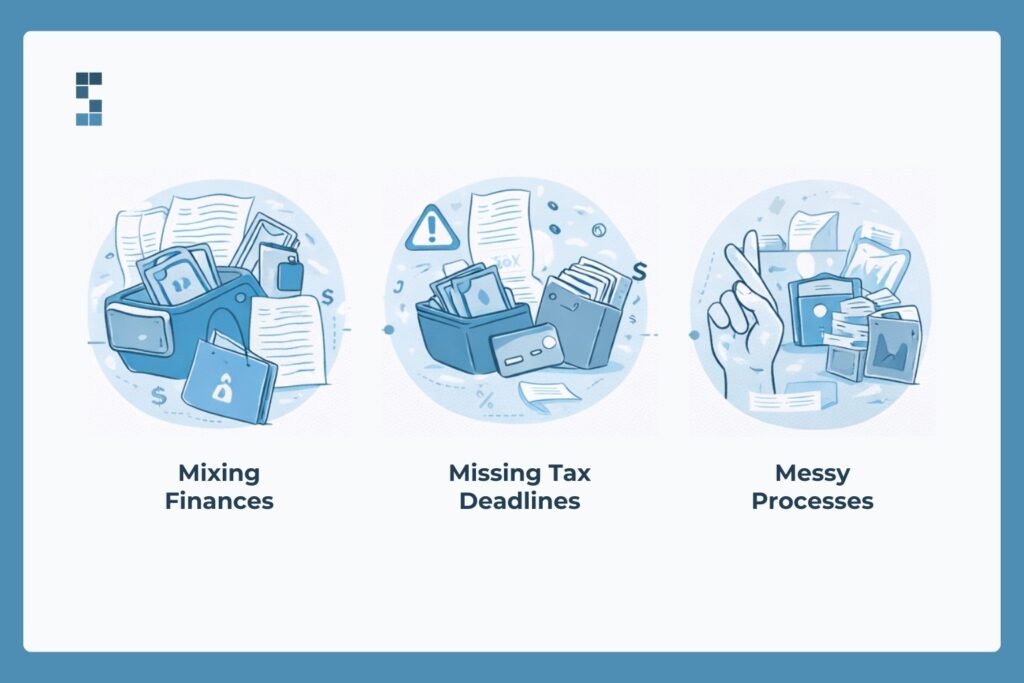
Let me tell you where this all goes wrong.
Waiting until January to start creates artificial deadlines that inevitably lead to mistakes. Mixing your personal and business expenses during the December rush means you’ll be sorting through credit card statements in February, trying to remember what that $247 charge was for. (Spoiler: you won’t remember.) Forgetting about sales tax in multiple jurisdictions? That’s how audits happen. Ignoring payroll deadlines creates compliance nightmares that persist. And skipping accrual adjustments makes your financial statements useless for any actual business decision.
You know what beehives and consulting practices have in common? They both need seamless communication and transparent processes to work. When year-end close becomes a total disaster, it’s usually because your underlying systems have been held together with spreadsheets and crossed fingers instead of actual processes.
The Solution That Works Year-Round
The best year-end close actually starts in January. Not next January. Last January.
When you do monthly closes—reconciling accounts, reviewing financials, and verifying transactions every 30 days—year-end becomes just another month, not a crisis. Automated transaction categorization eliminates hours of manual work and reduces most errors. Real-time dashboards replace the spreadsheet archaeology expedition you currently do to figure out where you stand financially.
“We’ve grown from eight to twenty-five employees in eighteen months,” one environmental consulting firm owner told us. “Our financial system scaled with us, so I never worry about our operational capacity limiting growth anymore.”
Here’s what actually happens when you build systems: your time tracking, billing, and accounting talk to each other. Project profitability updates automatically. Month-end close takes a few hours instead of eating your whole weekend. Cash flow forecasting updates in real-time as money moves. This isn’t some fantasy scenario—it’s what happens when you stop duct-taping processes together and actually build something that works.
Your Next Move
Look, year-end close doesn’t have to be that annual nightmare you start dreading in November. With some systematic prep work and actual systems instead of chaos, it becomes just another thing you do—not the thing that ruins your holidays and eats January alive.
Get started by December 15th. Block out 2 to 3 hours a week for year-end work. If you’re drowning, get help. Trying to tough it out solo is exactly how critical stuff gets missed.
Think about it: what could you actually accomplish in Q1 if you weren’t spending January cleaning up last year’s mess? What client opportunities could you go after if your financial house were genuinely in order instead of held together with hope and spreadsheets?
The answer starts with making this year-end different from all the previous ones.
About System Six
System Six is a Seattle-based bookkeeping and financial services firm specializing in technology-driven financial management solutions for consulting firms. Our team of over 35 professionals brings an average of 10+ years of accounting experience to every client relationship, serving more than 175 businesses across the U.S. We deliver the financial clarity and peace of mind that consulting firm owners need to thrive. Learn more at www.systemsix.com.