
The short answer: Getting the most from your bookkeeper comes down to four habits on your side of the relationship. Feed them clean, timely inputs so they’re not chasing you for receipts and answers. Set a communication rhythm, a quick weekly touchpoint, a monthly review, a quarterly look ahead, so questions don’t pile up. Treat them as your finance team rather than a vendor, and ask them real questions. And share context early, before a hire, a new entity, or a big contract, so they can plan ahead instead of cleaning up after. Do those four things and the same bookkeeper delivers several times the value.
Nadia had a good bookkeeper and got almost nothing out of her. Not because the bookkeeper was bad. Because Nadia treated the relationship like a utility bill: pay it monthly, expect it to work, never think about it otherwise. Receipts went in when Nadia remembered. Questions from the bookkeeper sat in her inbox for a week. Reports arrived and got filed unread. Then one afternoon Nadia mentioned, in passing, that she’d hired two contractors in a new state three months earlier. The bookkeeper went quiet, then asked why she was hearing about it now. There were filings due. There’d been filings due for a while.
Here’s what almost nobody tells you when you hire financial help: the quality of what you get back depends heavily on what you put in. A bookkeeper working with stale inputs, unanswered questions, and no context can only ever record your past. A bookkeeper you actually work with can help you shape what’s coming. Same person, same fee, wildly different result. So let’s talk about your half of the deal, the four habits that turn a bookkeeper you pay into a finance team you use.
What should you be sending your bookkeeper, and when?
Start with inputs, because everything downstream depends on them. Your bookkeeper builds your books out of what you hand over, and the two things that quietly wreck the output are late data and unanswered questions.
Late data first. Receipts that arrive in a shoebox at quarter-end, expense reports submitted whenever someone gets around to it, time entries logged from memory a week later: each one forces your bookkeeper to reconstruct rather than record, and reconstruction is where errors creep in. The fix isn’t heroic. It’s a rhythm. Snap the receipt when you get it, submit expenses weekly, log time daily. Most of this can be pushed to an app on your phone so the friction drops to almost nothing. Clean inputs on a schedule are the single biggest lever you control.
Then the questions. When your bookkeeper asks what a $1,200 charge was for, or which project a contractor invoice belongs to, that question is a transaction sitting in limbo. Every day it waits, your books are a little less current and your close slips a little further. Make a habit of clearing those same-day, even if the answer is two words. One System Six client, Warn, put it simply: the team keeps the books completely up to date, and issues get addressed immediately. That speed runs both directions. Your fast answers are what let your bookkeeper be fast.
How often should you talk to your bookkeeper?
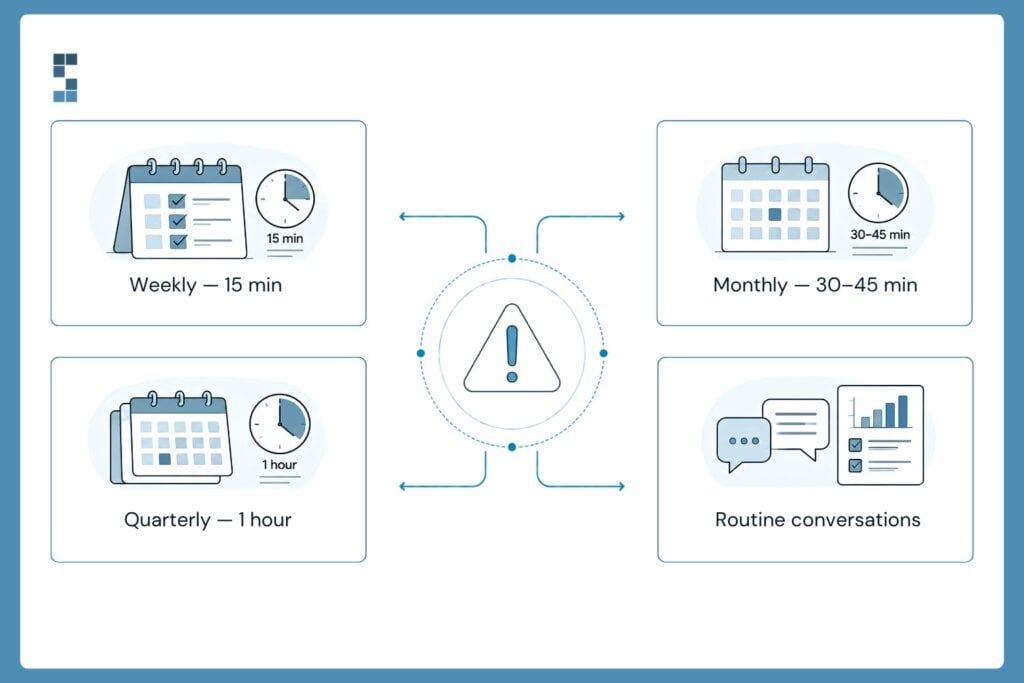
More than most owners do, and on a schedule, so it stops depending on someone remembering. A good cadence has three layers, and none of them take much time.
A short weekly touchpoint, fifteen minutes or a quick message thread, to clear open questions, flag anything unusual coming up, and check that nothing’s stuck. This is the layer that stops small things from becoming big things. A monthly review, thirty to forty-five minutes with the financials in front of you both, to walk through what happened, what surprised anyone, and what the numbers suggest for next month. Not a report handoff; a conversation about it. And a quarterly look ahead, an hour to step back from the month-to-month and talk about the next ninety days: hiring plans, cash needs, big contracts, tax positioning.
Why does the structure matter so much? Because without it, communication defaults to crisis. You talk to your bookkeeper when something’s wrong, which means every conversation is stressful and reactive. With a rhythm in place, most conversations are routine and forward-looking, and the crises mostly stop happening, because you caught them at the weekly touchpoint three weeks earlier. Aiko, a small business owner working with System Six, described the team as always open to questions and full of recommendations. That’s what a real cadence produces: a standing channel where questions and recommendations flow both ways, instead of a phone that only rings when something’s broken.
How do you get strategic value, not just clean books?
This is the habit that separates owners who get bookkeeping from owners who get a finance team, and it’s mostly a shift in how you think about the person on the other end.
A vendor executes tasks. A team member thinks about your business. If you only ever send transactions and receive reports, you’ve hired a vendor, no matter how capable they are. The upgrade is asking real questions. Not “is the close done?” but “which of my service lines is actually most profitable?” Not “did that invoice get paid?” but “are my collections getting slower, and what should I do about it?” Good bookkeepers are sitting on exactly the data that answers those questions, and most of them are quietly hoping you’ll ask, because it’s far more interesting work than categorizing expenses. Rebecca, a System Six client, said the team isn’t just a vendor but friends who feel like part of her team. That doesn’t happen by accident. It happens when you treat them that way first, by bringing them the questions a team member would get.
The payoff is the difference between reports that describe your past and insight that shapes your decisions. When a client of System Six described the team as inquisitive, asking follow-on questions and looking around corners, that’s the version of the relationship where your bookkeeper has been invited far enough into the business to see what’s coming. You can’t look around corners for someone who only shows you the hallway.
Why should you tell your bookkeeper before you make a move?
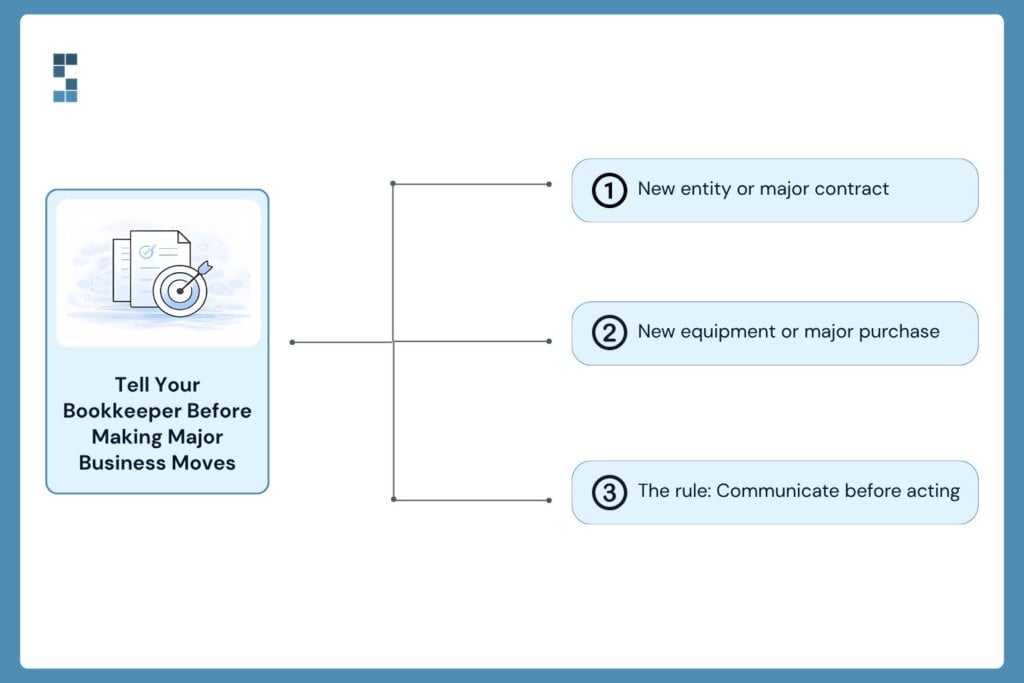
Back to Nadia’s two contractors in a new state. The mistake wasn’t hiring them. The mistake was that her bookkeeper found out three months later, when the only thing left to do was clean up.
Nearly every consequential business decision has a financial and compliance tail: a hire in a new state triggers payroll registration and tax filings; a new entity needs its own books and a plan for inter-company transactions; a big contract might need milestone billing, a different cash plan, or a fresh look at project margin; a new piece of equipment has a depreciation question attached. Told in advance, your bookkeeper sets all of that up before it’s a problem. Told afterward, they’re doing forensic work on a mess that didn’t need to exist. The rule is simple: if it changes how money moves in or out, your bookkeeper hears about it before it happens, not after. One quick heads-up costs you a sentence. The alternative costs you penalties, rework, and the exact stress you hired them to remove.
Your half of the deal
Notice what all four habits have in common. None of them require financial expertise. They require rhythm, responsiveness, and the willingness to treat your bookkeeper as someone who’s on your side of the table. Clean inputs on a schedule. A standing cadence instead of crisis calls. Real questions instead of status checks. A heads-up before the move instead of a confession after it.
Nadia changed all four, and the bookkeeper didn’t change at all. She just finally got to do the job she was capable of. That’s the thing worth sitting with: the ceiling on what your bookkeeper can deliver is usually set by you, not by them. This is the relationship System Six builds with the firms it serves, a front-line finance team rather than a back-office vendor, and it’s part of why over half of new clients arrive by referral and existing ones rate the firm an average 9.5 out of 10. People don’t refer a bookkeeper. They refer the feeling of having someone in their corner who already knows what’s coming.
So here’s the honest question. Are you getting bookkeeping, or are you getting a finance team? If the answer is the first one, the fastest fix might not be a new provider at all. It might be a better way of working with the one you already have. Send the receipt today. Answer the question today. Put the monthly review on the calendar. Then see how much more comes back.
Frequently asked questions
How often should I meet with my bookkeeper?
A three-layer cadence works well for most small firms: a short weekly touchpoint of about fifteen minutes to clear open questions and flag anything unusual, a monthly review of thirty to forty-five minutes to walk through the financials together, and a quarterly session of about an hour to plan the next ninety days. A standing rhythm keeps communication routine and forward-looking instead of reactive.
What information does my bookkeeper need from me?
Timely, clean inputs: receipts captured when you receive them, expenses submitted weekly, time logged daily, and fast answers to categorization questions, ideally same-day. Just as important is advance notice of any decision that changes how money moves, such as a new hire, a new state, a new entity, a large contract, or a major purchase, so your bookkeeper can set things up correctly before they become a problem.
How do I get more strategic value from my bookkeeper?
Ask real questions instead of status checks. Rather than asking whether the close is done, ask which service lines are most profitable, whether collections are slowing, or whether you can afford the next hire. Bookkeepers sit on the data that answers these questions and can provide far more insight when invited to, which turns a task-executing vendor into a finance team that helps shape your decisions.
What’s the difference between a bookkeeper and a finance team?
A bookkeeper records what happened; a finance team helps you decide what happens next. The difference is often less about the provider’s capability than about how you work with them. Providers given clean inputs, a regular cadence, real questions, and early context about upcoming decisions can look ahead and advise, while those given stale data and crisis-only contact can only ever report on the past.
About System Six
System Six is a Seattle-based bookkeeping and financial services firm that helps small and mid-sized businesses streamline their financial operations. We specialize in providing technology-driven financial management solutions for consulting firms, enabling owners to focus on growing their businesses without worrying about cash flow, payroll, or compliance. Our team of over 40 professionals brings an average of 10+ years of accounting experience to every client relationship, serving more than 175 businesses across the U.S. With a 9.5/10 NPS score, we deliver the financial clarity and peace of mind that consulting firm owners need to thrive. Learn more at www.systemsix.com.