Before I bought System Six, I had to answer this question with my own money. I was leaving a private equity career to acquire a bookkeeping firm with an SBA loan and a personal guarantee. If AI was about to automate bookkeeping away, I was about to make the worst financial decision of my life.
So I did what buyers do: I went deep. I studied the AI bookkeeping startups. I talked to investors in some of the best-funded ones. And I bought the human bookkeeping firm anyway. Several years in, with revenue up every year since, here is the honest version of what I learned — including the parts that should worry some bookkeepers.
Everyone asks this question. I asked it during diligence.
The question is not hype-driven; it is rational. Bookkeeping looks like exactly the kind of work AI should eat: repetitive, rules-based, digital. And a wave of venture-backed startups raised hundreds of millions of dollars saying precisely that.
What I found when I looked under the hood was different from the marketing.
What happened to the ‘AI bookkeeping’ wave
The cautionary tale is ScaleFactor, a startup that raised roughly $100M claiming AI-powered bookkeeping.
It’s a good story that went down in flames, because they were telling everybody they were AI — and then all the investors realized this isn’t AI, it’s offshore resources plus some tech. And they shut down.
And it was not just one bad actor. During diligence I talked to people close to the biggest names in the category:
Pilot and Bench and Botkeeper… if you talk to them as part of diligence — I talked to some investors in those businesses — they’re like: yeah, it’s tech-enabled. It’s not full AI yet, because it’s just more complicated than people thought it was.
Several firms that launched as ‘AI for bookkeeping’ quietly pivoted to API integrations, some automation, and offshore labor doing the rest. The pattern repeated after the podcast was recorded, too. [UPDATE: add 2024-2026 developments here — e.g., Bench’s abrupt December 2024 shutdown and acquisition, and the current state of AI bookkeeping tools — verify facts before publish.]
What AI actually does well in bookkeeping
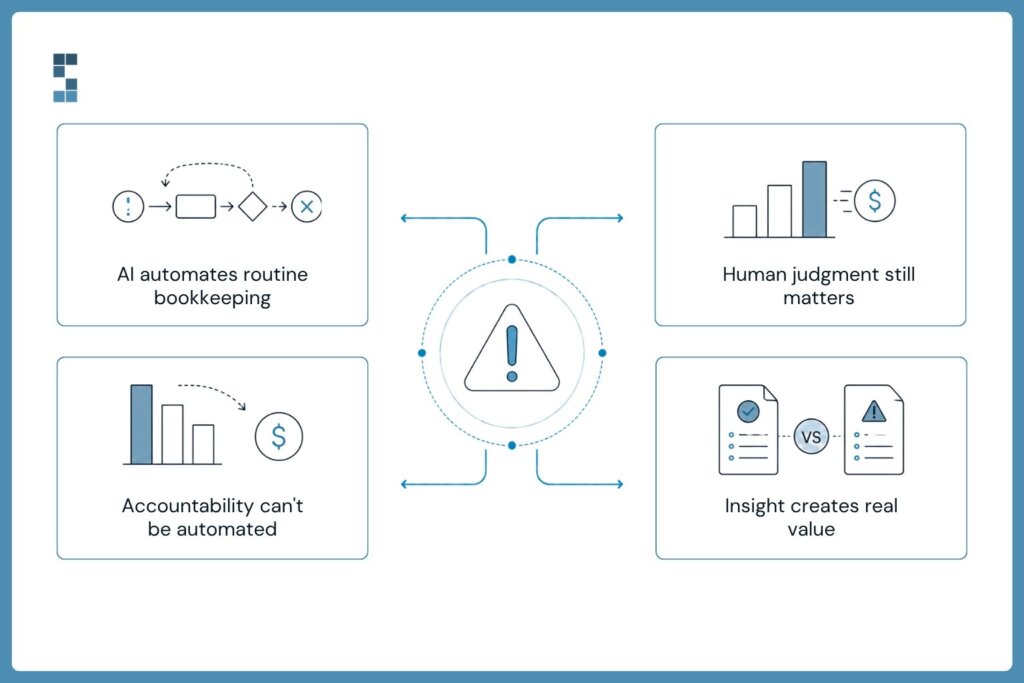
Here is the part that should worry bad bookkeepers: the routine layer really is getting automated, and I said so before I owned the firm.
The very basic reconciliation work or transaction coding — where you’re basically taking credit card transactions and putting them to the right account in your QuickBooks file — that’s already getting somewhat automated. That will continue to get further automated.
That prediction held. Today, automation and AI handle a meaningful share of transaction categorization, bank-feed matching, receipt capture, and anomaly flagging — and we use those tools aggressively inside our own workflows. [UPDATE: name the current tools/AI capabilities System Six uses in 2026.] If a provider is doing all of this by hand, you are paying for inefficiency.
What AI still does not do is the part clients actually pay for:
- Judgment calls: how to treat an unusual transaction, when something in the books signals a real business problem, what accrual treatment fits a messy contract.
- Accountability: someone whose name is on the work, who fixes it when a bank feed silently breaks or a payroll filing bounces.
- The advisor relationship: explaining what the numbers mean and what to do about them, in a conversation, with context about your business.
The bet I made: automation moves, humans judge
When I decided to buy, this was the thesis I hung my hat on:
At the end of the day, does the client want to deal with a robot, or somebody in an offshore capacity — or do they want to deal with a trusted advisor, US-based? That’s where we’re hanging our hat… There still has to be a person for the judgment-call stuff, and also just to be the adviser to the client. I don’t think that will ever get automated away.
Notice what the bet was not. It was not that AI would fail — it was that AI would commoditize the bottom of the market while making great humans more valuable. Clients who want the cheapest, lowest-touch service will increasingly be served by software, and that is fine. Clients who want someone to take real ownership of their finance function — bookkeeping plus payroll, bill pay, invoicing, and a controller-level second opinion — want a human team that uses the best tools, not a tool with no human behind it.
We priced and positioned the firm accordingly: higher service, higher value, deliberately not chasing the cheapest clients. Years later, that segmentation is exactly how the market has split. [UPDATE: add a current proof point — client growth, retention rate, or a client quote.]
What this means if you’re choosing a bookkeeping provider in 2026
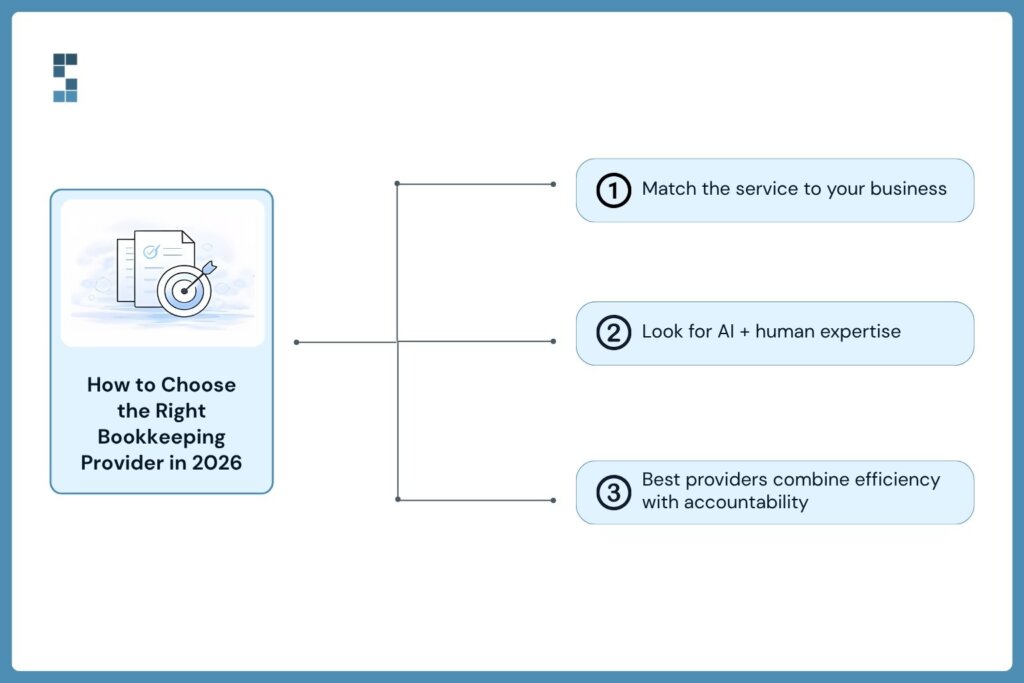
Whether you should use an AI-first service or a human team depends on what your books are to you:
- If your business is simple — low transaction volume, cash basis, no payroll complexity — an AI-first or software-only service is a legitimate, cheap option. Go in with eyes open about support when something breaks.
- If you run decisions off your financials, have payroll and bill pay, or answer to a lender or investors, you want humans with AI leverage: the automation catches the routine, a named team catches what the automation misses.
- Ask any provider the ScaleFactor question: what exactly does your AI do, and who checks its work? A confident provider will answer specifically. A marketing-driven one will repeat the word AI.
Frequently asked questions
Will AI replace bookkeepers?
It is replacing the routine layer — transaction coding, reconciliation matching, receipt capture — and it will keep absorbing more. It is not replacing judgment, accountability, or the advisor relationship. Bookkeepers who refuse to use AI will be replaced by bookkeepers who use it well.
Is AI bookkeeping accurate?
For clean, high-volume, repetitive transactions, quite accurate. The failure mode is silent errors on unusual items: miscategorized transactions that compound for months because no one with context reviewed them. That is why the working model is AI plus human review, not AI alone.
What happened to ScaleFactor?
It raised roughly $100M claiming AI-powered bookkeeping, and shut down in 2020 after it became clear the ‘AI’ was largely offshore accountants plus some tech. It remains the category’s cautionary tale about marketing outrunning capability.
Are services like Pilot actually AI?
They are tech-enabled human services: software handles integrations and automation, people do the judgment work. That is not a criticism — it is the model that works. The distinction matters when a provider’s pricing or marketing implies no humans are needed.
Should I use an AI bookkeeping service or a human team?
Simple books and tight budget: AI-first is viable. Real complexity — payroll, bill pay, accrual, investor reporting — get a human team that uses AI for leverage. The cost difference buys you someone accountable when it matters.
Talk to a human team that uses AI properly
We are not anti-AI — we are anti-unaccountable. Our team automates everything worth automating and puts a named, US-based human behind every judgment call. If you want to see exactly where AI fits in your books and where it should not, book an intro call and we will walk you through it with your own numbers.