Calculate DSCR every month on a trailing twelve-month basis, using the definition written in your loan agreement rather than a generic formula. Most borrowers calculate it once a year because that is when the covenant is tested. By then a breach has usually been building for two or three quarters, and the chance to fix it quietly has passed.
The covenant is tested annually. The ratio moves monthly. Track it monthly.
Use your loan agreement’s definition, not a textbook one
The general shape is the same everywhere:
DSCR = cash available for debt service ÷ total debt service
The floor you are measured against changed recently. Under SOP 50 10 8.1, effective 1 October 2026, the SBA’s coverage requirement became transaction-dependent rather than a single number: first-time acquisitions and owner buyouts are underwritten to a higher floor than business expansions, with 1.25x reported for acquisitions and 1.15x for expansions. Lenders can also no longer use forecast post-closing earnings to clear the floor, so the ratio is now measured on historical performance, or on the earnings established by a quality of earnings report where one is required.
If you closed before October 2026 your loan agreement may still carry the older covenant. Read yours rather than assuming either figure.
What goes into each half is not standard. Cash available for debt service usually starts from EBITDA and deducts some combination of unfinanced capital expenditure, cash taxes, and owner distributions. Some lenders deduct a maintenance capex allowance whether or not you spent it. Some add back specific non-recurring items; some do not. Total debt service is principal plus interest, and whether the seller note and equipment leases count varies.
Two borrowers with identical businesses can report ratios ten or fifteen points apart purely on definition. Find the clause in your loan agreement, write the formula out exactly as it reads, and use that one. If the wording is ambiguous, ask your lender to confirm their calculation in writing now, while nothing is wrong. That email is worth having on file.
The monthly worksheet
Build it once and fill it every month on the trailing twelve months:
|
Line |
Source |
|
Net income, trailing twelve months |
P&L |
|
Add: interest |
P&L |
|
Add: taxes |
P&L |
|
Add: depreciation and amortization |
P&L |
|
= EBITDA |
|
|
Less: unfinanced capital expenditure |
Cash flow statement or fixed asset register |
|
Less: cash taxes paid |
Cash flow statement |
|
Less: owner distributions, if your agreement deducts them |
Equity accounts |
|
= Cash available for debt service |
|
|
Principal and interest, SBA 7(a) |
Amortization schedule |
|
Principal and interest, seller note |
Amortization schedule |
|
Principal and interest, equipment or other debt |
Amortization schedules |
|
= Total debt service |
|
|
DSCR |
CADS ÷ debt service |
Trailing twelve months, not year to date. A year-to-date figure in March tells you almost nothing and swings wildly with one slow month.
What a slide looks like before it becomes a breach
A business with a 1.25x covenant, tracked monthly through a year of gradual margin erosion:
|
Month |
TTM EBITDA |
Less capex and cash taxes |
Cash available |
TTM debt service |
DSCR |
|
January |
$940,000 |
$155,000 |
$785,000 |
$553,000 |
1.42x |
|
March |
$918,000 |
$158,000 |
$760,000 |
$553,000 |
1.37x |
|
May |
$889,000 |
$162,000 |
$727,000 |
$553,000 |
1.31x |
|
July |
$861,000 |
$166,000 |
$695,000 |
$553,000 |
1.26x |
|
September |
$835,000 |
$170,000 |
$665,000 |
$553,000 |
1.20x |
|
November |
$812,000 |
$174,000 |
$638,000 |
$553,000 |
1.15x |
Nothing dramatic happens in any single month. EBITDA drifts down by roughly $20,000 a quarter and capex creeps up. The covenant is breached in July, and by November the business is a full ten points below it. A borrower calculating annually sees 1.42x at the start and 1.15x at the test, with no visibility into the ten months in between.
A borrower tracking monthly sees the direction by March, four months before the breach, and has that time to act while the options are still cheap: pricing, cost base, deferring discretionary capex, or pausing distributions.
The thresholds worth setting
Pick two internal trigger levels above your covenant and act on them, rather than waiting for the covenant itself:
|
Level |
Example on a 1.25x covenant |
What happens |
|
Comfortable |
Above 1.45x |
Normal reporting |
|
Watch |
1.35x to 1.45x |
Monthly review of the drivers; hold discretionary spend and capex |
|
Act |
1.25x to 1.35x |
Written plan with dated actions; tell your lender before they ask |
|
Covenant |
1.25x |
Technical default territory |
The gap between “act” and “covenant” is the whole point of monthly tracking. A lender who hears about a problem from you, with a plan attached, in a month where you are still compliant, has a completely different conversation with you than one who finds a breach at the annual test.
What actually moves the ratio
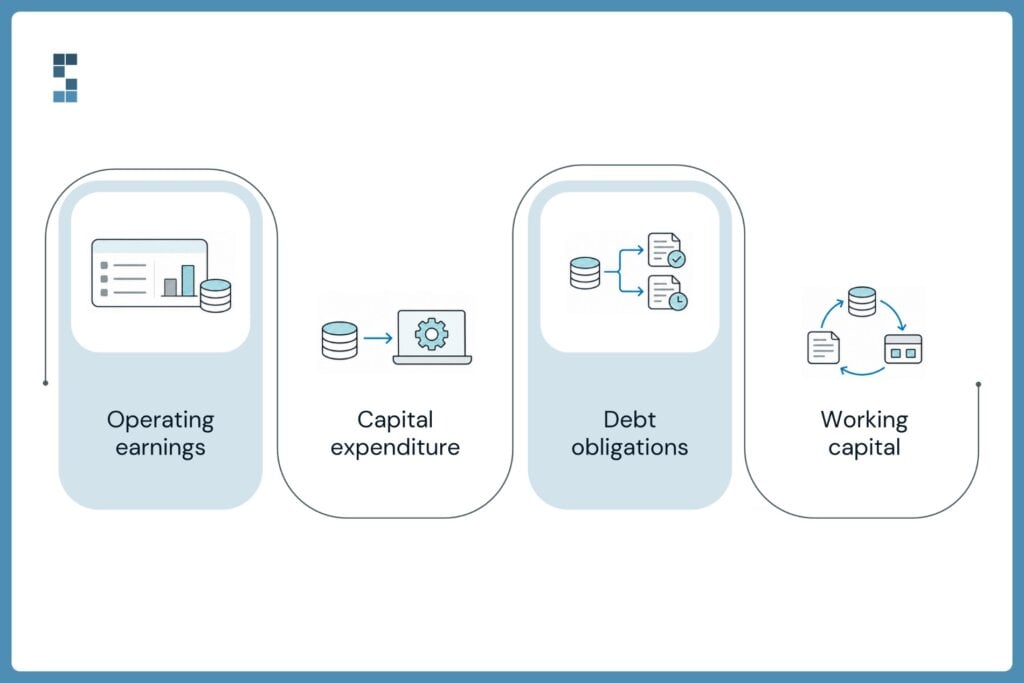
EBITDA, obviously, and it is the slowest to turn around. Watching the drivers monthly rather than the result is the whole job, which is what a monthly financial metrics and KPI dashboard is for.
Unfinanced capital expenditure. The line most borrowers forget is in the formula at all. Financing equipment rather than paying cash moves spend out of the numerator and adds a smaller amount to the denominator, which usually helps the ratio. Check your agreement before relying on that.
Owner distributions. Where your agreement deducts them, every dollar you take out reduces the ratio directly. Model the distribution against the covenant before you take it, not after.
The seller note. It belongs in debt service. Borrowers who leave it out are calculating a number their lender is not.
Working capital swings. These do not appear in the formula but they decide whether you can make the payments at all. Track the 13-week cash forecast alongside DSCR; the ratio can look fine in a month when cash does not.
What to do when it slips
- Confirm the calculation first. Re-run it on the loan agreement’s exact definition before acting on a number that may be wrong.
- Find the driver. Revenue, gross margin, overhead, capex, or debt service itself. One of them moved.
- Write a dated plan. Specific actions, specific months, specific expected effect on the ratio.
- Tell your lender early, with the plan. Covenant relief, a waiver, or a reamortization is far easier to obtain before a breach than after.
- Keep reporting on schedule. Missed reporting during a difficult period is its own default under many agreements, and it removes the goodwill you need.
Frequently asked questions
How often should I calculate DSCR?
Monthly, on a trailing twelve-month basis, as part of closing the books. It takes minutes once the worksheet exists.
What DSCR do SBA lenders require?
Since SOP 50 10 8.1 took effect on 1 October 2026 the requirement is transaction-dependent, with 1.25x reported for first-time acquisitions and owner buyouts and 1.15x for business expansions. Individual lenders can set a covenant above the SBA floor. Your loan agreement states both the figure and the definition that applies to you, and those two things travel together.
Does the seller note count in debt service?
In most agreements, yes. Some permit excluding a note that is fully subordinated with payments deferred. Read the clause; do not assume either way.
What if I am below the covenant but still paying on time?
A covenant breach is a default regardless of payment history. In practice lenders are far more willing to waive for a borrower who is current, communicating, and has a plan, but it is still a default and should be treated as one.
Should I report DSCR to the lender monthly if they only require it annually?
Including it in the monthly package costs nothing and builds a record of reliability that is worth real money when you need an amendment. The monthly reporting package covers what else belongs in it.
Who builds this if I do not have a controller?
Producing the statements is bookkeeping; running the covenant calculation and reading the trend is controller work. That gap is one of the first things to solve after closing, and it is what outsourced accounting for acquisition entrepreneurs is built for.
Reporting that shows the slide before the lender does
We close the month, run the covenant calculation on your loan agreement’s own definition, and flag the trend before it becomes a conversation you have to have. Send us your loan agreement and we will tell you what it actually requires and what it takes to meet it every month.
About System Six
System Six is a Seattle-based outsourced bookkeeping, accounting, payroll, and CFO advisory firm serving consulting and professional services businesses. We work with more than 175 businesses, our team averages over 10 years of accounting experience, and we’ve processed more than $100 million in payroll. Clients rate us 9.5 out of 10 on likelihood to recommend, and over half of our new clients come from referrals. We work on a fixed weekly fee with no long-term contracts. Learn more at systemsix.com.
Sources
- SBA Information Notice 5000-880695, Issuance of SOP 50 10 8.1 — the SBA’s own notice of the SOP, effective 1 October 2026
- SOP 50 10, Lender and Development Company Loan Programs — the SOP itself
- PBMares, New SBA Business Acquisition Rules Take Effect October 1 — the 1.25x and 1.15x figures and the change on projections