
by Chris Williams | May 12, 2026 | Blog
It’s Tuesday morning. Caroline pulls up her P&L on the office laptop and stares at the numbers. Revenue looks strong. Margins look fine. Her coffee’s gone cold while she scrolls through the same spreadsheet for the third time. So why does she feel like she’s flying blind every time her senior consultants ask whether they should chase a new account?
Here’s the thing. Her books are clean. Her bookkeeper is great. But the report in front of her tells her exactly one thing — what already happened. It doesn’t tell her whether the next big move is a smart bet or a slow disaster.
This is the gap most consulting firm owners hit somewhere between their fifteenth and fiftieth employee. The numbers come in on time. The reports look professional. But nobody’s sitting next to them helping interpret what those numbers actually mean for next quarter. That’s the difference between bookkeeping and financial advisory. And it’s a difference that, once you feel it, you can’t unfeel.
If you’ve ever closed your laptop at the end of a long day, wondering whether the decisions you’re about to make are the right ones — and whether the numbers you’re staring at can actually tell you — keep reading.
Bookkeeping shows the past. Advisory shapes the future.
Bookkeeping is the rearview mirror. It tells you, with precision and care, where you’ve been. That matters. Without accurate books, you’ve got nothing to plan against. But the rearview mirror doesn’t help you read the road ahead.
A financial advisor — someone who actually knows your business, your industry, and your numbers — does the harder work. They translate ledgers into a language you can use. They turn last month’s numbers into next month’s decisions. They ask the questions you’re too tired or too close to ask yourself.
One System Six client put it perfectly. Working with us, he said, gives him “an outside view, a 35,000-foot look at what you’re doing that isn’t possible from the inside out.” That outside view is the whole point. When you’re elbow-deep in client work, you can’t see the patterns shaping your firm’s trajectory. Someone has to be looking from above. Someone has to be doing that for a living, across dozens of firms like yours, every single week.
Think of it this way. Your bookkeeper builds the dashboard. Your advisor helps you drive the car. Both are essential. Neither replaces the other. But too many firm owners think they only need the dashboard — and then wonder why they keep ending up in the wrong lane.
What a financial advisor actually does for you
So what does this person do, day to day, that earns the title “strategic”?
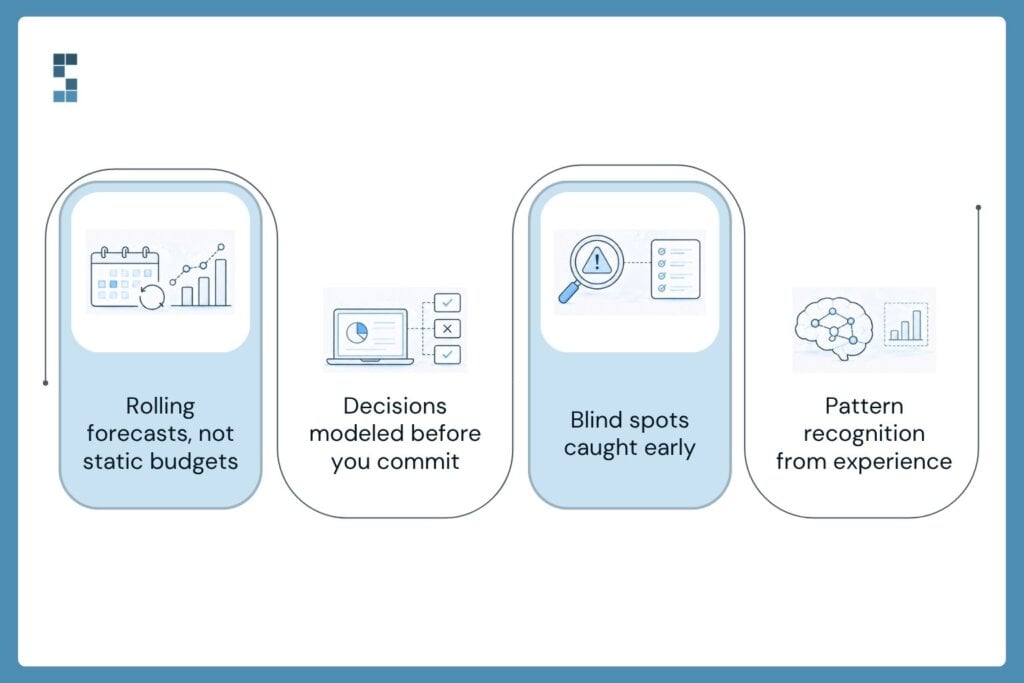
They forecast. Real forecasting — not a once-a-year budget you stop looking at by February, but a rolling thirteen-week cash flow that updates as reality shifts. They show you when money lands and when it leaves so that you can hire ahead of demand instead of behind it. They build a financial picture that breathes with your business, not one frozen in last quarter’s assumptions.
They model decisions before you make them. Should you take on the multi-state retainer? Open a second office? Bring on two senior consultants and a junior? A good advisor runs the math, surfaces the risks, and walks you through the scenarios. Marcus, one of our clients in the search fund world, put it like this: “I am in good hands with System Six, and I especially appreciate how they are inquisitive, ask follow-on questions, and look around corners.” Looking around corners. That’s the job.
They flag what you missed. They noticed the project that looked profitable but really wasn’t once you factored in partner oversight. They catch the slow drift in utilization before it shows up in the bottom line. Paul, another client, said it best: “S6 has been proactive at catching mistakes I’ve made or seeing challenges coming down the pike and asking me the right questions.”
Right questions. Not magic. Just experience, applied to your situation, before you trip. And it’s experience built across many businesses, not just one — patterns you can’t see from the inside of a single firm, but ones that jump out when you’ve watched dozens of firms scale and stumble.
What this looks like in real life
Back to Caroline. A few months into working with a financial advisor, she’s facing a real decision. A regional health system has offered her firm an eight-month engagement worth $1.4M. The work fits. The team can deliver. The problem? It requires hiring two senior consultants right now, and the engagement won’t start paying out for sixty days.
The old Caroline would have either said yes on instinct and prayed that cash held up, or said no out of fear and watched the opportunity walk away. The new Caroline has someone in her corner.
Her advisor pulls up the rolling forecast. They walk through three scenarios: full hire, phased hire, and contractor blend. They show her exactly which weeks would be tight, where the credit line might need to flex, and when the first invoice clears. They model what happens if the client pays on day forty-five versus day sixty. They flag the payroll cycle that lands right when receivables would be thinnest. By the end of the conversation, Caroline isn’t guessing. She’s deciding with data.
She takes the engagement. She structures the hiring in phases. Cash never wobbles. The firm grows by 22% that year, and she sleeps through the night.
This is the quiet, compounding value of advisory. It’s not flash. It’s not a single big save. It’s the steady, weekly removal of guesswork from the decisions that define your business. Over a year, that adds up. Over five years, it changes the trajectory of the whole firm.
The compounding return of clarity
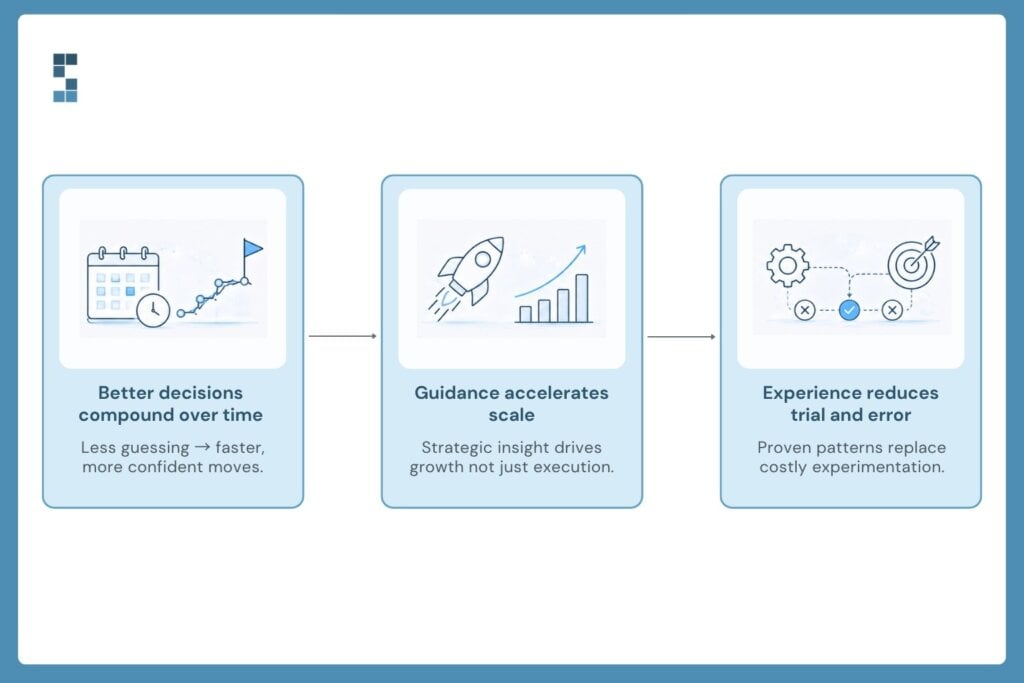
Here’s the part most firm owners underestimate. Strategic financial guidance isn’t a luxury you graduate to at $10M in revenue. It’s the very thing that gets you there.
The firms that outpace their peers aren’t necessarily the ones with the best consultants or the slickest brand. They’re the ones whose owners spend less time wondering and more time deciding. Less time staring at a P&L and asking “what does this mean?” More time saying “here’s our next move.”
That clarity has a name. It’s the financial advisor in your corner — the one who knows your business deeply enough to spot the trends before you do, and who’s been around enough firms like yours to know which moves work. The one who picks up the phone when you’re not sure whether to take the contract, hire the senior, or restructure the partner draws. Not because they’re cheaper than a full-time CFO, though they usually are. Because they’re often more curious, more honest, and more useful, across more than 175 businesses, our team has watched what works and what doesn’t — and that perspective shows up in every client conversation.
So here’s the question worth sitting with. When you look at your firm’s next big decision — the hire, the office, the new service line — are you guessing, or are you deciding?
If it’s still the first one, it might be time to put someone in your corner.
About System Six
System Six is a Seattle-based bookkeeping and financial services firm that helps small and mid-sized businesses streamline their financial operations. We specialize in providing technology-driven financial management solutions for consulting firms, enabling owners to focus on growing their businesses without worrying about cash flow, payroll, or compliance. Our team of over 40 professionals brings an average of 10+ years of accounting experience to every client relationship, serving more than 175 businesses across the U.S. With a 9.5/10 NPS score, we deliver the financial clarity and peace of mind that consulting firm owners need to thrive. Learn more at www.systemsix.com.

by Chris Williams | May 9, 2025 | Blog
A desk lamp casts a lonely light on its scattered receipts and expense reports. It is 9 PM, and Marcus, the owner of a thriving environmental consulting firm, is fighting reconciliations instead of preparing for tomorrow’s client presentation. Even though his client list has grown and his reputation is stellar, episodes of not having enough money have become all too familiar.
Sound familiar?
For a consulting firm, there is a gulf between business success and finances clarity. You know how to crack tough client challenges, but your cash flow is perpetually frustratingly opaque.
Why is that?
Understanding of Cash Flow & Its Importance for Consulting Firms
Challenges for cash flow: Similar to consulting businesses, Big corporate customers frequently want longer payment terms — Net-30, Net-60, or even Net-90. In the meantime, your staff expects to be paid every two weeks, and contractors expect on-time payments so you can maintain good relationships.
This misalignment puts pressure on your working capital.
But a deeper, darker problem lies beneath it: the fixed-fee project trap. “It felt like we were making money on every project until we looked at the numbers,” explains Tom, a strategy consultant who partners with a financial services company. We didn’t really maintain any time against our projects reliably, so we couldn’t see what our engagements were making.”
If you cannot visualize your financial data globally, you are flying blind. In today’s crowded space, that’s a luxury no consulting firm can afford.
These are all signs of cash flow issues, but their root cause is often poor visibility.
Impact of poor cash flow management costs go well beyond late payment fees or emergency loans. What’s actually at stake is this:
Professional Reputation: You cannot hide from reputational damage among your professional peers after you are unable to pay contractors on time. “We lost a couple of good contractors before we started managing our cash flow because we fell behind on paying them,” said one owner of a consulting firm. It takes months to rebuild those relationships.
Growth Opportunities: You cannot take on new ventures without a steady cash flow. Imagine passing on a dream project because you can’t staff up fast enough. “One big contract we had to pass on last year — we didn’t have the cash buffer to bring on the specialists required,” says another consulting company owner.
Team Morale: Seeing cash flow concerns as a constant lasts bleed into your team. When project managers obsess over budgets rather than deliverables, quality suffers.
The Best Tools for Financial Visualization in Consulting Firms

Progressive consulting firms are addressing these issues directly with practical visualization tools. Here are the standouts:
1. Fathom
Fathom turns QuickBooks or Xero data into beautiful visual reports and dashboards. That’s what it’s good at: tracking performance metrics tailored to consulting businesses.
We find Fathom invaluable for consulting firms because it can build custom KPIs for project profitability, consultant utilization, and cash flow forecasting. Plus, its clean, professional-looking reports make it easy to share insights with stakeholders or team members.
” One of our System Six clients says, “Since we started using Fathom, I feel I understand the numbers. “Instead of grappling with someone’s basic bookkeeping, I’m applying financial insights to inform decisions.”
2. Spotlight Reporting
For example, Spotlight Reporting multidimensional analysis is ideally suited for consultancies that manage multiple clients and projects simultaneously. Its forecasting capabilities are particularly strong, enabling firms to model various scenarios and visualize how they can affect cash flow.
I absolutely love that the tool has consulting-specific templates and can add immediate value without spending weeks customizing. Thanks to Spotlight’s visual forecasting functionality, some users say they’ve been able to spot cash crunches months in advance and reevaluate their business development or billing strategies in the meantime.
3. Tableau
Tableau delivers unmatched flexibility and integration capabilities for consulting firms with complex data needs. Its learning curve is steeper than some alternatives, but connecting to just about any data source means you can visualize financials, project management, CRM, and time-tracking data.
This holistic perspective is powerful for spotting correlations and trends that might otherwise be missed. One consulting firm found that its most profitable projects had several unexpected traits — enabling it to fine-tune its strategy for targeting clients.
4. Float
Float, which is exclusively developed for cash flow forecasting and visualization, is an excellent tool where cash flows are tight and changes in cash flows are frequent. Its intuitive interface makes it simple to visualize the effects of late payments, new projects, or hiring decisions on your cash position.
“Float saved us from a potential crisis,” a consulting firm owner writes. “We could see months in advance that a bunch of projects would finish simultaneously, and we would experience a temporary cash crunch, so we had time to finance and arrange it before it became an emergency.”
How to Successfully Implement Visualization Tools
Having the right tools is only half the battle. To maximize their impact:
First, ensure data quality. Financial visualization tools are only as good as the data behind them. Have financial experts clean up and organize your accounting data.
Define key metrics. Common examples in consulting firms are project profitability, consultant utilization rates, cash runway, and average collection period.
Create a rhythm. Set up your review schedule, frequent enough to get you points that matter: weekly for operational dashboards, monthly for strategic numbers.
Democratize access, but selectively. And consider how to improve decision-making across your organization by determining which financial visualizations should be shared with your project managers, partners, or team members.
As one System Six client says, “They’ve fully automated our financial workflow. I can generate pro forma invoices in one click, and the system automatically checks if they have been paid. “This is now showing exactly where we are at any time.”
The Ability to Write a Clear Financial Theme
Now, picture arriving at your office tomorrow, firmly aware of your cash flow, which projects are profitable, and when you’ll receive every payment. This is not a fantasy—it is the reality for consulting firms that have taken their cash flow issues seriously.
“Since visualizing our cash flow better, I’ve brought in three new big clients,” one consulting firm owner reported. Most deals got done because I focused on relationships — not reconciliations.”
Your company’s financial well-being shouldn’t provide a never-ending source of anxiety, however. The right visualization tools and support can help you turn cash flow management from a constant source of worry into a key competitive advantage.
After all, you initially became a consultant to solve complex client problems—not to dread Sunday night as an amateur accountant battling the spreadsheet.
Are you using any financial visualization tools? Are they helping you arrive at what you need to confidently decide the fate of your consulting firm?
About System Six
System Six is a bookkeeping and financial management firm located in Seattle, WA, that simplifies the financial operations of small and mid-sized businesses. We help consulting firm owners grow their businesses with proper monetary management, technology solutions, cash flow, payroll, compliance issues, etc. With a team of 35+, we average 10+ years of accounting experience per client relationship, serving over 175 businesses around the U.S. From accurate bookkeeping to buzz of cash flow forecasting, we provide consulting firm owners with the financial clarity and peace of mind they need to succeed. Learn more at www.systemsix.com.