Before I bought my first company, I kept a running list of everything I was afraid the seller’s P&L wasn’t telling me. Three acquisitions later, that list has become the checklist below: twenty items that determine whether the earnings you are buying are real, recurring, and transferable, organized the way a quality of earnings engagement actually works through them.
Use it three ways. Before the LOI, as a filter while you read the CIM. During diligence, as a tracker against your QoE provider’s work. And at the end, as the test of whether you can answer every item with evidence rather than the seller’s assurance. Anything you cannot evidence is either a question for the seller, a finding for the negotiation, or a reason to walk.
Earnings quality (items 1–5)
- Proof of cash. Can reported revenue and earnings be traced to actual bank activity, month by month? On unaudited books this is the credibility floor; if cash does not tie, stop here.
- Owner compensation normalized. Replace the owner’s actual comp with the market cost of the person who will do that job after close, including the jobs the owner does informally: sales, HR, the Saturday deliveries.
- Add-backs that survive the two tests. For every adjustment, ask the replacement test (does this cost truly not exist under my ownership?) and the lender test (will a credit committee accept it?). An add-back that fails either is a negotiating position, not an adjustment.
- One-time items that are actually one-time. The fourth consecutive year of one-time legal fees is a recurring cost. Check the same category across all periods before accepting any single-year exclusion.
- Related-party transactions at market. Rent to the seller’s LLC, supplies from a cousin’s company, family on payroll. Every related-party line gets restated to the market rate you will actually pay.
Revenue and customers (items 6–10)
- Recurring vs. one-time revenue split. How much revenue repeats by contract or by durable behavior, and how much has to be re-won every year? The split drives what multiple the earnings deserve.
- Customer concentration. Top-1 and top-5 customer share of revenue, and what actually holds those accounts: contracts that transfer, or the owner’s twenty-year friendships.
- Retention and cohort trends. Are customers staying and growing, or is the company refilling a leaky bucket? Churn hiding under headline growth is one of the most common diligence findings.
- Price vs. volume growth. Growth that is entirely price increases on a shrinking base looks identical on the P&L to healthy expansion. Decompose it.
- Revenue recognition and timing. Deposits booked as revenue, year-end stuffing, work billed ahead of delivery. Check that revenue sits in the right period, especially in the trailing twelve months you are paying on.
Working capital and debt-like items (items 11–15)
- Trailing-twelve-month working capital. What does normal working capital actually look like across the full cycle? This becomes the NWC peg, and the peg quietly moves real dollars at close.
- Seasonality. A peg set off the wrong months transfers cash from you to the seller. Seasonal businesses need the full-year view, not a convenient quarter.
- Deferred revenue. Money collected for work you will have to perform after close is a debt-like item, dollar for dollar. It is also the item sellers most often argue about.
- Accrued PTO and payroll liabilities. Earned but unused vacation, bonuses the team expects, payroll run timing. Missing accruals here are both a price issue and a month-one morale issue.
- Customer deposits and the debt-like inventory. Deposits, gift cards, warranties, retainage. List everything that behaves like debt and take it off the price before close, not after.
Hidden liabilities and sustainability (items 16–20)
- Tax exposure, payroll and sales tax above all. Unpaid payroll taxes and multi-state sales tax nexus follow the business to the new owner. These are the liabilities that show up two years after close with penalties attached.
- The month-one cost structure. Below-market wages, thin benefits, missing insurance. Will the earnings the seller is showing you actually show up in month one, at the costs required to keep the team and stay covered?
- Maintenance capex vs. depreciation. If the fleet is old and depreciation understates what it costs to keep equipment running, EBITDA flatters the business. Estimate true maintenance capex and subtract it mentally from every earnings figure.
- Off-balance-sheet commitments. Leases, purchase commitments, personal guarantees, licenses that do not transfer. Read the contracts, not just the balance sheet.
- Accounting changes that flatter the trend. A switch in method, a reclassification, a new capitalization policy in the final year. Any change that makes the trailing twelve months look better than the prior ones deserves a hard look.
How to use this with your QoE provider
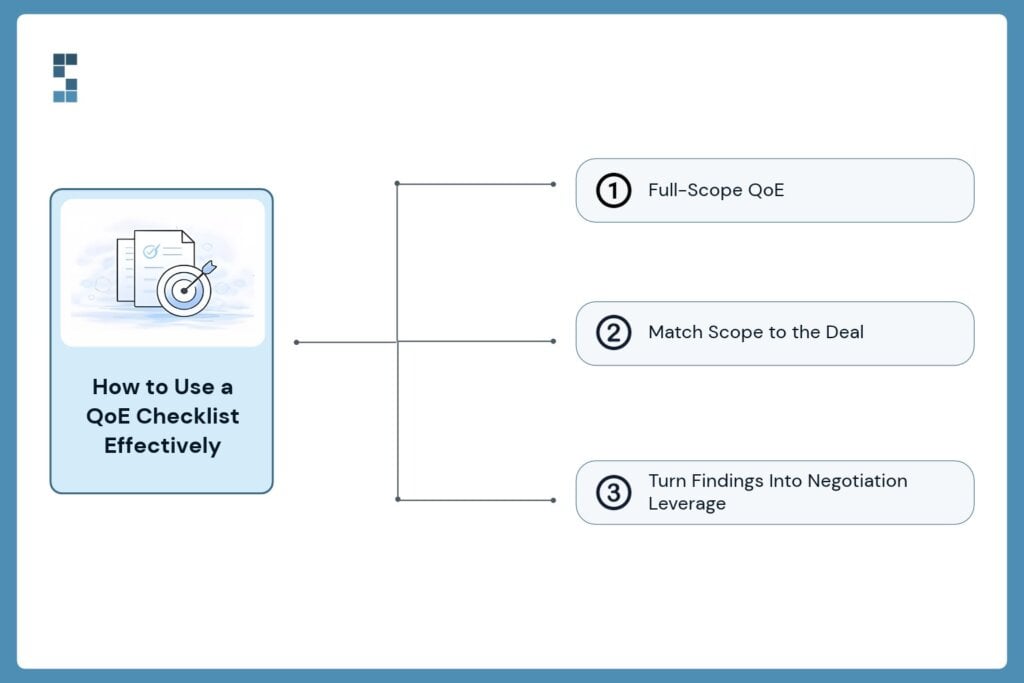
A full-scope QoE covers all twenty items with evidence and schedules; a QoE Lite engagement covers the kill-shot subset: items 1 through 5, a top-level pass on 6 through 8, and a simple working capital look at item 11. Which scope your deal needs depends on size, financing, and complexity; our QoE Lite vs. full-scope guide walks through the decision.
Either way, the checklist keeps you an active buyer rather than a report recipient. The buyers who get the most from diligence are the ones who can look at a finding and already know which item it belongs to and what it should do to price, terms, or the working capital peg.
Frequently asked questions
What is a quality of earnings checklist?
A structured list of the items a QoE engagement tests: earnings quality, add-backs, revenue durability, working capital, debt-like items, and hidden liabilities. It is how buyers track whether the earnings they are paying for are real, recurring, and transferable.
Can I run this checklist myself instead of buying a QoE?
Run it yourself first; it will sharpen every diligence conversation. But lenders and capital partners require independent validation, and a team that has tested hundreds of LMM companies will catch what a first-time buyer cannot. Do both.
How many of these items does a QoE Lite cover?
The kill-shot subset: proof of cash, major add-backs, obvious revenue risks, and a simple working capital analysis. Full scope covers all twenty with quantified findings.