The quality of earnings clock does not start when you sign the LOI. It starts when the seller delivers the data. Which means the single highest-leverage document in your diligence process is the request list you send on day one, and most buyers get it wrong in one of two directions.
Some send nothing for a week while the provider gets engaged, burning exclusivity on logistics. Others send a 150-line everything list cribbed from a private equity template, and watch a one-bookkeeper seller freeze. I have made the second mistake myself: ask an owner-operator for board minutes and a fixed-asset register on day one and you don’t get documents faster, you get a spooked seller and a stalled deal.
The fix is a lean list. Request only the most important things, the documents that actually gate the QoE work, and let everything else come in a second wave once the engagement is moving. Here is the list we send, why each item is on it, and what deliberately is not.
Why day-one data drives the whole timeline
A full-scope QoE runs three to four weeks from data delivery, and a QoE Lite can land inside ten business days. From data delivery. A seller who takes three weeks to produce bank statements adds three weeks to your deal, and most LOIs give you 60 to 90 days of exclusivity with financing and legal queued behind diligence. The math is unforgiving: every day between LOI signature and a complete data room is a day subtracted from your negotiating window.
So the list goes out the day the LOI is signed, ideally attached to the same email. Sellers are most responsive in the first week after signing, while momentum and goodwill are at their peak. Use that week for data, not for scheduling calls about data.
The day-one list: 12 items
Everything below should exist already in a reasonably run business. Nothing requires the seller to create new analysis, which is exactly why it is reasonable to ask for all of it immediately.
Financial statements and books
- Monthly financial statements, trailing 36 months. P&L and balance sheet by month, not annual summaries. Monthly grain is what makes trend, seasonality, and working capital analysis possible.
- Trial balances, same periods. The bridge between the statements and the underlying books. If the statements and the trial balance disagree, that is finding number one.
- Accounting file access. Read-only access to QuickBooks Online, Xero, or whatever system the books live in. One login replaces fifty document requests, and a seller’s reluctance here is itself diagnostic.
- Year-end tax returns, three years. The one set of numbers prepared under penalty. The gap between tax returns and the CIM’s EBITDA is often where the first real conversation starts.
Cash
- Bank statements, all operating accounts, trailing 24 months. The raw material for proof of cash, which is the credibility floor of the whole engagement. This is the request sellers most often drag on, so it goes first in the email, not last.
- Merchant processor and payment platform statements. Square, Stripe, PayPal, point-of-sale reports. Revenue that routes around the bank account has to be traced through its own rails.
Revenue and customers
- Customer-level revenue, trailing 36 months. By customer by month or quarter, ideally straight from the invoicing system. This powers concentration, retention, and cohort analysis; without it, revenue quality is a guess.
- Top-10 customer contracts. What actually holds the biggest relationships: terms, pricing, renewal dates, change-of-control clauses. The handshake accounts reveal themselves by what is missing.
- Accounts receivable and deferred revenue detail. Aged AR plus anything collected but not yet earned. Deferred revenue is a debt-like item, dollar for dollar, and it hides here.
People and obligations
- Payroll register, trailing 12 months. Every person, their comp, and their role, including family members and the owner. This is where normalized owner comp and below-market wages get tested.
- Debt schedule and any leases. Everything the business owes and every contract it cannot walk away from: loans, lines, equipment leases, the building lease, related-party arrangements above all.
- Add-back support. The seller’s own schedule of claimed adjustments with backup for each. Asking on day one sets the expectation that every add-back will need evidence, which improves the quality of the conversation from the start.
That is the whole list. Twelve items, all of which exist already, most of which export in minutes from the systems that produced them.
What deliberately is not on it
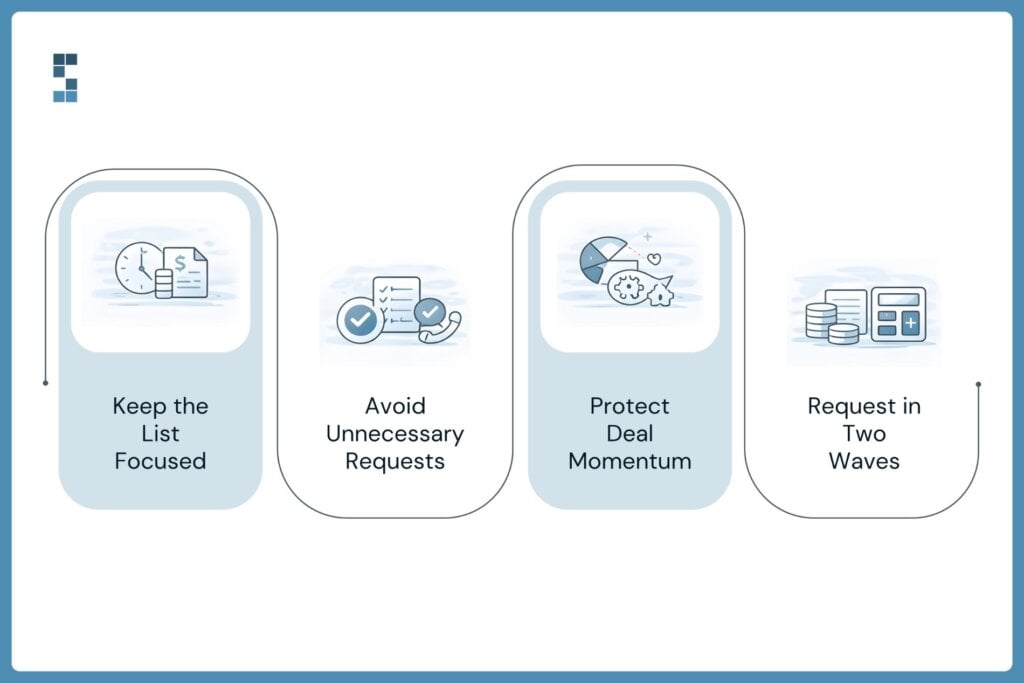
No board minutes, no insurance policies, no fixed-asset registers, no org charts, no vendor contracts, no five-year projections. Some of that matters later, and your QoE team will request it in a targeted second wave once the first-pass analysis shows where to dig. Day one is for the documents that gate the work, nothing else.
Two reasons to hold the line on this. First, seller psychology: a lean, obviously reasonable list signals a professional buyer and keeps momentum, while an overwhelming one reads as hostility or inexperience and can kill the deal in week one. Second, focus: fifty extra documents on day one do not speed anything up, because the analysis cannot use them until the core twelve arrive anyway.
How to send it
- Attach the list to the LOI-signing email, with a shared folder already set up. Never make the seller build the data room.
- Name a single point of contact on each side. Document requests die in group threads.
- Offer the easy path: if exporting is a burden, read-only system access substitutes for most of the list.
- Set a soft deadline a week out and a standing fifteen-minute call to clear blockers. What gets scheduled gets delivered.
Frequently asked questions
What documents does a QoE require?
The core set: monthly financials and trial balances for three years, tax returns, 24 months of bank statements, customer-level revenue, payroll detail, the debt schedule, and support for claimed add-backs. Everything else comes in targeted follow-ups.
How long should the seller take to deliver?
A week is a healthy target for the core list. Slower than two weeks usually means the books are in worse shape than represented, which is itself diligence information.
Should I send the request list before the LOI is signed?
Share the list’s scope during LOI negotiation so nothing surprises the seller, but send the formal request at signing. Asking for bank statements before exclusivity tends to go nowhere.
Is this list different for a QoE Lite?
Barely. QoE Lite leans hardest on the bank statements, financials, and add-back support, but the lean list above serves both scopes, which is another argument for keeping it lean.
Get the working version
The downloadable version of this list is formatted to forward straight to a seller, with a tab for tracking what has arrived. It is the same one we attach to our own engagement kickoffs.
Download the buy-side QoE data-request list from System Six.
About System Six
System Six is a Seattle-based outsourced bookkeeping, accounting, payroll, and CFO advisory firm serving consulting and professional services businesses. We work with more than 175 businesses, our team averages over 10 years of accounting experience, and we’ve processed more than $100 million in payroll. Clients rate us 9.5 out of 10 on likelihood to recommend, and over half of our new clients come from referrals. We work on a fixed weekly fee with no long-term contracts. Learn more at systemsix.com.