The short answer
Three federal dates matter to calendar-year service businesses this quarter. October 15 is the final deadline for extended 1040 and calendar-year 1120 returns, and there’s no second extension. November 2 is the deadline for your Q3 Form 941 (October 31 falls on a Saturday), or November 10 if you made every deposit on time and in full. January 15, 2027 is the fourth-quarter estimated tax payment, and the decisions that set its size happen between now and December 31. State and local deadlines run on their own calendars, so check yours.
Every fall I get some version of the same phone call. The owner sounds calm, but they’re talking a little too fast. Their CPA just emailed. Something’s missing. The return is due in eight days.
Nobody did anything wrong, exactly. The deadline didn’t move. It just showed up.
Before I bought System Six, I spent years in private equity, where you looked at a quarter’s numbers before it ended, not after. That habit is the whole point of this post. Three federal tax dates land on most service businesses between now and January. Each has something you can do this week to make it boring. Boring is the goal.
Oct 15 — extended 1040 and calendar-year 1120 returns
If you filed an extension in April, here’s the part people forget: this is it. There is no further extension. October 15 is the last day to file your extended personal return, or your C corporation’s, before failure-to-file penalties stack on top of what you owe. (The extension gave you time to file, not time to pay. Interest has been running since April.)
So ask your preparer one question this week: “Is anything outstanding on my file?”
Not “How’s it going?” That question gets you “Fine.” The specific one gets you a list.
What’s usually on that list? October surprises tend to come from three places. The first is a missing K-1. If you own a piece of a partnership or S corporation — a real estate deal, a friend’s firm, a fund — you can’t finish your 1040 until it sends your share of its income. Their extended deadline was September 15, but K-1s still straggle in. The second is unreconciled books. Your preparer can’t sign a return built on a P&L whose bank balance doesn’t match the bank.
The third is the quietest: a document each side assumed the other had. Picture Leah, who runs a twelve-person consulting firm outside Seattle. Her CPA assumed the bookkeeper had sent the fixed asset schedule. The bookkeeper assumed Leah had. Leah assumed it was handled because everyone seemed so relaxed. It surfaced on October 9th. It got done — at the cost of a weekend nobody wanted to give up.
The fix is one email, everyone copied, sent today. One of our clients, Paul, valued more than clean books (his auditors found zero errors). He valued that our team kept “seeing challenges coming down the pike.” That’s all the outstanding-items question is. Looking down the pike while there’s still road left.
Nov 2 — Q3 Form 941
This one slips past owners because it feels automatic. Form 941 is your quarterly payroll tax return: the federal income tax you withheld from employees, plus both halves of Social Security and Medicare. The Q3 return covers July through September. It’s normally due October 31, but that’s a Saturday in 2026, so the deadline moves to Monday, November 2. Employers who made timely deposits in full payment of the quarter’s taxes get until November 10.
Most owners hear “941” and relax, because the payroll provider handles it. Maybe. This distinction is worth five minutes of your time.
Some providers file the 941. When you signed up, you authorized them as your reporting agent (IRS Form 8655), and they make the deposits, sign the return and submit it. Others only prepare it. They calculate the numbers and generate a clean PDF, which then sits in a dashboard waiting for someone at your company to sign, file and sometimes pay. Both kinds will show you a Form 941. Only one of them sent it.
Which kind do you have? Log in and look for a filed status or an IRS acknowledgment, not just a document. If you can’t tell, email them: “Did you file our Q3 941, or did you prepare it for us to file?”
Why does it matter so much? Because the penalty falls on the business either way. The IRS doesn’t mail the notice to your payroll company. It comes to you, with your EIN at the top.
Jan 15 — Q4 estimated payment
This one surprises people: your January payment is mostly decided by December 31. The check goes out in January, but the number gets set in the next 90 days, by decisions you’re about to make anyway.
Do you run the bonuses in December or January? Buy the new laptops and the conference-room build-out before year-end, or after? Push hard to collect December receivables, or let a few invoices go out on January 2? If you keep your books on a cash basis, each of those calls moves taxable income from one year into the other. Each one moves cash, too.
A lesser-known wrinkle for S corporation owners: tax withheld from your own W-2 wages generally counts as paid evenly across the year, even if it all comes out of one December paycheck. Estimated payments count on the day you make them. So an owner who’s behind can sometimes catch up with a year-end bonus and extra withholding. Talk to your preparer first. And if your business is a C corporation, its own fourth-quarter estimate is due December 15.
Make these calls against a one-page Q4 projection. Not a forty-tab model. One page.
What goes on it? Start with actual results through September, from reconciled books. Add your best estimate of October through December revenue, client by client if you can — service businesses usually know who’s billing what. Then expected expenses, including payroll, any bonus you’re weighing and the purchases on your list. That gives you projected taxable income. Under it, write what you’ve already paid: three estimates plus withholding. Next, your safe-harbor target, generally 100% of last year’s tax, or 110% if your adjusted gross income topped $150,000. Hit that and you avoid underpayment penalties however the year shakes out. The gap between paid and needed is your January 15 number.
Last line: cash on hand. Because the right answer on paper isn’t the right answer if the account can’t cover it.
Another client, Marcus, says he appreciates that our team will “look around corners.” A one-page projection does exactly that, while you can still change what’s there.
State and local dates are yours to check
Everything above is federal. State and local deadlines vary. Washington has no personal income tax, but B&O excise returns follow their own schedule. California runs its own estimated payment calendar through the Franchise Tax Board. Cities often add more. Check your own state and city calendars this week, and write those dates next to these three.
Three dates, three small moves
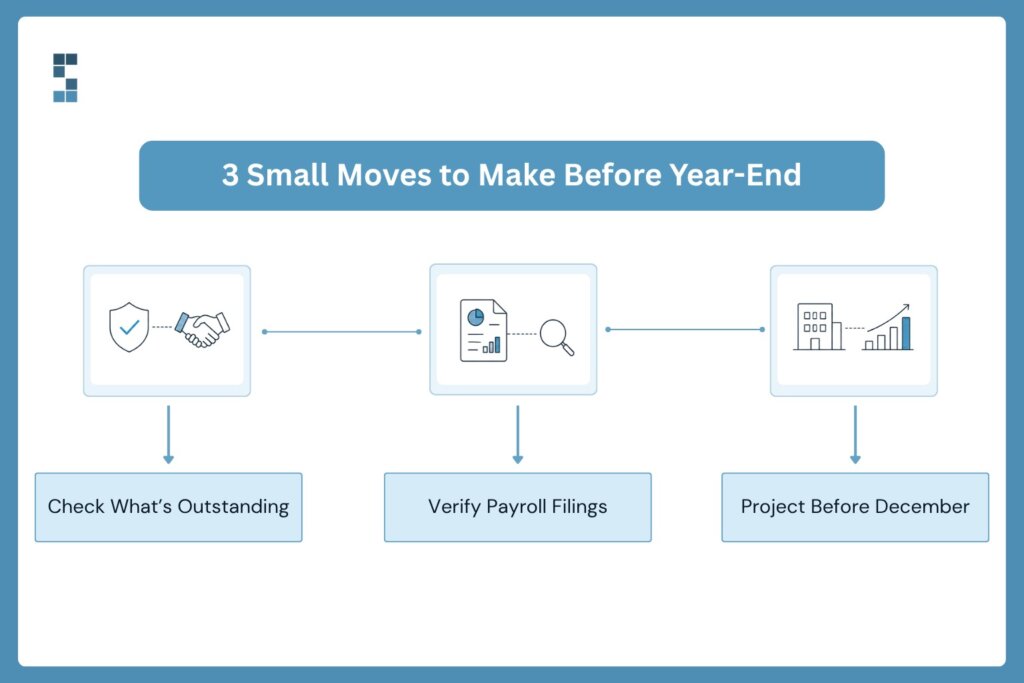
Ask your preparer what’s outstanding. Confirm your payroll provider filed your 941, not just prepared it. Build the one-page projection before December makes your decisions for you.
None of it takes long. All of it is easier in October than in January.
If you’d like a second set of eyes, we’ll review your file with you: what’s open, what’s coming due, and what the next 90 days could change. You can start here: systemsix.com/get-started.
Frequently asked questions
What happens if I miss the October 15 extended deadline?
File as soon as you can. The failure-to-file penalty is generally a percentage of the unpaid tax for each month the return is late, and interest keeps accruing on any balance. If you’re owed a refund, there’s usually no penalty, but there’s no upside to waiting either.
Do I really get until November 10 to file my Q3 Form 941?
Only if you deposited all of the quarter’s taxes on time and in full. If any deposit was late or short, the deadline is November 2.
Can I skip the January 15 estimated payment?
Individuals who file their full 2026 return and pay the entire balance by February 1, 2027 (January 31 falls on a Sunday) generally don’t need to make the fourth-quarter payment. With K-1s and year-end books still in motion, few business owners are ready that early, so plan to pay on January 15.
This post offers general information for US businesses and owners filing on a calendar year. It isn’t tax advice, and your situation may differ. Check all dates against current IRS guidance, including any disaster-relief postponements that apply to your area, and confirm state and local deadlines with the relevant agencies.