The short answer: To keep the books clean across multiple LLCs, run each entity as its own complete set of books with an identical chart of accounts, never commingle funds or expenses between them, document every inter-company transaction as it happens, and roll the separate books up into one consolidated report for the full picture. The structure that scales is simple: separate at the entity level, consistent across all entities, consolidated at the top.
Olivia didn’t set out to run four companies. She set out to run one. A profitable marketing consultancy, humming along. Then she spun up a second LLC to hold some real estate. Then a third for a new service line that didn’t fit the original brand. Then her accountant suggested a holding company to tie it together. Four entities, four bank accounts, four sets of books, and one growing knot in her stomach every time someone asked, “So how’s the business doing?” Which business? And how would she even know?
If you’re running more than one entity, you already feel this. The moment you go from one company to several, bookkeeping stops being a chore and starts being a structural problem. Get the structure right and multiple entities stay clean, clear, and easy to report on. Get it wrong, and you spend your weekends untangling which card paid for what, and your year-end becomes a forensic investigation. Let’s build the structure right.
Why does multi-entity bookkeeping get messy so fast?
The trouble almost always starts with one innocent-looking move: paying for something out of the wrong account. The marketing LLC’s card is in your wallet, the real estate company owes a contractor, you’re standing at the counter, and you pay it. “I’ll sort it out later.” You won’t. Multiply that across a year, and you’ve got hundreds of tiny cross-contaminations, each one blurring the line between entities that the law, the IRS, and your future buyer all expect to stay crisp.
Here’s why that line matters more than it feels like it does. The whole point of separate entities is separation. Liability protection depends on it. Tax treatment depends on it. If your books show the entities bleeding into each other, that protection gets thin, and an auditor or an acquirer will notice. Commingled funds aren’t just messy. They’re a legal and financial liability dressed up as a convenience.
And the complexity compounds the same way it does when you scale clients. One System Six client described going from twelve to thirty-five clients in eight months and realizing he’d accidentally become a full-time accountant. Multi-entity does the same thing with a smaller number. Four entities isn’t four times the work. It’s four sets of reconciliations, four tax positions, four chances to miscode something, plus the entirely new job of figuring out how they all add up together. The work multiplies. It doesn’t just add.
What is the right framework for managing multiple LLCs?
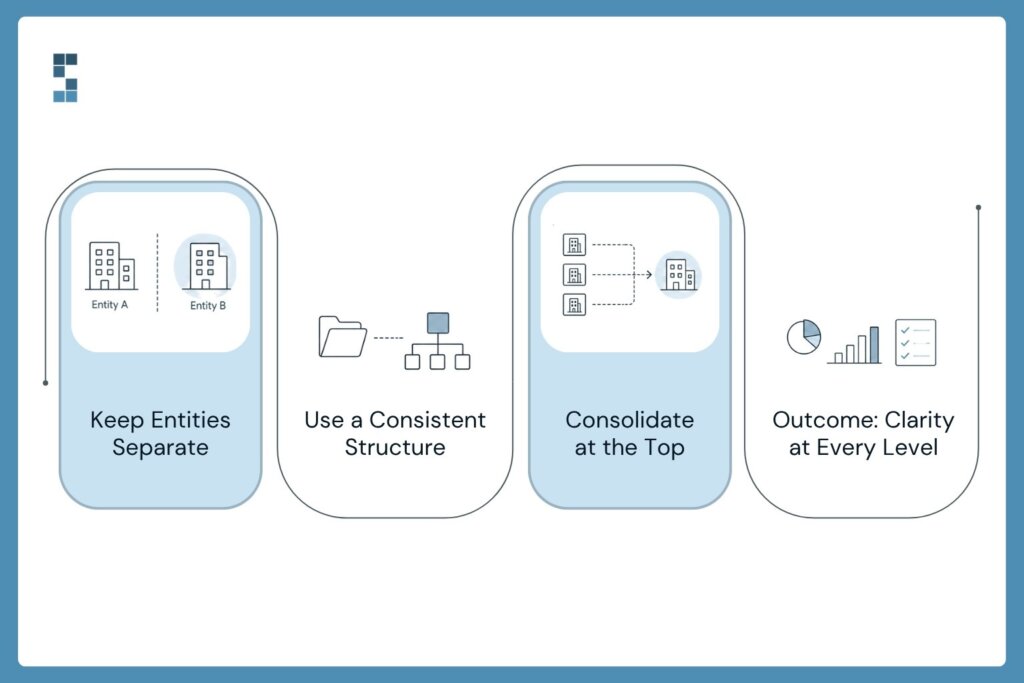
So how do you tame it? Not with more spreadsheets. With a framework built on three rules that hold no matter how many entities you stack up. Think of it as separate, consistent, consolidated.
Rule one: keep every entity fully separate. Each LLC gets its own bank account, its own credit card, and its own complete set of books. No shared accounts, no “we’ll split it later.” When the real estate company owes the marketing company money, that’s a real transaction between two real businesses, and you record it as one. This sounds obvious, but it’s the rule people break first and regret most. Separation isn’t bureaucracy. It’s the foundation everything else sits on.
Rule two: keep the structure consistent across all of them. Every entity should use the same chart of accounts: the same categories, the same names, the same numbering. When “Office Supplies” is account 6200 in one company, it’s 6200 in all of them. Why does this matter so much? Because the day you want to compare entities or combine them, a consistent structure means the numbers line up. An inconsistent one means hours of manual mapping every single time. Set the template once, apply it everywhere, and your future self will thank you.
Rule three: consolidate at the top. Separate books answer “how is this entity doing?” But you also need to answer “how is the whole thing doing?” That’s consolidated reporting: rolling all the entities up into one combined view, with inter-company transactions netted out so you’re not double-counting. This is where a holding-company structure earns its keep. One client called System Six their “secret weapon when it comes to getting our finances in order” — and consolidation is exactly the kind of order multi-entity owners are missing. You get clean books per entity and one clear picture across all of them.
How do you get consolidated reporting that actually works?
Consolidated reporting is where most DIY setups fall apart, because doing it by hand is brutal. You export each entity’s numbers, line them up in a master spreadsheet, manually strip out the money that moved between entities so you don’t count it twice, and pray you didn’t fat-finger a cell. Then you do it all again next month. It’s the kind of task that’s technically possible and practically miserable.
The fix is the same one that fixes most financial bottlenecks: consistent structure plus automation. When every entity shares a chart of accounts and the transactions flow in cleanly, consolidation stops being a monthly archaeology project and becomes something close to a button press. The inter-company eliminations follow rules instead of guesswork. The combined statements tie out because the underlying books were built to tie out. This is the difference between bookkeeping that records the past and financial operations that give you a live picture you can actually steer by.
And the payoff is real visibility. When Olivia can pull a consolidated report and see all four entities at a glance, plus drill into any single one, she finally has an answer to “how’s the business doing?” She can see which entity is carrying the others, where cash is trapped, and whether that third LLC was a good idea or an expensive hobby. That clarity isn’t a nice-to-have. It’s the thing that lets her make the next decision with confidence instead of a guess. As one client put it after a clean audit, the team wasn’t just mistake-free — they were proactive about catching problems and seeing challenges coming. That’s what good multi-entity bookkeeping buys you: not just tidy books, but a head start on every decision.
Start before the next entity, not after
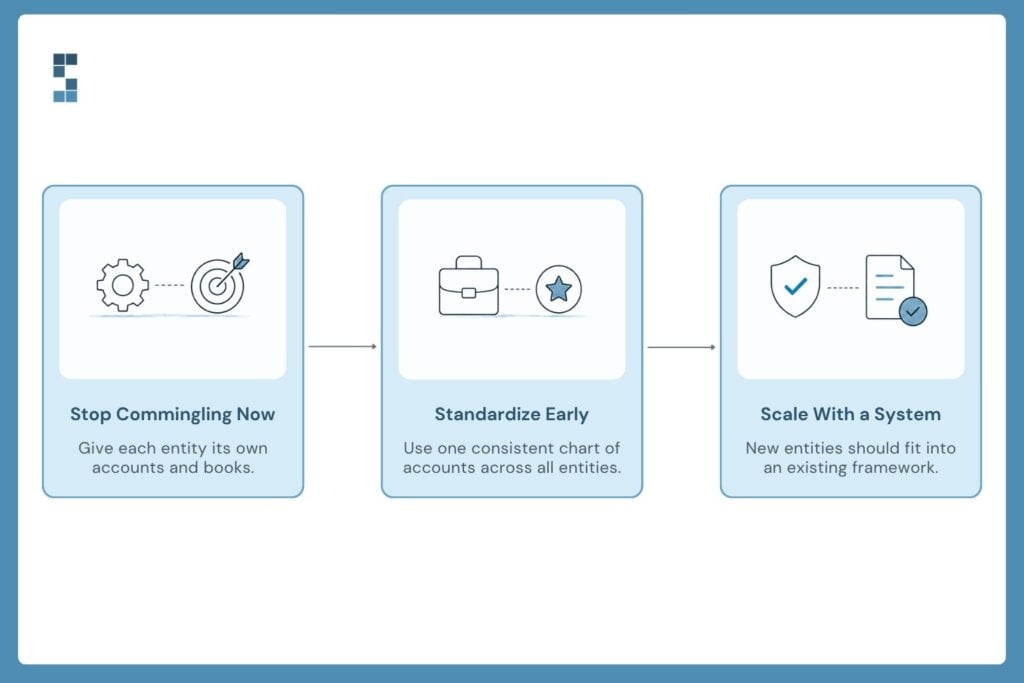
If you’re already juggling multiple entities and the books are a tangle, don’t try to fix all of it at once. Start by drawing the lines that should already exist: give each entity its own account, stop the commingling today, and get one clean chart of accounts you can apply across the board. That alone will take a surprising amount of weight off.
And if you’re about to spin up entity number two? That’s the best possible moment to get this right, before the mess has a chance to form. Build the structure now and every entity after it slots neatly into a system that already works. This is the model System Six builds for the search funds, family offices, and growing firms it serves: clean separation, consistent structure, consolidated clarity. It’s also why over half of new clients come by referral, and why existing ones rate the firm an average 9.5 out of 10. People don’t refer a bookkeeper. They refer the relief of finally knowing how the whole thing is doing.
So here’s the question worth asking before you open that next LLC. When someone asks how your business is doing, do you want to go digging for the answer, or do you want to already know? Because with multiple entities, the answer isn’t about working harder at year-end. It’s about building the structure today that makes the answer obvious. The entities will keep multiplying. Make sure your clarity multiplies with them.
Frequently asked questions
Do I need separate books for each LLC?
Yes. Each LLC should have its own bank account, its own credit card, and its own complete set of books. Separate entities exist to keep liability and tax treatment distinct, and that separation only holds if the bookkeeping reflects it. Commingling funds between entities weakens your liability protection and creates problems an auditor or future buyer will flag.
How do you do consolidated reporting across multiple entities?
Consolidated reporting rolls every entity’s books up into one combined view, with inter-company transactions netted out so nothing gets double-counted. It works cleanly when all entities share an identical chart of accounts and transactions flow in automatically. With that foundation in place, consolidation becomes close to automatic; without it, you’re stuck mapping manually and eliminating figures by hand every month.
Should I use one QuickBooks file for multiple companies or separate files?
Separate files, one per entity, kept on an identical chart of accounts. A single file blurs the entities together and undermines the separation that makes them worth having. Separate files with a consistent structure give you clean per-entity books that still roll up easily into a consolidated report at the holding-company level.
When should a growing firm set up a multi-entity bookkeeping structure?
Ideally, before you launch the second entity, while there’s no mess to untangle yet. If you already have multiple entities, the next best time is now: separate the accounts, stop any commingling immediately, and standardize the chart of accounts across all entities. Building the structure early means every future entity slots into a system that already works.
About System Six
System Six is a Seattle-based bookkeeping and financial services firm that helps small and mid-sized businesses streamline their financial operations. We specialize in providing technology-driven financial management solutions for consulting firms, enabling owners to focus on growing their businesses without worrying about cash flow, payroll, or compliance. Our team of over 40 professionals brings an average of 10+ years of accounting experience to every client relationship, serving more than 175 businesses across the U.S. With a 9.5/10 NPS score, we deliver the financial clarity and peace of mind that consulting firm owners need to thrive. Learn more at www.systemsix.com.