
Set the peg at the average normalized monthly net working capital over the trailing twelve months, then adjust for seasonality, growth, and anything in the balance sheet that will not transfer to you. For a business with stable revenue, the twelve-month average is the defensible starting point. For a growing or seasonal business, the average of the last three to six months, compared against what the business will actually need in the month you close, is closer to the truth.
The number matters. How the number is defined in the purchase agreement matters more. Most working capital disputes are not arguments about the peg itself. They are arguments about what counts.
What a working capital peg actually is
The peg is the amount of working capital the seller agrees to leave in the business at closing.
Buying a business on a cash-free, debt-free basis means the seller keeps the cash and pays off the debt. What is left is the operating engine: receivables you still have to collect, inventory you still have to sell, and payables you still have to pay. If the seller empties that engine on the way out, you are funding it yourself on day one, on top of the purchase price you already paid.
The peg stops that. At closing, actual net working capital is measured against the peg, and the purchase price moves dollar for dollar to cover the difference.
How to calculate the peg, step by step
1. Define net working capital for this deal
For acquisition purposes, net working capital is current assets minus current liabilities, with specific exclusions:
|
Include |
Exclude |
|
Accounts receivable, net of a reserve |
Cash and cash equivalents |
|
Inventory, net of obsolescence |
Debt and all debt-like items |
|
Prepaid expenses that transfer to you |
Accrued interest |
|
Unbilled revenue and work in progress |
Income taxes payable |
|
Accounts payable |
Seller transaction costs |
|
Accrued expenses and accrued payroll |
Related-party balances being settled at close |
|
Customer deposits and deferred revenue |
Any asset you are not acquiring |
This table is the single most argued-over part of the agreement. Write it into the purchase agreement as a schedule, item by item, and attach the actual calculation as an exhibit.
2. Build twelve months of monthly working capital
One number is not a peg. You need a monthly schedule, because a single month-end can be unrepresentative by a wide margin, particularly if the seller timed collections or stretched payables before putting the business on the market.
Pull each month-end balance sheet for the trailing twelve months and calculate working capital on the definition above for every month.
3. Normalize each month
Raw book balances are not the basis for a peg. Remove or adjust:
- Receivables that are uncollectible or long past due, through a reserve
- Inventory that is obsolete, damaged, or will not be sold
- Prepaid items that do not transfer, such as the owner’s insurance or a vehicle lease
- Related-party receivables and payables that are being settled at closing
- One-time items that will not recur under your ownership
- Items misclassified between current and long-term
Normalization is where a quality of earnings analysis earns its fee. The same testing that validates adjusted EBITDA validates the working capital balances that feed the peg. If you are financing with SBA debt at a purchase price of $3 million or more, SOP 50 10 8.1 has required that analysis since 1 October 2026, so the normalization work will be done either way and the peg should be built from it rather than from the raw books.
4. Choose the averaging method
|
Business profile |
Method |
Why |
|
Stable revenue, no seasonality |
Trailing twelve-month average |
Smooths normal month-to-month movement |
|
Growing quickly |
Trailing three to six-month average |
Working capital rises with revenue, so older months understate the requirement |
|
Seasonal |
Average adjusted to the closing month, or a peg set by month |
A December peg on a business that peaks in July will leave you short |
|
Declining revenue |
Trailing twelve-month average, with the trend disclosed |
Recent months understate what you need if the decline reverses |
Start with the twelve-month average, look at the last three to six months, and compare both against what the business will need in the month you expect to close. If those three numbers diverge, the divergence is the conversation to have with the seller before signing, not after.
5. Set the true-up mechanism
The peg does nothing on its own. The agreement needs to say:
- Who prepares the closing statement, and by when. Typically the buyer, within 60 to 90 days of closing.
- How disputes are resolved. Name an independent accounting firm and say who pays for it.
- Whether there is a collar. A collar is a band, for example plus or minus $25,000, inside which no adjustment is made. It prevents arguments over small variances. It also means you absorb any shortfall inside the band.
- How it settles. Cash payment, escrow release, or an offset against a seller note.
- Which accounting policies apply. The closing statement should be prepared using the same methods used to calculate the peg. Say so explicitly, or the seller will prepare it differently.
A worked example
A buyer agrees to acquire a service business for $3,000,000. The trailing twelve-month average of normalized net working capital is $213,000, and that becomes the peg.
|
Scenario |
Actual NWC at close |
Adjustment |
Price paid |
|
Seller delivers the peg |
$213,000 |
None |
$3,000,000 |
|
Seller delivers less |
$185,000 |
$28,000 reduction |
$2,972,000 |
|
Seller delivers more |
$240,000 |
$27,000 increase |
$3,027,000 |
The adjustment is dollar for dollar in both directions. A seller who collects aggressively and delays paying suppliers in the final month inflates cash, which they keep, and depletes working capital, which you have to replace. The true-up is what makes that neutral.
What causes working capital disputes
Six items account for most of them.
Accounts receivable quality. The seller books receivables at face value. You want a reserve against anything over 90 days. Agree the reserve methodology before closing, not after.
Deferred revenue. Money collected for work not yet delivered is a liability you inherit, and you have to perform the work without receiving the cash. Sellers often argue it should be excluded. It should not be, unless the price was negotiated on that basis.
Accrued paid time off. Employee leave earned before closing will be taken after closing, at your cost. It belongs in working capital.
Work in progress and unbilled revenue. In project-based businesses this can be the largest single item, and it is the one most likely to be measured inconsistently between the peg calculation and the closing statement.
Customer deposits. Same logic as deferred revenue. You owe the performance.
The accounting policy mismatch. The peg is calculated one way during diligence and the closing statement is prepared another way. This is avoidable with one sentence in the agreement and it is the most expensive one to leave out.
When to walk away from the peg structure
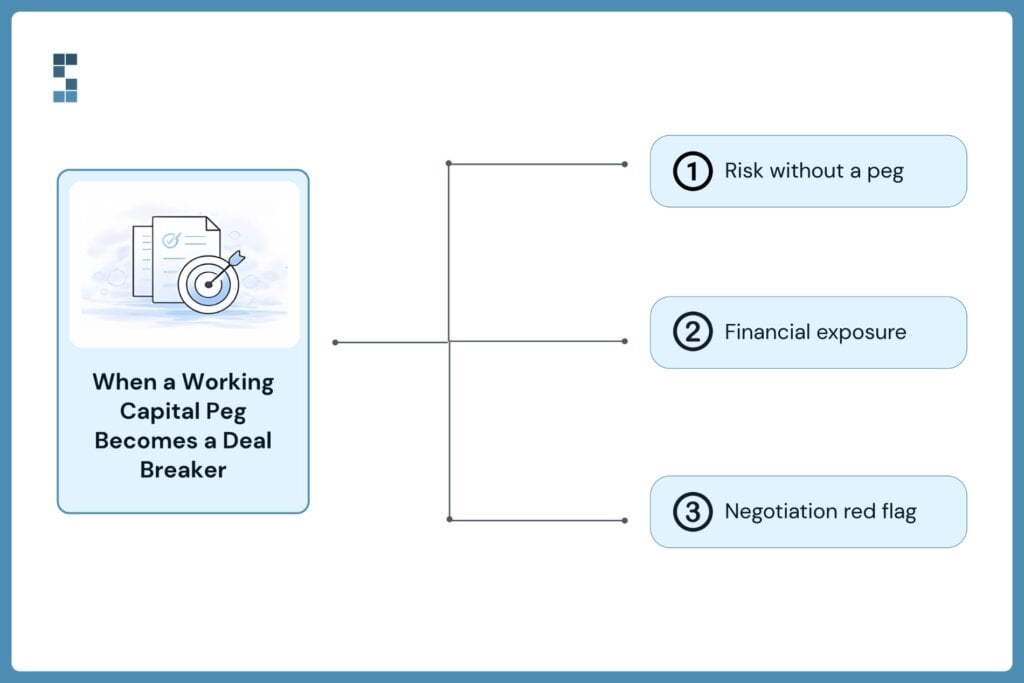
Occasionally a seller refuses a working capital adjustment entirely, usually arguing the business is simple enough not to need one. That position is reasonable only when working capital is genuinely immaterial, for example a business that collects at the point of sale, carries no inventory, and pays suppliers on terms shorter than it collects.
For everything else, no peg means the seller controls how much working capital you inherit, and they control it right up to the closing date. Treat a refusal as information about the deal.
Frequently asked questions
Is the working capital peg the same as the purchase price?
No. The peg is a target balance that sits inside the deal. If actual working capital at closing differs from the peg, the purchase price adjusts by the difference.
Should cash be included in net working capital?
Not in a cash-free, debt-free transaction, which is the standard structure for lower middle market deals. The seller keeps the cash and settles the debt, and the peg covers the operating balances that remain.
How long after closing is the true-up settled?
Most agreements give the buyer 60 to 90 days to prepare the closing statement, followed by a 30-day review period for the seller. Disputes that survive that go to an independent accountant named in the agreement.
What if the business is seasonal?
A single annual average will be wrong for most closing dates. Either set the peg against the month you expect to close, or agree a schedule of monthly pegs and apply the one matching the actual closing date.
Who calculates the peg?
The buyer’s diligence team, usually as part of the quality of earnings work, because the same normalization testing applies. The figure is then negotiated and written into the purchase agreement.
Sources
- SBA Information Notice 5000-880695, Issuance of SOP 50 10 8.1, effective 1 October 2026
- CBIZ, SOP 50 10 8.1 introduces new quality of earnings requirement on acquisitions
The working capital definition is negotiated once and lived with for the life of the deal. Bring us the seller’s monthly balance sheets and we will tell you what the peg should be, what belongs in the definition, and where this seller’s numbers are likely to be challenged. Fixed fee, quoted before we start.
About System Six
System Six is a Seattle-based outsourced bookkeeping, accounting, payroll, and CFO advisory firm serving consulting and professional services businesses. We work with more than 175 businesses, our team averages over 10 years of accounting experience, and we’ve processed more than $100 million in payroll. Clients rate us 9.5 out of 10 on likelihood to recommend, and over half of our new clients come from referrals. We work on a fixed weekly fee with no long-term contracts. Learn more at systemsix.com.