
Caroline thought she’d solved her bookkeeping problem.
She runs operations at a 22-person consulting firm in Denver. For the first two years, she handled the books herself, along with everything else. Last spring, she finally hired a part-time bookkeeper — someone good, someone affordable, someone who showed up every Tuesday and reconciled the accounts cleanly.
The reconciliations were perfect. She still missed the 1099 deadline. Payroll questions still landed on her desk at 6 PM. When her CEO asked for a breakdown of project profitability in March, the bookkeeper said it wasn’t really her thing.
Here’s what Caroline learned the hard way: most owners shop for bookkeeping when what they actually need is a finance function. Those are different products. The visible benefits of full-service support — accurate books, on-time payroll — are the surface. The hidden value is what makes it worth paying for. Let’s get into it.
Coverage That Doesn’t Take a Vacation
The first hidden benefit nobody asks about until it bites them: continuity.
When you hire one bookkeeper, you’ve hired one bookkeeper. They get sick. They take their kid to the dentist. They quit. A friend of mine spent three weeks last December trying to find someone to cover her solo bookkeeper’s maternity leave. Payroll went out late. Two vendor invoices got missed. It was a mess.
A full-service team works differently. Multiple people know your books. Somebody is always on. When your primary contact is out, the work doesn’t stop — it shifts. Quietly. Without you having to chase anyone down.
This is partly why System Six clients tend to describe the relationship in family-like terms. Rebecca, who runs operations at a Pacific Northwest services firm, put it this way: “System Six isn’t just a vendor; they’re friends who feel like part of our team.” That kind of language only shows up when continuity is built in. You can’t feel like part of someone’s team if you disappear when one person catches the flu.
The practical version is simple. Caroline eventually switched to a full-service provider. Last August, she went on vacation to Spain for ten days and didn’t check her email once. Payroll ran. Bills got paid. A vendor dispute got handled by someone who knew the account. She came back to a clean inbox. That had never happened before.
What continuity actually buys you is permission to step away. Most owners don’t realize how much of their week is quietly structured around being available — not doing their own finance work, but serving as the backstop in case something goes sideways. A team-based model removes that gravitational pull. The phone stops being something you check at dinner. The Sunday-night dread fades because you know somebody is already on it.
Looking Around Corners
The second hidden benefit is harder to put on an invoice.
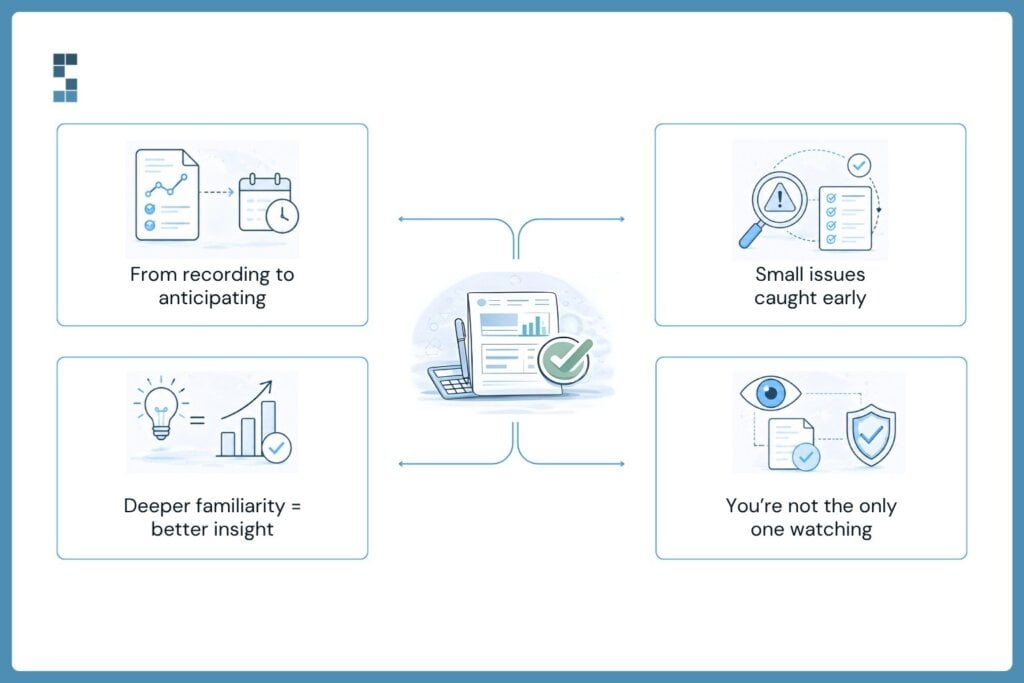
A search-funded CEO named Marcus once described his finance team this way: they’re inquisitive, they ask follow-on questions, and they look around corners. That last phrase is the whole game. A transactional bookkeeper records what happened. A full-service team notices what’s about to happen.
The difference shows up in small ways that compound. One System Six client was bleeding $700 a month in overdraft fees nobody had flagged — until somebody did. Another was Paul, who runs a search-fund-backed company. After his 2022 audit, the auditors found exactly zero errors in two years of books. He’s told people more than once that hiring a full-service team was the best decision he made at the start of the business.
Stories like that aren’t about heroic bookkeeping. They’re about the work’s basic posture. When the same team handles your bills, payroll, reporting, and cleanup, they develop a feel for your business. They notice when a recurring vendor charge jumps. They notice when a contractor’s invoice looks off. They notice when your gross margin slips by 2 points and bring it up before you have to ask.
That’s one of the more underrated outsourced finance advantages — you stop being the only person paying close attention to your own numbers. Somebody else is watching, and they’re trained to notice things you wouldn’t.
When Everything Talks to Everything
The third hidden benefit is structural. It’s about what happens when one team owns the whole pipeline.
Caroline’s old setup had three vendors and four logins. Her bookkeeper handled the books. A separate payroll service handled payroll. A bill-pay tool handled AP. Her CPA handled taxes. Nothing reconciled cleanly because nobody owned the handoffs. Every month-end was a small archaeological dig — figuring out which numbers from which system matched which other numbers. The handoffs were where things broke.
Full-service consolidates ownership. When bookkeeping, payroll, AP, reporting, and controllership all live under one roof, the data is already connected. The team that processes payroll is the team that books it. The team that pays the bills is the team that reports on cash flow. Decisions get faster because nobody has to email three vendors to assemble a clean picture.
This is the part that sneaks up on people. The full-service bookkeeping benefits aren’t just about saving hours — they’re about removing friction. System Six clients typically see a 70-80% reduction in administrative time within 90 days. But the time number only tells half the story. The other half is what disappears: the back-and-forth, the reconciliation gaps, the quarterly scramble to figure out where everything is. All of it goes quiet.
Month-end is where this shows up most clearly. With a fragmented setup, closing the books is a project — chasing down statements, reconciling between systems, and asking three different vendors to confirm the same number. With a full-service team, close happens in the background. You get clean financials on a predictable cadence, and you stop scheduling your life around the second week of every month.
What’s left is a finance function that runs in the background. You stop having to hold the whole picture in your head. That’s a different way to live.
The Shift in How You Think About Finance
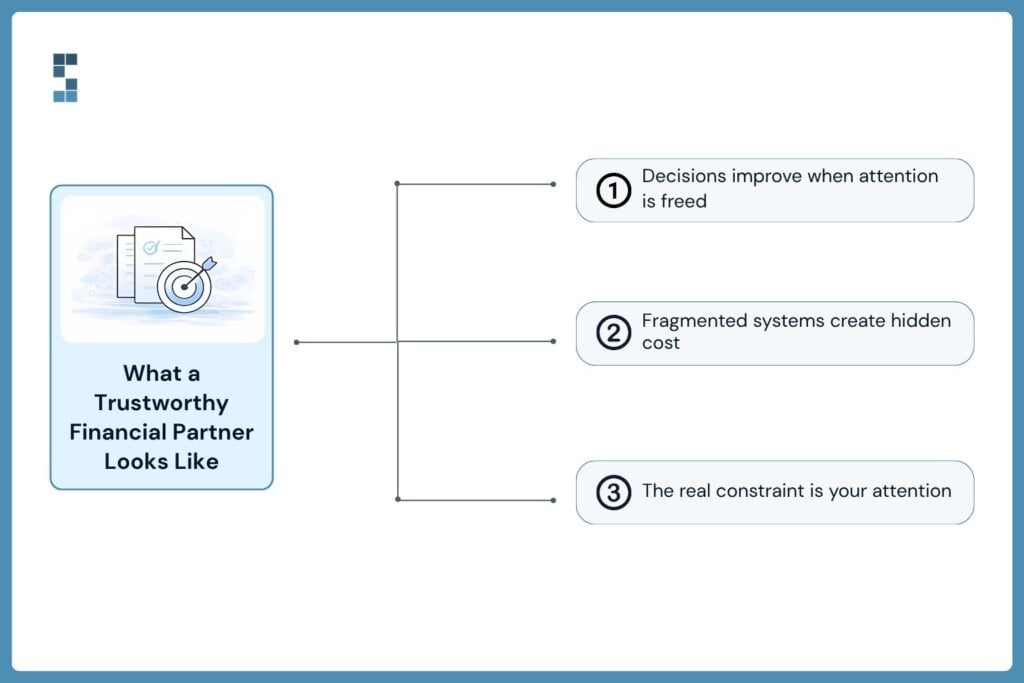
Here’s what I’d tell Caroline now, looking back. Full-service financial support isn’t a premium tier of bookkeeping. It’s a different operating model. You’re not buying more hours from a bookkeeper — you’re buying out of an entire category of cognitive load.
The hidden value is what you stop having to think about. The compliance deadline. The missing invoice. The question of whether last month’s numbers can be trusted. The vendor who emailed twice and got ignored. The payroll question your office manager doesn’t know the answer to—all of it. Gone, or at least handed off to people whose job is to handle it.
So the question isn’t really whether you can afford full-service support. It’s whether you can afford to keep running your finance function as a collection of disconnected tasks held together by your own attention. Because attention is the resource you’re actually short on. Everything else is downstream of that.
If you’ve been running the math on what your finance function is costing you in time, distraction, and missed catches — and you’ve decided the answer matters — that’s worth a conversation.
About System Six
System Six is a Seattle-based bookkeeping and financial services firm that helps small and mid-sized businesses streamline their financial operations. We specialize in providing technology-driven financial management solutions for consulting firms, enabling owners to focus on growing their businesses without worrying about cash flow, payroll, or compliance. Our team of over 40 professionals brings an average of 10+ years of accounting experience to every client relationship, serving more than 175 businesses across the U.S. With a 9.5/10 NPS score, we deliver the financial clarity and peace of mind that consulting firm owners need to thrive. Learn more at www.systemsix.com.