The invoice arrives on a Tuesday morning, right when you’re prepping for a client call. You open it expecting the usual number — the one you’ve mentally budgeted for — and it’s $380 more than last month. No explanation. Just more hours. You pay it, because what else are you going to do? But somewhere in the back of your mind, a question starts forming:
Is this really the best way to handle my books?
If you’ve been running a consulting firm for more than a year or two, you’ve probably wrestled with this. The question of how your bookkeeper charges you might seem like a minor operational detail. It isn’t. The engagement model you’re on shapes your cash flow predictability, your incentive alignment with your financial team, and — critically — whether your back-office infrastructure can actually keep pace as your firm grows. Fixed fee or hourly? It’s worth thinking through carefully.
How Hourly Billing Works – And Where It Starts to Break Down
Hourly billing is simple enough in theory. Your bookkeeper logs time, and you pay for what they use. At the start, especially when your transaction volume is modest and your needs are straightforward, it can feel like the sensible option. You’re not locked in. You’re not paying for more than you need.
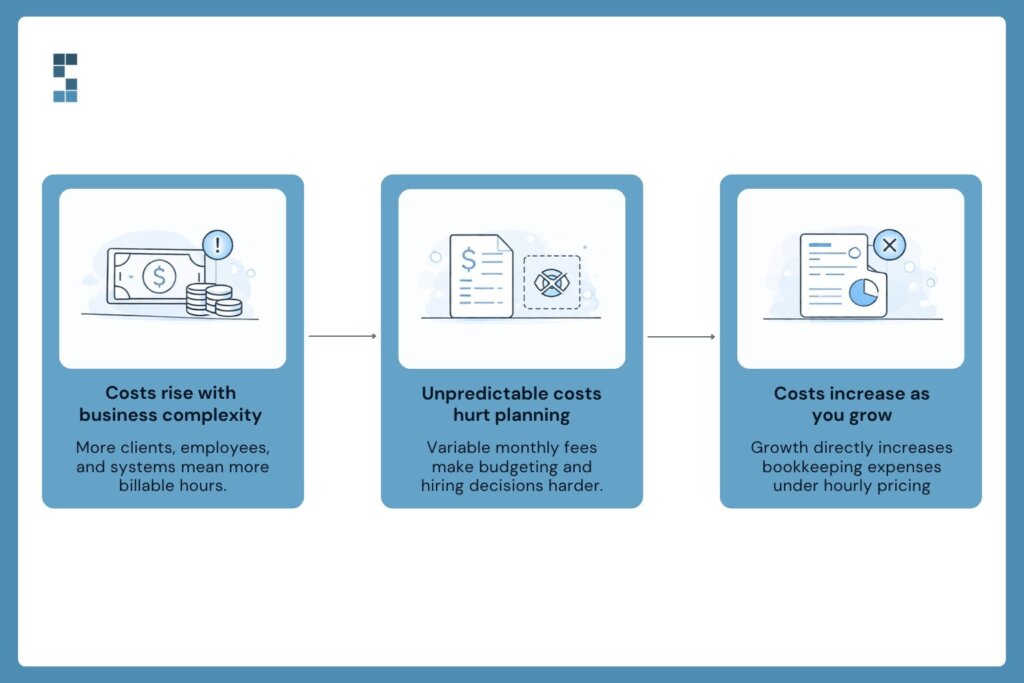
But here’s the thing about consulting firms: they don’t stay simple. You land a new retainer client, your revenue model shifts from pure project-based to a mix of retainers and milestones, you add your third full-time hire, and suddenly, you’re navigating payroll in a new state. Each of those changes adds complexity to your books. And under an hourly model, every added layer of complexity translates directly into a bigger bill.
The real problem isn’t the cost itself — it’s the unpredictability. When you can’t reliably forecast your bookkeeping costs, they become noise in your financial planning. You start making overhead decisions based on a number that shifts month to month. And when you’re trying to model whether you can afford that next hire or take on a lower-margin engagement, noise is the last thing you need.
There’s also an incentive misalignment worth naming. Under an hourly model, efficiency isn’t rewarded. A faster bookkeeper earns less. That’s nobody’s fault — it’s just how the structure works. But it means you and your bookkeeper aren’t necessarily pulling in the same direction.
The Case for Fixed-Fee Bookkeeping
Fixed-fee bookkeeping flips the dynamic. You pay a set amount — typically weekly or monthly — tied to the scope and complexity of your books, not the clock. Your bookkeeper is now incentivised to be efficient, because their fee doesn’t change whether a task takes them two hours or five.
For a growing consulting firm, this matters in a few specific ways. First, your monthly overhead becomes predictable. You know what bookkeeping costs. You can build around it. Second, when you call with a question or ask for a quick report, you’re not quietly watching the meter tick. The relationship changes. It becomes less transactional and more collaborative.
System Six operates on a fixed weekly fee model with no long-term contracts — a combination that’s rarer than it should be. The no-contract piece is important. It reflects a straightforward premise: the firm should earn your continued business by consistently delivering value, not by locking you into an agreement. Hourly billing is reserved for one-time project work like system onboarding, cleanups, or implementation — situations where the scope is genuinely variable and time-based billing makes sense. For ongoing recurring work, the fee is fixed.
With a 9.5 out of 10 NPS across 175+ clients and a US-based team averaging more than 10 years of accounting experience, that model clearly resonates. Clients aren’t staying because they have to. They’re staying because it works.
The Scalability Question Nobody Asks Early Enough
Most firm owners choose an engagement model based on their current situation. That’s understandable. But the smarter question is whether the model holds up when you’re twice the size you are today.
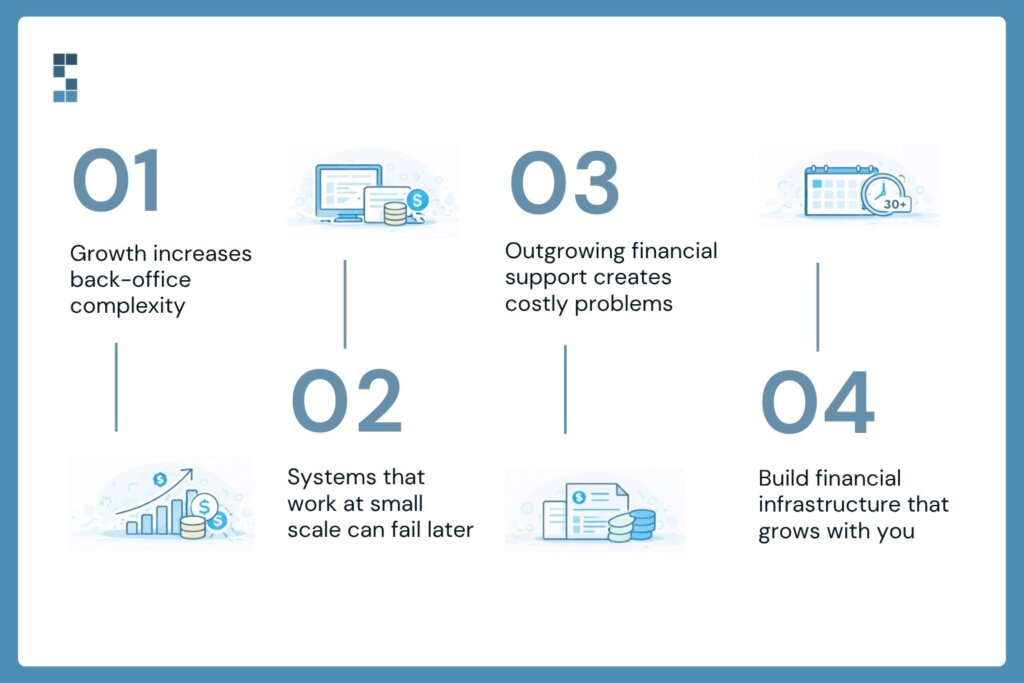
Think about what scaling actually means for a consulting firm’s back office. More clients mean more invoicing cycles. More staff means payroll across potentially multiple states, each with its own compliance requirements. A bigger operation means more vendor relationships, more expense categorisation, and more month-end complexity. The financial infrastructure that served you at $900K in revenue isn’t automatically equipped to serve you at $2.5M.
Manish G., a client who learned this the hard way, described what happened when he relied on a freelance bookkeeper who couldn’t keep up with the firm’s growth: “Most of our payroll taxes were filed incorrectly, and there was no easy way for a non-expert to figure out how to solve that mess.” Rebuilding from that — fixing misfiled taxes, restoring vendor relationships, regaining employee trust — took time and money that should have been spent growing the business.
A flexible bookkeeping engagement isn’t just about price structure. It’s about working with a partner whose service scope can expand alongside yours — from core bookkeeping to payroll processing, bill pay, cash flow forecasting, and financial reporting — without forcing you to switch providers every time you hit a new growth threshold. The goal is infrastructure that grows with you, not infrastructure you outgrow.
A Simple Way to Think About the Decision
So which model is right for your firm? Here’s a practical way to frame it.
Hourly billing probably makes sense if you’re pre-revenue, running genuinely minimal books with very few monthly transactions, or if you need a one-time project — a cleanup, a system migration, an onboarding process. For defined, bounded, variable-scope work, time-based billing is fair.
Fixed-fee billing makes more sense the moment your financial operations become consistent and ongoing. If you have regular payroll, monthly close, recurring invoicing, and any meaningful transaction volume, a fixed fee gives you what you actually need: cost certainty, aligned incentives, and a predictable line item in your operating budget.
One more thing worth considering: the no-contract piece. One of the most common objections to switching financial providers is the perceived switching cost — the disruption of changing systems and relationships. A fixed-fee model with no long-term contract removes that friction almost entirely. You’re not locked in. You can leave if it stops working. That changes the risk calculus significantly.
If your firm has grown since you set up your current bookkeeping arrangement and you’re still on hourly, it’s worth doing the math. Add up your last six months of bookkeeping invoices, average them, and ask yourself: Would a fixed monthly fee in that range feel more manageable? For most growing firms, the answer is yes — and the predictability alone is worth the switch.
Your Bookkeeping Setup Is Infrastructure
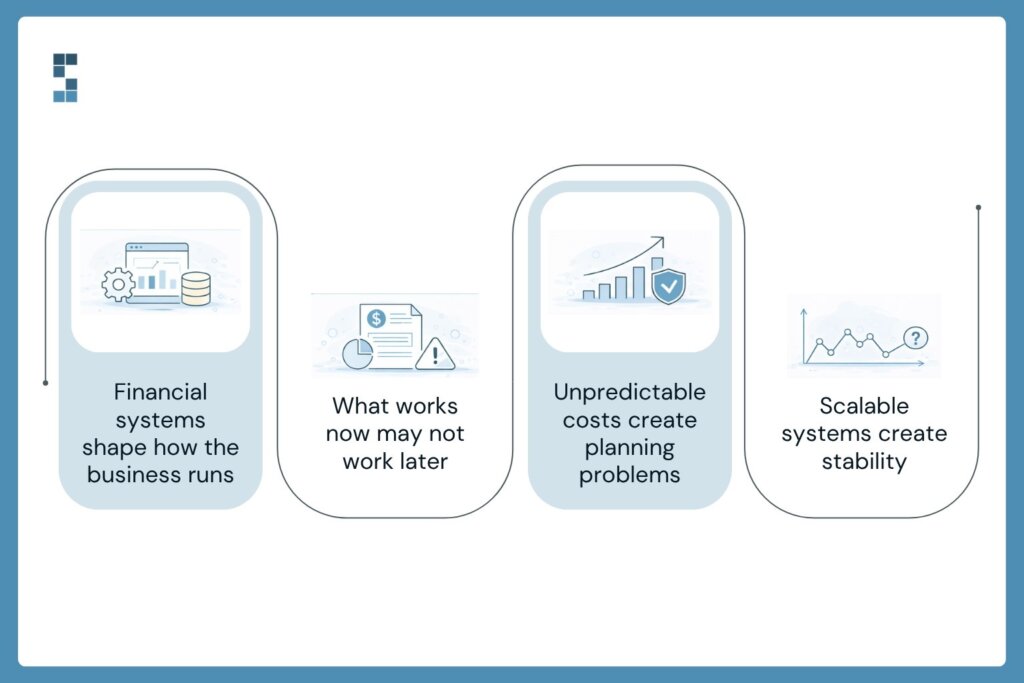
Think of your engagement model the way you’d think about your project management software or your CRM. It’s not glamorous, but it shapes how everything else runs. Infrastructure built for where you are today is fine — until it isn’t. The firms that scale smoothly are the ones that think about this before they hit the wall, not after.
The model that fits your firm at $800K in revenue probably isn’t the one that serves you at $3M. The question is whether you’re going to figure that out proactively — or on a Tuesday morning when an invoice shows up and it’s $380 more than you expected.
What would it mean for your firm to know, exactly, what bookkeeping costs every month — and to trust that the number won’t change unless your needs do?
About System Six
System Six is a Seattle-based bookkeeping and financial services firm that helps small and mid-sized businesses streamline their financial operations. We specialise in providing technology-driven financial management solutions for consulting firms, enabling owners to focus on growing their businesses without worrying about cash flow, payroll, or compliance. Our team of over 40 professionals brings an average of 10+ years of accounting experience to every client relationship, serving more than 175 businesses across the U.S. With a 9.5/10 NPS score, we deliver the financial clarity and peace of mind that consulting firm owners need to thrive. Learn more at www.systemsix.com.