
Picture this: You’ve just landed the contract you’ve been chasing for months. A major client, prestigious work, and it’s going to double your firm’s workload overnight. You should be celebrating. Instead, you’re sitting at your desk at 10 PM, staring at a tangle of spreadsheets and sticky notes, wondering how your financial systems will handle the surge.
Sound familiar? You’re not alone. I’ve talked with dozens of consulting firm owners who’ve faced this exact moment—the terrifying realization that the growth they worked so hard to achieve might break the very systems that keep their businesses running.
Here’s what separates firms that scale smoothly from those that collapse under their own success: It’s not more software. It’s not hiring faster. It’s having documented, repeatable financial processes (SOPs) in place before growth hits. Most firms try to scale first and systematize later. That’s backwards, and it’s expensive.
Why Chaos Scales Faster Than Growth
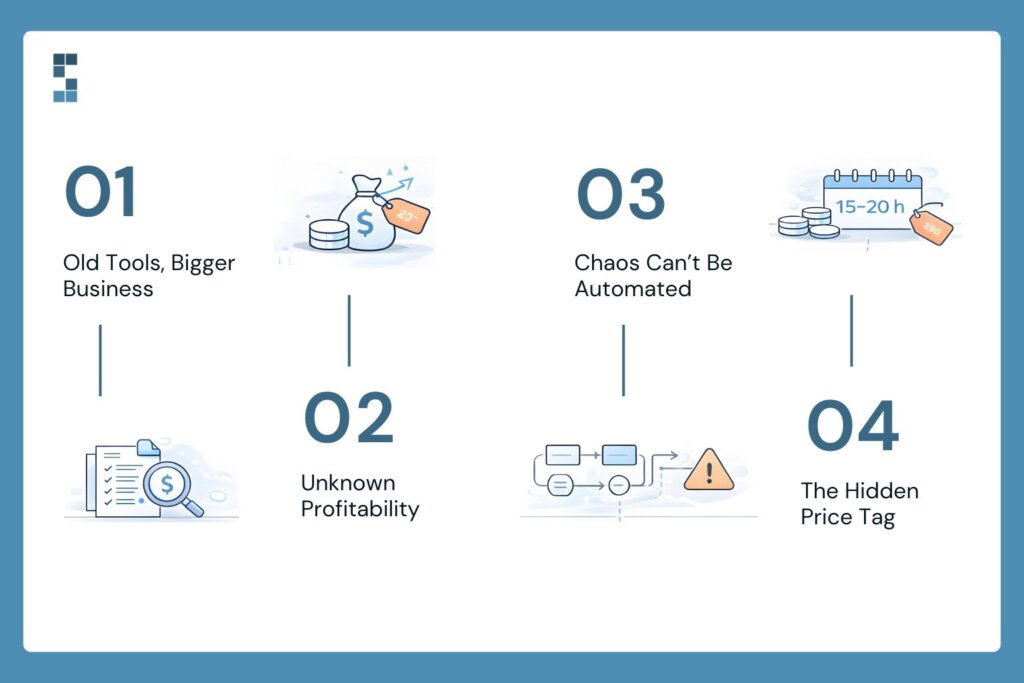
Most consulting firms outgrow their financial systems but never upgrade. They’re running a $5 million company with the same spreadsheets they used at $500K. The invoicing process that worked when you had three clients? It buckles under thirty. The expense tracking that lived in your head? It creates chaos when five people need access to it.
I spoke with Mark, whose environmental consulting firm hit this wall hard. “We thought we were making money on every project until we dug into the numbers,” he told me. “We had no reliable way to track time against projects, so we couldn’t see which engagements were profitable. Turns out our large regulatory projects were actually break-even when you factored in all the partner time.”
The common mistake? Trying to automate chaos rather than documenting transparent processes first. You can’t systematize what you haven’t defined. And when growth hits, undefined processes don’t just stay messy—they multiply the mess.
Here’s the real cost: Most consulting firm owners spend 15-20 hours monthly on financial administration. At typical consulting rates of $200-300 per hour, that’s $3,000-6,000 in lost billable time every month—or up to $72,000 annually. That’s not just time lost. That’s a new hire—a significant marketing push. Revenue sacrificed to wrestling with spreadsheets.
The Four Non-Negotiable Finance SOPs for Scalability
Think of SOPs like the foundation of a house. Nobody sees them once the building’s up, but try adding a second story without one. These four financial SOPs form the foundation that lets you scale without cracking.
Project Profitability Tracking. Time is your inventory. You’re not selling widgets—you’re selling hours and expertise. Your SOP must connect time tracking directly to profitability reporting. Document who logs time, how frequently, what categories to use, and how it maps to client billing. Without this, you’re flying blind. One System Six client put it simply: “They revamped our whole accounting system into accurate and dependable practices. Now I can pull up real-time insights about project profitability from my phone between client meetings.”
Expense Management and Categorization. The old way involves collecting receipts in a shoebox, entering them manually on weekends, and hoping you don’t miss anything important. The documented way creates clear rules: who approves what, how expenses get categorized, and when receipts must be captured. One consulting firm owner reported cutting their expense processing time by 80% after implementing a documented workflow. No more lost receipts. No more delayed reimbursements. No more Sunday afternoon data entry.
Invoice and Collections Workflow. Document the entire lifecycle: what triggers invoice generation, who approves before sending, when invoices go out, and the exact cadence for follow-ups on overdue accounts. This SOP paid off dramatically for one firm whose average payment time dropped from 45 to 22 days after implementation. That’s not just faster money—it’s predictable cash flow that lets you plan with confidence.
Compliance Calendar and Tax Documentation. Map every deadline across state and federal requirements. Create systematic documentation collection so you’re not scrambling at tax time. As one client shared, “System Six has done wonders for my stress level. They’ve created automated systems that track every deadline and requirement. I no longer worry about compliance—it’s all handled automatically.” That peace of mind doesn’t happen by accident. It happens because someone documented the process.
From Your Head to the Page—and Into Practice
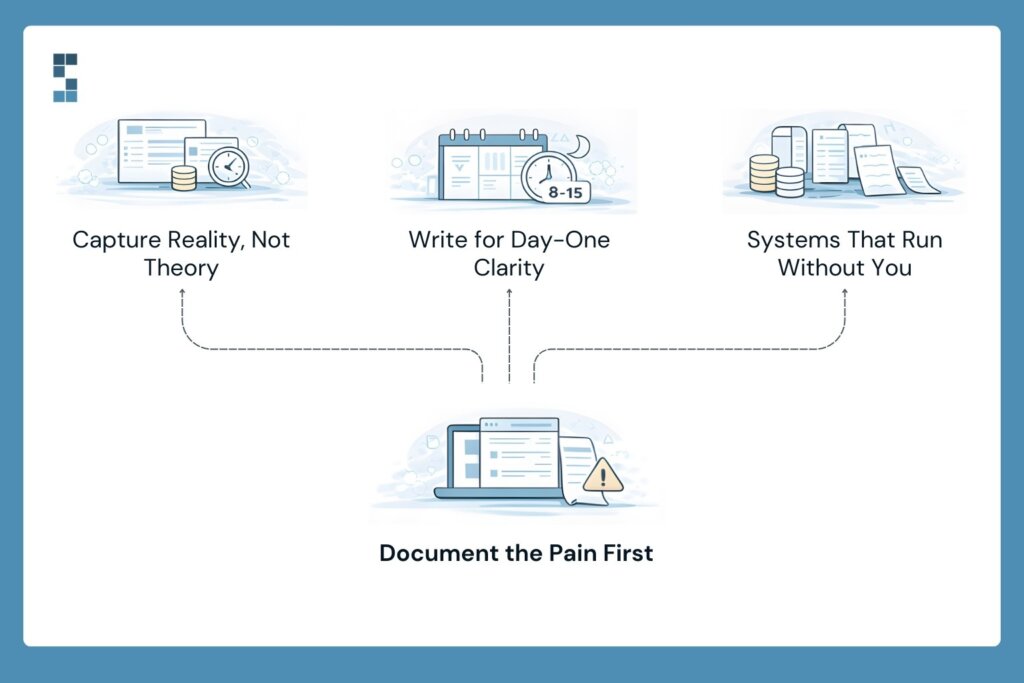
Having SOPs isn’t about creating bureaucracy. It’s about making yourself unnecessary for day-to-day financial tasks so you can focus on client work and business development when growth hits. But documentation that lives in a forgotten folder helps no one. Here’s how to create SOPs that actually survive contact with reality.
Start with your pain points. Where are you spending the most time each month? What causes the most stress? Those pressure points tell you exactly where documentation will yield the most significant dividends. Map the actual workflow before you try to improve it—you can’t fix what you haven’t captured honestly.
Write it so someone else can follow it without asking you questions. Build in triggers and decision points: “If X happens, do Y.” The test isn’t whether you can follow it. The test is whether a new hire could follow it on day one.
The common pitfalls? Creating SOPs only you understand. Over-documenting to the point of paralysis. And the worst one: documenting but never training or enforcing. As one reviewer described working with System Six: “They take on the entire setup and effectively act as consultants until your accounting operations run smoothly.” That’s the goal—building systems that work without you hovering over them.
Consider Lisa, whose environmental consulting firm grew from eight to twenty-five employees in eighteen months. “Our financial system scaled seamlessly with us,” she explains, “so I never worry about operational capacity limiting our growth anymore.” That seamless scaling didn’t happen by accident. It happened because the processes were documented before the growth arrived.
From Sunday Night Spreadsheets to Monday Morning Strategy
What does life look like on the other side of documented financial SOPs? Monthly close takes hours, not days. Cash flow forecasting updates in real-time as invoices get paid and expenses get recorded. Project profitability data is always up to date because your time-tracking, billing, and reporting systems are connected.
One client described the transformation this way: “I don’t have to think about my accounting anymore. It’s just taken care of seamlessly. Great service, great value.” Another reported, “Since automating our finances, I’ve landed three new major clients. Those deals happened because I could focus on relationships instead of reconciliations.”
The psychological shift is massive. When you’re not constantly putting out financial fires, you can think strategically about growth rather than just surviving it. You can say yes to bigger opportunities because you’re not worried about whether your back-office can handle the load. The bandwidth you recover isn’t just time—it’s mental energy for the work that actually requires your expertise.
Building Before You Need It
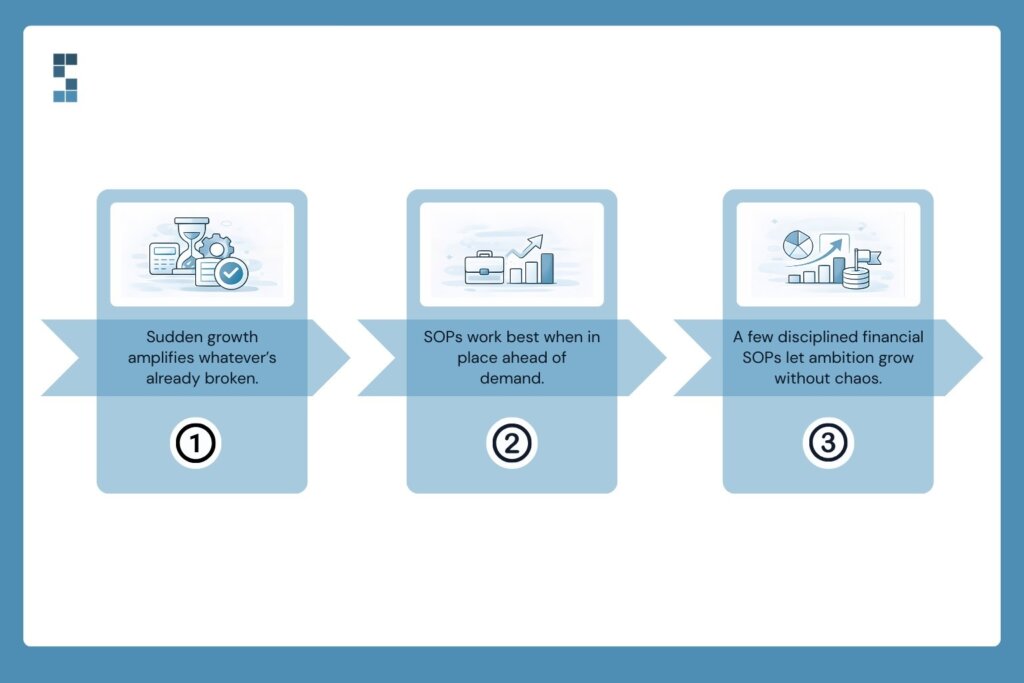
Let’s go back to that scenario—you’ve just doubled your workload with a significant contract win. The difference between thriving and drowning isn’t luck, talent, or even hustle. It’s preparation. It’s having built the financial infrastructure that amplifies your competitive advantages rather than creating limitations you have to work around.
The best time to build these SOPs was before you needed them. The second-best time is now, before the next growth surge catches you unprepared.
Start with an honest audit of your current pain points. Which financial tasks consume the most time each month? Where do bottlenecks emerge when you’re busy? What keeps you up at night during tax season? Those pressure points tell you exactly where documentation and systematization will yield the most significant dividends.
The consulting firms thriving in 2025 won’t necessarily have the fanciest offices or the most significant marketing budgets. They’ll have something better: financial systems that scale as fast as their ambitions. And that starts with four documented SOPs and the discipline to follow them.
About System Six
System Six is a Seattle-based bookkeeping and financial services firm that helps small and mid-sized businesses streamline their financial operations. We specialize in providing technology-driven financial management solutions for consulting firms, enabling owners to focus on growing their businesses without worrying about cash flow, payroll, or compliance. Our team of over 40 professionals brings an average of 10+ years of accounting experience to every client relationship, serving more than 175 businesses across the U.S. With a 9.5/10 NPS score, we deliver the financial clarity and peace of mind that consulting firm owners need to thrive. Learn more at www.systemsix.com.