About one in five. In Axial’s Dead Deal Report on 2025’s broken LOIs, quality of earnings EBITDA discrepancies accounted for 21.3% of deals that collapsed after a signed letter of intent. It was the second most common cause, behind non-QoE diligence findings at 25.3%.
That is the best published figure available, and it is worth understanding what it does and does not cover before you rely on it.
What the number actually measures
Axial’s report looks at 75 transactions sourced through its own marketplace that broke down after an executed LOI during 2025, across eight firm types and eight industries. The full breakdown:
|
Reason the LOI broke |
Share of broken deals |
|
Non-QoE diligence findings |
25.3% |
|
QoE EBITDA discrepancies |
21.3% |
|
Renegotiation challenges |
14.7% |
|
Seller decisions |
13.3% |
|
Financing constraints |
10.7% |
|
Business underperformance |
8.0% |
Three caveats matter.
It counts deals that already died. The denominator is broken LOIs, not all LOIs. It tells you that among failed deals roughly a fifth failed on QoE findings. It does not tell you what share of all deals fail that way, which is a much smaller number.
It is one marketplace’s deal flow. 75 transactions from Axial’s own network, skewed toward intermediated lower middle market deals. Your deal may look nothing like that population.
The categories overlap. “Renegotiation challenges” at 14.7% frequently begins with a diligence finding of some kind. The clean line between a QoE discrepancy and a failed renegotiation is thinner in practice than in a pie chart.
What no published source gives you is a figure for QoE engagements specifically: of all the reports commissioned, how many ended a deal. That would need a population of engagements with known outcomes, and the firms holding that data do not generally publish it.
The more useful question is not what percentage of deals die, but which findings reprice and which ones kill.
What findings actually do
A finding has three possible outcomes, and the outcome is fairly predictable from the type of finding.
|
Finding |
Usual outcome |
Why |
|
Owner compensation not normalized |
Reprice |
Quantifiable, explainable, and the earnings are still real |
|
Related-party rent below market |
Reprice, or buy the property |
A known cost you can model exactly |
|
Add-backs without documentation |
Reprice |
The business is worth less, not differently |
|
One-time revenue treated as recurring |
Reprice |
Changes the base, not the quality of the business |
|
Working capital below the peg |
Price adjustment at close |
The true-up mechanism exists for exactly this |
|
Customer concentration not disclosed |
Restructure |
Usually an earn-out or a holdback rather than a price cut |
|
Cash-basis books hiding a margin trend |
Reprice or pause |
Depends on what the restated trend actually shows |
|
Revenue that cannot be traced to cash received |
Often fatal |
You cannot price earnings you cannot establish, which is what a proof of cash tests |
|
Seller cannot explain their own numbers |
Often fatal |
A trust finding, not a financial one |
|
Records incomplete enough to prevent testing |
Often fatal |
The figure is unknown rather than lower |
The pattern down that table is the useful part. Findings that quantify a problem get priced. Findings that prevent you from quantifying anything end deals. A business earning less than advertised is a negotiation. A business whose earnings cannot be established is a different risk entirely, and no price protects you from it.
Why repricing is the normal outcome
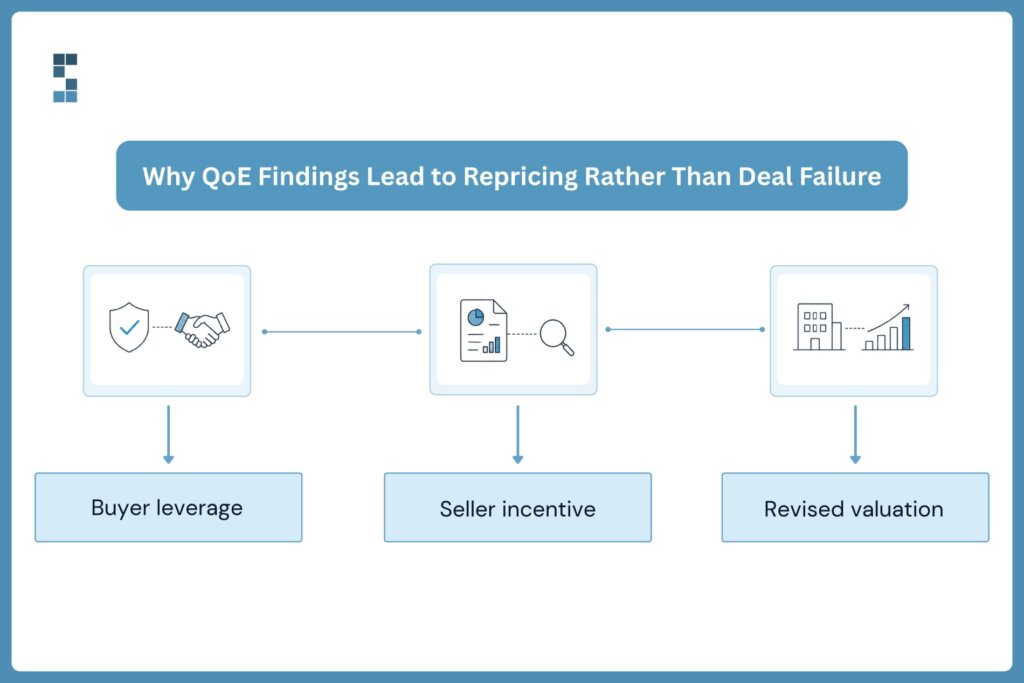
By the time a QoE is underway, both sides have spent money and months. A buyer with a documented, specific finding is in a strong negotiating position, and a seller facing a documented finding usually prefers a revised price to restarting with a new buyer who will find the same thing.
That is also why the documentation matters more than the discovery. A finding you can evidence line by line moves a price. The same finding asserted without support usually just produces an argument. How much EBITDA typically changes after a QoE review covers the size of movement to expect, and the arithmetic that turns an earnings finding into a price change.
What this means for your deal
Three practical consequences.
Commission the work early enough to act on it. A finding is only useful while you still have room to renegotiate. Inside the last week of exclusivity your options narrow to accepting or walking. How long a QoE takes covers what to budget, and the buy-side engagement what it covers.
Separate the price question from the trust question. Before reacting to a finding, ask which kind it is. A number that is lower than advertised is a negotiation. A seller who cannot explain their own books is information about the rest of the relationship, including the transition period you are about to depend on.
Expect something. In owner-operated businesses with self-prepared books, a clean report with no adjustments at all is the unusual outcome. Budget for a revised number rather than treating any finding as a crisis.
Frequently asked questions
Is it common for a QoE to end a deal?
Less common than buyers fear. Among deals that did break after an LOI, Axial attributes 21.3% to QoE EBITDA discrepancies, but that is a share of failures rather than a share of all deals. The usual outcome of a finding is a revised price or structure. Findings that end deals tend to be about verifiability and trust rather than the size of the earnings.
Does the new SBA rule change this?
It changes who sees the findings. For SBA-financed acquisitions at a purchase price of $3 million or more, SOP 50 10 8.1 requires a quality of earnings analysis from 1 October 2026, and the lender uses the QoE earnings figure in its debt service coverage determination. A finding that would once have been a private negotiation between buyer and seller now also sits with the lender.
Can I walk away after a QoE?
That is what diligence is for. A letter of intent is generally non-binding on price and on closing, so confirm the specific terms of yours with your attorney, including any break fee or expense reimbursement.
Who pays for the report if the deal dies?
The buyer, in a buy-side engagement, and the fee is not usually contingent on closing. That is a real cost of diligence and also the point of it: a fee spent on a deal you did not do is cheaper than the deal.
Should I tell the seller what the QoE found?
Share the specific findings if you want the price to move. Specific documented adjustments are far more persuasive than a revised offer with no explanation, and a seller who sees the support is more likely to accept the conclusion.
What if the seller disputes the findings?
Ask them to provide the support that contradicts them. Disputes resolve quickly when the conversation is about documents rather than opinions, which is why add-back testing is done against source records rather than the schedule itself.
Sources
- Axial, Dead Deal Report: unpacking 2025’s broken LOIs — 75 transactions, the category breakdown and the 21.3% figure
- SBA Information Notice 5000-880695, Issuance of SOP 50 10 8.1, effective 1 October 2026
- CBIZ, SOP 50 10 8.1 introduces new quality of earnings requirement on acquisitions
Find the problems while you can still act on them
A finding three weeks before close is leverage. The same finding three days before close is a crisis. Send us the deal and we will tell you what we would test, how long it takes, and what it costs as a fixed fee.
About System Six
System Six is a Seattle-based outsourced bookkeeping, accounting, payroll, and CFO advisory firm serving consulting and professional services businesses. We work with more than 175 businesses, our team averages over 10 years of accounting experience, and we’ve processed more than $100 million in payroll. Clients rate us 9.5 out of 10 on likelihood to recommend, and over half of our new clients come from referrals. We work on a fixed weekly fee with no long-term contracts. Learn more at systemsix.com.