You’re sitting at your desk on a Tuesday morning, coffee in hand, ready to tackle your project pipeline. Then you open an envelope from the IRS.
Penalty notice. $50,000.
Turns out you missed filing 1099s for contractors last year. And the year before. The penalties stacked up automatically—$280 per form, per year, for every contractor you paid over $600. What started as an oversight turned into a five-figure problem that no amount of explaining can make disappear.
Sounds like a nightmare? It happens more often than you’d think. IRS penalties are automatic, costly, and completely avoidable. But here’s the thing—they’re also one of the easiest compliance requirements to get right once you understand how the system actually works.
Let me walk you through what you need to know.
Why 1099 Compliance Hits Consulting Firms Hardest
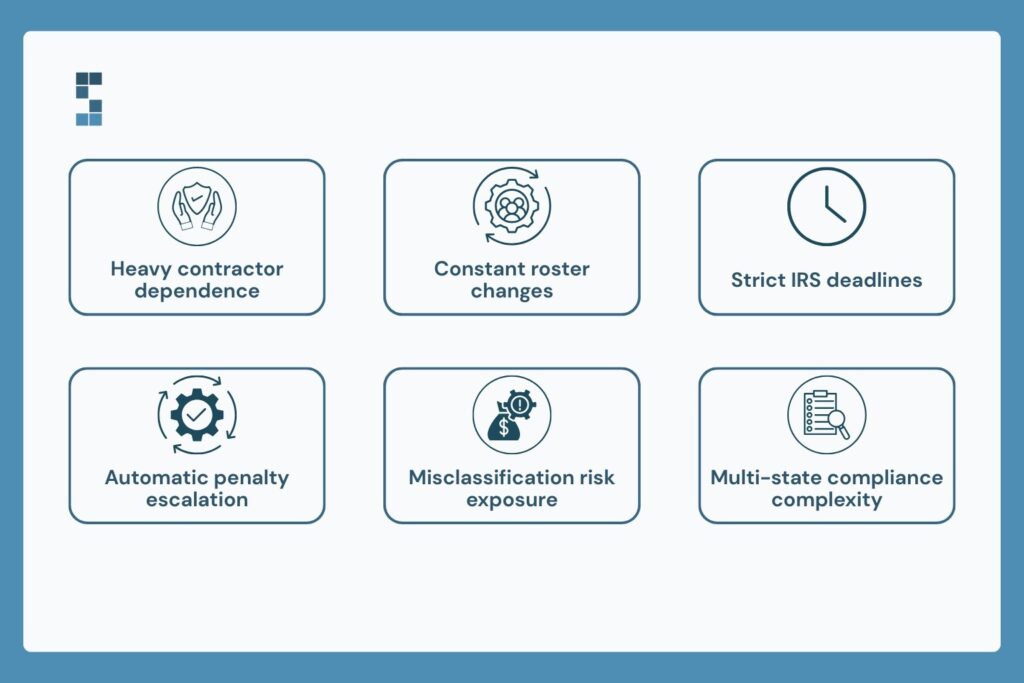
Consulting firms live in a particularly tricky space when it comes to 1099s. You’re not like product companies with straightforward payroll. You rely heavily on specialized freelance talent—the graphic designer for that client presentation, the data analyst for the three-month project, the industry expert you bring in quarterly.
And it’s not just about having contractors. It’s about having lots of them, across multiple states, with seasonal workloads that make your contractor roster look different every quarter.
Here’s what the IRS requires: If you pay any contractor $600 or more in a calendar year for services, you need to file a 1099-NEC by January 31st. You need their correct legal name, address, and tax ID number (either EIN or SSN). Miss any of these details? The IRS doesn’t care about your reasons.
The penalty structure is straightforward and ruthless. File up to 30 days late? That’s $50 per form. Miss it by more than 30 days? Now it’s $110. Don’t file at all or file after August 1st? You’re looking at $310 per form. These aren’t negotiable. They’re automatic.
But the objective complexity isn’t just filing on time. It’s knowing who needs a 1099 in the first place. Contractor versus employee classification is where most consulting firms trip up. That freelance consultant you hired for a six-month engagement? Probably needs a 1099. But what about the one who works exclusively with your firm and uses your equipment? Now you’re in gray area territory.
Multi-state operations add another layer. Employment laws vary by state. Some states require separate state-level 1099 filings. Professional services sales tax gets complicated when you’re serving clients across state lines. One System Six client put it perfectly: “System Six has done wonders for my stress level to feel like this is all now taken care of with a professional partner.”
The Five Deadliest 1099 Mistakes Consulting Firms Make
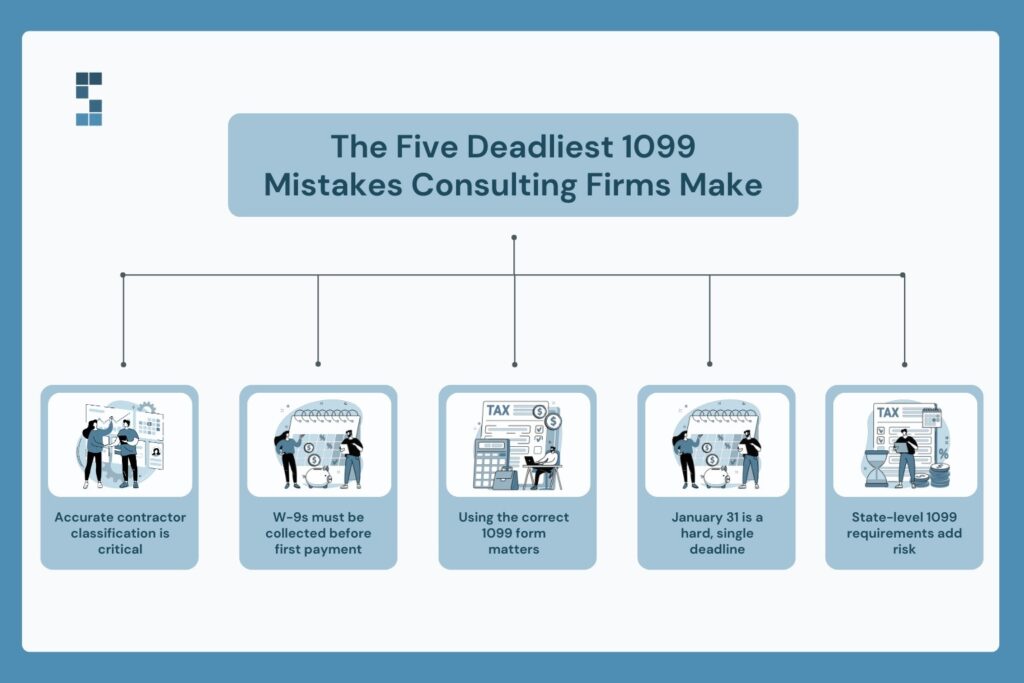
Let’s talk about where things actually go wrong. Because understanding the mistakes means you can avoid them.
Mistake #1: Missing the Classification Call
Not every payment requires a 1099. Payments to corporations? Usually exempt. Payments through credit cards? The payment processor handles that reporting. But payments to LLCs, sole proprietors, and partnerships? That’s where you need to pay attention.
The problem is when you’re not sure. That project-based consultant you hired quarterly—are they a contractor or an employee? Get this wrong, and you’re facing penalties from both the IRS and the Department of Labor. It’s not just about avoiding the 1099. It’s about classification accuracy.
Mistake #2: Forgetting the W-9
Here’s the golden rule: Get the W-9 before you cut the first check. Not in December when you’re scrambling. Not in January when the deadline looms. Before. First. Payment.
What happens when contractors don’t respond to your January emails requesting their tax ID? You’re stuck. You can’t file without that information, but you can’t skip filing either. The penalty applies whether or not the contractor cooperated. Which means you need systems, not good intentions.
Mistake #3: Wrong Information, Wrong Form
Did you know there are actually multiple types of 1099s? The 1099-NEC (nonemployee compensation) form is used for payments to contractors. The 1099-MISC covers other types of payments, like rent or royalties. Use the wrong form? The IRS rejects it.
Then there’s the EIN versus SSN confusion, and Address errors. Name mismatches between the W-9 and the IRS records. Each mistake triggers a rejection and puts you on the clock for corrections.
Mistake #4: Procrastinating Until January
January comes fast. And when you’re trying to compile a year’s worth of contractor payments while also closing your books and preparing for tax season, mistakes multiply.
Remember that January 31st deadline? That’s for both sending forms to contractors and filing with the IRS. You don’t get different deadlines. You get one date for everything, and if you’re working from spreadsheets and scattered records, you’re already behind.
Plus, many states have their own filing requirements in addition to federal requirements. Massachusetts, for instance, requires separate state-level 1099 submissions. Miss the state deadline, and you’re facing penalties there, too.
Mistake #5: Manual Tracking in Spreadsheets
Manual processes breed mistakes. Version control becomes a nightmare when three people are updating the “contractor master list” in different Excel files. You miss contractors because someone paid them through a different account. You double-count payments because the spreadsheet didn’t account for refunds.
Did you know that 40% of small businesses still rely on manual bookkeeping? In an age of automation, this isn’t just surprising—it’s costly. One System Six client discovered they’d been making a simple bookkeeping error that was costing them $700 monthly in bank fees. That single mistake was costing $8,400 annually.
Building Your Bulletproof 1099 Compliance System
So how do you actually get this right? It’s not complicated, but it does require a year-round system, not just in January.
Start with onboarding. Make W-9 collection part of your contractor onboarding process—non-negotiable, before first payment. Digital forms work better than paper because they’re searchable and can’t be lost. Store everything in a central location that your bookkeeper or accountant can access.
Track throughout the year. Monthly reconciliation beats annual panic every time. Your accounting system should flag when any contractor crosses the $600 threshold. Automated tracking means you’re not scrambling in December trying to remember whom you paid for what.
Automate the heavy lifting. This is where professional 1099 compliance consultants make the most significant difference. Automation prevents the five mistakes we just covered. Real-time tracking beats year-end compilation. Integration with your existing accounting system means no manual data transfer is required.
Since implementing automated expense tracking with System Six, one consulting firm has cut its processing time by 80%. No more lost receipts. No more delayed reimbursements. And critically, no more missed 1099 filings.
Partner with expertise when it matters. Multi-state operations? Complex contractor classifications? Growth phases where your contractor roster keeps expanding? These are the moments when professional help pays for itself immediately.
What does a professional 1099 service actually include? Year-round contractor tracking. W-9 collection and verification. Automated threshold monitoring. Pre-filing accuracy checks. State filing coordination. And the expertise to handle the gray areas.
As one client reported: “We just finished our 2022 audit, and the auditors found exactly zero errors. Not only have they been mistake-free, but S6 has also been proactive at catching mistakes I’ve made or seeing challenges coming down the pike.”
Zero errors. That’s what systems and expertise create.
Verify before filing. Even with automation, a pre-filing checklist catches the edge cases. Common rejection reasons include name mismatches, incorrect EINs, and wrong contractor addresses. State filing coordination ensures you don’t miss secondary requirements.
Another client put it this way: “For any internal NPS or Customer Satisfaction tracking, please mark us down as an 11/10. Your team is awesome, proactive, and exactly what we need.”
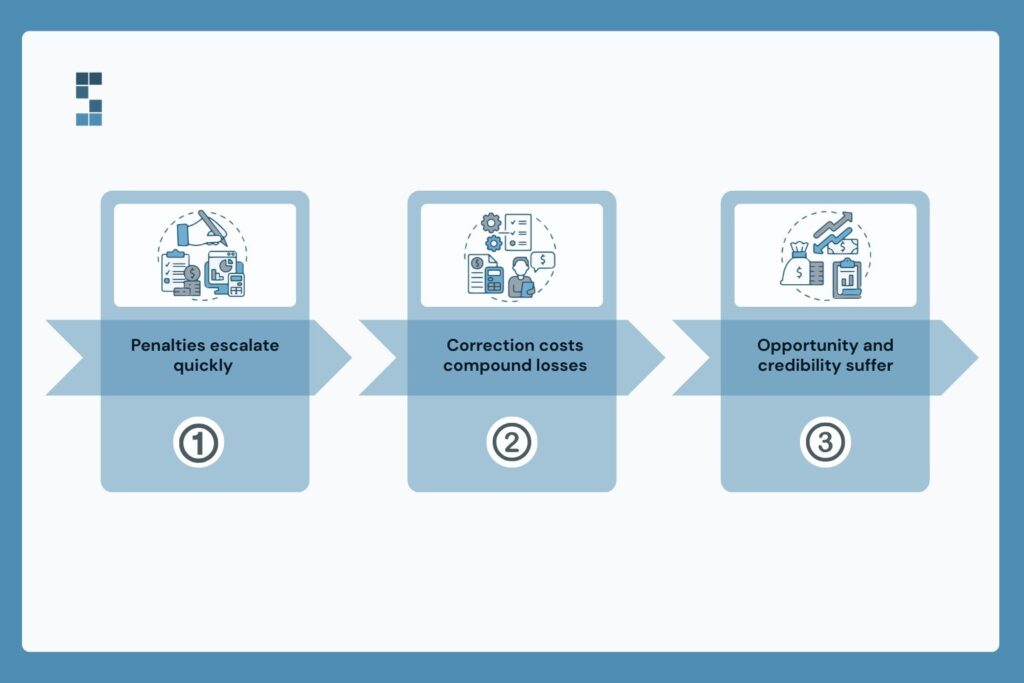
The Real Cost of Getting It Wrong
Let’s talk numbers because that’s what actually drives decisions.
If you have 50 contractors and miss filing their 1099s entirely, you’re looking at $280 per form. That’s $14,000 in penalties. For one year. If the IRS audits backward and finds multiple years of non-compliance, multiply that figure.
Then add professional fees to correct and refile everything. Tax attorneys and CPAs charge by the hour to untangle these messes. We’re talking thousands more in professional fees on top of the penalties.
But here’s the opportunity cost that hurts even more. Those 20-30 hours you spend every January scrambling to compile contractor information? That’s billable time you’re not selling. Strategic planning, you’re not doing. Client work you’re delaying.
One System Six client captured it perfectly: “Our team was spending so much mental energy worrying about whether we’d make payroll that client work suffered.”
When your team’s mental energy goes toward administrative panic instead of client excellence, everyone loses. Your contractors get frustrated with incorrect or late forms. Your CPA relationship suffers because you’re handing them messy records. And your professional credibility takes a hit.
Your Next Steps
Here’s what to do right now. Today.
Audit your current 1099 process. Who tracks contractor payments in your firm? What system do you use? When do you collect W-9s? Write down the answers honestly.
Then identify the gaps. Where could things go wrong? What would happen if your office manager left tomorrow—could someone else pick up the 1099 process?
Calculate your risk exposure. How many contractors did you pay last year? Are you confident you filed correctly for all of them? If not, what’s your potential penalty if the IRS comes knocking?
Long-term, build systems that scale with your growth. Automate what can be automated—threshold tracking, W-9 collection, and filing coordination—partner with 1099 compliance consultants where expertise matters—classification decisions, multi-state requirements, growth planning.
What could your consulting firm achieve if 1099 compliance ran on autopilot—no panic, no penalties, no late nights in January? You’d get your weekends back. Your team could focus on client work instead of administrative scrambles. And you’d sleep better knowing that when the IRS sends mail, it’s not a penalty notice.
That’s not wishful thinking. That’s what systems create.
About System Six
System Six is a Seattle-based bookkeeping and financial services firm specializing in technology-driven financial management solutions for consulting firms. Our team of over 35 professionals brings an average of 10+ years of accounting experience to every client relationship, serving more than 175 businesses across the U.S. We deliver the financial clarity and peace of mind that consulting firm owners need to thrive. Learn more at www.systemsix.com.