Picture this. It’s Monday morning. You sit down with your coffee, open your laptop, and pull up QuickBooks. But something’s wrong. The screen doesn’t look right. Your data’s gone—or worse, locked behind a ransomware message demanding payment in cryptocurrency. Years of billing records, project profitability data, client payment histories, and payroll files. All of it, inaccessible.
Your stomach drops. You think about the tax filing due next month. The client invoices are waiting to go out. The payroll runs on Friday.
Now ask yourself: how fast could you recover?
If you run a consulting firm and your financial records live in the cloud, you might assume they’re safe. And to a point, they are. Cloud platforms like QuickBooks Online, Gusto, and Ramp are far more reliable than the filing cabinet in your back office. But “in the cloud” doesn’t automatically mean “protected from disaster.” There’s a gap between cloud storage and true disaster recovery—and that’s where consulting firms get hurt.
Let’s close it.
“Cloud” Doesn’t Mean “Covered”

Here’s the thing most consulting firm owners don’t realize: cloud platforms protect against their failures—server outages, hardware problems, platform-level issues. They don’t necessarily protect against yours.
What does that mean in practice? It means your data is still vulnerable to plenty of real-world threats. A team member accidentally deletes a critical account category, and no one notices for 3 weeks. A ransomware attack encrypts your local machine and spreads to connected cloud syncs. An integration between your expense management tool and your accounting platform glitches, corrupting transaction data across both systems. Or a former employee with lingering access makes unauthorized changes.
These aren’t hypotheticals. Nearly half of all small businesses have experienced some form of data loss, and a significant percentage of those that suffer a major data event never fully recover. For a consulting firm with complex project billing, multi-state payroll, and client-sensitive financial information, the stakes are even higher.
So what actually protects your financial records when things go wrong?
Three Pillars of a Cloud Disaster-Recovery Plan
You don’t need a degree in IT to build a solid disaster-recovery plan for your financial data. You need three things working together: reliable backups, strong access controls, and a tested recovery process. Think of them like the legs of a stool. Remove one, and the whole thing tips over.
Pillar 1: Automated Backups That Actually Run
This sounds obvious, and yet it’s where most firms stumble. They assume their cloud platform handles backups automatically. And it does—to a point. But platform-level backups are designed to protect the platform, not necessarily your specific data configuration, custom reports, or integration settings.
What you need is a separate, automated backup system that captures your complete financial picture at regular intervals. For consulting firms running active billing cycles with retainer payments, milestone invoices, and expense reimbursements flowing through every week, daily backups aren’t overkill. They’re the minimum.
And those backups need to live somewhere independent of your primary cloud environment. If everything sits on the same platform and that platform has a bad day, your backup goes down with it. Redundancy isn’t a luxury. It’s the whole point.
Pillar 2: Access Controls and Security Layers
The best backup in the world won’t help if someone walks in the front door and messes up your records before you notice. Access controls are your first line of defense—and most consulting firms don’t treat them that way.
Think about how many people can currently access your financial systems. Your office manager, your accountant, a partner or two, a contractor helping with special projects. How many of those people have full admin access? How many use the same password for their email and their accounting login?
A strong disaster-prevention strategy includes bank-level security with encrypted data transmission, restricted access protocols that limit who can see what, and comprehensive confidentiality agreements with anyone who touches your financial data. It also means two-factor authentication on every account, regular access audits, and immediate offboarding when someone leaves the firm.
This is especially critical for consulting firms serving regulated industries. Your clients trust you with sensitive information. If your financial systems get compromised, it’s not just your problem—it becomes theirs, too.
Pillar 3: A Tested Recovery Process
Here’s where things get real. Having backups is one thing. Knowing you can actually use them is another.
Imagine a firm that diligently backs up its QuickBooks data every night. Feels great. Then one day, a corrupted file wipes out two months of transaction data. They go to restore the backup and realize—nobody on the team actually knows how. The backup files are in a format no one recognizes. The person who set up the system left the company last year. And now everyone’s scrambling while the clock ticks toward a payroll deadline.
A disaster-recovery plan without regular testing is just a document gathering digital dust. Run fire drills. At least once a quarter, walk through the actual recovery process. Verify that backups are complete, that someone on your team knows how to restore them, and that the restored data matches what you’d expect. The time to discover a problem with your recovery plan is during a drill—not during a crisis.
Why Your Financial Partner Matters More Than Your Software
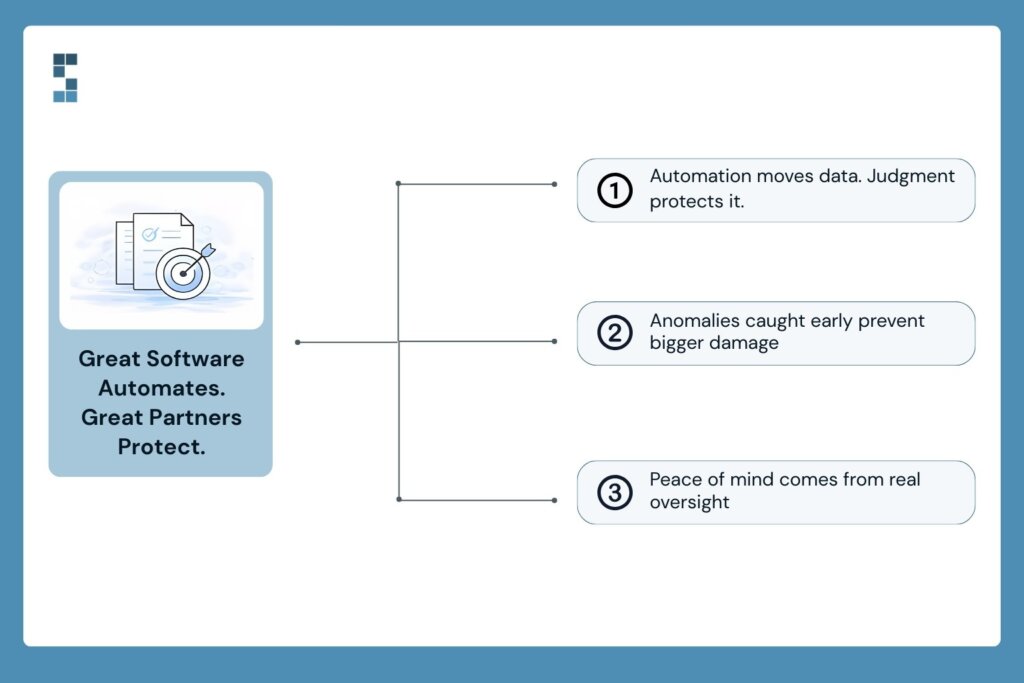
Software handles automation. People handle judgment. And when something goes wrong with your financial records, you need both—but you really need people who know your specific setup inside and out.
A dedicated financial team doesn’t just process your transactions and move on. They monitor data integrity. They catch anomalies before they become disasters. They notice when something looks off in your reconciliation and dig in before a small discrepancy becomes a large one.
One business owner put it this way: “Hiring them was the best decision I made at the start of the business. We just finished our audit, and the auditors found exactly zero errors. Not only have they been mistake-free, but they’ve also been proactive at catching mistakes I’ve made and seeing challenges coming down the pike.” That kind of vigilance—the kind that looks around corners—is what separates a service provider from a genuine partner.
At System Six, this is built into how we work. Our cloud-based infrastructure employs bank-level security, including encrypted data transmission and restricted access protocols. Our team of 35+ U.S.-based professionals, each averaging over 10 years of accounting experience, operates as an extension of your business—not a faceless vendor you email and hope for the best. When our clients say they feel like we’re “part of the team,” that’s not marketing language. It’s what a 9.5 out of 10 NPS score looks like in practice.
As another client shared, “System Six has done wonders for my stress level to feel like this is all now taken care of with a professional partner.” That peace of mind? It comes from knowing someone’s watching the details you can’t afford to miss—including the integrity of your financial data and the systems protecting it.
The Bottom Line: Hope Is Not a Recovery Strategy
Disaster recovery isn’t an IT problem. It’s a financial survival strategy. For consulting firms juggling project billing across multiple clients, managing multi-state payroll for remote consultants, and handling sensitive financial data that clients trust you to protect, the stakes are too high for a “hope for the best” approach.
The good news? You don’t have to figure this out alone. The right financial partner will already have these protections in place—automated backups, bank-level security, tested recovery protocols, and a team that treats your data with the same care they’d give their own.
So here’s the question worth sitting with: if your financial records disappeared tomorrow, how fast could you get back to business?
If the answer makes you uncomfortable, it might be time to talk.
Schedule a complimentary consultation with System Six to assess your current financial infrastructure and identify gaps in your data protection and disaster recovery strategy, because the best time to plan for a crisis is before you’re in one.
About System Six
System Six is a Seattle-based bookkeeping and financial services firm that helps small and mid-sized businesses streamline their financial operations. We specialize in providing technology-driven financial management solutions for consulting firms, enabling owners to focus on growing their businesses without worrying about cash flow, payroll, or compliance. Our team of over 40 professionals brings an average of 10+ years of accounting experience to every client relationship, serving more than 175 businesses across the U.S. With a 9.5/10 NPS score, we deliver the financial clarity and peace of mind that consulting firm owners need to thrive. Learn more at www.systemsix.com.