You can do a useful first pass yourself, and if you are screening deals you should. What you cannot reliably do alone are the three procedures that actually move the purchase price: a proof of cash, a conversion from cash-basis to accrual, and testing every add-back against source documents.
There is also a hard constraint that has nothing to do with your ability. If you are financing with an SBA loan at a business purchase price of $3 million or more, SOP 50 10 8.1 has required an independent quality of earnings analysis since 1 October 2026, and obtaining it is the lender’s responsibility. Your own spreadsheet does not satisfy that, however good it is.
What you can genuinely do yourself
|
Procedure |
Do it yourself? |
What it takes |
|
Reconcile tax returns to the P&L |
Yes |
An afternoon, and a willingness to ask the seller about every difference |
|
Build a monthly revenue and margin trend |
Yes |
The monthly P&L and a spreadsheet |
|
Revenue concentration by customer |
Yes |
Revenue by customer by month |
|
Check the add-back schedule for repeats |
Yes |
Three years side by side; anything “one-time” in all three is not |
|
Compare owner compensation to market |
Yes |
Salary data for the role and the region |
|
Review receivables ageing |
Yes |
The ageing report, and scepticism about anything over 90 days |
|
Proof of cash |
Rarely |
Complete bank statements, and the judgment to tell timing from a finding |
|
Cash-to-accrual conversion |
Rarely |
Technical accounting work, and it often changes the earnings figure materially |
|
Testing add-backs to source documents |
Partly |
Invoice-level support for every claimed adjustment, and the discipline to reject what is not documented |
|
Normalized working capital by month |
Rarely |
Twelve monthly balance sheets, normalized consistently |
The top half of that table is screening. It tells you whether to keep going. The bottom half is diligence. It tells you what to pay.
Why the bottom half is harder than it looks
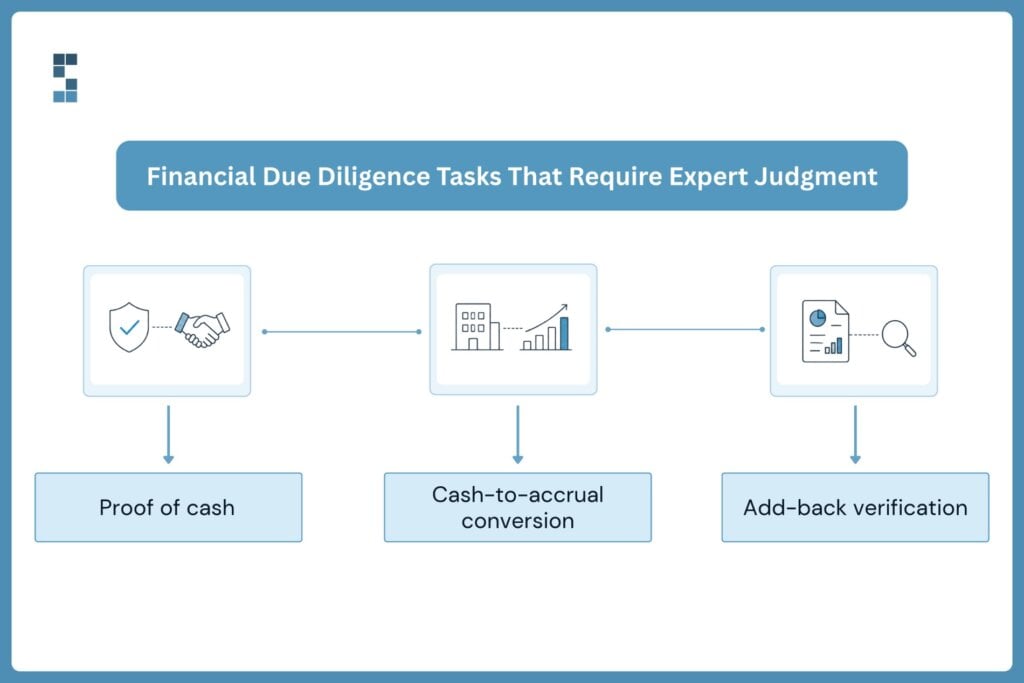
Proof of cash. The mechanics are a spreadsheet exercise. The difficulty is interpretation: knowing which differences are ordinary timing and which are findings, and knowing what to ask next when something does not tie. Most buyers running their own analysis correctly identify that a difference exists and then cannot explain it. See what a proof of cash is for what the procedure covers.
Cash-to-accrual conversion. Cash-basis books record revenue when money arrives. Converting moves revenue and cost into the periods they belong to, and in a business with deposits, retainers, or long project cycles the restated picture is frequently different from the one you were sold. This is technical accounting, and getting it wrong in your favour is as damaging as getting it wrong in the seller’s.
Testing add-backs. Not reading the schedule. Asking for the invoice behind each line and removing what cannot be supported. It is tedious, it is where the money is, and it is uncomfortable to do yourself because you are negotiating with the same person you are asking for documents.
The constraint that is not about skill
Two things sit outside your control.
The lender. Since 1 October 2026, SOP 50 10 8.1 has required a quality of earnings analysis on SBA-financed acquisitions where the business purchase price is $3 million or more. The threshold is the purchase price, not the loan amount. Three details change what you should do about it:
- Obtaining the report is the lender’s responsibility, not yours. Do not commission anything before talking to them.
- A report prepared for you may still count, where it comes with a reliance letter or a secondary review. That is the lender’s decision, and worth asking about early if you want to control the scope.
- The QoE earnings figure feeds the lender’s coverage test, so a finding does not just affect your price, it affects whether the loan clears at all.
- Some transactions sit outside it, including qualifying owner buyouts and ESOP deals.
Below the threshold, individual lenders can still impose their own requirement. Check before you decide to self-perform, because discovering it late costs you weeks you do not have inside an exclusivity period.
Your own objectivity. By the time you are in diligence you have spent months on this deal, paid legal fees, and told people you are buying a business. That is the worst possible position from which to assess evidence that you should not. An outside reviewer has no sunk cost and no story to protect.
The time it actually takes
A competent self-performed review on a single-entity business with reasonably organized records is roughly 40 to 60 hours spread over two to three weeks, assuming the seller responds promptly. Messy records, multiple entities, or a slow seller push it well past that.
Price that against your exclusivity window and against what else needs doing in it: financing, legal, lease assignment, insurance, and the transition plan. Buyers who self-perform most often run out of time rather than ability.
A middle path most buyers miss
You do not have to choose between a full engagement and nothing.
- Screen it yourself. Run the top half of the table above before you sign a letter of intent. Most deals die here, and you should not pay anyone for that.
- Scope a focused review after the LOI. A lighter engagement that covers the procedures you cannot do, usually proof of cash, the accrual conversion, add-back testing, and normalized working capital, rather than full-scope work.
- Upgrade only if the first pass finds something. If the focused review surfaces a material issue, extend the scope then, with a specific reason.
QoE Lite versus full-scope QoE sets out what each level covers and what it costs.
When doing it yourself is genuinely the right call
It is reasonable to self-perform when most of the following are true:
- The purchase price is small enough that a review fee is a meaningful share of the deal
- There is no bank debt, or the lender has confirmed in writing it does not require an independent report
- The books are on accrual basis and were prepared by a CPA firm
- The business does not handle cash from consumers
- Revenue is contracted and traceable to a small number of identifiable customers
- You have an accounting background, or someone who does will review your work
- The add-back schedule is short and documented
If most of those are false, particularly the first three, self-performing is a saving on the fee and a risk on the price.
Frequently asked questions
How much would a focused review cost instead?
Scope and fee vary with deal size and the state of the books. Our QoE pricing by deal size page sets out the ranges, and a focused scope sits at the lower end.
Can my CPA do it?
Sometimes. A tax CPA and a transaction advisory practice are different disciplines, and the procedures above are not part of routine tax or compliance work. Ask directly whether they have performed a proof of cash and a working capital analysis on an acquisition before.
Will the seller take my own analysis seriously in a renegotiation?
Less seriously than an independent report, which is a real and often underestimated cost of self-performing. A documented third-party finding is harder to argue with than a buyer’s spreadsheet, and price revisions are won on documentation.
What if I run out of time inside exclusivity?
Ask for an extension early rather than late, and ask with a specific reason. Sellers grant extensions for diligence that is clearly progressing far more readily than for one that has stalled.
Can I do part of it and have someone review my work?
Yes, and it is a reasonable structure on a smaller deal. Expect the reviewer to re-perform anything they are putting their name to, so the saving is smaller than it looks, but the cost is real and lower than a full engagement.
Sources
- SBA Information Notice 5000-880695, Issuance of SOP 50 10 8.1, effective 1 October 2026
- HBK, How new SBA quality of earnings rules affect business acquisitions — the $3M purchase-price threshold, the exclusions, and the reliance-letter point
- CBIZ, SOP 50 10 8.1 introduces new quality of earnings requirement on acquisitions — what the analysis covers and how it feeds underwriting
Tell us about the deal before you decide
We would rather tell you a deal does not need us than scope work it does not warrant. Send us the CIM or the seller’s P&L and we will tell you what we would test, what you could reasonably do yourself, and what the rest would cost as a fixed fee.
About System Six
System Six is a Seattle-based outsourced bookkeeping, accounting, payroll, and CFO advisory firm serving consulting and professional services businesses. We work with more than 175 businesses, our team averages over 10 years of accounting experience, and we’ve processed more than $100 million in payroll. Clients rate us 9.5 out of 10 on likelihood to recommend, and over half of our new clients come from referrals. We work on a fixed weekly fee with no long-term contracts. Learn more at systemsix.com.