There’s a lot of advice about how to buy a business. There’s much less about the part nobody can rehearse: the first year of actually owning one. I went through a self-funded search in 2020. In July 2021, I closed on System Six, an outsourced accounting and bookkeeping firm — a roughly 18-person business doing about $2.5M in revenue and just over $1M in EBITDA, financed through a typical self-funded SBA loan, a seller note, and some investor capital. About fourteen months in, I sat down to talk honestly about what had actually happened. This is that account — what the transition really looked like, what I’d tell my 2020 self, and where a new owner should put their attention first.
The numbers, fourteen months in — and why the margin going down is fine
Start with the scoreboard, because it isn’t as clean as the pitch decks suggest. We went from about 18 people to roughly 30, and from $2.5M to somewhere around $3.6–3.7M in revenue. But EBITDA did not grow in lockstep — it was up maybe 10% in a year when revenue was up 25–30%.
That gap surprises new owners, and it shouldn’t. When you’re accelerating growth, your margin compresses on purpose. We hired ahead of the revenue, added a management layer, and put more of everyone’s time — including mine — into running and building the business rather than just doing the work. If you buy a small company and your margin holds perfectly flat while you grow, you’re probably under-investing in the thing that lets you grow next year.
The first thing I protected: don’t break the books — or the team
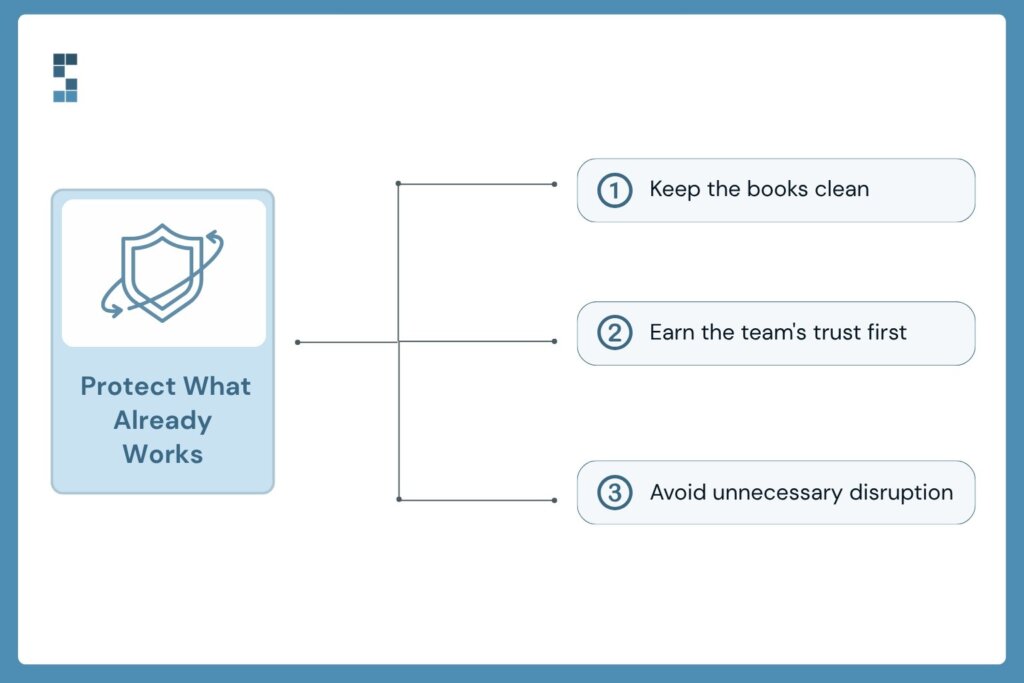
The single biggest risk in the early months isn’t strategy. It’s that you, the new owner, quietly break something that was working. For us, that meant two priorities above everything else.
First, the financials. We are a bookkeeping firm, so this is on-brand, but it’s true for any acquisition: your clean books are how you know whether anything else you’re doing is working. A messy transition that corrupts your numbers blinds you for a year. Keep the close running on time from month one.
Second, the people. I’d spent real time before the deal with the seller and his family, and it was obvious how much they cared about the team they’d built. My job in the first six months wasn’t to remake the place — it was to earn the team’s trust and keep the culture that made the business worth buying. Changes came later and slowly.
Self-funded SBA vs traditional search fund: what I’d tell my 2020 self
I came out of business school oriented toward a traditional search fund, and ended up doing a self-funded SBA deal instead. Fourteen months in, I’m glad I did — and I have two reflections for anyone choosing a path now.
The first is about optionality. Finding a genuinely good business to buy is hard, and anything that increases your odds of getting a deal done is worth a lot:
To the extent you can keep your options open by self-funding and allowing yourself to buy a smaller business, which is what I did, use an SBA loan… it just increases the chances that you’re going to buy a business.
Chris Williams — Acquiring Minds
The second is a counterweight: don’t let “self-funded” trap you into thinking small. If you can find a bigger business, the economics and the way you spend your time as CEO both improve. I recommend staying self-funded for optionality and keeping your eyes open for larger [$3–5M EBITDA] businesses if one appears. You’ll own a smaller slice, but a bigger, faster-scaling business can be the better outcome.
Inheriting the sales seat
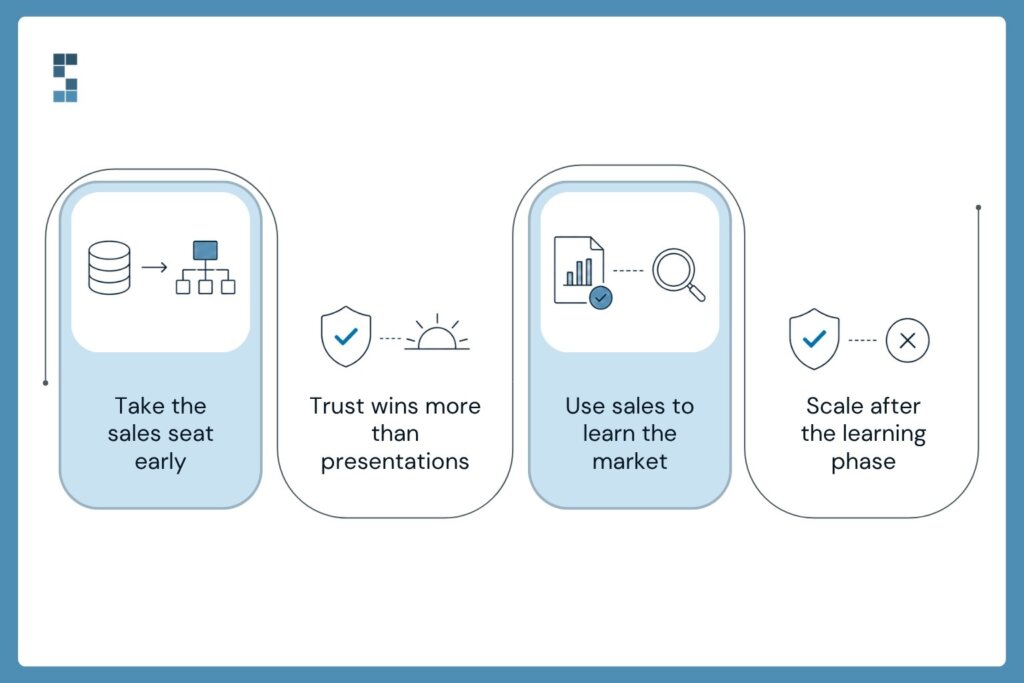
Here’s the transition I underestimated most. The seller, John, was a natural salesman, and sales were his engine. I am not naturally inclined toward sales, and on close, that engine became my job.
There’s no clever shortcut I can offer — the answer was reps. I did about 75 sales calls in my first six months as owner, and well over a hundred the following year. What I learned is that our sale isn’t a hard technical demo; it’s a trust-building exercise:
We are really purchased based on trust and how much competence we can demonstrate through our sales process, which is really two touch points. I do a discovery call, and then we gain access to somebody’s books. We dig through it. Our team asks some questions.
Chris Williams — Acquiring Minds
That’s also a hint about how the service should feel later: if you win the deal by demonstrating competence on someone’s actual books, you’ve set the expectation that you’ll keep doing exactly that once they’re a client. The longer-term goal is to build a sales function that isn’t just the CEO — but in year one, founder-led selling is how you learn what your buyers actually need.
Hiring turned out to be the real constraint.
Most people assume the bottleneck in a service business is demand. For us, it was the opposite. The market was strong, and growth was sitting right in front of us; what gated it was our ability to bring the right people on board.
A business like ours, we can only grow as much as we can bring great people onto the team.
Chris Williams — Acquiring Minds
That reframed how I think about scaling. The top of the funnel that matters most isn’t leads — it’s hiring. And you can’t simply hire the leadership team you’ll need at 60 people when you’re sitting at 30; they’d be underutilized and bored. The move that actually worked was promoting from within: our team lead, Kelly, stepped into a Head of People role, growing into the seat as the company grew into needing it. Building the org one well-coached promotion at a time beats hiring a finished structure off the shelf.
The searcher niche found us.
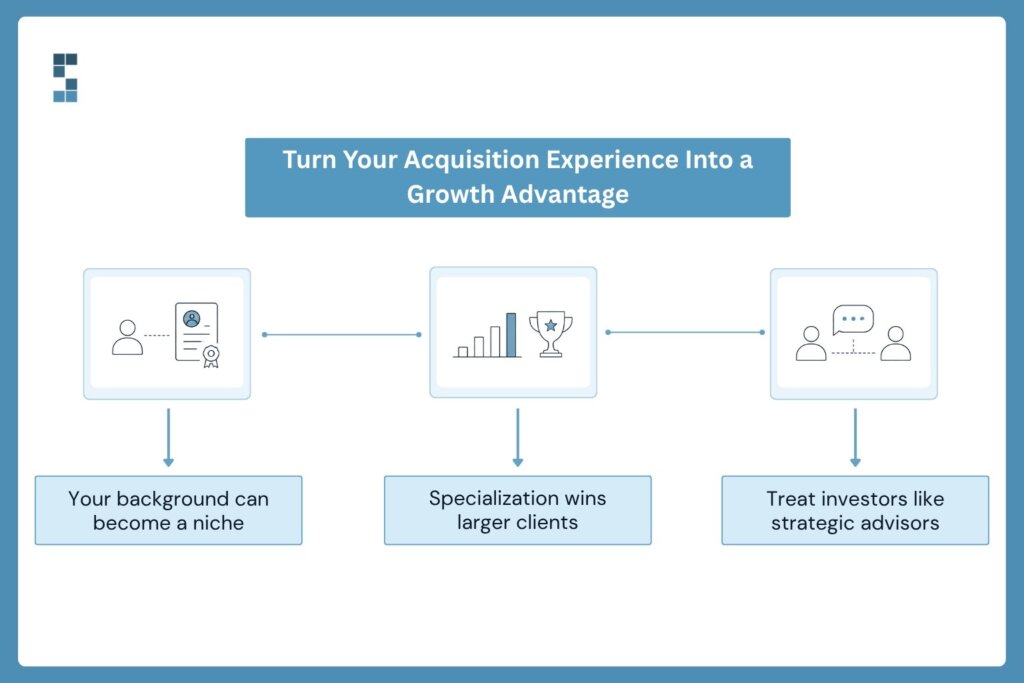
One unexpected gift of the first year: being a former searcher turned into a real channel. Other people who’d just bought businesses wanted a books partner who understood what they were going through — and they tended to be larger, more sophisticated clients.
We have 15 or so search-acquired businesses we’re now serving; they’re larger and are pushing our average customer size up. More of them are accrual-based, which we can handle where others can’t.
Chris Williams — Acquiring Minds
Investors became an asset in the same period — not as bosses, but as a sounding board. I don’t have to give them control to get the benefit of their perspective: I want to treat them like they’re my board. And we’ve had board meetings every quarter. The meetings I prepared real materials for were the ones that pulled me up out of the day-to-day and made me think about the business strategically. If you take on investor capital, use it that way.
What year one actually teaches you
If I compress fourteen months into a few sentences: protect the books and the people before you change anything; expect margin to dip while you invest in growth; get your reps in on sales even if it isn’t your strength; and treat hiring as the real ceiling on how fast you can grow. None of it is glamorous, and all of it compounds.
If you’ve just bought a business — or you’re close — the highest-leverage thing you can do in the first 90 days is make sure your financials stay clean while everything else is in motion. That’s the one area where a mistake quietly costs you the whole year.