At some point in every first acquisition, someone, often a well-meaning attorney or a board member from a corporate background, says the safe move is hiring a Big-4 firm for the quality of earnings. The logic sounds unassailable: biggest firms, deepest benches, names every lender knows. I used to sit on the side of the table where that logic came from, approving Big-4 engagement letters in private equity without blinking.
Then I bought a company with my own money, and the same engagement letter looked very different. For a lower-middle-market deal, the Big-4 versus boutique question is not about quality versus thrift. It is about fit, and the honest trade-offs run differently than the brand names suggest.
The trade-offs at a glance
| Big-4 / national firm | LMM boutique | |
| Typical LMM fee | $100,000+ | $25,000–$50,000 full scope; $10,000–$20,000 QoE Lite |
| Who does the work | Partner sells; junior staff deliver, often rotating between engagements | Varies by firm; the good ones are partner-led, with seniors in the workpapers |
| Calibration | Processes built for $100M+ audits and PE platform deals | Pattern library built on owner-operated, sub-$25M companies |
| Timeline | Often 6–8 weeks; your deal queues behind larger clients | 3–4 weeks full scope; QoE Lite inside 10 business days |
| Pricing structure | Frequently hourly with broad estimates | Fixed-fee is standard at credible shops |
| Lender acceptance | Universal | Broad: most LMM lenders accept any credible independent provider |
| Where it shines | Cross-border, multi-entity, institutional LP requirements | Owner-operated LMM deals on a deal clock |
Brand credibility vs. what you actually pay for it
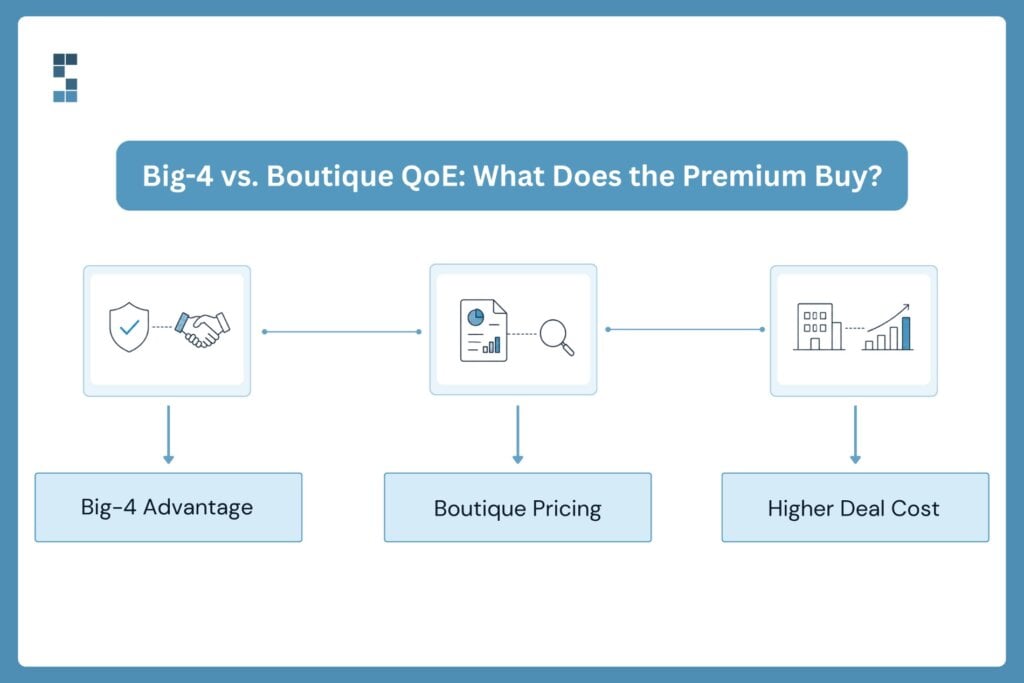
Start with what the premium buys, because it does buy something. A Big-4 name carries universal recognition: no lender, LP, or co-investor anywhere will question the letterhead. The firms have genuinely deep technical benches, and for complex situations, multi-entity structures, cross-border issues, industry-specific accounting, that depth is real.
What the premium costs in the lower middle market: $100,000 and up for work a boutique delivers at $25,000 to $50,000. You shouldn’t be spending this much on an LMM deal, and here is the uncomfortable reason why: the extra spend mostly purchases brand insurance for stakeholders who were not asking for it. On a $5M purchase, a Big-4 QoE can approach 2% of the deal, triple the fee for the same diligence questions, answered by a team less familiar with companies your size.
The partner-sold, junior-delivered problem
The structural issue with large-firm economics is leverage: a partner wins the engagement, and the work flows to whoever is available on the staffing grid. The person testing your add-backs may be two years out of school, excellent at process, and seeing their first owner-operated company, where the owner’s spouse runs payroll, the rent flows to a family LLC, and half the January revenue is really December’s.
This is not a criticism of the people; it is a description of the model. Big-firm processes exist precisely so junior staff can execute reliably at scale. But LMM diligence is a judgment business, and judgment lives with whoever is actually in the workpapers. When the person who priced your engagement will not touch your schedules, you are buying the brand, not the brain.
The fair counterpoint: not every boutique is partner-led either. Small firms can run the same leverage model at lower price points. Which is why the staffing question from our provider guide applies to everyone: ask exactly who will be in your workpapers, whatever the letterhead says.
Lender acceptance: the question that answers itself
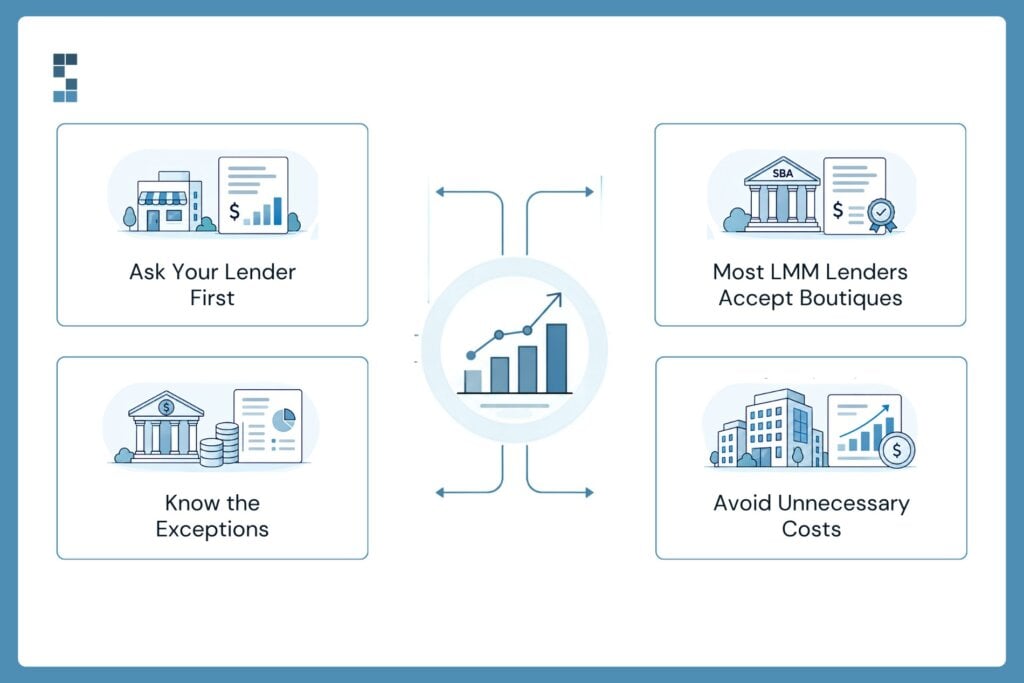
The strongest argument for Big-4 is usually some version of: my lender will require it. So ask your lender. It is a five-minute call, and in the lower middle market the answer is almost always that any credible independent provider is acceptable. SBA lenders, regional banks, and most private credit funds underwrite the schedules, not the signature. What they want is independence, rigor, and schedules that lift cleanly into a credit memo.
Where the answer differs: institutional equity with LP documentation requirements, some larger private credit funds, and cross-border financing occasionally specify national firms. If that is your capital stack, the requirement is real and the premium is just a cost of the deal. But require is the operative word. Paying $100,000 to pre-empt a requirement nobody stated is the most expensive form of guessing.
When each one actually fits
Big-4 or national firm fits when: your capital partners contractually require it; the target is multi-entity or cross-border with genuinely complex accounting; the deal is large enough that the fee is rounding error; or you are a fund whose LPs expect institutional paper on every deal.
A boutique fits when: the target is an owner-operated company under $25M; your exclusivity window is 60 to 90 days and the deal clock matters; you want the person who scoped the deal in the workpapers; or the fee needs to be proportionate to the deal. For most searchers, independent sponsors, and first-time buyers, this is the deal you have.
Either way: run the same six-criteria scorecard. The brand answers none of the six questions by itself, and a boutique that fails the staffing or defensibility test is not a bargain at any price.
Frequently asked questions
Is a Big-4 QoE worth the premium for a small deal?
Rarely. For owner-operated LMM targets, a credible boutique answers the same diligence questions for a third of the fee, faster, with a team calibrated to companies your size. The premium makes sense mainly when your capital partners contractually require a national firm.
Will lenders accept a boutique QoE report?
Most LMM lenders, including SBA lenders, accept any credible independent provider. They underwrite the quality of the schedules, not the brand. Confirm with your specific lender before paying a brand premium.
What is the alternative to a Big-4 quality of earnings?
A partner-led boutique that specializes in lower-middle-market transactions: fixed fee, three-to-four-week full scope or a QoE Lite inside ten business days, with senior people in the workpapers.
Are boutique QoE firms lower quality?
Quality varies at every size. The right test is not the firm’s size but its answers to the six scorecard criteria: staffing, LMM fluency, the sample report, defensibility, speed, and fixed-fee pricing.
Put both columns on one page
Download the scorecard, score the national firm and the boutique side by side, and let the answers decide. If you want our column filled in first: send the CIM, and a partner will scope your deal with a fixed fee and a start date.
Download the QoE provider evaluation scorecard from System Six.