A proof of cash is a reconciliation that ties every dollar of bank activity over a period to the revenue and expenses recorded in the financial statements. It answers one question: did the money the seller says came in actually come in, and did the money they say went out actually go out?
It matters because it is the only procedure in financial due diligence that tests the books against an independent record. Everything else relies to some degree on what the seller recorded. The bank statements do not.
As of 1 October 2026 it is also no longer optional on larger SBA deals. Under SOP 50 10 8.1, SBA-financed acquisitions at a purchase price of $3 million or more require a quality of earnings analysis, and that analysis must include a cash proof covering the trailing twelve months and the prior two fiscal years. A procedure buyers used to trade away to save fee is now a condition of the loan.
How it differs from a bank reconciliation
The two are often confused. They do different work.
|
Bank reconciliation |
Proof of cash |
|
|
Covers |
A single point in time, usually month end |
A full period, month by month |
|
Tests |
The closing balance |
Opening balance, all receipts, all disbursements, closing balance |
|
Catches |
Timing differences and errors in the balance |
Unrecorded transactions, misstated revenue, diverted funds |
|
Typically performed by |
The bookkeeper, monthly |
The buyer’s diligence team, over 12 to 36 months |
A bank reconciliation proves the ending balance is right. It can be right while large amounts of activity are missing from the books entirely, because activity that was never recorded does not create a reconciling difference. A proof of cash closes that gap by reconciling the flows, not just the balance.
What the reconciliation looks like
The standard format runs four columns across each period: opening balance, receipts, disbursements, closing balance. Each column is reconciled from the bank’s figure to the book’s figure.
|
Opening balance |
Receipts |
Disbursements |
Closing balance |
|
|
Per bank statement |
$142,300 |
$1,284,500 |
$1,201,700 |
$225,100 |
|
Deposits in transit, opening |
$12,000 |
($12,000) |
— |
— |
|
Deposits in transit, closing |
— |
$18,400 |
— |
$18,400 |
|
Outstanding checks, opening |
($9,800) |
— |
($9,800) |
— |
|
Outstanding checks, closing |
— |
— |
$14,200 |
($14,200) |
|
Per books |
$144,500 |
$1,290,900 |
$1,206,100 |
$229,300 |
Each column reconciles on its own, and the rows then have to agree across: $144,500 opening plus $1,290,900 of receipts less $1,206,100 of disbursements gives the $229,300 closing balance per the books. If those two routes to the closing figure disagree, something is unrecorded.
Then the receipts and disbursements totals are traced into the profit and loss. Recorded revenue for the period, adjusted for the change in receivables and deferred revenue, should explain the receipts. Recorded expenses, adjusted for the change in payables and prepaid items, should explain the disbursements.
Where it does not reconcile, the difference is the finding.
What a proof of cash catches
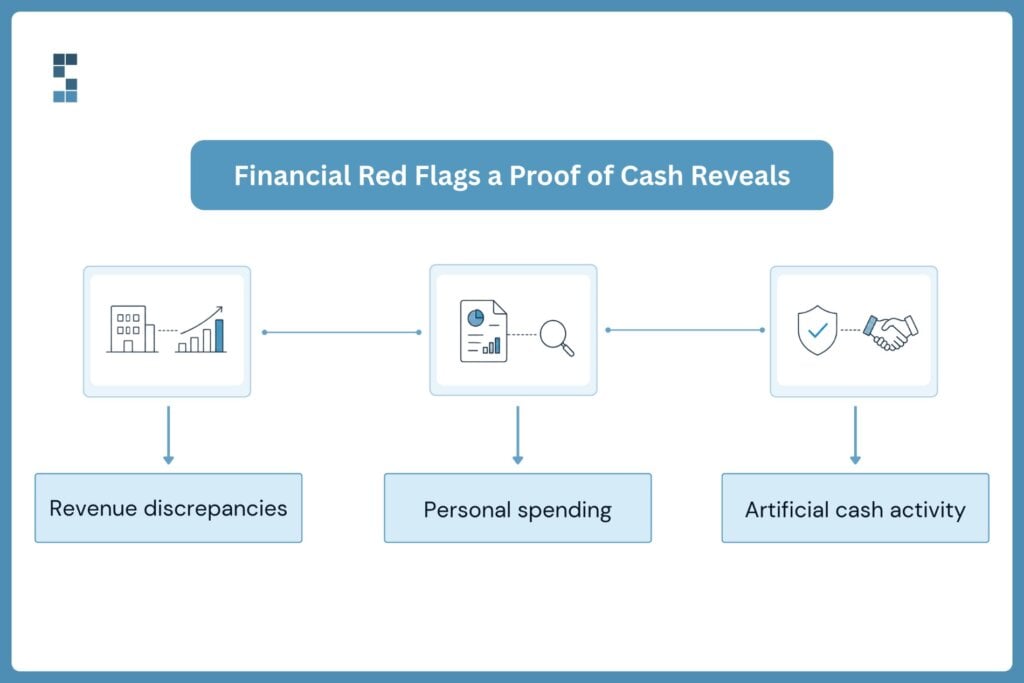
Revenue that was never recorded. Cash receipts that never reached the books. In a business that takes cash payments, this is the single most common finding, and it cuts both ways: an owner who kept cash off the books has a business worth more than the financials show, and no way to prove it to a lender.
Revenue recorded that never arrived. Invoices booked as revenue with no matching receipt, inflating both revenue and receivables. The receivables ageing usually shows it too, but the proof of cash shows it first.
Personal spending run through the business. Disbursements that do not tie to any recorded business expense. This connects directly to the add-back schedule, because owner draws coded as expenses are one of the most common sources of EBITDA adjustment.
Round-tripping. Money moved out and back to create the appearance of sales activity. The flows reconcile to the bank but not to any customer.
Undisclosed accounts. Transfers to or from accounts the seller did not include in the data request.
Timing manipulation before sale. Collections accelerated and payments delayed in the months before a sale, inflating the trailing cash picture. This one also feeds directly into the working capital peg.
When it matters most
A proof of cash is worth prioritizing when any of these are true:
- The business handles cash or card payments directly from consumers
- The books are maintained on a cash basis
- The financials were prepared by the owner or a part-time bookkeeper rather than a CPA firm
- There is no audit or review on any period
- Revenue is concentrated in a small number of large payments
- The seller’s adjusted EBITDA relies heavily on add-backs
In an owner-operated business with self-prepared books, which describes most lower middle market acquisition targets, all six are usually true at once.
What you need from the seller
Request these for the full period under review, typically 24 to 36 months:
- Bank statements for every operating, payroll, savings, and merchant account, as issued by the bank
- Merchant processor statements and payout reports
- The general ledger, exported, for the same period
- Bank reconciliations as prepared
- A list of all accounts in the business name, including closed ones
Ask for statements directly from the bank’s portal rather than a PDF the seller assembled. Reluctance to provide complete statements for a complete period is itself a diligence finding, and it is one of the clearest you will get.
Is a proof of cash part of every QoE?
It depends on the scope, and since October 2026 it also depends on how the deal is financed.
If you are using SBA debt at $3 million or more, it is required. SOP 50 10 8.1 obliges the lender to obtain a quality of earnings analysis on those transactions, and that analysis must include a cash proof covering the trailing twelve months and the prior two fiscal years. The lender then uses the QoE earnings figure in its debt service coverage determination, so the proof of cash feeds directly into whether the loan clears.
Two practical points follow. The lender is responsible for obtaining the report, so commission nothing without talking to them first; a report prepared for you may still be accepted where it comes with a reliance letter or a secondary review, but that is the lender’s call, not yours. And certain transactions sit outside the requirement, including qualifying owner buyouts and ESOP deals.
Outside that threshold, it is a scoping decision. A lighter review may test revenue through sampling rather than performing a full proof of cash. A full-scope engagement normally includes it.
If the business is cash-intensive or the books are self-prepared, a proof of cash is not the part of the scope to economize on. See QoE Lite versus full-scope QoE for what each level of work covers and what it costs.
Frequently asked questions
Is a proof of cash the same as an audit? No. An audit is an opinion on whether financial statements are fairly presented, performed under professional standards. A proof of cash is a single diligence procedure. It tests one thing thoroughly rather than the whole statement at a reasonable assurance level.
How far back should it go? Twenty-four to thirty-six months is standard, matching the period the adjusted EBITDA is based on. On an SBA deal at $3 million or more, the cash proof must cover the trailing twelve months plus the prior two fiscal years, so plan the data request around that from the start.
How long does it take? For a single-entity business with a handful of accounts, a few days once the records arrive. Multiple entities, multiple banks, or missing statements extend it considerably, and missing records are the usual cause of delay.
Can I do it myself? The mechanics are straightforward if you are comfortable in a spreadsheet and the records are complete. The judgment is harder: knowing which differences are normal timing and which are findings, and knowing what to ask next when something does not tie. Most buyers doing their own analysis find the difference but not the explanation.
What if the seller will not provide full bank statements? Treat it as a material finding. There is no version of a credible financial diligence process that proceeds without them, and a seller with clean books has no reason to withhold them.
Sources
- SBA Information Notice 5000-880695, Issuance of SOP 50 10 8.1, effective 1 October 2026
- Doeren Mayhew, SOP 50 10 8.1: what SBA lenders should be thinking about before Oct 1 — the cash proof requirement and the period it must cover
- HBK, How new SBA quality of earnings rules affect business acquisitions — the $3M threshold, the exclusions, and the reliance-letter point
Test the cash before you commit
A proof of cash is where most findings surface, and it is the procedure buyers most often skip to save fee. Bring us the deal and we will tell you what scope it warrants, who would do the work, and what it costs as a fixed fee.
About System Six
System Six is a Seattle-based outsourced bookkeeping, accounting, payroll, and CFO advisory firm serving consulting and professional services businesses. We work with more than 175 businesses, our team averages over 10 years of accounting experience, and we’ve processed more than $100 million in payroll. Clients rate us 9.5 out of 10 on likelihood to recommend, and over half of our new clients come from referrals. We work on a fixed weekly fee with no long-term contracts. Learn more at systemsix.com.