A complete monthly package is a profit and loss statement, a balance sheet, a cash flow statement, a debt service coverage calculation, and a short written summary of what happened and why. Deliver it within 15 days of month end. Most SBA loan agreements require monthly or quarterly financial statements and annual tax returns, and the specific requirement sits in your loan documents, so read them rather than relying on a general rule.
Three different readers use that package, and each one is looking for something different.
Who reads what
|
Reader |
What they are checking |
What they look at first |
|
The SBA lender |
That the business generates enough cash to service the debt, holds enough liquidity, and complies with its covenants |
Debt service coverage ratio, cash balance, revenue trend |
|
Equity investors or a seller note holder |
That the acquisition is performing against the thesis and their capital is protected |
EBITDA against plan, growth initiatives, cash position |
|
You, the operator |
That you can see a problem while it is still small |
Margin by month, receivables ageing, 13-week cash |
Build one package that serves all three. Producing separate reports for separate audiences is how reporting becomes a job instead of a byproduct of closing the books.
The monthly package
Six to ten pages is the right length. More than that and nobody reads it.
|
Section |
Contents |
|
Cover summary |
One page. Revenue, EBITDA, cash, DSCR, each against prior month and plan. Three to five sentences on what moved and why. |
|
Profit and loss |
Current month and year to date, compared to prior year and to budget. Accrual basis. |
|
Balance sheet |
Month end, compared to prior month and to the opening balance sheet at acquisition. |
|
Cash flow statement |
Current month and year to date. |
|
Debt service coverage |
The calculation shown, not just the result. |
|
Receivables and payables ageing |
Current, 30, 60, 90 plus. Flag concentrations. |
|
Operating metrics |
Three to six numbers specific to the business. Not generic KPIs. |
|
13-week cash forecast |
Rolling. The most useful page in the pack for a leveraged business. |
Back it with detailed statements exported from your accounting system. If the business runs on QuickBooks or Xero, the underlying reports come straight out of it, which is the point of standardizing the books early. See cleaning up the books after an acquisition if you inherited records that cannot yet produce this.
The debt service coverage ratio
DSCR is the number your lender cares about most, and it is the covenant most likely to be tested.
DSCR = annual cash available for debt service ÷ annual debt service
Cash available for debt service is usually EBITDA less unfinanced capital expenditure, less cash taxes, less owner distributions, though the exact definition is set in your loan agreement and definitions vary between lenders. Annual debt service is principal plus interest on all debt, including the seller note.
A worked example:
|
Line |
Amount |
|
EBITDA (trailing twelve months) |
$940,000 |
|
Less unfinanced capital expenditure |
($60,000) |
|
Less cash taxes |
($95,000) |
|
Cash available for debt service |
$785,000 |
|
Annual principal and interest, SBA 7(a) |
($472,000) |
|
Annual principal and interest, seller note |
($81,000) |
|
Total annual debt service |
($553,000) |
|
DSCR |
1.42x |
Since SOP 50 10 8.1 took effect on 1 October 2026, the SBA’s coverage requirement is transaction-dependent: 1.25x is reported for first-time acquisitions and owner buyouts, 1.15x for business expansions, and individual lenders can set a covenant above the floor. Lenders can also no longer use forecast post-closing earnings to clear it, so the test runs on historical performance. Check your own loan agreement for the figure and the definition that apply to you.
Track the ratio monthly on a trailing twelve-month basis rather than waiting for the annual test, because a covenant breach discovered at year end has already happened for several months. Tracking DSCR after an SBA acquisition covers the monthly worksheet and the warning levels.
Timing
Close the books within 10 business days of month end. Deliver the package by day 15.
That cadence does two things. It gives you the month’s numbers while you can still act on them, and it builds a record of reliability with your lender. A borrower who reports on time every month without being chased is treated differently when they need an amendment, a waiver, or additional capital.
Late or missing reporting is itself a technical default under many loan agreements, regardless of how the business is performing.
Common mistakes in the first year
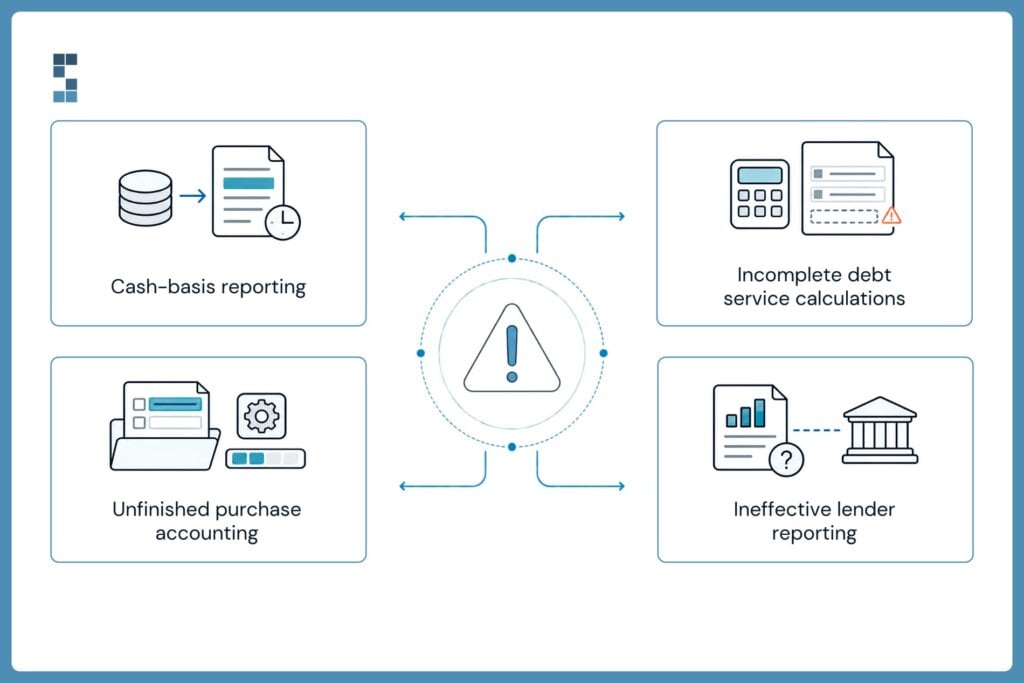
Reporting on cash basis. Cash-basis statements will not show a lender what they need, and they hide the timing problems that matter most in a leveraged business.
Omitting the seller note from debt service. A DSCR that covers only the bank debt is not the ratio your lender is calculating.
Leaving the opening balance sheet unfinished. Purchase accounting has to be recorded properly, including the allocation of purchase price and any goodwill, or every subsequent balance sheet is wrong.
Reporting metrics nobody uses. Six numbers tied to how this business actually makes money beat twenty generic ones. Our monthly financial metrics and KPI dashboard covers how to choose them.
Waiting until something is wrong to communicate. A lender who hears about a weak quarter in the monthly pack, with your explanation attached, responds differently from one who finds it in an annual review.
Frequently asked questions
How often does an SBA lender require financial statements?
Most SBA 7(a) loan agreements require monthly or quarterly statements plus annual tax returns and, in some cases, annual reviewed or audited financials. The frequency is set in your specific loan agreement, so confirm it there rather than assuming a standard.
What DSCR do SBA lenders require?
Under SOP 50 10 8.1, effective 1 October 2026, the requirement is transaction-dependent, with 1.25x reported for first-time acquisitions and owner buyouts and 1.15x for business expansions. Lenders may set a covenant above the SBA floor, and underwriting at origination typically looks for headroom above it. Your loan agreement states both the required ratio and the definition used to calculate it.
Do I need an audit?
Usually not for a loan of this size. Internally prepared monthly statements plus annual tax returns satisfy most lower middle market SBA facilities. Some agreements require a review or an audit above a certain loan amount, and investor agreements may require more than the lender does.
What should I send equity investors that the lender does not get?
Progress against the original investment thesis: the growth initiatives you committed to, where they stand, and what you are learning. The financial statements are the same; the narrative is different.
Can my bookkeeper produce this?
A bookkeeper can produce the statements. The package also needs the covenant calculation, the forecast, and the written summary, which is controller-level work. That gap is one of the first things to solve after closing, and it is what outsourced accounting for acquisition entrepreneurs is built for.
Sources
- SBA Information Notice 5000-880695, Issuance of SOP 50 10 8.1, effective 1 October 2026
- SOP 50 10, Lender and Development Company Loan Programs
- PBMares, New SBA business acquisition rules take effect October 1 — the coverage figures and the change on projections
Reporting your lender will not chase you for
Most buyers inherit books that cannot produce a lender package on day one. We close the month, build the covenant calculation, and deliver the pack on the same date every month. Bring us your loan agreement and we will tell you exactly what it requires and what it takes to meet it.
About System Six
System Six is a Seattle-based outsourced bookkeeping, accounting, payroll, and CFO advisory firm serving consulting and professional services businesses. We work with more than 175 businesses, our team averages over 10 years of accounting experience, and we’ve processed more than $100 million in payroll. Clients rate us 9.5 out of 10 on likelihood to recommend, and over half of our new clients come from referrals. We work on a fixed weekly fee with no long-term contracts. Learn more at systemsix.com.