
Before you sign a letter of intent, ask for five things: three years of business tax returns, three years of profit and loss statements, three years of balance sheets, the trailing twelve months by month, and the seller’s add-back schedule with support. That set is enough to decide whether the business is worth pursuing and whether the asking price is in a sane range.
After the LOI, when you have exclusivity, the request expands considerably. Asking for everything up front slows down a deal that may not deserve the time, and sellers who are early in a process are often unwilling to share detail until they know you are serious.
Before the LOI: the five-document set
|
Document |
Period |
What it tells you |
|
Business tax returns |
3 years |
The numbers the seller was willing to report to a tax authority. The most reliable figure you will get at this stage. |
|
Profit and loss statements |
3 years |
Revenue and margin trend, and how the books compare to the returns. |
|
Balance sheets |
3 years |
Debt, receivables quality, inventory, and the working capital the business actually runs on. |
|
Monthly P&L, trailing twelve months |
12 months |
Seasonality, trend direction, and whether recent months are being presented as the run rate. |
|
Add-back schedule with support |
3 years |
What the seller is claiming and whether any of it is documented. |
Reconcile the tax returns against the profit and loss statements first. If they do not agree, the explanation for the difference is the most informative conversation you will have before the LOI.
One step further is worth taking on any deal you are serious about: ask the seller to sign IRS Form 4506-C so the returns can be verified against transcripts held by the IRS rather than taken on trust. Lenders do this routinely through the IRS Income Verification Express Service, and if you are financing the purchase your lender will almost certainly require it. A seller who hesitates at a transcript request has told you something before you have read a single document.
After the LOI: the full request
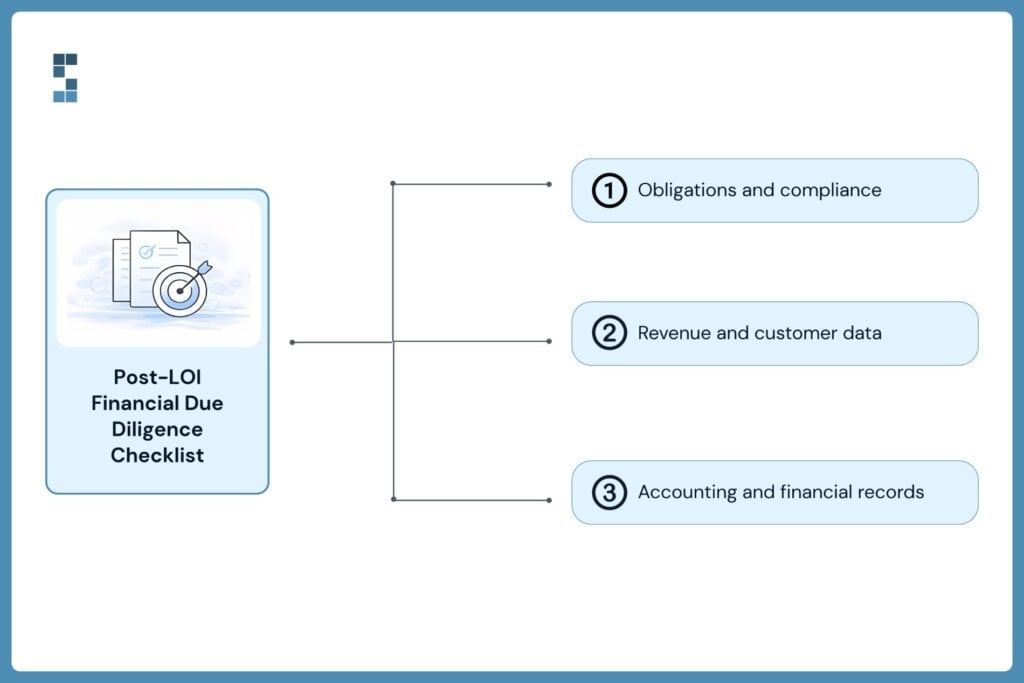
Once you have exclusivity, request the following. A good rule is 24 to 36 months for anything transactional, matching the period your adjusted EBITDA will be based on.
Accounting records – General ledger, exported, 24 to 36 months – Trial balance at each year end and at the most recent month end – Chart of accounts – Bank statements for every account, as issued by the bank – Bank reconciliations as prepared – Merchant processor statements and payout reports – Accounts receivable ageing, current and at each year end – Accounts payable ageing, current and at each year end – Fixed asset register with depreciation schedules – Inventory listing with valuation method, if applicable
Revenue detail – Revenue by customer, by month – Revenue by product or service line – Top 10 customers by revenue for each year – Customer contracts, including any that are assignable or terminable on change of control – Backlog, work in progress, or signed but undelivered work
People – Payroll register and payroll tax filings – Employee census: role, tenure, compensation, employment status – Contractor payments and 1099 filings – Benefit plan documents and any accrued leave balances – Any employment or non-compete agreements
Obligations and commitments – Loan agreements and amortization schedules for all debt – Equipment leases and the property lease – Supplier contracts and any minimum purchase commitments – Insurance policies and claims history – Any open litigation, disputes, or regulatory matters
Tax and entity – Payroll, sales, and state tax filings – Entity formation documents and ownership records – Any correspondence with tax authorities
The bank statement rule
Ask for bank statements as issued by the bank, downloaded from the bank’s portal, not a summary or a PDF the seller assembled.
This matters more than any other single item on the list. The bank record is the only independent evidence in the entire data request. Every other document originates with the seller. The proof of cash procedure that ties reported revenue to actual deposits depends entirely on having complete statements for a complete period.
A seller who provides partial statements, statements for some accounts but not others, or reformatted summaries has given you a finding whether they intended to or not.
Reading the response, not just the documents
How a seller handles the request tells you as much as what is in it.
Fast and complete usually means a business with real systems and an owner who has prepared for a sale. It also tends to mean other buyers will find diligence easy.
Slow but complete is the most common pattern in owner-operated businesses. The records exist but nobody has ever had to assemble them. Build the time into your timeline rather than reading it as evasion.
Partial, with explanations needs attention. Some gaps are genuine, such as records lost in a system migration. Others are not. The test is whether the missing item is one you could reconstruct from another source, and whether the seller helps you do that.
Refusal on the core five before an LOI is normal in a competitive process and unusual in a proprietary one. Refusal on bank statements after an LOI is a different matter entirely.
What to do with it once you have it
The document list is the input. The analysis is separate work, and the sequence that follows is:
- Reconcile tax returns to the financial statements
- Convert cash-basis books to accrual, if needed
- Test the add-back schedule item by item against support
- Run a proof of cash against the bank statements
- Build monthly normalized working capital for the peg calculation
- Analyze revenue concentration and customer retention
Our quality of earnings checklist sets out what each of those steps covers.
Frequently asked questions
How many years of financials should I ask for? Three years plus the trailing twelve months by month. Three years shows the trend, the monthly detail shows seasonality and whether the recent run rate is representative.
Should I ask for tax returns or financial statements? Both, and the comparison between them is the point. Tax returns were filed under penalty; internal statements were not. Differences are often legitimate, and the explanation is what you are looking for. Verify the returns against IRS transcripts rather than accepting PDFs, using a signed Form 4506-C.
Does an SBA loan change what I need to collect? Yes, above a threshold. Since SOP 50 10 8.1 took effect on 1 October 2026, SBA-financed acquisitions at a purchase price of $3 million or more require a quality of earnings analysis that includes a cash proof covering the trailing twelve months and the prior two fiscal years. That means complete bank statements for roughly three years, not one, so build the request around that period from the start.
What if the business keeps books on a cash basis? That is common in businesses of this size and not a reason to walk. It does mean the financials need converting to accrual before the earnings figure means anything, and the conversion frequently changes the picture.
Will a seller sign an NDA before releasing this? Usually, yes, and you should expect to sign one. A mutual non-disclosure agreement before the pre-LOI set is standard practice.
Can I request all of this myself, or do I need an advisor? You can request it yourself, and many buyers do. The volume becomes the issue after the LOI: the full set runs to hundreds of files, and the analysis has a defined sequence. Most buyers assemble the pre-LOI set themselves and bring in a buy-side quality of earnings provider for the post-LOI work.
Sources
- IRS Income Verification Express Service — verifying tax returns against IRS transcripts
- SBA Information Notice 5000-880695, Issuance of SOP 50 10 8.1, effective 1 October 2026
- Doeren Mayhew, SOP 50 10 8.1: what SBA lenders should be thinking about before Oct 1 — the cash proof period
Know what to ask for, and what the answers mean
Getting the documents is the easy half. Bring us the CIM or the seller’s P&L and we will tell you what else to request, what we would test first, and what we would scope. No sales pitch, just the deal.
About System Six
System Six is a Seattle-based outsourced bookkeeping, accounting, payroll, and CFO advisory firm serving consulting and professional services businesses. We work with more than 175 businesses, our team averages over 10 years of accounting experience, and we’ve processed more than $100 million in payroll. Clients rate us 9.5 out of 10 on likelihood to recommend, and over half of our new clients come from referrals. We work on a fixed weekly fee with no long-term contracts. Learn more at systemsix.com.