Use seller’s discretionary earnings when the owner works in the business full time and earnings are below roughly $1 million. Use EBITDA above that, or whenever the business already has a manager running it who is not the owner.
The difference between the two figures is one salary: the cost of paying somebody to do the owner’s job. SDE leaves that cost out. EBITDA puts it back in.
Which you use changes nothing about the business. It changes the number, and it changes the multiple that number should be multiplied by. Mixing the two is the most expensive arithmetic error a first-time buyer makes.
What each one actually measures
Seller’s discretionary earnings is the total financial benefit one working owner takes out of the business in a year. It assumes the buyer will replace the owner and do the job themselves, so the owner’s compensation is added back as a benefit available to the next owner.
EBITDA is earnings before interest, taxes, depreciation and amortization. It assumes the business is run by paid management, so a market-rate salary for that role stays in the cost base.
One business, two defensible figures. The question is which assumption describes what you are actually buying.
The reconciliation, line by line
A service business with $2,400,000 of revenue, owner-operated:
|
Line |
Amount |
|
Net income as reported |
$185,000 |
|
Add back: owner salary |
$120,000 |
|
Add back: owner payroll taxes |
$9,200 |
|
Add back: interest |
$38,000 |
|
Add back: depreciation and amortization |
$52,000 |
|
Add back: owner’s personal vehicle |
$11,000 |
|
Add back: one-time legal settlement |
$14,000 |
|
Seller’s discretionary earnings |
$429,200 |
|
Less: market salary for a general manager |
($135,000) |
|
EBITDA |
$294,200 |
Both numbers are correct. SDE says a working owner can take $429,200 out of this business. EBITDA says that if you hire somebody to run it, it produces $294,200.
Note what sits in both: interest, depreciation, amortization, genuine one-time costs, and documented personal expenses. The only line separating them is the owner’s replacement cost.
The mistake that costs money
The same business, valued at the same multiple, against the two different figures:
|
Earnings figure |
Amount |
At 4.0x |
|
SDE |
$429,200 |
$1,716,800 |
|
EBITDA |
$294,200 |
$1,176,800 |
A $540,000 difference on a business under $2M, from nothing but which line the multiple was applied to.
This happens because SDE multiples and EBITDA multiples are not interchangeable. SDE is the larger number, so the multiples quoted against it are correspondingly lower. A broker quoting “3.5x” against SDE and a buyer mentally applying “3.5x” against EBITDA are describing two very different prices.
When anyone quotes you a multiple, the first question is: a multiple of what, exactly? Ask them to show you the earnings calculation the multiple applies to, line by line.
Which one your deal should use
|
Situation |
Use |
Why |
|
Owner works full time, earnings under ~$1M |
SDE |
You are buying a job plus a business, and the owner’s pay is genuinely available to you |
|
Owner works full time, earnings over ~$1M |
Either, stated clearly |
Above this size buyers and lenders increasingly expect EBITDA, and the business is usually too big for one person to run alone |
|
A manager already runs the business |
EBITDA |
The management cost is a real, continuing expense and will not disappear when you buy |
|
You intend to hire a manager rather than operate |
EBITDA |
Price what you are actually going to own: a business with a payroll line for its operator |
|
Two or more working owners |
EBITDA, or SDE with only one owner’s compensation added back |
Adding back two salaries overstates what one buyer can extract |
|
An SBA lender is financing it |
Follow the lender’s convention |
They underwrite against their own definition, and that is the number that decides whether the deal funds |
The crossover is a convention, not a rule. What matters more than the threshold is that one figure is used consistently through the whole negotiation: the offer, the diligence, the lender package, and the final purchase agreement.
Where the add-backs go wrong
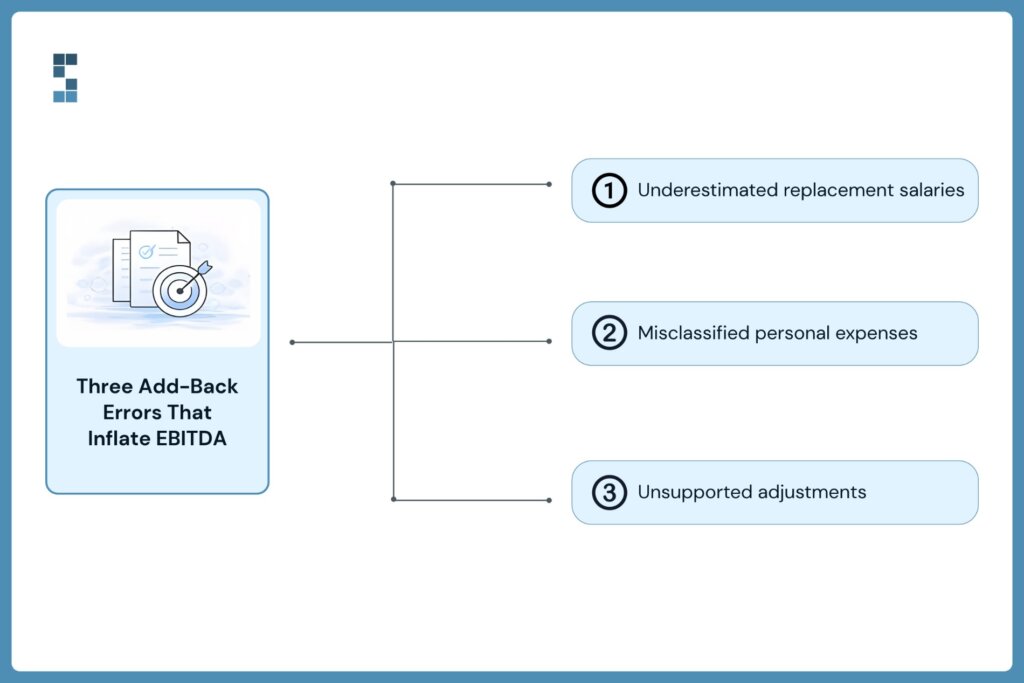
Both figures depend on the add-back schedule, and that is where most of the disagreement actually lives. Three recurring problems:
One-time costs that appear every year. A legal settlement is a genuine add-back once. The same line in all three years is a cost of doing business.
Replacement cost set too low. A seller computing EBITDA will choose a modest manager salary, because a smaller deduction produces a larger EBITDA. Price the role at what it would actually cost you to hire for it in that market. The Bureau of Labor Statistics publishes median and percentile wages by occupation and metro area, including general and operations managers, which is a defensible starting point and harder for a seller to argue with than an assertion.
Personal expenses that run the business. The owner’s vehicle may be genuinely personal, or it may be how the work gets done. Whatever portion is operational stays in the cost base. See owner draws coded as expenses for how this surfaces in small business books.
Testing those line by line against source documents is what a buy-side quality of earnings engagement does, and it is also what typically moves the earnings figure. How much EBITDA changes after a QoE covers the size of the movement to expect.
Frequently asked questions
Is SDE always higher than EBITDA?
For an owner-operated business, yes, by the cost of replacing the owner. If the owner takes no compensation at all, the two figures converge, which is itself a sign the financials need normalizing.
Which do SBA lenders use?
Lenders have their own definition of cash available for debt service, and it is set out in the loan agreement rather than following either convention exactly. Since SOP 50 10 8.1 took effect on 1 October 2026, acquisitions at a purchase price of $3 million or more require a quality of earnings analysis, and the lender uses the earnings figure from that report in its coverage test. Ask your lender for their calculation early, because it is the one that decides whether the deal funds.
Can I use SDE for a business with $3M of revenue?
Revenue is not the test. What matters is whether one person can genuinely run it. A $3M business with a working owner and no management layer is usually an SDE business; a $3M business with a general manager is not.
What about adjusted EBITDA?
Adjusted EBITDA is EBITDA after normalization adjustments: add-backs, owner compensation set to market, related-party rent corrected to market, and non-recurring items removed. It is the figure most lower middle market deals are actually priced on.
Does the multiple change if I switch figures?
It has to. The multiple and the earnings figure are a matched pair. Applying a multiple derived from EBITDA comparables to an SDE figure overstates value, and the error compounds with deal size.
Sources
- Bureau of Labor Statistics, Occupational Employment and Wage Statistics: general and operations managers — wage data for setting owner replacement cost
- SBA Information Notice 5000-880695, Issuance of SOP 50 10 8.1, effective 1 October 2026
Get the earnings figure right before you negotiate
Price is a multiple times a number, and the number is the part most buyers never test. Send us the seller’s P&L and the add-back schedule, and we will tell you what we think SDE and EBITDA actually are, what we would test, and what a review would cost as a fixed fee.
About System Six
System Six is a Seattle-based outsourced bookkeeping, accounting, payroll, and CFO advisory firm serving consulting and professional services businesses. We work with more than 175 businesses, our team averages over 10 years of accounting experience, and we’ve processed more than $100 million in payroll. Clients rate us 9.5 out of 10 on likelihood to recommend, and over half of our new clients come from referrals. We work on a fixed weekly fee with no long-term contracts. Learn more at systemsix.com.