In most lower middle market acquisitions, adjusted EBITDA moves between 5% and 15% from the figure the seller presented. Smaller moves are common in businesses with clean, accrual-basis books. Larger moves happen when the seller prepared the financials themselves, the business runs on cash-basis accounting, or the add-back schedule was built to support an asking price rather than to describe the business.
The direction of the change matters as much as the size. A sell-side report tends to move EBITDA up by identifying legitimate add-backs the owner never recorded. A buy-side report tends to move it down by removing adjustments that cannot be supported.
What the size of the change tells you
|
EBITDA change after QoE |
What it usually means |
|
0% to 5% |
Minor adjustments. Books are clean and the add-back schedule was prepared conservatively. |
|
5% to 10% |
Common and modest. Normal normalization of owner compensation and a handful of personal expenses. |
|
10% to 15% |
Meaningful, but not unusual in owner-operated businesses. Worth repricing, rarely worth walking. |
|
15% to 25% |
Significant. The valuation needs to be renegotiated, and the quality of the accounting itself becomes a diligence question. |
|
25% or more |
Material discrepancy. Treat it as a finding about the seller and their records, not only about the number. |
These are practical underwriting bands, not a published industry statistic. Treat them as a way to read your own result, not as a benchmark your deal has to hit.
Why adjusted EBITDA moves
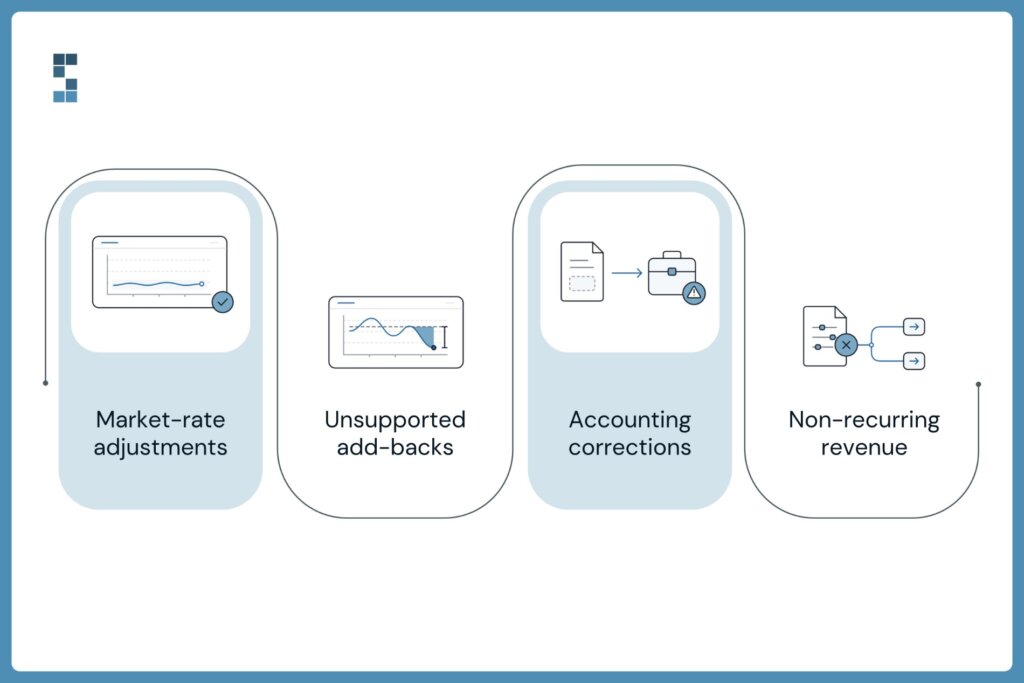
Six findings account for most of the movement.
Owner compensation that was never normalized. The owner pays themselves $60,000 and the market rate for the role is $140,000. That $80,000 gap is a real cost you will carry, and it comes straight out of EBITDA. The reverse also happens: an owner paying themselves $400,000 for a role worth $140,000 creates a legitimate upward adjustment.
Add-backs with no support. A seller adds back $85,000 of “one-time expenses” across three years. One-time items that appear in all three years are not one-time. Every add-back needs a document behind it, and the ones that cannot be documented come out.
Personal expenses that are actually business expenses. Vehicles, travel, phones, and meals get added back wholesale. Some of that spending genuinely runs the business, and whatever portion does stays in the cost base. See owner draws coded as expenses for how this shows up in small business books.
Cut-off and accrual errors. Cash-basis books record revenue when the money arrives and expenses when they are paid. Converting to accrual moves revenue and cost into the periods they belong to, and the restated picture is frequently different, particularly in a business with deposits, retainers, or long project cycles.
Related-party arrangements at non-market rates. The owner’s building leased to the business at $2,000 a month when market rent is $6,500 inflates EBITDA by $54,000 a year. You will pay market rent, or buy the building.
Non-recurring revenue treated as recurring. A large one-off project, a government relief payment, or a single customer order that will not repeat sits in the trailing twelve months and inflates the base the multiple is applied to.
What the change does to the purchase price
The EBITDA adjustment is not the whole impact. It is multiplied.
Take a business presented at $1,500,000 of adjusted EBITDA, under offer at a 4.0x multiple, so a $6,000,000 purchase price.
|
QoE finding |
Adjusted EBITDA |
Value at 4.0x |
Change in price |
|
No change |
$1,500,000 |
$6,000,000 |
— |
|
Down 5% |
$1,425,000 |
$5,700,000 |
$300,000 |
|
Down 10% |
$1,350,000 |
$5,400,000 |
$600,000 |
|
Down 15% |
$1,275,000 |
$5,100,000 |
$900,000 |
|
Down 25% |
$1,125,000 |
$4,500,000 |
$1,500,000 |
A 10% EBITDA finding on this deal is worth $600,000 of purchase price. That is the arithmetic that makes a quality of earnings engagement pay for itself several times over at almost any fee level.
It also affects your debt, and more so than it used to. If you are financing with an SBA 7(a) loan, the lender underwrites debt service coverage against the adjusted figure. Under SOP 50 10 8.1, effective 1 October 2026, acquisitions at a purchase price of $3 million or more require a quality of earnings analysis and the lender must use the earnings from that report in its coverage determination. Lenders also can no longer rely on forecast post-closing earnings to clear the floor.
Both changes point the same way: the QoE number is now the number the loan is sized on. An EBITDA reduction that is comfortable for you may not be comfortable for the lender, and the deal can fail on coverage even after you and the seller agree a new price.
When a large change should end the deal
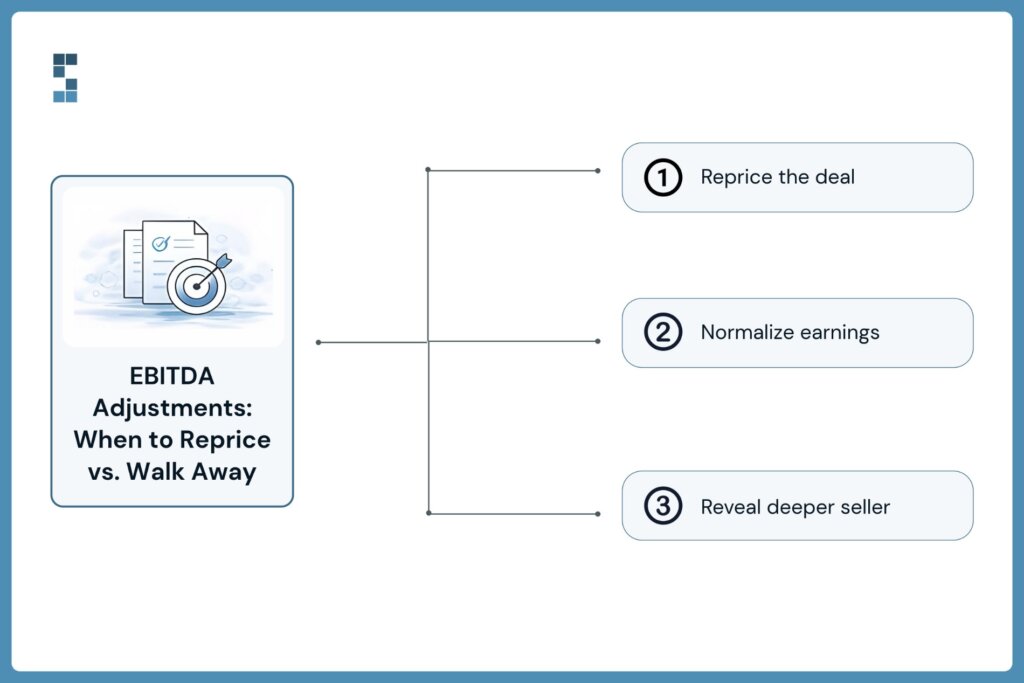
A big adjustment is a reason to reprice. It is a reason to walk only when it tells you something about the seller or the business that repricing cannot fix.
Reprice when the finding is explainable and bounded: owner compensation, related-party rent, a documented one-time project. You now know the real earnings and you can pay for them.
Reconsider the deal when the finding is any of these:
- The seller cannot explain their own numbers, or the explanation changes
- The books cannot support basic testing, so the real figure is unknown rather than lower
- Revenue cannot be traced to cash received
- The adjustment pattern suggests the schedule was reverse-engineered from a target price
- Customer concentration surfaces that was not disclosed
The second list is about trust and verifiability. A business whose earnings cannot be established is a different risk from one whose earnings are lower than advertised.
Frequently asked questions
Does a QoE always reduce EBITDA?
No. Buy-side reviews more often reduce it, because they remove unsupported add-backs. Sell-side reviews frequently increase it, because owners routinely fail to add back legitimate personal and one-time costs. The direction follows who commissioned the work and what the books started as.
Is a 10% reduction normal?
It is within the common range for an owner-operated business with cash-basis or self-prepared books. In a business with audited or reviewed accrual financials, a 10% move would be on the high side and worth understanding in detail.
Can I renegotiate the price after a QoE?
Yes, and it is one of the reasons buyers commission the work before signing a definitive agreement. A letter of intent is generally non-binding on price, and a documented finding is the strongest basis for a revision you will get.
Should the seller see the report?
Share the findings, not necessarily the full report. You need the seller to engage with the specific adjustments if you want the price to move, and specific documented findings are far more persuasive than a revised offer with no explanation attached.
How long does the analysis take?
A focused review on a smaller transaction typically runs one to two weeks. A full-scope engagement runs three to four weeks. See how long a QoE takes for what drives the timeline.
Sources
- SBA Information Notice 5000-880695, Issuance of SOP 50 10 8.1, effective 1 October 2026
- CBIZ, SOP 50 10 8.1 introduces new quality of earnings requirement on acquisitions — what the analysis tests and how it feeds underwriting
- Axial, Dead Deal Report: unpacking 2025’s broken LOIs — QoE EBITDA discrepancies as a share of failed deals
Find out what the real number is
If the add-back schedule looks optimistic, it usually is. Send us the seller’s P&L and their adjustments, and we will tell you what we would test, what we expect to find, and what it would cost as a fixed fee. If a QoE Lite pass is all the deal needs, that is what we will recommend.
About System Six
System Six is a Seattle-based outsourced bookkeeping, accounting, payroll, and CFO advisory firm serving consulting and professional services businesses. We work with more than 175 businesses, our team averages over 10 years of accounting experience, and we’ve processed more than $100 million in payroll. Clients rate us 9.5 out of 10 on likelihood to recommend, and over half of our new clients come from referrals. We work on a fixed weekly fee with no long-term contracts. Learn more at systemsix.com.