Searching for the best QoE firms for a lower-middle-market deal puts you in a strange market. There is no ranking that means anything, no Michelin guide for diligence, and the brand names you recognize are built for deals ten times your size. Meanwhile the work you are buying is the work that decides whether you overpay by a turn of EBITDA.
I have bought diligence from both ends of this market: as a private equity investor with a Big-4 budget, and as a searcher buying my own company with every dollar scrutinized. What I learned is that choosing a provider is itself a diligence exercise, and buyers who run it well use criteria, not logos. Here are the six that matter, how to test each one, and the traps on either end of the price range.
The six-criteria scorecard
Score every provider you talk to against these six. The deeper dives follow, and the downloadable version at the end formats this as a side-by-side comparison sheet.
| Criterion | What to ask | The red flag |
| 1. Who does the work | Exactly who will be in my workpapers, and is the person selling me also the person doing the analysis? | A confident partner in the sales call who cannot name the team |
| 2. LMM fluency | How many sub-$25M, owner-operated deals did you work in the last year? | War stories that all start at $100M revenue |
| 3. The sample report | Can I see a redacted sample before engaging? | No sample, or one that buries the answer on page 40 |
| 4. Defensibility | How have your adjustments held up with sellers’ accountants and lenders’ credit committees? | No examples of findings surviving a fight |
| 5. Speed | What is your start date and committed timeline, in writing? | A quote in weeks-from-now before work even begins |
| 6. Price structure | Fixed fee, scoped after a look at the books? | Hourly billing, or a quote without seeing anything |
1. Who actually does the work
The industry’s open secret is partner-sold, analyst-delivered: a persuasive partner wins the engagement, then a rotating bench of juniors you never meet performs it. Nothing about that structure is dishonest, but you should know you are buying it, because the judgment calls in a QoE, which add-backs survive, what a finding is worth, live with whoever is actually in the workpapers.
Ask for names. Ask whether the person in the sales call will review every schedule. Ask what happens if that person is on another deal when yours hits a snag. A firm built partner-led will answer in one sentence; a firm built on leverage will answer in an org chart.
2. Lower-middle-market fluency
A team calibrated on $500M companies misreads a $4M one in both directions at once. It flags normal owner-operator behavior as chaos, and it misses the risks that actually live in small companies: payroll tax exposure, related-party rent, below-market family wages, cash revenue that never touches the books.
The test is recency and volume: how many owner-operated, sub-$25M deals in the last twelve months? You want a team whose pattern library was built on companies like your target, because pattern recognition is most of what you are paying for.
3. The sample-report test
Ask for a redacted sample before you engage. It is the cheapest diligence you will ever run on a provider, and it is remarkable how much it reveals. You are looking for three things: an executive summary that leads with the answer, findings quantified in dollars rather than described in adjectives, and schedules a lender can lift straight into a credit memo.
If the sample reads like a compliance document, your report will too. And if the firm will not share one at all, ask yourself what the paying clients received that cannot survive redaction.
4. Defensibility under scrutiny
Your report will be attacked from two directions: the seller’s accountant disputing every adjustment, and your lender’s credit committee stress-testing the number their loan depends on. A QoE that cannot survive both is a shelf document.
Ask providers how their adjustments have held up in actual retrades. Ask whether lenders have accepted their reports without commissioning re-work. Ask for an example of a finding the seller fought and lost. Firms that do defensible work tell these stories easily, because the stories are the product.
5. Speed inside the exclusivity window
Most LOIs give you 60 to 90 days, with financing and legal queued behind diligence. A provider quoting six to eight weeks because of backlog is spending your negotiating window on their staffing problem. The benchmarks: a full-scope QoE should run three to four weeks from data delivery, and a QoE Lite can land inside ten business days.
Ask about the start date, not just the duration. A fast team that cannot start for a month is slower than a steady one that starts Monday. And get the commitment in writing alongside the fee.
6. Price structure, and the two traps
Push for a fixed fee, scoped after the provider has actually looked at the books. Hourly billing puts the cost risk and the timeline risk on you simultaneously, and reluctance to quote fixed is information about how well a firm knows this market. The ranges to expect: $10,000 to $20,000 for QoE Lite on deals under $5M, $25,000 to $50,000 for full scope from a boutique. Our pricing guide covers what moves you inside those ranges.
The traps sit at the extremes. Below $10,000 you are usually buying a template: no proof of cash, no working capital analysis, no one senior in the workpapers. This is one of the largest financial decisions of your life; don’t skimp on the very work that may save you from blowing it up. Above $100,000 you are usually buying a logo, and in the lower middle market the logo is rarely required: lenders care that the work is independent, rigorous, and legible, not whose letterhead it arrived on. The Big-4 vs. boutique trade-offs get their own article.
What is deliberately not a criterion
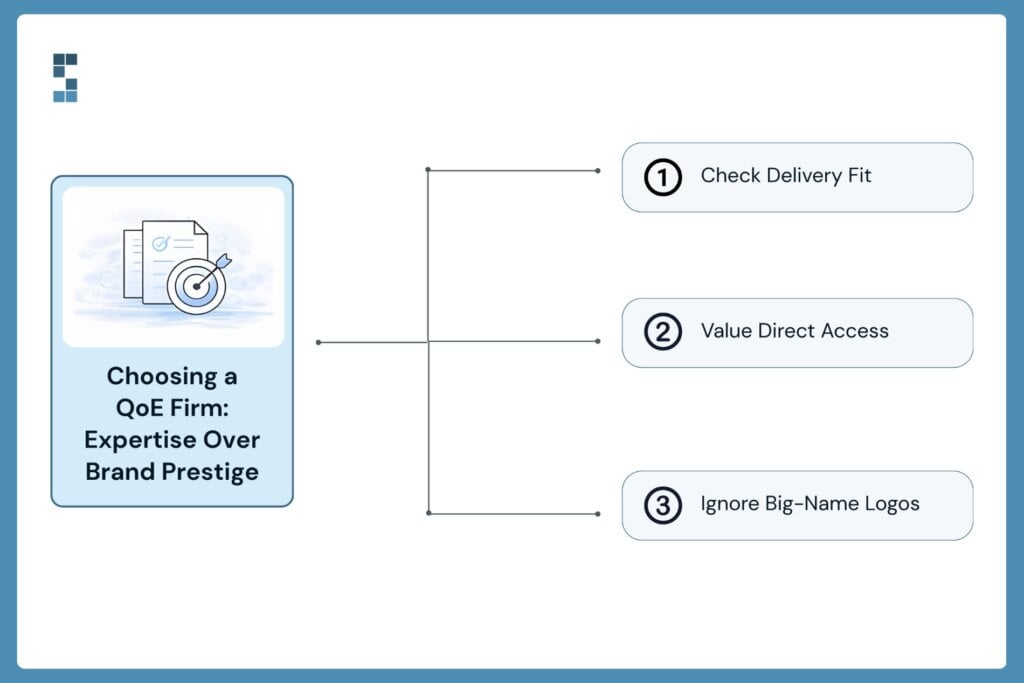
Brand prestige. A national firm’s name on the cover does not change your lender’s underwriting, and it does not make the add-back analysis sharper. The question is never who has the most famous letterhead; it is who will put a partner in your workpapers, inside your window, at a fee that matches your deal. Relationships beat logos in this market, which is exactly why we built our practice partner-led and white-glove: the person you scope with is the person who answers the phone when the seller’s CFO says something odd on a Tuesday.
Frequently asked questions
Who are the best QoE firms for small deals?
There is no meaningful ranking. The right firm for a lower-middle-market deal is partner-led, fluent in owner-operated companies, fixed-fee, and fast enough for your exclusivity window. Score candidates against criteria, not brand recognition.
How do I evaluate a QoE provider before engaging?
Run the six-criteria scorecard: who does the work, LMM fluency, the sample-report test, defensibility, committed speed, and fixed-fee pricing. The sample report and the staffing answer reveal the most.
Do lenders care which QoE firm I use?
Lenders care that the work is independent and rigorous, and that the schedules hold up in underwriting. Very few LMM lenders require a national firm; many accept any credible independent provider. Ask your lender before you pay a brand premium.
Should I just use my CPA?
No. Your CPA may be excellent, but lenders and investors want independence, and transaction diligence is a different discipline from accounting. Use your CPA as a reviewer, not as the provider.
Score us against the list
Download the scorecard, put System Six in one column, and put anyone else in the next. Then send us the CIM: a partner will scope your deal, name the exact team, and quote a fixed fee with a start date. If we are not the right fit for your deal, the scorecard will show you who is.
Download the QoE provider evaluation scorecard from System Six.
About System Six
System Six is a Seattle-based outsourced bookkeeping, accounting, payroll, and CFO advisory firm serving consulting and professional services businesses. We work with more than 175 businesses, our team averages over 10 years of accounting experience, and we’ve processed more than $100 million in payroll. Clients rate us 9.5 out of 10 on likelihood to recommend, and over half of our new clients come from referrals. We work on a fixed weekly fee with no long-term contracts. Learn more at systemsix.com.