Most consulting and professional services firms need both rhythms. A weekly cash flow monitoring check takes about fifteen minutes and answers one question: can we cover the next two weeks? A monthly financial pulse check takes an hour or two, needs closed books, and answers a bigger one: are we headed where we want to go? Weekly keeps you out of trouble. Monthly tells you where you’re going. Skip either one and you’ll usually find out the hard way.
It was 4:40 on a Friday afternoon when Leah noticed the number.
She runs a nine-person brand strategy firm in Seattle. Good clients, good work, a waiting list most quarters. And there she was, staring at her bank balance with payroll due Monday and two big invoices still sitting in some corporate client’s accounts payable queue. The math worked. Barely. She made it through, but she spent the whole weekend doing the kind of mental arithmetic nobody should be doing on a Saturday.
Here’s the thing. Leah’s firm was profitable. Her books were clean. She looked at her financials every month, like you’re supposed to. The problem wasn’t that she wasn’t paying attention. She was paying attention at the wrong tempo.
That’s what this post is about. Not whether cash flow monitoring matters (it does), but how often to do it, what to look at each time, and how to tell which rhythm your firm needs.
Why do so many firm owners check their cash at the wrong time?
Because monthly feels responsible. You close the books, you read the P&L, you nod. Done.
But a monthly review is a rearview mirror. By the time the numbers land on your desk, the month they describe is over. And cash doesn’t move monthly anyway. It moves in lumps. A client pays Net-60, if they pay on time. Payroll hits every two weeks whether or not anyone’s paid you. A quarterly tax payment lands on a random Tuesday. Add project-based revenue, where a big quarter can be followed by a thin one, and you’ve got a business that’s profitable on paper and short on cash on a Friday afternoon.
I spent years reading quality-of-earnings reports before I bought System Six, and this pattern showed up over and over: healthy firms, decent margins, and a cash position that lurched around like a small boat in chop. Nobody was doing anything wrong. They just weren’t looking often enough to see the waves coming.
So what’s the fix? Not more reports. A faster pulse.
What should a weekly cash flow check actually look like?
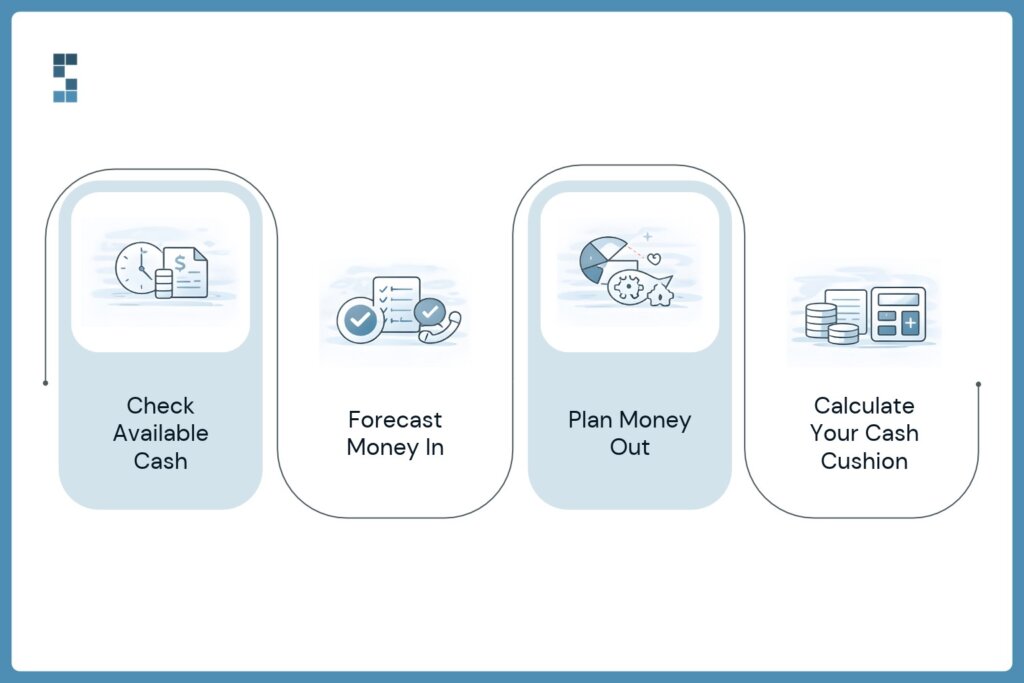
Think of it as taking your pulse, not getting a physical. Fifteen minutes, same day every week, same four questions.
What’s in the bank right now? Not what the ledger says, what’s actually cleared. What’s coming in over the next two weeks, and how sure are you about each one? (An invoice that’s twelve days late is not a sure thing.) What’s going out over the next two weeks: payroll, rent, the software stack, that contractor invoice? And the number that matters most: after all of that, how much cushion is left?
That’s it. You’re not reconciling anything. You’re not analyzing margins. You’re answering one question, can we cover the next two weeks comfortably, and writing the answer down so you can see the trend over time.
Leah does hers Monday morning with coffee, before she opens email. Some weeks it takes eight minutes. The payoff isn’t the number itself. It’s that surprises stop being surprises. A slow-paying client shows up as a yellow flag two weeks out instead of a red one two days out, which gives you time to do something useful: send a reminder, shift a payment, hold off on a purchase. Instead of just absorbing the hit.
What belongs in the monthly financial pulse check?
Now zoom out. The weekly check keeps you safe. The monthly check makes you smarter.
This one needs closed books, which means it only works if your bookkeeping is current. (If your books are six weeks behind, your “monthly” review is really a review of two months ago. That’s a different problem, and it comes first.) With clean numbers in hand, you’re asking bigger questions. How did revenue and expenses compare to what you expected? Which clients and projects make money once you count the hours that never got billed? How old is your receivables balance, and which clients are drifting from Net-30 to Net-whenever? And where does your cash forecast stand for the next thirteen weeks? (We walked through building one in our post on rolling forecasts.)
This is where decisions live. Hiring. Raising rates. Dropping a client that’s quietly costing you money. You can’t make those calls from a weekly glance at the bank balance. You need the full picture, and you need it every month, so you can see which way things are trending.
One client put it this way after a year with us: “We have really appreciated the improvements they have made to our bookkeeping process. We are in a much better place today than we were twelve months ago.” That’s Trevor, and the phrase I’d underline is twelve months ago. Monthly reviews compound. Each one makes the next one more useful.
How do you know which rhythm your firm needs?
Most firms need both. But the weighting changes with your situation, and here’s a rough way to think about it.
If you’ve got less than two months of operating expenses in the bank, the weekly check is non-negotiable. Same if your revenue is lumpy: big projects, long payment terms, a couple of clients who make up most of your billings. In those conditions, a lot can go wrong in thirty days.
If you run mostly on steady retainers and you’re sitting on a comfortable cushion, you can lean monthly. But keep the weekly glance. Five minutes with the bank balance costs you nothing and catches the odd surprise.
And if you’re growing fast? Both, religiously. Growth eats cash. You’re hiring ahead of revenue, and the gap between “we signed the client” and “the client paid” is exactly where good firms get into trouble.
There’s one more question worth asking: who’s doing this? If the honest answer is “me, when I remember,” that’s the real problem. The owners who sleep well tend to have someone whose job it is to watch the numbers between meetings. Paul, who runs an investor-backed business, described what that looks like: “Not only have they been mistake free, but S6 has also been proactive at catching mistakes I’ve made or seeing challenges coming down the pike and asking me the right questions to keep the books updated.” Another client, Marcus, said he appreciates how the team is “inquisitive, ask follow on questions, and look around corners.”
That’s what a rhythm is, really. Not a report. Somebody looking around corners on a schedule.
Finding your rhythm
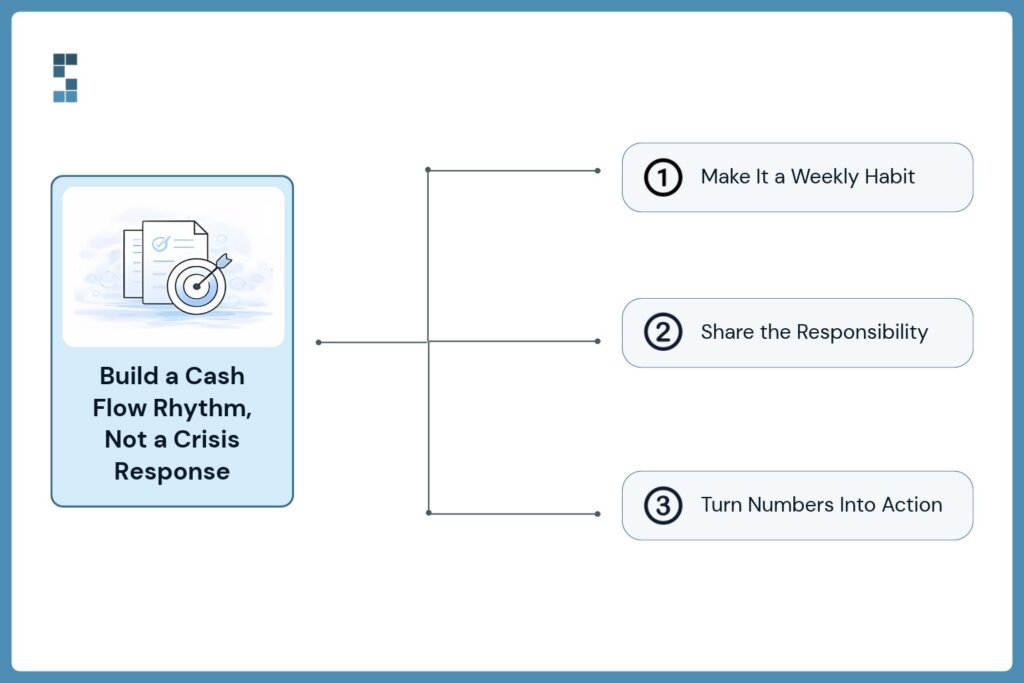
Leah still does her Monday check. It’s a habit now, like locking the door. But she also stopped being the only person watching, and that’s the part that changed her weekends. Her monthly review now shows up with the books already closed and the questions already asked: what moved, why, and what she should do about it.
Betsy, one of our clients, said it better than I can: “System Six has done wonders for my stress level to feel like this is all now taken care of with a professional partner.” We hear versions of that a lot. Our clients rate us 9.5 out of 10 on how likely they are to recommend us, and more than half of our new clients each year come from referrals. I don’t think that’s because we produce prettier reports. I think it’s because somebody’s taking the pulse every week, so the monthly checkup rarely holds surprises.
So here’s the question: when was the last time you looked at your cash position? And did you look because it was Monday, or because something felt wrong?
If it’s the second one, let’s talk. We’ll help you set the rhythm, and then we’ll keep it for you.
Frequently asked questions
How often should a consulting firm monitor cash flow?
Weekly for the short view (bank balance, cash in and out over the next two weeks, remaining cushion) and monthly for the full picture with closed books, a P&L, receivables aging, and a rolling forecast. Firms with thin cushions or lumpy revenue should treat the weekly check as mandatory.
What is a financial pulse check?
A short, regular review of a handful of numbers that tell you whether the business is healthy right now: cash on hand, money due in, money due out, and the gap between them. It’s deliberately brief so you’ll actually do it every week.
What’s the difference between cash flow monitoring and a cash flow forecast?
Monitoring looks at what’s happening now and over the next couple of weeks. A forecast projects further out, typically thirteen weeks, so you can plan hiring, purchases, and growth. You need both. Monitoring keeps the forecast honest.
Can I do this myself, or do I need an outside team?
You can run the weekly check yourself in fifteen minutes. The monthly check depends on current, accurate books, which is where most owners fall behind. An outsourced finance team keeps the books closed on time and flags issues between reviews.
About System Six
System Six is a Seattle-based outsourced bookkeeping, accounting, payroll, and CFO advisory firm serving consulting and professional services businesses. We work with more than 175 businesses, our team averages over 10 years of accounting experience, and we’ve processed more than $100 million in payroll. Clients rate us 9.5 out of 10 on likelihood to recommend, and over half of our new clients come from referrals. We work on a fixed weekly fee with no long-term contracts. Learn more at systemsix.com.