Every lower-middle-market deal I have ever seen prices off the same three letters. The seller says the business does two million of EBITDA, the multiple gets applied, and suddenly a number with an enormous amount of judgment baked into it is treated like a fact. Buy-side quality of earnings work exists to interrogate that number before you wire money based on it.
I have been on both sides of this. In private equity, the QoE was routine, something the deal team ordered the way you order title insurance. Then I became a searcher buying a company with my own savings and an SBA loan, and the same report stopped being routine and became the thing standing between me and a very expensive mistake. Three deals later, two of them add-ons, here is how I think about validating EBITDA as a buyer, and what a buy-side QoE should actually do for you.
What buy-side QoE actually is (and is not)
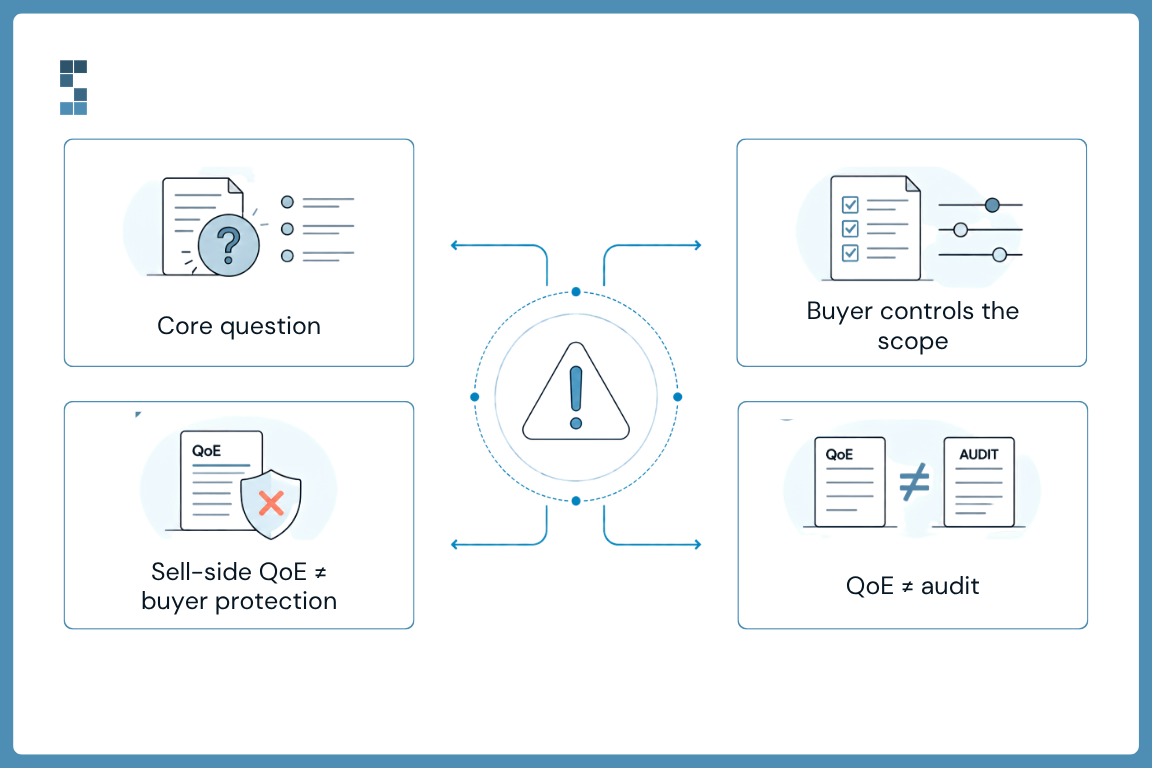
A buy-side quality of earnings engagement is diligence you commission, on the target’s numbers, answering your question: are these earnings real, recurring, and transferable to me? The report is your work product. Your team picks the scope, your team hears the findings as they surface, and the schedules are built to serve your negotiation and your financing.
That last part is what separates it from a sell-side QoE. A sell-side report is commissioned by the owner before going to market. It is genuinely useful, and a seller who has one is usually a more prepared counterpart. But it was scoped to present the business well and defend the add-backs, not to hunt for the problems that only matter to a buyer. Read it, use it, and do not rely on it. The analyses were framed by someone whose incentives point the other way.
Buy-side QoE is also not an audit. No opinion is issued and GAAP compliance is not certified, though a good team will chase every inconsistency it finds. Just know it can’t catch everything; if you don’t trust your seller, no report will 100% protect you. For a fuller treatment of that distinction, see our guide on quality of earnings vs. audits. The short version: most LMM targets have never been audited anyway, which means your diligence is the first rigorous test the numbers have ever faced.
The three EBITDAs: reported, adjusted, and run-rate
Every deal conversation is secretly about three different numbers wearing the same name.
| Reported EBITDA | Adjusted EBITDA | Run-rate / pro forma EBITDA |
| What is it? What the books say today, as kept by the seller |
Reported, corrected for add-backs that survive scrutiny: owner comp to market, personal expenses out, true one-time items removed, related-party amounts marked to market |
Adjusted, then projected forward for known changes: a signed price increase, a lost customer, a new lease at market rent |
| Where it sits in the negotiation Where negotiations start |
Where deals should price |
Where sellers want to price, and where buyers should be most skeptical |
The QoE’s core deliverable is the bridge between the first two: a line-by-line walk from reported to adjusted EBITDA where every adjustment is evidenced and defensible. Run-rate adjustments deserve extra suspicion as a class. Some are legitimate, like a signed lease change. Many are hope dressed as arithmetic: annualized best quarters, unsigned price increases, cost savings you will supposedly capture. My rule as a buyer: pro forma adjustments must be contractual, not aspirational, before they earn a place in the number you pay on.
Add-backs: where LMM deals are won and lost
In the lower middle market, the gap between reported and adjusted EBITDA is usually dominated by add-backs, and this is where owner-operated businesses get interesting. The owner has been running the company partly as a business and partly as a lifestyle, and untangling the two is the work.
The add-backs that generally survive scrutiny: owner compensation normalized to the market cost of the person you will actually hire to replace them, genuinely personal expenses (the vehicle, the family cell phones, the country club), true one-time items like a lawsuit settlement or a flood repair, and related-party amounts restated to market, rent above all.
The ones that fail: recurring items dressed as one-time (the fourth consecutive year of one-time legal fees), below-market wages for family members who do real work and will need real replacements, the marketing spend the seller cut to dress up the trailing twelve months, and bonuses reclassified as discretionary when the team has received them every year for a decade and expects them in month one of your ownership.
Two tests cut through most arguments. First, the replacement test: will this cost genuinely not exist under my ownership, at market rates, with the team I need to retain? Second, the lender test: will a credit committee accept this adjustment when my financing depends on it? An add-back that fails either test is not an adjustment; it is a negotiating position. Our add-backs deep dive covers the full taxonomy.
Revenue quality: EBITDA is only as good as the revenue under it
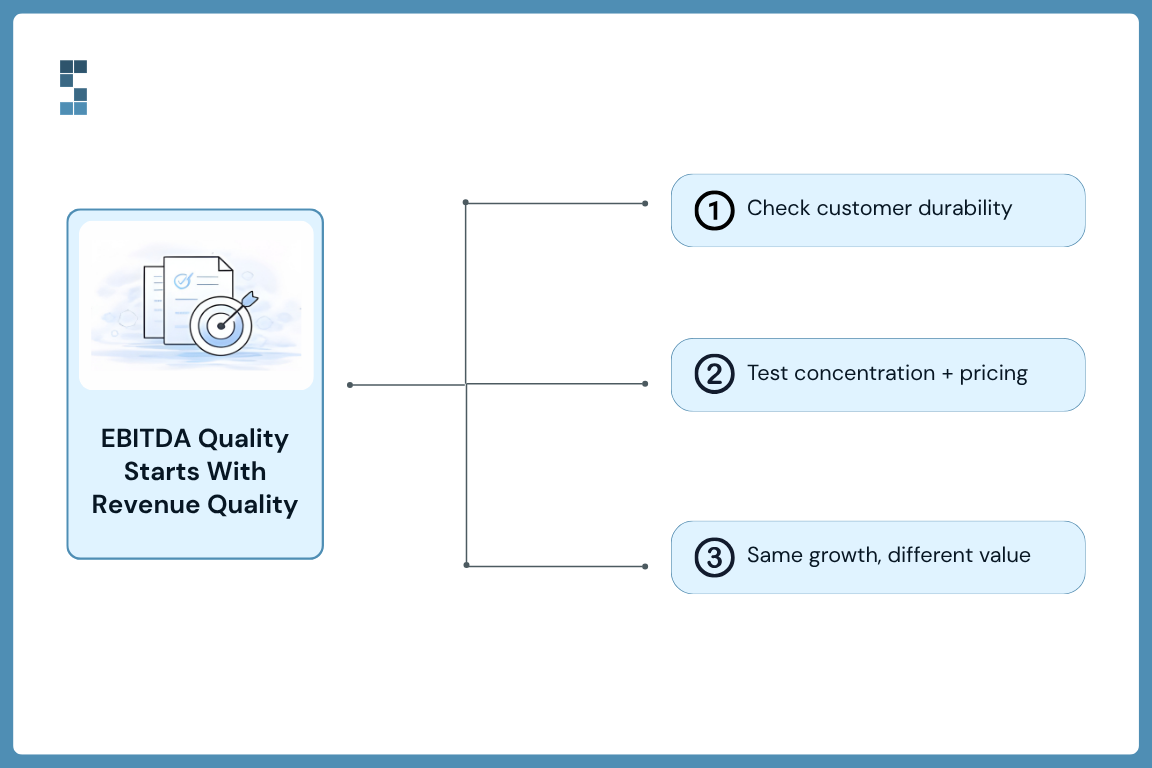
An adjusted EBITDA figure can be perfectly clean and still describe a business that is quietly falling apart. That is why adjusted EBITDA analysis has to reach below the earnings line into revenue quality.
The questions that matter: How much revenue is genuinely recurring or reliably re-occurring, versus project-based and re-won every year? What do customer cohorts look like, meaning do customers stay and grow, or is the company refilling a leaky bucket? How concentrated is the base, and what actually holds the top five accounts, contracts or the owner’s friendships? And is growth coming from volume, or from price increases that a competitor can undercut the month after close?
A company growing entirely through price on a shrinking customer base looks identical on the P&L summary to one growing through expansion on a loyal base. They deserve very different multiples. The QoE’s revenue section is what tells you which one you are buying.
Proof of cash: the credibility floor
Everything above assumes the books describe something real. Proof of cash is how you find out. The analysis ties reported revenue and earnings to actual bank activity, month by month, across the diligence period.
On unaudited, cash-basis books kept by a part-time bookkeeper, this is the single most important test in the engagement, and it is the reason I am skeptical of any cut-rate diligence product that skips it. If reported revenue cannot be traced into the bank account, there is nothing to adjust; the conversation is over. When cash ties, every schedule that follows stands on solid ground, and your lender knows it.
From findings to price: making the QoE pay for itself
A finding that never becomes a number is trivia. The last job of buy-side QoE is converting what it found into deal terms, and this is where the report earns its fee many times over.
The mechanics are straightforward. An EBITDA adjustment moves price through the multiple: at 4–7x, a $100,000 add-back that dies in diligence is $400,000 to $700,000 of purchase price. Working capital findings set the peg you negotiate, and the peg quietly moves real dollars at close. I can’t overstate this one: I have seen too many buyers get a decent business and then really struggle through a post-close cash crunch from working capital oversights. Debt-like items, including deferred revenue, unpaid payroll taxes, customer deposits, and accrued PTO, come off the price dollar for dollar. And findings you cannot quantify cleanly become escrows, holdbacks, or reps instead of price changes.
How you use the findings matters as much as the findings. Anchor every conversation on the evidence, not the accusation: this is what the schedule shows, this is the dollar impact, here is how we propose to handle it. Sellers can argue with your tone. They have a much harder time arguing with their own bank statements.
One warning from experience: do not treat the QoE as a weapon to grind price on every line. The goal is paying the right price for the real earnings, and keeping a seller relationship healthy enough to close and transition well. A buyer who retrades on every $5,000 finding kills deals that deserved to live. Save the fight for findings that move the number.
Frequently asked questions
What is a buy-side quality of earnings report?
An independent analysis, commissioned by the buyer during diligence, of whether a target’s earnings are real, recurring, and transferable. It bridges reported to adjusted EBITDA, tests add-backs, ties earnings to bank activity, and quantifies findings that affect price and terms.
How is buy-side different from sell-side QoE?
Who commissions it and whose question it answers. Sell-side is ordered by the owner to prepare and defend the numbers before going to market. Buy-side is your work product, scoped around your risks and your financing. If a sell-side report exists, use it as an input, not a substitute.
Do I need a QoE for a lower-middle-market deal if the books look clean?
Yes. Clean-looking books are an argument for a lighter scope, not for skipping diligence. Most LMM targets have never been audited, and proof of cash on a clean company is fast and cheap relative to what it protects.
What does a buy-side QoE cost?
Typically $10,000–$20,000 for a QoE Lite scope on deals under $5M, and $25,000–$50,000 for full scope from a boutique firm. See our full pricing guide for what drives the ranges.
Can I do the EBITDA analysis myself?
You should absolutely rebuild the bridge yourself; the instinct is right. But lenders and capital partners require independence, and a team that has tested hundreds of LMM add-backs will catch patterns a first-time buyer cannot. Do your own work and buy the independent version of it.
Validate the number before you pay for it
If you are under LOI or close to one, the highest-leverage thing you can do this week is get the EBITDA question moving. Send us the CIM or the seller’s P&L and we will tell you what we see in the add-backs, what scope the deal actually needs, and a fixed fee with a start date. Partner-led, built for the lower middle market, and scoped to your exclusivity window.
Book a diligence scoping call with System Six.