Hannah opened her laptop on a Tuesday morning to find her third tax notice of the year. Different state this time. Same problem. Her payroll provider had missed another filing, and the penalty letter sat there in her inbox like an unpaid bill she didn’t owe.
She’d been thinking about switching payroll providers for six months. She’d even gotten quotes. But every time she pictured the actual switch — moving twenty-two employees, two states of registration, four kinds of deductions — she pictured something going wrong. A missed paycheck. A botched W-2. Someone’s direct deposit landed in the wrong place during their kid’s birthday week. So she stayed. And the errors kept coming.
If you’ve been sitting on this same decision, you’re not alone. Switching payroll providers is one of those moves business owners put off for a year longer than they should. The fear is reasonable. The cost of waiting, though, is almost always worse than the move itself.
Here’s how to do it without dropping a single paycheck.
Why do we wait too long?
Most owners don’t switch because the math feels lopsided. You can see the cost of moving — the migration time, the staff communication, and the small risk that something breaks. What you can’t see as clearly is the cost of staying. Tax penalties accrue quietly. Your team loses trust in the system. You spend hours every quarter cleaning up filings that should have been right the first time. None of it lands in one big invoice, so it’s easy to ignore.
But add it up—a few hundred dollars in penalties here. An afternoon spent on hold there. Three employees are asking why their pay stubs don’t match their offer letters. The hidden bill is bigger than the visible one. Almost always.
The good news: a clean migration takes weeks, not months. And once it’s done, it’s done.
Before you touch a single button
The temptation is to sign the contract with your new provider and start moving things over the same day. Don’t. The work that determines whether your switch is smooth or chaotic happens before any data gets entered anywhere.
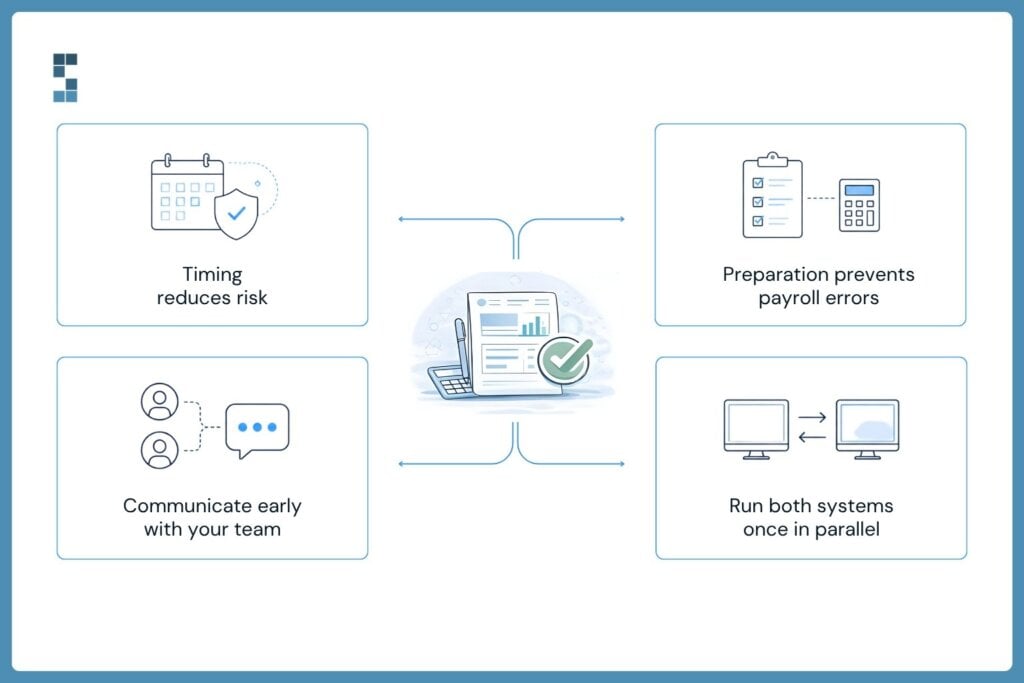
Start with timing. The cleanest moment to switch is quarter-end. Your old provider files the quarter’s taxes, you cut the cord, and your new provider takes over with a fresh slate. Mid-quarter switches work too, but they require parallel year-to-date entries that increase the risk of W-2 errors at year-end. If you have the flexibility, wait the extra few weeks.
Next, gather your data. You’ll need year-to-date wages for every employee, federal and state tax IDs, state unemployment account numbers, deduction setups for benefits and 401(k) and HSAs, active garnishments, and direct deposit details. Your old provider should give you a clean export — if they push back, that’s a sign you’re making the right call.
Then tell your team. Sooner than feels comfortable. People don’t panic about payroll changes; they panic about surprises. A two-paragraph email three weeks out, explaining that you’re upgrading systems and that nothing about their pay will change, removes ninety percent of the questions before they’re asked.
Finally, plan a parallel run. For one pay cycle, calculate payroll in both systems and compare the results, line by line. This is the single most valuable hour you’ll spend during the entire migration. It catches the mismatched tax rates, the deduction that didn’t carry over, the rounding error that would have shown up on someone’s paycheck, and ruins your week.
The actual migration
Once your data is gathered and your team is informed, the mechanical work begins. This is where most migrations either glide or stumble, and the difference comes down to two things: getting your tax accounts right and reconciling before you go live.
Your new provider needs your state tax accounts in their system, and they need them registered correctly. Each state where you have employees requires its own withholding and unemployment registration. If you’ve been running payroll in three states for years, you already have these. But your new provider can’t access them automatically — you’ll need to update Power of Attorney forms with each state so they can file on your behalf. This usually takes a week or two per state, which is why timing matters.
Loading historical year-to-date data is the other piece people underestimate. If you switch mid-year, the new system needs to know what was already paid in wages, what was already withheld, and what was already filed. Without it, your W-2s in January will be wrong, your employees will get confused letters from the IRS, and you’ll spend February untangling something that took ten minutes to prevent.
Reconcile the first calculated run against your old provider’s numbers before any money moves. Gross wages should match. Tax withholdings should match. Deductions should match. If anything is off by more than a few cents, find out why before you click submit. A few cents is rounding. A few dollars is a problem.
What to watch for after go-live
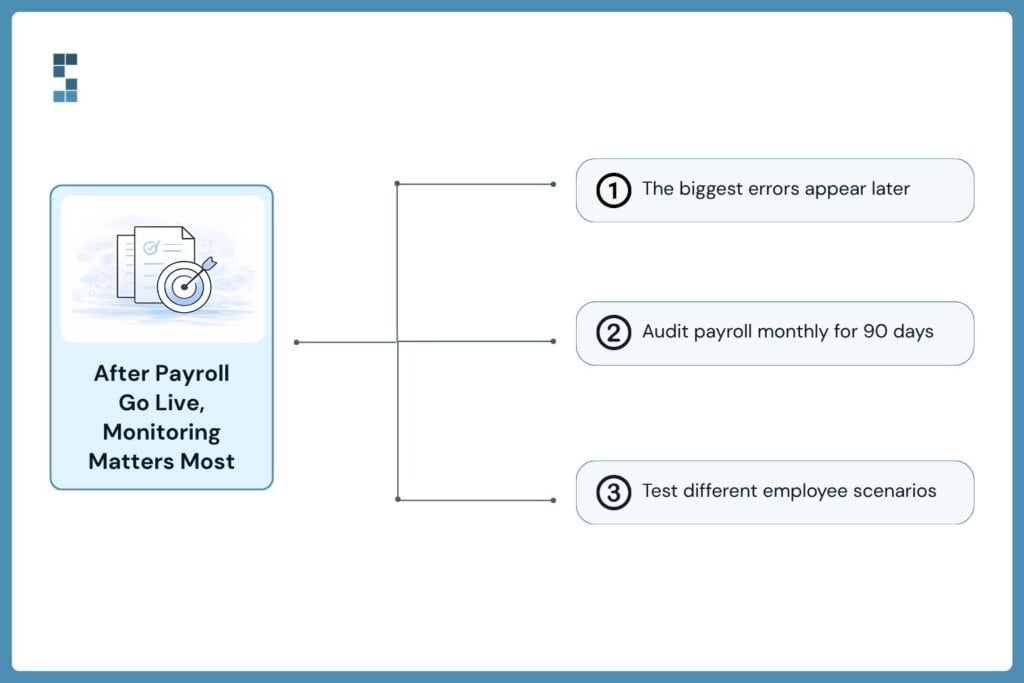
The first clean payroll feels like a win, and it is. But the errors that hurt most don’t show up in week one. They show up in week six, when someone’s 401(k) match looks light, or in month three, when a garnishment that should have been deducted wasn’t, or at year-end, when a multi-state employee’s W-2 doesn’t reconcile.
Build a quick monthly check for the first quarter after the switch. Spot-check three or four employees across different scenarios — someone with a 401(k) match, someone with a garnishment, someone who works across state lines. Look at gross-to-net. Look at the tax filings the new provider produced. If everything ties out for three months running, you’re past the danger zone.
This is also where having a real partner matters. One of our clients came to us after a previous bookkeeper had been quietly filing payroll taxes incorrectly for over a year. By the time he noticed, he had a stack of state notices and no easy way to untangle the mess. “System Six has literally saved my business from falling into operational ruins,” Manish, the owner, wrote afterward. The fix took time, but the bigger lesson was that the errors had been there long before anyone caught them. He didn’t have anyone watching closely enough.
A good provider doesn’t just process payroll. They flag the things that look wrong before they become things you have to explain to the IRS.
The real cost of standing still
Hannah finally made the switch over Labor Day weekend. Quarter-end timing, parallel run, clean cutoff. Her first payroll on the new system went out on a Friday, on time, with every direct deposit landing exactly where it should have. She still remembers the relief.
If you’ve been delaying your own switch, ask yourself which feels more expensive: the few weeks of focused work to migrate, or another year of the problem you’re already paying for? Missing a beat isn’t what happens when you change providers. Missing a beat is what’s already happening every time your current provider drops the ball.
The cleanest move is the one you stop putting off.
About System Six
System Six is a Seattle-based bookkeeping and financial services firm that helps small and mid-sized businesses streamline their financial operations. We specialize in providing technology-driven financial management solutions for consulting firms, enabling owners to focus on growing their businesses without worrying about cash flow, payroll, or compliance. Our team of over 40 professionals brings an average of 10+ years of accounting experience to every client relationship, serving more than 175 businesses across the U.S. With a 9.5/10 NPS score, we deliver the financial clarity and peace of mind that consulting firm owners need to thrive. Learn more at www.systemsix.com.